How to care for precious metal objects & surfaces in your home sustainably
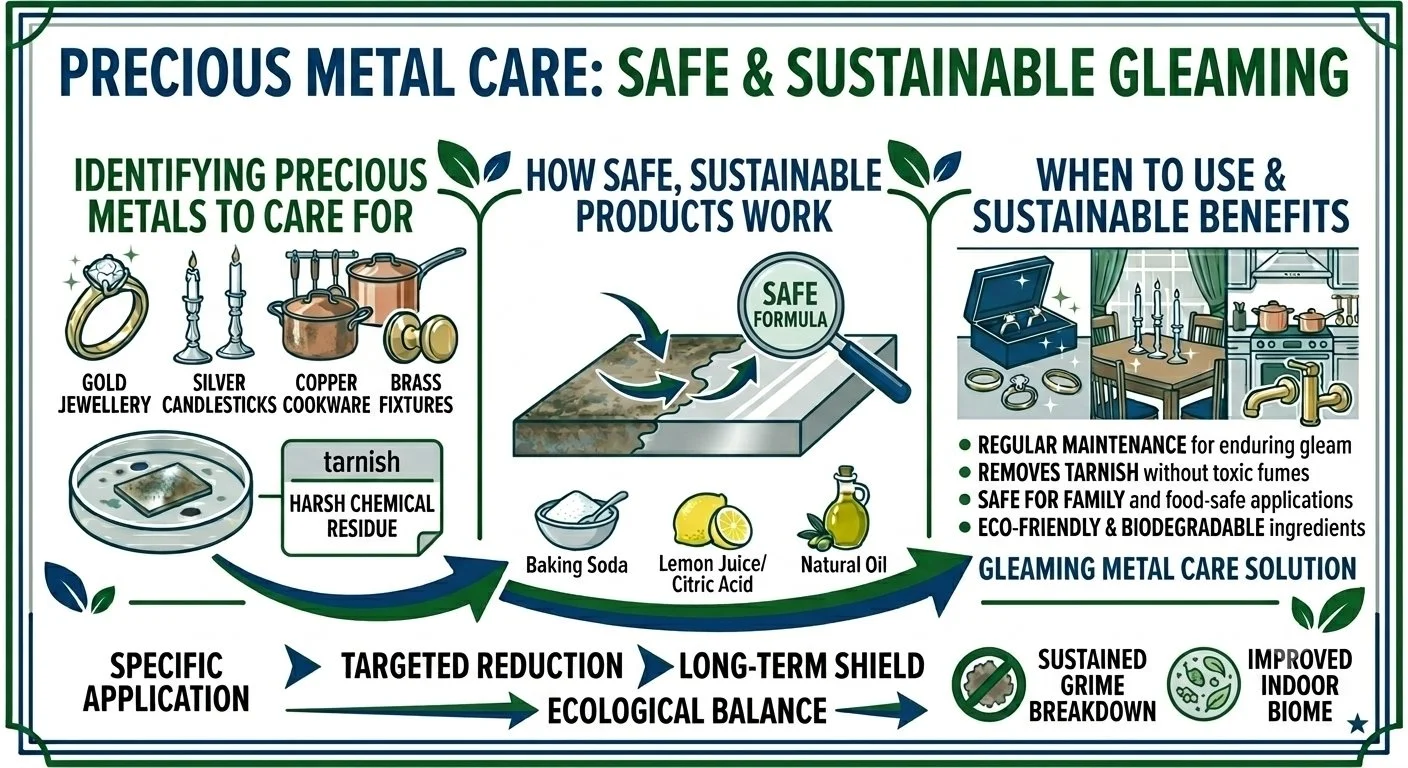
Your gold jewellery, silver candlesticks, copper cookware, and brass fixtures deserve proper care–but most commercial metal polishes are loaded with harsh chemicals. Here's how you can keep precious metal surfaces gleaming using safe, sustainable products that won't harm your family or the environment.
If you've ever reached for a bottle of commercial silver polish and stopped to read the ingredients label, you may have put it right back on the shelf. Many conventional metal cleaners contain ammonia, phosphates, and synthetic compounds that are hard on skin, harsh on the environment, and when rinsed down the drain contribute to water pollution.
The good news is that you don't need any of that. Whether you're maintaining antique silverware passed down through your family, keeping copper cookware in your kitchen gleaming, or preserving the brass hardware on your condo door, there are effective, gentle, and planet-friendly ways to get the job done.
This guide covers everything you need to know about caring for common precious and decorative metals — gold, silver, copper, and brass — using sustainable products and methods that are safe for your household and the environment.
Why your choice of metal cleaner matters
Precious and decorative metals are porous and reactive. That means the products you use to clean them don't just sit on the surface – they interact with the metal at a chemical level. Harsh commercial polishes can accelerate oxidation over time, leave behind residues that dull the finish, or strip protective patinas that actually help preserve older pieces.
Beyond the objects themselves, there's the question of what happens after cleaning. When chemical-laden rinse water makes its way into the sewer system, it can affect local waterways, including Lake Ontario, which serves as the source of drinking water for millions of people in the Greater Toronto Area.
Choosing sustainable, biodegradable cleaning products isn't just an ethical preference – it's a practical one. Natural cleaning agents tend to be gentler on metals, are safer for households with children or pets, and are far less likely to cause the kind of surface damage that leads to costly repairs or replacements down the road.
Caring for gold
What to know
Pure gold (24 karat) is highly resistant to tarnish, but most gold objects in your home are alloyed with other metals like copper or silver to increase their durability. It's these alloys that can tarnish or dull over time, not the gold itself.
What to use
The safest and most effective sustainable method for cleaning gold at home is a simple warm water soak with a small amount of plant-based dish soap. Add a few drops to a bowl of warm (not hot) water, submerge the gold piece for 10–15 minutes, then gently scrub with a soft natural-bristle brush (a repurposed toothbrush with natural fibres works beautifully) and rinse thoroughly.
What to avoid
Avoid ultrasonic cleaners for pieces with set gemstones, as vibrations can loosen settings. Steer clear of chlorine bleach entirely — it can break down gold alloys and cause permanent discolouration. And despite what you may have read online, toothpaste is too abrasive for regular gold cleaning.
Storing gold
Store gold pieces individually in soft cloth pouches or lined boxes to prevent scratching. Keeping pieces separated also reduces the frequency with which they need to be cleaned.
Caring for silver
What to know
Silver tarnishes as a result of a chemical reaction with sulphur compounds in the air — a process called oxidation. Tarnish appears as a yellowish or dark grey film and is entirely natural. It does not damage the silver itself, but it does affect appearance.
What to use
One of the most effective and surprisingly eco-friendly methods for removing silver tarnish involves items you likely already have at home: baking soda, aluminum foil, and boiling water. Line a baking dish or sink with aluminum foil (shiny side up), lay your silver pieces on top, sprinkle generously with baking soda, and pour boiling water over everything. The electrochemical reaction transfers the tarnish from the silver to the foil – no scrubbing required! Rinse thoroughly and buff dry with a soft, natural cotton or linen cloth.
What to avoid
Commercial dip-style silver polishes work quickly but are among the harshest products available for home metal care. Many contain thiourea, a compound that is toxic to aquatic organisms. Repeated use of dip polishes can also erode the fine details in ornate silverware over time.
Avoid rubber gloves when handling silver, as rubber can actually accelerate tarnishing.
How to store
The best sustainable strategy for silver is prevention. Silverware without wood components is best stored by wrapping in buffered acid-free tissue. Unbleached cotton flannel is a great sustainable alternative that will help protect any wood on your silver pieces. Both options will slow the oxidation process significantly. Silica gel packets placed near silver in display cabinets can also help manage humidity levels and reduce tarnishing–and can be refreshed by adding to a low heat (200 degrees fahrenheit (90 celcius)) for a couple of hours.
Silver cloth can also be used as an extra layer of protection.
Caring for copper
What to know
Copper is one of the most beautiful and functional metals you'll find in a home, appearing in everything from cookware and bakeware to decorative bowls, planters, and architectural accents. Over time, copper develops a green or blue-green patina called verdigris, which – unlike rust – is not structurally damaging and is actually prized in many decorative applications. Whether you want to restore the bright orange-red shine or preserve a natural patina is entirely a matter of preference.
What to use
Important note: Many copper items are lacquered to prevent tarnishing, which can be damaged by acidic cleaning methods and should only be cleaned with soap and water. If unsure, one way to test for lacquered copper is to briefly apply a mild acid to its surface. If it doesn’t change colour, then it is lacquered and the methods described below should not be used to clean it.
The most classic and effective natural copper cleaner is a mixture of salt and either lemon juice or white vinegar. The mild acid in the lemon or vinegar dissolves the copper oxide that causes tarnish, while the salt provides gentle mechanical abrasion.
Apply the mixture with a soft cloth, rub gently in circular motions, rinse thoroughly with warm water, and dry immediately to prevent water spots.
For copper cookware with stubborn spots, a paste of flour, salt, and white vinegar (equal parts) applied and left for 10 minutes before rinsing is particularly effective. Ketchup (yes, really) also works well due to its acetic acid content, and it's a fun option to have on hand.
What to avoid
Never use steel wool or abrasive scrubbing pads on copper, as these will leave permanent scratches. Avoid letting copper cookware soak in water for extended periods, as this can cause surface pitting. And be cautious about cleaning copper with a patina you want to preserve–acids will remove it.
How to store
After cleaning and drying copper thoroughly, apply a very thin coat of beeswax or food-grade mineral oil to create a protective barrier that slows re-oxidation. This is particularly useful for decorative copper pieces that aren't washed regularly.
Caring for brass
What to know
Brass–an alloy of copper and zinc–is common in homes as door hardware, light fixtures, decorative objects, and musical instruments. Like copper, brass tarnishes over time, developing a dark, dull surface layer. It's worth noting that much modern "brass" hardware is actually brass-plated steel or zinc, which responds differently to cleaning than solid brass.
What to use
Unlacquered brass
The same lemon-and-salt or vinegar-and-salt method that works for unlacquered copper is equally effective on solid, unlacquered brass. For a gentler everyday clean, warm water with a small amount of plant-based dish soap and a soft natural-bristle brush is sufficient. For heavily tarnished pieces, a mixture of lemon juice and a cream of tartar – applied, left for a few minutes, then rinsed – produces excellent results.
Lacquered brass
Like copper, many modern brass fixtures are lacquered to protect the finish and slow tarnishing. Lacquered brass should only ever be cleaned with warm water and a soft cloth. Any acidic or abrasive cleaner will damage the lacquer coating and cause uneven tarnishing underneath. If the lacquer on your fixtures is already peeling or damaged, it may be worth having it professionally stripped and either re-lacquered or left as living, unlacquered brass.
What to avoid
Avoid ammonia-based cleaners on brass entirely, as they can cause permanent discolouration. Do not use rough scrubbing pads. And as with copper, always dry brass thoroughly after cleaning to prevent water spotting.
General sustainable tips for all precious metals
A few principles apply across the board when it comes to sustainable metal care at home:
Always dry metals thoroughly after cleaning. Water left on metal surfaces accelerates oxidation and tarnishing.
Use soft, natural-fibre cloths for buffing and drying. Unbleached cotton, linen, and wool felt are all excellent choices that won't scratch or leave synthetic fibre residue.
Wear cotton gloves when handling polished silver and gold pieces. The oils on your hands can leave prints that accelerate tarnishing.
Clean metal objects less frequently but more thoroughly. Over-cleaning, even with gentle methods, causes wear over time. Develop a regular but measured routine.
Look for locally made, certified natural metal polishes when choosing a commercial option. Several Toronto and Ontario-based producers offer beeswax-based and plant-derived products that are effective and environmentally responsible.
Dispose of cleaning solutions responsibly. Even natural cleaning rinse water, particularly from heavy tarnish removal, should be diluted before going down the drain.
What to look for in a sustainable metal cleaning product
If you prefer to purchase a ready-made metal cleaner rather than making your own, here's what to look for on the label:
Plant-derived or mineral-based ingredients with recognisable names
No phosphates, ammonia, sodium hypochlorite (bleach), or synthetic fragrances
Biodegradable formula — look for third-party certification where possible
Recyclable or compostable packaging
Produced by a Canadian or local Ontario company when possible, to reduce transportation emissions
As the founder of EcoEthical Cleaning, I've built my practice around the same principles outlined in this guide — using only thoughtfully chosen, sustainable products that protect both your home and our shared environment here in Toronto. Whether it's the care of precious surfaces or a thorough top-to-bottom clean, every service I provide across the Harbourfront District and surrounding neighbourhoods is fragrance-free, biodegradable, and delivered with attention to the details other cleaners overlook.
If you're ready to experience cleaning that's as conscientious as it is thorough, reach out today for a free, no-obligation estimate.
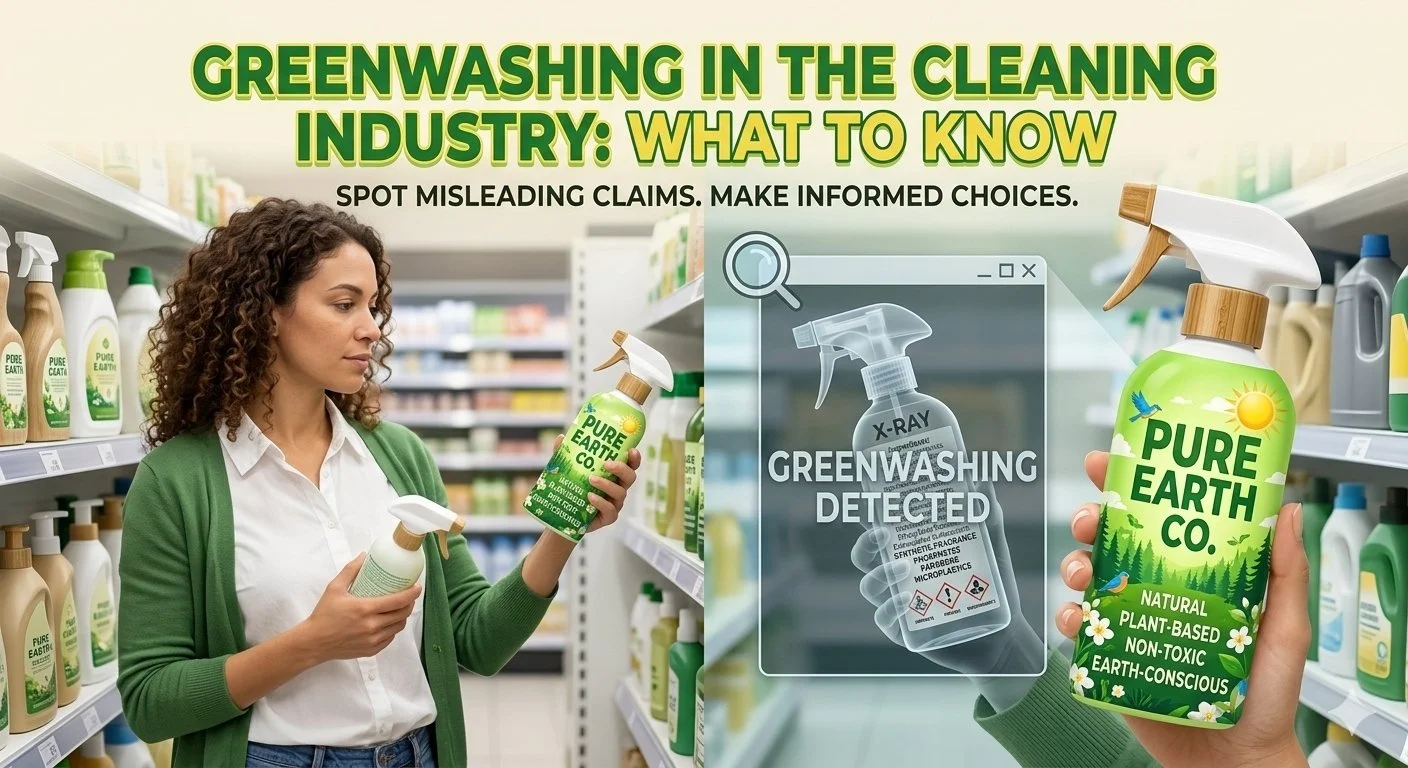
Greenwashing in the cleaning industry: what to know about this unethical practice
"Green" is everywhere — on labels, in taglines, and throughout marketing materials. But how much of it is real? Learn how to identify greenwashing in the cleaning industry, what warning signs to look for, and how to find a company that genuinely walks the walk.
Walk through any grocery store, scroll through any cleaning company’s website, or read a product label, and you’ll find the same language everywhere: "green," "natural," "eco-friendly," "non-toxic," "plant-based," "earth-conscious." The words are reassuring. They suggest that the company behind the product cares about the same things you do; your family’s health and the health of the planet.
Sadly though, Canada still lags behind other nations when it comes to regulating product labels. Many of these terms are entirely unregulated. At the time of this writing, any company can still use the word "natural" on a label without a single gram of a natural ingredient inside. The gap between what companies and products claim and what they actually do has a name: greenwashing.
This guide is designed to help you understand what greenwashing is, why the cleaning industry is particularly prone to it, how to spot it, and most importantly, how to find cleaning companies and products that genuinely do what they advertise.
What is greenwashing?
Greenwashing is the practice of using misleading, vague, or outright false environmental claims to create the impression that a product, service, or company is more sustainable or eco-friendly than it actually is. The term was coined in the 1980s by environmentalist Jay Westervelt, who noticed that hotels were promoting towel reuse programs as a conservation initiative, while simultaneously expanding their properties in environmentally destructive ways.
Today, greenwashing is far more sophisticated. It ranges from subtle misdirection (using the colour green and nature imagery with no substantive environmental claims) to outright deception (claiming a product is biodegradable when it isn’t). It can be intentional or the result of genuine ignorance about what “eco-friendly” actually requires.
What makes greenwashing particularly frustrating is that it actively harms the companies and individuals who are doing the right thing. When every cleaning product claims to be green, genuinely sustainable options become harder to identify, and consumers who want to make better choices have no reliable way to do so.
Why the cleaning industry is especially prone to greenwashing
Cleaning products are used in intimate spaces — kitchens, bathrooms, children’s bedrooms — which means health and safety claims resonate strongly with buyers. At the same time, the ingredients in cleaning products are complex, poorly understood by many consumers, and rarely scrutinized. This creates a perfect environment for vague claims to go unchallenged.
Add to this the fact that Canada has no single regulated definition for terms like “green,” “natural,” or “eco-friendly” in cleaning products, and the incentive to use this language without substantiating it becomes very strong.
The most common greenwashing tactics in the cleaning industry rarely looks like outright lying. It’s usually more subtle — a carefully chosen word here, an omission there. Here are the most common tactics to watch for:
Vague and unregulated language
Words like “natural,” “green,” “eco-friendly,” “earth-conscious,” and “plant-derived” have no legal definition in Canada when used on cleaning product labels.
This doesn’t mean every product using this language is greenwashing, but it does mean the words alone are not evidence of anything. They should prompt you to look deeper, not reassure you that the work is done.
Irrelevant claims
Some products trumpet the absence of something that was never present in the first place. "CFC-free" is a classic example — chlorofluorocarbons have been banned in Canadian consumer products since 1996, so advertising their absence is technically accurate but entirely meaningless.
Hidden trade-offs
A product might genuinely be better in one environmental dimension while being worse in others. A cleaning product might use biodegradable surfactants, and also contain synthetic fragrances that are harmful to aquatic life. A company might use recycled packaging, and also ship their products across the planet.
Hidden trade-offs are a form of greenwashing because they highlight a single positive attribute while obscuring the overall environmental picture. Genuine sustainability requires looking at the whole, not just the most flattering part.
Fake or misleading certifications
Certification logos and seals of approval carry a lot of weight with consumers, which is exactly why some companies create their own. A self-awarded badge that says "Eco-Approved" or "Green-Certified" may have no standards behind it whatsoever.
Even legitimate-looking certifications can be misleading. Some are awarded based on self-reported data with no third-party verification. Others have standards so low that almost any product would qualify. It’s worth taking a moment to look up any certification you see, who issues it, what the standards are, and whether verification is independent.
Greenwashing through imagery and design
Not all greenwashing is in the words. Green packaging, leaf imagery, earthy colour palettes, and nature photography are all design choices that signal environmental responsibility without making a single verifiable claim. This is sometimes called “visual greenwashing,” and it’s particularly effective because it operates below the level of conscious scrutiny.
Be aware that a bottle covered in leaves and printed in green ink may contain the same ingredients as a bottle printed in clinical white. Design is not evidence.
"Natural" fragrances
This one deserves its own mention because it’s so widespread. Many cleaning products advertise "natural" or "botanical" fragrances as a selling point, implying that they’re safer and more eco-friendly than synthetic alternatives.
The reality is more complicated. The word "fragrance" on an ingredient list, whether natural or synthetic, is a catch-all term that can conceal dozens of individual chemicals, none of which are required to be disclosed in cleaning products. Some naturally derived fragrances are perfectly harmless. Others are known allergens or irritants. And some products labelled "fragrance-free" still contain masking agents designed to neutralize odours without a detectable scent.
The most transparent products will either contain no fragrance at all, or will disclose the specific source and composition of any scent used.
Selective disclosure
A company might publish a list of ingredients that sounds impressive — highlighting the plant-based ones while omitting mention of synthetic additives, preservatives, or processing aids that are also present. Or they might disclose ingredients at a product level but not disclose the environmental and labour practices upstream in their supply chain.
Genuine transparency means sharing the full picture, including potential negatives.
Red flags to watch for
When you’re evaluating a cleaning product or company, here are the warning signs that should prompt closer scrutiny:
Unsubstantiated superlatives: Claims like "the most eco-friendly cleaner on the market" with no data or certification to back them up.
Buzzword overload: Descriptions that lean heavily on words like "green," "natural," "pure," and "clean" without any specifics.
No ingredient disclosure: A company that won’t tell you what’s in their products has no transparency to offer. Full ingredient lists should be readily available.
Self-issued certifications: Any seal or badge that was created and awarded by either the same company selling the product, or any entity that benefits from the sale of their certified products.
Vague "biodegradable" claims: True biodegradability is measurable and verifiable. "Biodegradable" without a timeframe or standard (such as OECD 301) is often meaningless.
No safety data: Reputable products have Safety Data Sheets (SDS) that are publicly available. If a company won’t provide one, that’s a significant red flag.
Greenwashing by association: A company that donates 1% of profits to an environmental charity while using harmful products in their core business is not an eco-friendly company — it’s a company with a charitable giving program.
Inconsistency between marketing and practice: A cleaning company that talks about the environment on their website but ships products from overseas in single-use plastic packaging, uses synthetic microfibre cloths, and drives long distances every day is not living up to its own claims.
Questions to ask a cleaning company
If you’re hiring a cleaning service and want to know whether their environmental claims are genuine, here are the questions most likely to separate the real from the performative. A transparent company should be able to answer all of these without hesitation.
About their products
Can they provide a full ingredient list or Safety Data Sheet for the products they use?
Are their products certified by a third-party organization? If so, which one, and what does that certification require?
Are their products biodegradable, and if so, to what standard?
Do their products contain synthetic fragrances, dyes, or preservatives?
Where are their products manufactured?
About their practices
What type of cloths and scrubbers do they use? Are they synthetic or natural fibre?
How do they dispose of wastewater from the cleaning process?
Do they reuse or refill product bottles, or use single-use packaging?
How do they travel to client homes? Do they account for the carbon footprint?
About their transparency
Can they provide a sample checklist or service summary from a previous job?
How do they handle it if a product they use turns out to have an ingredient that concerns a client?
What would they do if a product they currently use was found to have a harmful ingredient?
What a transparent answer looks like
A genuinely eco-conscious cleaner won’t be defensive about these questions, they’ll welcome them. They’ll be able to name their products, explain why they chose them, point you to the manufacturer’s website, and describe the specific properties that make them a better choice. Vague reassurances like “we only use the best green products” are not answers, they’re deflections.
What genuine sustainability actually looks like
Now that you know what greenwashing looks like, it’s equally important to understand what actually constitutes a viable sustainable option.
Full ingredient transparency
A truly transparent company will publish complete ingredient lists for every product they use, along with explanations of what each ingredient does and why it was chosen. They’ll be able to point you to third-party Safety Data Sheets and explain the biodegradability profile of each product.
Third-party certifications with real standards
Look for certifications issued by credible, independent bodies with publicly available and verifiable standards. In Canada, UL Solutions is one of the oldest and most rigorous environmental certification programs for cleaning products. Products bearing these marks have been evaluated against defined criteria by independent verifiers.
That said, the absence of a certification doesn’t necessarily mean a product isn’t genuinely sustainable — some excellent smaller manufacturers haven’t pursued certification for cost or administrative reasons. In those cases, ingredient transparency and a willingness to answer questions become even more important.
Natural fibre cleaning tools
One of the most overlooked aspects of sustainable cleaning is the tools used, not just the products. Synthetic microfibre cloths shed microplastics into wastewater with every wash. These microplastics pass through most municipal wastewater treatment systems and accumulate in waterways and aquatic life.
Genuinely eco-conscious cleaners use cloths, brushes, and scrubbers made from natural, compostable fibres such as cotton, coconut husk (coir), sisal, bamboo, and wood cellulose. These materials clean effectively, biodegrade naturally, and don’t contribute to microplastic pollution.
Locally sourced products
A cleaning company that sources products manufactured in Canada has a significantly smaller carbon footprint than one importing products from other countries. Local sourcing also supports domestic businesses and keeps money circulating in the community.
Intentional service geography
This one rarely comes up in conversations about sustainable cleaning, but it matters. A cleaner who operates within a small, walkable or transit-accessible geography produces far fewer emissions than one who drives long distances between clients every day. Proximity to clients is a genuine environmental advantage — and one that also tends to improve punctuality and reliability.
Consistent behaviour, not just marketing
The most reliable signal of genuine sustainability is consistency between what a company says and what they do. Do they use refillable product bottles or single-use packaging? Do they disclose the full environmental profile of their business, including the parts that aren’t flattering? Are they willing to be held accountable for their practices by clients who ask questions?
Genuine sustainability is a practice, not a marketing strategy. Companies that are truly committed to it are usually more interested in talking about what they do than in talking about how green they are.
The bigger picture: why this matters beyond your home
Greenwashing is not just an inconvenience for consumers trying to make good choices. It has real environmental consequences.
When cleaning products that claim to be biodegradable are washed down the drain and don’t actually biodegrade, those chemicals accumulate in waterways. When synthetic microfibre cloths shed microplastics into laundry wastewater, those particles pass through treatment systems and enter the food chain. When a company markets itself as sustainable and isn’t, it crowds out the companies that are — and makes it harder for consumers to reward genuine environmental leadership with their purchasing choices.
Consumer demand is one of the most powerful forces available to drive genuine sustainability improvements in industry. But that demand only creates the right incentives when consumers can tell the difference between companies that are genuinely sustainable and those that are merely performing it. Knowing how to spot greenwashing is, in a very practical sense, a form of environmental action.
The bottom line
"Green" is one of the most valuable words in consumer marketing, which is exactly why it’s so widely misused. As a homeowner or tenant hiring a cleaning service, you have every right to ask hard questions and expect straight answers.
The companies worth hiring are the ones that welcome those questions. They can tell you exactly what’s in every product they use, explain why they chose it, point you to third-party data, and describe their full practice — not just the flattering parts. They use natural fibre tools. They source locally. Their environmental commitment shows up in how they run their business, not just in their marketing copy.
If a company can’t answer basic questions about their products, that’s your answer.
About the author
Trevor Delaney is the founder of EcoEthical Cleaning, an independent residential cleaning service serving Toronto’s Harbourfront and surrounding downtown neighbourhoods. EcoEthical Cleaning prioritizes plant-based, biodegradable, Canadian-made products and natural fibre cleaning tools. Full product details, including ingredient breakdowns and manufacturer links, are available at https://www.ecoethicalcleaning.ca/products.
For a free, no-obligation estimate: https://www.ecoethicalcleaning.ca/estimate
📞 (416) 605-7549
📧 trevor.delaney@ecoethicalcleaning.ca
Sources & further reading
Competition Bureau Canada, “Environmental claims and greenwashing” (2025)
Terra Choice Environmental Marketing, “The Sins of Greenwashing” (2010)
U.S. EPA, Safer Choice Program
Sanitizing vs. Disinfecting: What's the Difference and When Does Each Actually Matter?
In recent years, household hygiene has taken center stage in our daily routines. Learn the crucial differences between cleaning, sanitizing, and disinfecting—and discover when each approach actually matters for your health. Most of the time, simple cleaning is enough. This science-based guide explains what Canadian public health actually recommends, which methods work for different situations, and how to keep your home appropriately clean without unnecessary chemicals or environmental harm.
In recent years, household hygiene has taken center stage in our daily routines. From high-touch surfaces like doorknobs and light switches to kitchen countertops and shared workspaces, the focus on maintaining a germ-free environment has never been higher. As we move toward more sustainable and long-term wellness habits, the priority is shifting from universal application to targeted hygiene — choosing the right level of clean for the right situation.
Applying the most powerful chemical solution isn't always the most effective strategy. To achieve a healthy balance between safety, environmental impact, and household budget, we must move beyond the "one size fits all" approach to cleaning.
The confusion starts with terminology. "Sanitizing" and "disinfecting" sound similar and are often used interchangeably, but they're actually quite different — with different purposes, different chemical requirements, and different appropriate applications.
Understanding the distinction matters for your health, your home, your budget, and the environment. Using disinfectants when you only need to sanitize means exposing your family to unnecessary chemicals. Not disinfecting when you actually need to could leave dangerous pathogens in place. And doing either when simple cleaning is sufficient wastes time, money, and creates environmental harm.
This guide will explain exactly what sanitizing and disinfecting mean, how they differ from basic cleaning, when each is actually necessary, and how to approach them sustainably. You'll learn what Canadian public health guidelines actually recommend, which methods work for different situations, and how to keep your home appropriately clean without creating other health problems in the process.
Defining the terms: Cleaning, sanitizing, and disinfecting
These three terms represent different levels of germ reduction, each with specific purposes and appropriate applications.
Cleaning
What cleaning does:
Removes visible and tactile soil and grime
Reduces germ count through physical removal
Makes surfaces look and feel clean
Cleaning germ reduction: Removes approximately 80-90% of germs through physical action (wiping, scrubbing)
When cleaning is appropriate: Most everyday situations in healthy households
Sanitizing
What sanitizing does:
Reduces bacteria to acceptable levels
Takes less time and uses less harsh chemicals than disinfecting
Appropriate for most food-contact and high-touch surfaces
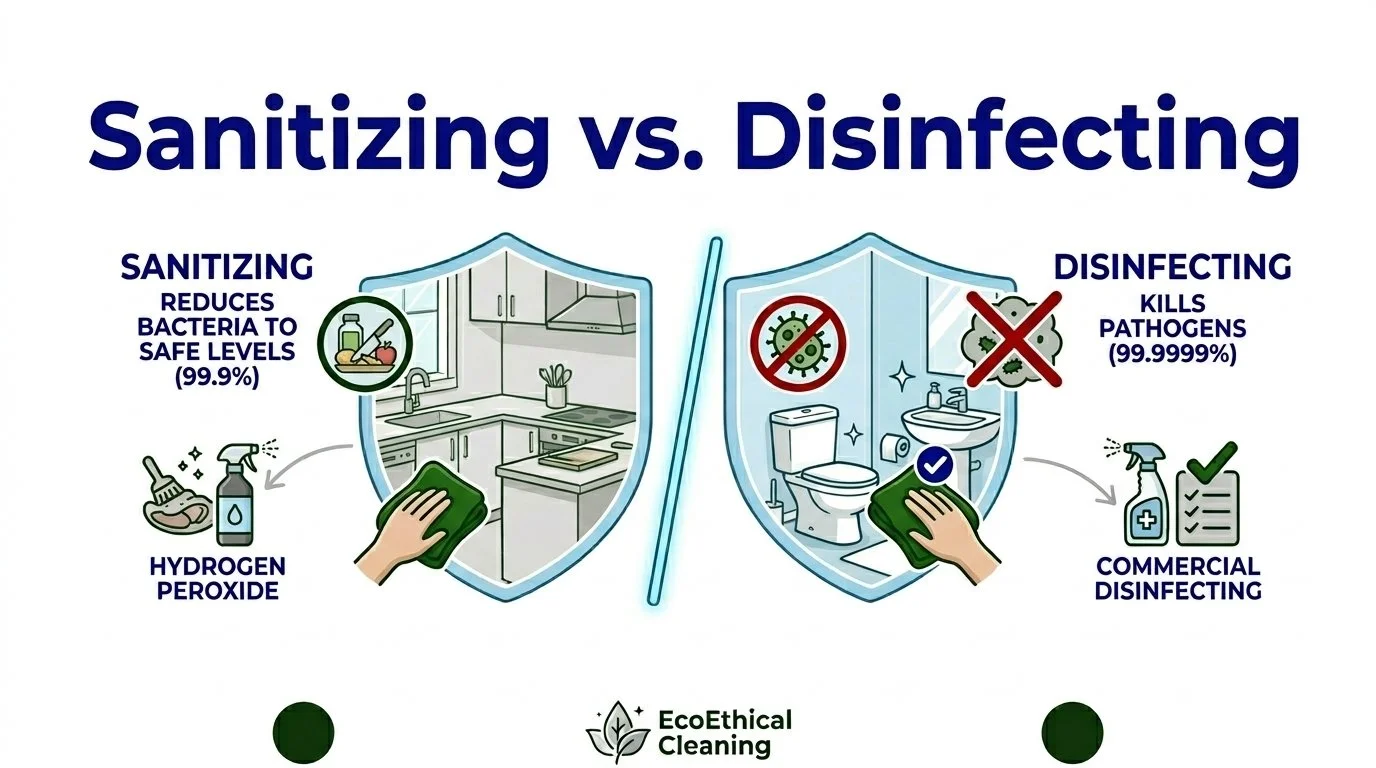
Sanitizing germ reduction: Reduces bacteria by 99.9% (3-log reduction) within a short contact (dwell) time, depending on the product
Regulatory standard: In Canada, sanitizers must reduce bacteria by 99.9% to meet Health Canada standards when used as directed
When sanitizing is appropriate: Food preparation surfaces, children's toys, eating surfaces, areas with moderate contamination
Disinfecting
What disinfecting does:
Kills bacteria, viruses, and fungi
Eliminates pathogens that cause disease
Requires stronger chemicals and a longer contact time
Very thorough level of germ elimination
Disinfecting germ reduction: Kills 99.9999% of pathogens (6-log reduction) within 5-10 minutes, depending on the product and targeted organism
Regulatory standard: In Canada, disinfectants must be registered with Health Canada and prove efficacy against specific pathogens when used according to label directions
When disinfecting is appropriate: Situations with high contamination risk, illness in the household, immunocompromised individuals, or specific high-risk surfaces (toilets)
Note: There is a 4th level of germ reduction, sterilizing — which is the complete destruction of all microbial life. Sterilizing is almost always reserved for medical scenarios, making it beyond the scope of this guide.
The key differences: Side-by-side comparison
Understanding how these three approaches differ helps you choose the right one for each situation:
Cleaning
Primary goal: Remove dirt and grime
Germ reduction: 80-90% (removal)
Method: Physical removal
Dwell time: None
Products used: Cleaners, water
Chemical strength: Mild
Appropriate for: Daily maintenance
Environmental impact: Lowest
Cost: Lowest
Sanitizing
Primary goal: Reduce bacteria to safe levels
Germ reduction: 99.9%
Method: Chemical reduction
Dwell time: Typically 30 seconds - 5 minutes
Products used: Sanitizers, mild solutions
Chemical strength: Moderate
Appropriate for: Food areas, high-touch surfaces
Environmental impact: Moderate
Cost: Moderate
Disinfecting
Primary goal: Kill pathogens
Germ reduction: 99.9999%
Method: Chemical killing
Dwell time: Typically 5-10+ minutes
Products used: Disinfectants
Chemical strength: Strong
Appropriate for: High contamination zones (toilets), homes with illness
Environmental impact: Highest
Cost: Highest
Important: You must clean before sanitizing or disinfecting. Dirt, grease, and organic matter interfere with sanitizers and disinfectants, preventing them from working effectively.
When regular cleaning is sufficient
This is actually most of the time in most healthy households. Understanding when simple cleaning is enough prevents unnecessary chemical use.
Daily/Weekly household surfaces in healthy homes
These typically need only regular cleaning:
Floors (vacuum, sweep, damp mop)
Countertops (wiped with soap and water or all-purpose cleaner)
Tables and desks
Dusting surfaces
Appliance exteriors
Windows and mirrors
Most furniture
Why cleaning is enough: These surfaces don't typically harbor dangerous pathogens in healthy households. Regular cleaning removes dirt and reduces germs adequately for health.
When to upgrade to sanitizing: If preparing food, after handling raw meat, or weekly for high-touch surfaces.
When to resort to disinfecting: Only during illness or other high-risk situations.
When sanitizing is the right choice
Sanitizing hits the sweet spot for many household situations: effective germ reduction without the unnecessary chemical exposure of disinfection or risk to the environment.
Food preparation surfaces
When: After preparing food, especially raw meat, poultry, or eggs
Why cleaning is not enough: Raw animal products can carry Salmonella, E. coli, Campylobacter, and other foodborne pathogens. Sanitizing reduces these pathogens to safe levels.
How to do it sustainably:
Option 1: 3% Hydrogen peroxide
Clean surface first with soap and water
Spray hydrogen peroxide, let sit 2-3 minutes
If it is food-grade hydrogen peroxide, allow it to air dry. Non-food-grade hydrogen peroxide (what is found in first aid sections) should be rinsed off any surface that will come into contact with food.
Keep hydrogen peroxide in its original container until ready to use
Option 2: Commercial food-safe sanitizer
Choose products approved for food contact surfaces
Follow label directions for dilution and contact time
Look for eco-certified options when available
Option 3: Very hot water
Water above 77°C (170°F) can sanitize
Suitable for sanitizing via dishwasher
Children's toys and items that go in mouths
When: Regularly for infant/toddler toys, after illness, when visibly soiled
Why cleaning is not enough: Cleaning removes visible dirt but may not adequately reduce pathogens that cause common childhood illnesses (colds, stomach bugs, hand-foot-and-mouth disease).
How to do it sustainably:
Hard plastic toys:
Wash with soap and water first
Sanitize with hydrogen peroxide (as described above)
Or wash in dishwasher on ‘Sanitize’ setting
As with food contact surfaces, food-grade hydrogen peroxide can be left to air dry. Otherwise rinse thoroughly before next use.
Soft toys and fabric items:
Wash in washing machine with hot water
Use hot dryer cycle (the heat provides sanitization)
For items that can't be washed: steam clean or leave in direct sunlight for several hours (ultraviolet rays have sanitizing properties)
Teething toys and pacifiers:
Many can be boiled for 5 minutes (check manufacturer instructions)
Or sanitize with hydrogen peroxide, then rinse thoroughly with clean water
High-touch surfaces in healthy households
When: Weekly or as part of regular cleaning routine
Why cleaning is not enough: High-touch surfaces (door handles, light switches, faucets, etc.) collect bacteria and viruses from hands. Regular cleaning may not adequately reduce germ levels.
How to do it sustainably:
The approach:
Incorporate sanitizing into weekly cleaning routine
Clean first (remove visible dirt)
Then sanitize high-touch surfaces
Sustainable sanitizing methods:
Hydrogen peroxide - safe for most household surfaces
Hot water at a minimum sustained temperature of 66°C (150°F) for a minimum of 20 seconds - most sustainable way to sanitize, but caution required as water at this temperature can cause severe burns
70% Alcohol solution - for surfaces sensitive to heat, moisture, oxidation, or anything mildly acidic
Commercial eco-certified sanitizers
Which surfaces:
Door handles and knobs
Light switches
Faucet handles
Cabinet pulls
Stair railings
Remote controls
Phones and tablets (follow device manufacturer guidance)
Cutting boards after use
When: After every use, especially after raw meat, poultry, or fish
Why cleaning is not enough: Soap and water may not adequately penetrate the knife grooves on a cutting board, where bacteria hide.
How to do it sustainably:
Clean first by scrubbing with soap and hot water
Apply hydrogen peroxide and allow it to sit for 10 minutes, to give it time to penetrate the knife grooves
Rinse non-food-grade hydrogen peroxide
Wipe the surface dry, to prevent the wood from warping and splitting
Plastic, dishwasher-safe cutting boards can be sanitized via dishwasher
Replace cutting boards when they become heavily scored
When disinfecting is actually necessary
Disinfecting uses stronger chemicals and should be reserved for specific high-risk situations where sanitizing isn't sufficient.
Someone in the household is sick
When: During and immediately after illness, particularly with highly contagious conditions
Why disinfecting: Some viruses and bacteria are highly contagious and resistant to sanitizers. Disinfecting kills these pathogens to prevent household spread.
Conditions that warrant disinfection:
Norovirus (stomach flu) - extremely contagious, sanitizers may not kill it
Influenza - spreads easily through respiratory droplets and surface contact
COVID-19 - can survive on surfaces, though surface transmission is less common than airborne
MRSA or any other antibiotic-resistant infections
Which surfaces to disinfect:
Bathroom surfaces (toilets, sinks, faucets, counters)
Door handles and light switches throughout the home
Faucets and cabinet handles
Specific surfaces the sick person touched frequently
Shared items (remote controls, touchscreens, medicine bottles)
How to do it sustainably:
Ensure that the sustainable disinfectant you wish to use has a Drug Identification Number (DIN) and is listed in the Drug Product Database (DPD)
Important: Follow contact time requirements. Spraying and immediately wiping removes the disinfectant before it can work. The surface must stay wet with disinfectant for the time specified by the manufacturer.
After sewage backup or flood contamination
When: After any sewage exposure or flood water containing sewage
Why disinfecting: Sewage contains dangerous pathogens including E. coli, Hepatitis A, rotavirus, and many others. Sanitizing isn't sufficient for this level of contamination.
Approach:
Remove all porous materials that contacted sewage (carpets, drywall, insulation)
Clean hard surfaces thoroughly first
Disinfect with appropriate solution
May require professional remediation
Note: This is a situation where calling professionals is often warranted. Sewage cleanup involves serious health risks.
Immunocompromised household members
When: Someone in the home has a significantly weakened immune system
Why disinfecting: Individuals with compromised immunity are vulnerable to infections from pathogens that don't typically affect healthy people. Additional precautions are necessary.
Who this includes:
Cancer patients undergoing chemotherapy
Organ transplant recipients
People with HIV/AIDS
Those on long-term immunosuppressive medications
Elderly with significantly weakened immune systems
Approach:
Consult with their healthcare provider about specific recommendations
May need to disinfect bathroom surfaces and high-touch areas daily
More frequent than needed in healthy households
Focus on surfaces the vulnerable person contacts
Important: Work with healthcare providers to determine the necessary level of disinfecting. Over-disinfecting creates chemical exposure concerns; under-disinfecting creates infection risk.
Bathroom surfaces after vomiting or diarrhea
When: After incidents of vomiting or diarrhea, even if not from known illness
Why disinfecting: Vomit and diarrhea may contain highly contagious pathogens. Quick disinfection prevents potential spread.
Which surfaces:
Toilet (entire fixture, including exterior and floor around base)
Bathroom sink and counter
All high-touch surfaces (door handles, faucets, light switches, etc.)
Safety note: Wear gloves and wash hands (and reusable gloves) thoroughly after cleaning contamination.
Pet accidents involving diarrhea or vomit
When: After pet diarrhea or vomiting, especially if pet is ill
Why disinfecting: Pets can carry pathogens transmissible to humans (zoonotic diseases), including some that cause serious illness.
Approach:
Safely remove all solid matter
Clean the area thoroughly
Disinfect with pet-safe disinfectant (use as directed)
Note: Routine pet urine accidents on hard floors typically only require cleaning, not disinfection (unless the pet has a urinary tract infection).
The risks of over-disinfecting
Using disinfectants unnecessarily creates several problems:
Chemical exposure:
Disinfectants contain strong chemicals that can cause respiratory irritation, skin irritation, and other health effects
Children are particularly vulnerable to chemical exposures
Chronic exposure to strong disinfectants may have long-term health impacts
Environmental harm:
Disinfectants enter waterways through drains
Many are toxic to aquatic life
Many don't break down quickly in the environment
Antimicrobial resistance:
While less studied than antibiotic resistance, some research suggests the overuse of antimicrobial products may contribute to bacterial resistance
Creates selection pressure for resistant organisms
Immune system concerns:
Some researchers believe excessive disinfection may interfere with normal immune system development in children
"Hygiene hypothesis" suggests some pathogen exposure is beneficial for immune system training
Balance is key: protect against dangerous pathogens without creating a sterile environment
False sense of security:
Disinfecting surfaces doesn't address airborne transmission (the main route for many respiratory illnesses)
Hand hygiene and respiratory etiquette are often more important than surface disinfection
What Canadian public health actually recommends
Health Canada and Public Health Ontario guidelines emphasize:
For healthy households:
Regular cleaning with soap and water is sufficient for most surfaces
Hand hygiene (handwashing) is more important than surface disinfection
Ventilation (open windows, air circulation) matters more than chemical interventions
Reserve disinfection for specific situations (illness, contamination events)
The focus should be:
Regular cleaning to remove dirt and reduce germs
Handwashing frequently and properly
Avoiding touching face
Covering coughs and sneezes
Staying home when ill
Good ventilation
Surface disinfection ranks lower in importance for disease prevention than these behavioral and environmental interventions.
Best practices
Whatever product you choose:
Clean first: Always remove visible dirt before sanitizing or disinfecting. Organic matter interferes with chemical efficacy.
Follow contact time: Product must stay wet on surface for specified time. Spraying and immediately wiping doesn't work.
Use proper dilution: Concentrated products must be diluted according to instructions. More concentrated isn't better and may actually be less effective.
Ensure adequate ventilation: Open windows, use fans, especially when using bleach or strong disinfectants.
Wear gloves: Protects skin from irritation through exposure.
Store safely: Keep all products away from children and pets.
Check expiration dates: Effectiveness decreases with product age. Expired products can not be relied upon to provide adequate disinfection.
Practical scenarios: Choosing the right approach
Let's apply this knowledge to real-world situations:
Scenario 1: Daily kitchen counter maintenance
Situation: Wiping down kitchen counters after preparing daily meals
Right approach: Cleaning
Why: Daily light maintenance of surfaces without contamination doesn't require sanitizing or disinfecting. Cleaning removes crumbs, spills, and reduces germs adequately.
When to sanitize: After preparing raw meat, poultry, or eggs.
Scenario 2: Child's high chair after meals
Situation: Cleaning high chair tray and seat after each meal
Right approach: Cleaning, with periodic sanitizing
Why: Daily cleaning removes food and most germs. Weekly or after messy meals, sanitizing provides extra assurance.
Method:
Wipe with soap and water after each meal
Weekly: Spray with food-grade hydrogen peroxide, let sit 3 minutes, air dry (or rinse with clean water if using non-food-grade hydrogen peroxide)
Or wash removable parts in dishwasher’s sanitation cycle (if safe to do so)
Scenario 3: Bathroom surfaces
Situation: Weekly bathroom cleaning in a healthy household
Right approach:
Cleaning for low-touch items (mirrors, shelves, floors)
Sanitizing for high-touch items (counters, sinks, faucets, door knobs, light switches)
Disinfecting for toilets and surrounding area
Why: Bathrooms need regular cleaning. Toilets and adjacent areas come into direct contact with harmful pathogens from human waste and need disinfecting to remove these often more resilient germs
Method:
Clean all surfaces first
Disinfect toilet bowl and exterior, flush handle, adjacent surfaces
Sanitize remaining high-touch areas
Scenario 4: Child's daycare sends note about stomach flu outbreak
Situation: Several kids at daycare have norovirus; your child is healthy but was exposed
Right approach:
Increased sanitizing of high-touch surfaces
Upgrade to disinfecting if child develops symptoms
Scenario 5: Pets
Situation: Pet has an accident in the home
Right approach:
Cleaning to remove pet waste
Disinfect the area after cleaning
Why: Like human waste, pet waste contains unsafe pathogens requiring disinfection.
Method:
Clean pet waste with enzymatic pet cleaner or soap and water
Disinfect with an appropriate product
Wash hands thoroughly after dealing with pet waste
Teaching children about hygiene without creating anxiety
Balancing cleanliness education with appropriate attitudes helps children develop healthy relationships with hygiene.
What to teach
Emphasize handwashing:
Most important hygiene practice
Before eating, after bathroom, after playing outside, after touching pets
Proper technique:
Wet
Lather
Scrub for 20 seconds
Rinse
Dry
Explain basic cleanliness:
Food shouldn't stay on surfaces where bacteria can grow
Bathroom surfaces need regular cleaning
Living spaces should be kept clean and tidy
Age-appropriate germ concepts:
Germs exist and some can make us sick
Cleaning and handwashing help remove germs
Our bodies are good at fighting most germs
Many germs are good for us and help fight against the bad ones
What to avoid
Don't create germophobia:
Excessive focus on eliminating germs creates anxiety
Constant disinfecting teaches that everything is dangerous
Don't over-promise:
You can't eliminate all germs (nor should you want to)
Hand sanitizer doesn't replace handwashing
Being "too clean" may not be healthier
Model a balanced approach:
Children learn by watching
If you're constantly disinfecting and anxious about germs, they'll adopt that attitude
Show that normal living involves some exposure, and that's okay
The bottom line: Rational, science-based hygiene
The key takeaways for maintaining a healthy home:
1. Understand the hierarchy:
Cleaning → removes dirt and most germs → sufficient for most daily situations
Sanitizing → reduces bacteria to safe levels → appropriate for food surfaces, moderate risk areas
Disinfecting → kills pathogens → necessary for illness, contamination, high-risk situations
2. Reserve stronger interventions for situations that warrant them:
Don't sanitize when cleaning is sufficient
Don't disinfect when sanitizing is sufficient
3. Focus on what matters most:
Handwashing prevents more illness than surface disinfection
Ventilation (opening windows) reduces airborne transmission
Staying home when sick prevents spread better than disinfecting afterward
Covering coughs and sneezes (with elbows, not hands) matters more than sanitizing surfaces
4. Use chemicals purposefully, not routinely:
Every disinfectant has an environmental and health impact
Use them only when the benefits outweigh the costs
In healthy households, that's less often than product marketing suggests
5. Trust the science:
Canadian public health guidelines don't recommend routine disinfection for healthy households
Regular cleaning + handwashing + smart practices = adequate protection
Over-sanitizing/disinfecting doesn't necessarily make you healthier and may lead to other problems
The goal isn't a sterile home. It's a home that's clean enough to be healthy, maintained in a way that's sustainable for your family and the environment.
Looking for cleaning services that understand the difference between clean, sanitized, and disinfected — and apply each appropriately? As an independent cleaner and founder of EcoEthical Cleaning, I bring science-based, sustainable practices to every Toronto home I serve. Contact me for a free, no-obligation estimate. Proudly serving Toronto’s Harbourfront and surrounding neighbourhoods.
Sources & Further Reading
Public Health Ontario, "Best Practices for Environmental Cleaning for Prevention and Control of Infections"
Centers for Disease Control and Prevention (CDC), "When and How to Clean and Disinfect Your Home"
Journal of Hospital Infection, "Factors Affecting the Efficacy of Disinfection and Sterilization"
Bohaychuk VM, Gensler GE, King RK, Manninen KI, Sorensen O, Wu JT, Stiles ME, McMullen LM. “Occurrence of pathogens in raw and ready-to-eat meat and poultry products collected from the retail marketplace in Edmonton, Alberta, Canada”. J Food Prot. 2006 Sep;69(9):2176-82. doi: 10.4315/0362-028x-69.9.2176. PMID: 16995521.
The environmental impact of microfibre cloths
If you’ve switched to microfibre because it was marketed as a greener option, you’re not alone. Unfortunately, each microfibre wash releases plastic fibres that make their way into our waterways and ecosystems. Before you toss what you own, let’s explore what microfibre is made of, why it’s a problem, and how to move toward genuinely sustainable cleaning materials instead.
If you've been told that microfibre cloths are the sustainable cleaning solution, you're not alone. They've been marketed as reusable, effective, and even "eco-friendly" alternatives to disposable paper towels. And in some ways, they deliver — you can clean with just water, they last for years, and they genuinely work.
But here's the uncomfortable truth that's only recently come to light: microfibre cloths are shedding hundreds of thousands of tiny plastic fibres every time they are washed. These microscopic particles are flowing into our waterways, entering our food chain, and accumulating in ecosystems across the world. The very thing we thought was helping the planet is actually contributing to one of the most pressing environmental challenges we face — microplastic pollution.
Before you toss all your microfibre cloths in despair (please don't, I'll explain what to do with them later on), let's understand what's actually happening, why it matters, and what genuinely sustainable alternatives exist.
What are microfibre cloths?
Despite the natural-sounding name, microfibre is 100% synthetic plastic.
Most microfibre cloths are made from a blend of polyester (derived from petroleum) and polyamide, also known as nylon (another petroleum-based plastic). These materials are woven together to create ultra-fine fibres (typically 1/100th the diameter of a human hair) which gives microfibre its signature soft texture and cleaning ability.
While some microfibre is marketed as being "made from recycled materials," it may sound better but doesn't change the fundamental issue: it's still plastic that will shed more plastic.
Unlike cotton or other natural fibres, microfibres are plastic-based, which means they do not break down naturally in the environment.
How microfibre cloths actually work
Microfibre's cleaning power comes from its unique structure. Those ultra-fine plastic fibres create millions of tiny spaces and edges that:
Trap dirt mechanically — The fibres act like tiny hooks that grab and hold onto dust, dirt, and grime at a microscopic level. This is why you can often clean effectively with just water—the physical structure does most of the work.
Absorb moisture efficiently — The spaces between fibres allow microfibre to absorb up to seven times its weight in liquid.
Create static charge — When dry, microfibre builds up a static charge that attracts and holds dust particles, making it excellent for dusting without sprays.
Split and lift oils — Quality microfibre has "split" fibres with wedge-shaped edges that can penetrate and lift oil-based grime that would normally require soap.
It's not marketing hype, microfibre genuinely outperforms traditional cotton cloths for most cleaning tasks. The problem isn't that it doesn't work. The problem is what happens after you use it.
How microfibre cloths harm the environment
The microplastic pollution crisis
Each time a microfibre cloth is washed, it sheds thousands to hundreds of thousands of tiny synthetic fibres that enter wastewater systems. According to research published in Marine Pollution Bulletin, washing a single load of synthetic fabrics can release up to 700,000 microfibres into the water supply.
These fibres are too small for most wastewater treatment facilities to completely filter out, meaning they flow directly into rivers, lakes, and oceans. A study by Imogen Napper and Richard Thompson found that fabric type and washing conditions significantly affect microfibre release, with some materials shedding far more than others during routine washing.
For Canada, this is a particularly significant problem. The Great Lakes — which provide drinking water to millions of Canadians — are among the most contaminated bodies of water for microplastic pollution. Research by McGill University found that microplastics, including those from textiles, are present in the St. Lawrence River at levels comparable to the world's most polluted oceans.
Once in the water, these plastic fibres don't degrade — they just break down into smaller and smaller pieces, persisting in the environment for centuries.
Harm to marine life and Canada's food chain
Microfibre pollution doesn't just affect water quality; it's devastating to marine life. Small fish, plankton, and other aquatic organisms mistake microplastics for food, ingesting particles that provide no nutrition and can cause physical harm.
A study by Fisheries and Oceans Canada has shown that fish from Canadian waters contain microplastics in their digestive systems, which can lead to malnutrition, reproductive issues, and increased mortality rates.
More concerningly, microplastics bioaccumulate up the food chain. When small organisms ingest microfibres, those plastics travel through larger predators and, eventually, to humans. Since seafood is a dietary staple for many Canadians — particularly in coastal communities — this represents a direct threat to public health.
Research from Environment and Climate Change Canada indicates that microplastics have been found in table salt, drinking water, and even human feces, proving that plastic fibres have fully entered our food system. We're literally consuming the plastic pollution we've created.
Fossil fuel dependence and carbon emissions
Beyond the shedding problem, microfibre cloths contribute to climate change from the moment they're manufactured.
These cloths are derived from petroleum-based products — primarily polyester and nylon — which are made from fossil fuels. The production of these materials is energy-intensive, releasing large amounts of carbon dioxide into the atmosphere. According to Canada's Energy Regulator, the oil and gas sector accounts for a quarter of the nation's greenhouse gas emissions.
By supporting the production and use of synthetic fabrics like microfibre, we're indirectly contributing to Canada's carbon footprint. And unlike natural fibres such as cotton, hemp, or bamboo, microfibres cannot be composted or safely disposed of at the end of their life. They typically end up in landfills or incinerators, both of which contribute to environmental degradation.
Even dry use releases plastic
Microfibre cloths shed fibres even when you're using them dry. When you dust with microfibre, you're releasing plastic particles into the air in your home. These particles settle on surfaces and eventually make their way into indoor dust.
While indoor microplastic exposure is still being studied, researchers have already found microplastics in human lung tissue and blood samples. The full health implications aren't yet understood, but the trajectory isn't encouraging.
Why microfibre cloths aren't as "eco-friendly" as advertised
Many microfibre cloths are marketed as sustainable because they're reusable and reduce the need for paper towels or disposable cleaning products. While it's true that microfibre cloths reduce single-use waste, their overall environmental impact is far more damaging.
Here's why they're not a truly sustainable choice:
Plastic shedding — Each wash releases hundreds of thousands of microplastics into waterways—contributing to the estimated 35% of microplastic pollution in oceans that comes from synthetic textiles.
Non-biodegradability — They don't break down naturally and persist in the environment for centuries, continuing to fragment into smaller particles.
Petroleum-based production — They rely on fossil fuel extraction, contributing to greenhouse gas emissions and global warming.
End-of-life waste — They cannot be easily recycled or composted. Textile recycling infrastructure is limited, and mixed synthetic fabrics like microfibre are particularly difficult to process.
Invisible pollution — Unlike plastic bottles or bags that we can see and measure, microfibre pollution is invisible — which makes it easier to ignore but no less harmful.
Sustainable alternatives to microfibre cloths
The good news is that genuinely sustainable alternatives exist that clean just as effectively without the plastic pollution problem. Natural fibres have been cleaning homes effectively for centuries — we just got distracted by newer technology.
Natural fibre cloths
Cotton huck towels — These lint-free, tightly woven cotton towels are what professional window cleaners used for decades before microfibre existed. They're exceptionally absorbent, leave no streaks on glass, and can be washed hundreds of times.
Best for: Glass, mirrors, stainless steel, general wiping
Organic cotton — Biodegradable, durable, and can be washed repeatedly. Look for GOTS-certified organic cotton, which is free from harmful chemicals and pesticides.
Best for: All-purpose cleaning, kitchen surfaces
Swedish dishcloths — Made from cellulose (wood pulp) and cotton, these biodegradable cloths can absorb 15 times their weight in liquid. When they wear out after months of use, they can be composted.
Best for: Countertops, spills, general kitchen cleaning
Bamboo — A fast-growing, renewable resource that requires less water and no pesticides to grow. Bamboo cloths are naturally antibacterial, highly absorbent, and an excellent alternative to microfibre.
Best for: Bathrooms, kitchen surfaces, general cleaning
Hemp — One of the most sustainable textiles available. It requires minimal water and is naturally resistant to pests, meaning it doesn't rely on chemical treatments. Hemp cleaning cloths are exceptionally durable and biodegradable.
Best for: Heavy-duty cleaning, scrubbing
Linen — Naturally antimicrobial and highly durable, linen becomes softer and more absorbent with each wash. A bit of an investment upfront, but they'll last for years.
Best for: Kitchen surfaces, glassware, fine cleaning
Upcycled cotton rags -- Instead of purchasing new materials, consider using old t-shirts, towels, or linens as cleaning cloths. Not only does this reduce waste, but it also extends the life of existing fabrics. True sustainability isn't just about buying better; it’s about utilizing what already exists.
Best for: General cleaning, any household task
Wool — For dusting specifically, wool cloths naturally attract and trap dust particles through static electricity without synthetic fibres. Wool is compostable and does not release microplastics when washed.
Best for: Dusting furniture, electronics, delicate surfaces
Natural fibre sponges and brushes
For scrubbing tasks, consider:
Cellulose sponges — Made from wood pulp, they're biodegradable and work just as well as synthetic sponges
Coconut fibre scrubbers — Tough enough for stuck-on food without scratching surfaces
Natural bristle brushes — Perfect for grout, tile, and detail cleaning
Making the switch: Practical tips
Start with what you replace most often — If you're constantly reaching for microfibre for glass cleaning, replace those first with cotton huck towels. Test what works for your routine.
Use what you already have — Before buying anything new, repurpose old cotton t-shirts, towels, and linens. Cut them into cleaning-sized squares.
Designate cloths by task — Just like with microfibre, assign specific natural-fibre cloths to specific jobs (bathrooms, kitchen, dusting). This prevents cross-contamination and keeps things organized.
Adjust your technique slightly — Natural fibres work a bit differently than microfibre. You might need to:
Rinse and wring cloths more frequently during use
Use slightly more water for some tasks
Dampen cotton cloths before dusting (rather than using them dry)
Switch to a dry cloth for final buffing on glass
Wash properly — Natural fibres are easier on the environment, but you still want them to last:
Wash in warm or hot water
Avoid fabric softener (it reduces absorbency)
Hang dry when possible to extend their life
No special care needed—they're far more forgiving than synthetic materials
What if you already own microfibre cloths?
Don't throw them away — that just sends more plastic to the landfill immediately. Instead:
Use them until they wear out — The environmental damage from washing them is already happening, but manufacturing new products (whether microfibre or natural alternatives) also has an environmental cost. Get your use out of what you own.
Reduce microplastic shedding when washing them:
Wash in cold water (reduces fibre release)
Use liquid detergent instead of powder (less agitation)
Wash full loads (less friction between items)
Consider a microfibre-catching laundry bag like Guppyfriend or Cora Ball — they can capture many microplastics before they reach waterways
If you use a laundry filter, dispose of captured fibres by placing them in a sealed non-recyclable bag and adding to your household trash
Air dry instead of machine drying when possible
Repurpose for non-washing tasks — Use old microfibre for garage cleaning, car detailing, or other jobs where you won't wash them frequently.
Replace gradually with natural alternatives — As microfibre cloths wear out, replace them with natural fibre options. This spreads out the cost and lets you test what works best for your cleaning routine.
How Canadians can take action
If you're concerned about the environmental impact of microfibre cloths, here are practical steps you can take today:
Switch to sustainable alternatives — Opt for natural fibre cloths instead of microfibre. Even switching half your cleaning cloths makes a difference.
Use a laundry filter — If you must continue using microfibre, consider installing a microfibre filter in your washing machine to capture plastic fibres before they enter wastewater.
Support microplastic research and advocacy — Organizations like Ocean Wise and Oceana Canada are actively working to combat microplastic pollution. Consider supporting their work or staying informed about their initiatives.
Spread awareness — Educate friends and family about the environmental costs of microfibre products. Most people genuinely don't know about this issue. Sharing information facilitates change.
Support businesses making better choices — Choose cleaning services and products that prioritize natural materials over synthetics. Consumer demand drives industry change.
Advocate for better infrastructure — Contact your local representatives about improving wastewater treatment facilities to better filter microplastics, and support policies that address plastic pollution at the source.
Final thoughts: Progress over perfection
Here's the thing about sustainable living: it's complicated, and there's rarely a perfect solution. Microfibre cloths seemed like the right choice when we first learned about them. The fact that we're now discovering they have serious environmental downsides doesn't mean we failed — it just means our understanding evolved, and we're now responding to new information.
The goal isn't to shame anyone for using microfibre or to create anxiety about every cleaning choice. It's to make informed decisions with the information we now have.
Natural fibre cleaning cloths are a genuinely better alternative for the environment. They work beautifully for most cleaning tasks, they're biodegradable, and they don't shed plastic into our water systems. For the vast majority of home cleaning, you truly don't need synthetic materials.
Will switching your cleaning cloths single-handedly save the Great Lakes? No. But microplastic pollution is a massive problem that requires action at every level — from individuals to industries. Your choices do contribute to demand, and demand shapes what manufacturers produce and what becomes normalized.
Plus, there's something quietly satisfying about cleaning with simple, natural materials that humans have used effectively for centuries. Cotton, linen, and cellulose work. They've always worked. We just got enticed by technology that seemed more advanced.
If you're ready to make the switch, start small. Replace one type of cleaning cloth. See how it works. Adjust your routine. Then replace another. Before long, you'll have a cleaning kit that's genuinely sustainable — not just marketed that way.
Every small change helps in the fight against plastic pollution. Are you ready to make the switch?
Need help with sustainable, microfibre-free cleaning solutions for your home? As an independent cleaner and the founder of EcoEthical Cleaning, I understand the science behind every cleaning method and choose approaches that protect both your surfaces and our environment. Contact me for a free, no-obligation estimate and experience professional cleaning that's both effective and responsible. I serve Toronto’s Harbourfront-CityPlace district and surrounding areas.
Sources & further reading
Katie Okamoto, "Your Laundry Sheds Harmful Microfibers. Here's What You Can Do About It," Wirecutter, New York Times, August 5, 2021
Imogen E. Napper, Richard C. Thompson, "Release of synthetic microplastic plastic fibres from domestic washing machines: Effects of fabric type and washing conditions," Marine Pollution Bulletin, ScienceDirect, October 12, 2016
"Provincial and Territorial Energy Profiles," Canada Energy Regulator, September 10, 2024
"Science assessment of plastic pollution," Environment and Climate Change Canada, October 2020
McGill University research on microplastics in the St. Lawrence River
Fisheries and Oceans Canada studies on microplastics in Canadian fish populations
For more information on combating microplastic pollution: