How to care for precious metal objects & surfaces in your home sustainably
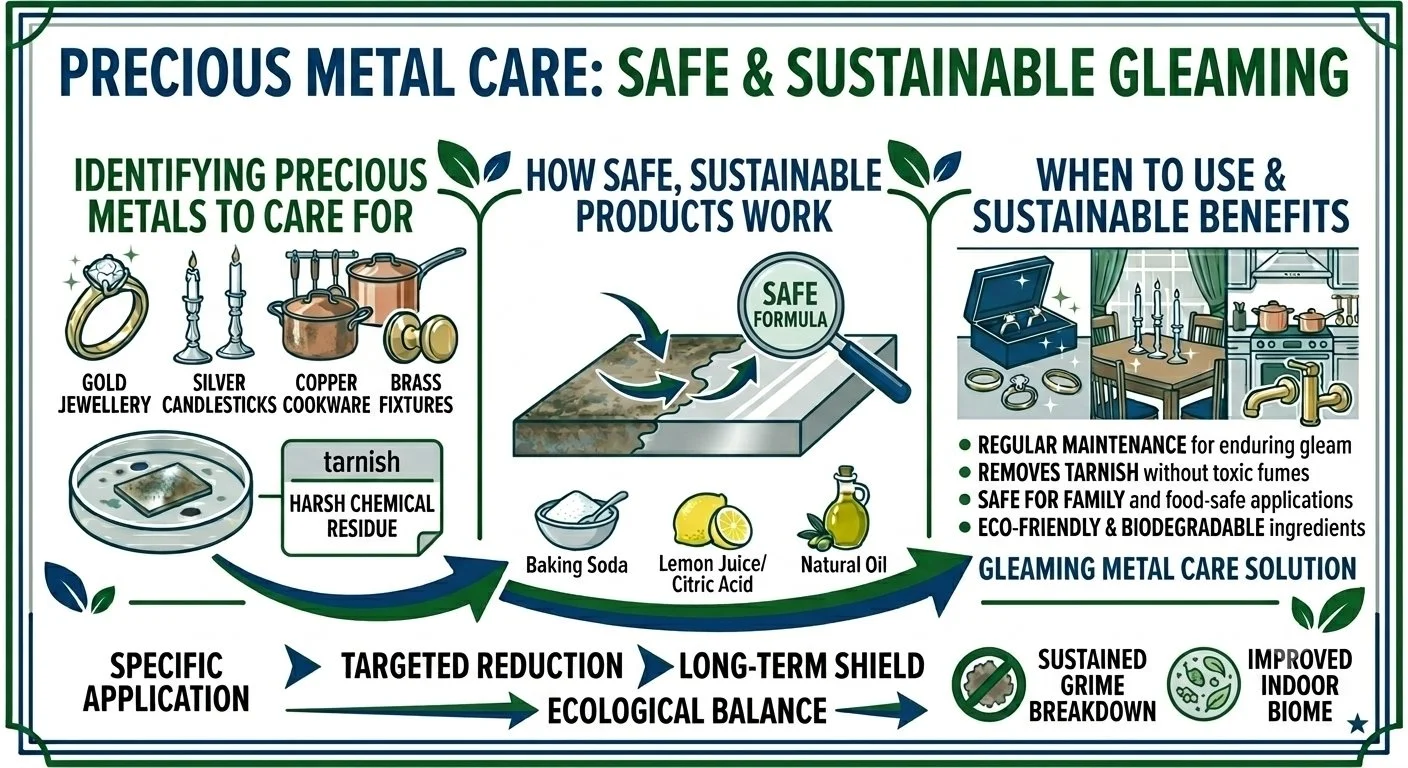
Your gold jewellery, silver candlesticks, copper cookware, and brass fixtures deserve proper care–but most commercial metal polishes are loaded with harsh chemicals. Here's how you can keep precious metal surfaces gleaming using safe, sustainable products that won't harm your family or the environment.
If you've ever reached for a bottle of commercial silver polish and stopped to read the ingredients label, you may have put it right back on the shelf. Many conventional metal cleaners contain ammonia, phosphates, and synthetic compounds that are hard on skin, harsh on the environment, and when rinsed down the drain contribute to water pollution.
The good news is that you don't need any of that. Whether you're maintaining antique silverware passed down through your family, keeping copper cookware in your kitchen gleaming, or preserving the brass hardware on your condo door, there are effective, gentle, and planet-friendly ways to get the job done.
This guide covers everything you need to know about caring for common precious and decorative metals — gold, silver, copper, and brass — using sustainable products and methods that are safe for your household and the environment.
Why your choice of metal cleaner matters
Precious and decorative metals are porous and reactive. That means the products you use to clean them don't just sit on the surface – they interact with the metal at a chemical level. Harsh commercial polishes can accelerate oxidation over time, leave behind residues that dull the finish, or strip protective patinas that actually help preserve older pieces.
Beyond the objects themselves, there's the question of what happens after cleaning. When chemical-laden rinse water makes its way into the sewer system, it can affect local waterways, including Lake Ontario, which serves as the source of drinking water for millions of people in the Greater Toronto Area.
Choosing sustainable, biodegradable cleaning products isn't just an ethical preference – it's a practical one. Natural cleaning agents tend to be gentler on metals, are safer for households with children or pets, and are far less likely to cause the kind of surface damage that leads to costly repairs or replacements down the road.
Caring for gold
What to know
Pure gold (24 karat) is highly resistant to tarnish, but most gold objects in your home are alloyed with other metals like copper or silver to increase their durability. It's these alloys that can tarnish or dull over time, not the gold itself.
What to use
The safest and most effective sustainable method for cleaning gold at home is a simple warm water soak with a small amount of plant-based dish soap. Add a few drops to a bowl of warm (not hot) water, submerge the gold piece for 10–15 minutes, then gently scrub with a soft natural-bristle brush (a repurposed toothbrush with natural fibres works beautifully) and rinse thoroughly.
What to avoid
Avoid ultrasonic cleaners for pieces with set gemstones, as vibrations can loosen settings. Steer clear of chlorine bleach entirely — it can break down gold alloys and cause permanent discolouration. And despite what you may have read online, toothpaste is too abrasive for regular gold cleaning.
Storing gold
Store gold pieces individually in soft cloth pouches or lined boxes to prevent scratching. Keeping pieces separated also reduces the frequency with which they need to be cleaned.
Caring for silver
What to know
Silver tarnishes as a result of a chemical reaction with sulphur compounds in the air — a process called oxidation. Tarnish appears as a yellowish or dark grey film and is entirely natural. It does not damage the silver itself, but it does affect appearance.
What to use
One of the most effective and surprisingly eco-friendly methods for removing silver tarnish involves items you likely already have at home: baking soda, aluminum foil, and boiling water. Line a baking dish or sink with aluminum foil (shiny side up), lay your silver pieces on top, sprinkle generously with baking soda, and pour boiling water over everything. The electrochemical reaction transfers the tarnish from the silver to the foil – no scrubbing required! Rinse thoroughly and buff dry with a soft, natural cotton or linen cloth.
What to avoid
Commercial dip-style silver polishes work quickly but are among the harshest products available for home metal care. Many contain thiourea, a compound that is toxic to aquatic organisms. Repeated use of dip polishes can also erode the fine details in ornate silverware over time.
Avoid rubber gloves when handling silver, as rubber can actually accelerate tarnishing.
How to store
The best sustainable strategy for silver is prevention. Silverware without wood components is best stored by wrapping in buffered acid-free tissue. Unbleached cotton flannel is a great sustainable alternative that will help protect any wood on your silver pieces. Both options will slow the oxidation process significantly. Silica gel packets placed near silver in display cabinets can also help manage humidity levels and reduce tarnishing–and can be refreshed by adding to a low heat (200 degrees fahrenheit (90 celcius)) for a couple of hours.
Silver cloth can also be used as an extra layer of protection.
Caring for copper
What to know
Copper is one of the most beautiful and functional metals you'll find in a home, appearing in everything from cookware and bakeware to decorative bowls, planters, and architectural accents. Over time, copper develops a green or blue-green patina called verdigris, which – unlike rust – is not structurally damaging and is actually prized in many decorative applications. Whether you want to restore the bright orange-red shine or preserve a natural patina is entirely a matter of preference.
What to use
Important note: Many copper items are lacquered to prevent tarnishing, which can be damaged by acidic cleaning methods and should only be cleaned with soap and water. If unsure, one way to test for lacquered copper is to briefly apply a mild acid to its surface. If it doesn’t change colour, then it is lacquered and the methods described below should not be used to clean it.
The most classic and effective natural copper cleaner is a mixture of salt and either lemon juice or white vinegar. The mild acid in the lemon or vinegar dissolves the copper oxide that causes tarnish, while the salt provides gentle mechanical abrasion.
Apply the mixture with a soft cloth, rub gently in circular motions, rinse thoroughly with warm water, and dry immediately to prevent water spots.
For copper cookware with stubborn spots, a paste of flour, salt, and white vinegar (equal parts) applied and left for 10 minutes before rinsing is particularly effective. Ketchup (yes, really) also works well due to its acetic acid content, and it's a fun option to have on hand.
What to avoid
Never use steel wool or abrasive scrubbing pads on copper, as these will leave permanent scratches. Avoid letting copper cookware soak in water for extended periods, as this can cause surface pitting. And be cautious about cleaning copper with a patina you want to preserve–acids will remove it.
How to store
After cleaning and drying copper thoroughly, apply a very thin coat of beeswax or food-grade mineral oil to create a protective barrier that slows re-oxidation. This is particularly useful for decorative copper pieces that aren't washed regularly.
Caring for brass
What to know
Brass–an alloy of copper and zinc–is common in homes as door hardware, light fixtures, decorative objects, and musical instruments. Like copper, brass tarnishes over time, developing a dark, dull surface layer. It's worth noting that much modern "brass" hardware is actually brass-plated steel or zinc, which responds differently to cleaning than solid brass.
What to use
Unlacquered brass
The same lemon-and-salt or vinegar-and-salt method that works for unlacquered copper is equally effective on solid, unlacquered brass. For a gentler everyday clean, warm water with a small amount of plant-based dish soap and a soft natural-bristle brush is sufficient. For heavily tarnished pieces, a mixture of lemon juice and a cream of tartar – applied, left for a few minutes, then rinsed – produces excellent results.
Lacquered brass
Like copper, many modern brass fixtures are lacquered to protect the finish and slow tarnishing. Lacquered brass should only ever be cleaned with warm water and a soft cloth. Any acidic or abrasive cleaner will damage the lacquer coating and cause uneven tarnishing underneath. If the lacquer on your fixtures is already peeling or damaged, it may be worth having it professionally stripped and either re-lacquered or left as living, unlacquered brass.
What to avoid
Avoid ammonia-based cleaners on brass entirely, as they can cause permanent discolouration. Do not use rough scrubbing pads. And as with copper, always dry brass thoroughly after cleaning to prevent water spotting.
General sustainable tips for all precious metals
A few principles apply across the board when it comes to sustainable metal care at home:
Always dry metals thoroughly after cleaning. Water left on metal surfaces accelerates oxidation and tarnishing.
Use soft, natural-fibre cloths for buffing and drying. Unbleached cotton, linen, and wool felt are all excellent choices that won't scratch or leave synthetic fibre residue.
Wear cotton gloves when handling polished silver and gold pieces. The oils on your hands can leave prints that accelerate tarnishing.
Clean metal objects less frequently but more thoroughly. Over-cleaning, even with gentle methods, causes wear over time. Develop a regular but measured routine.
Look for locally made, certified natural metal polishes when choosing a commercial option. Several Toronto and Ontario-based producers offer beeswax-based and plant-derived products that are effective and environmentally responsible.
Dispose of cleaning solutions responsibly. Even natural cleaning rinse water, particularly from heavy tarnish removal, should be diluted before going down the drain.
What to look for in a sustainable metal cleaning product
If you prefer to purchase a ready-made metal cleaner rather than making your own, here's what to look for on the label:
Plant-derived or mineral-based ingredients with recognisable names
No phosphates, ammonia, sodium hypochlorite (bleach), or synthetic fragrances
Biodegradable formula — look for third-party certification where possible
Recyclable or compostable packaging
Produced by a Canadian or local Ontario company when possible, to reduce transportation emissions
As the founder of EcoEthical Cleaning, I've built my practice around the same principles outlined in this guide — using only thoughtfully chosen, sustainable products that protect both your home and our shared environment here in Toronto. Whether it's the care of precious surfaces or a thorough top-to-bottom clean, every service I provide across the Harbourfront District and surrounding neighbourhoods is fragrance-free, biodegradable, and delivered with attention to the details other cleaners overlook.
If you're ready to experience cleaning that's as conscientious as it is thorough, reach out today for a free, no-obligation estimate.
The complete guide to microbial cleaning
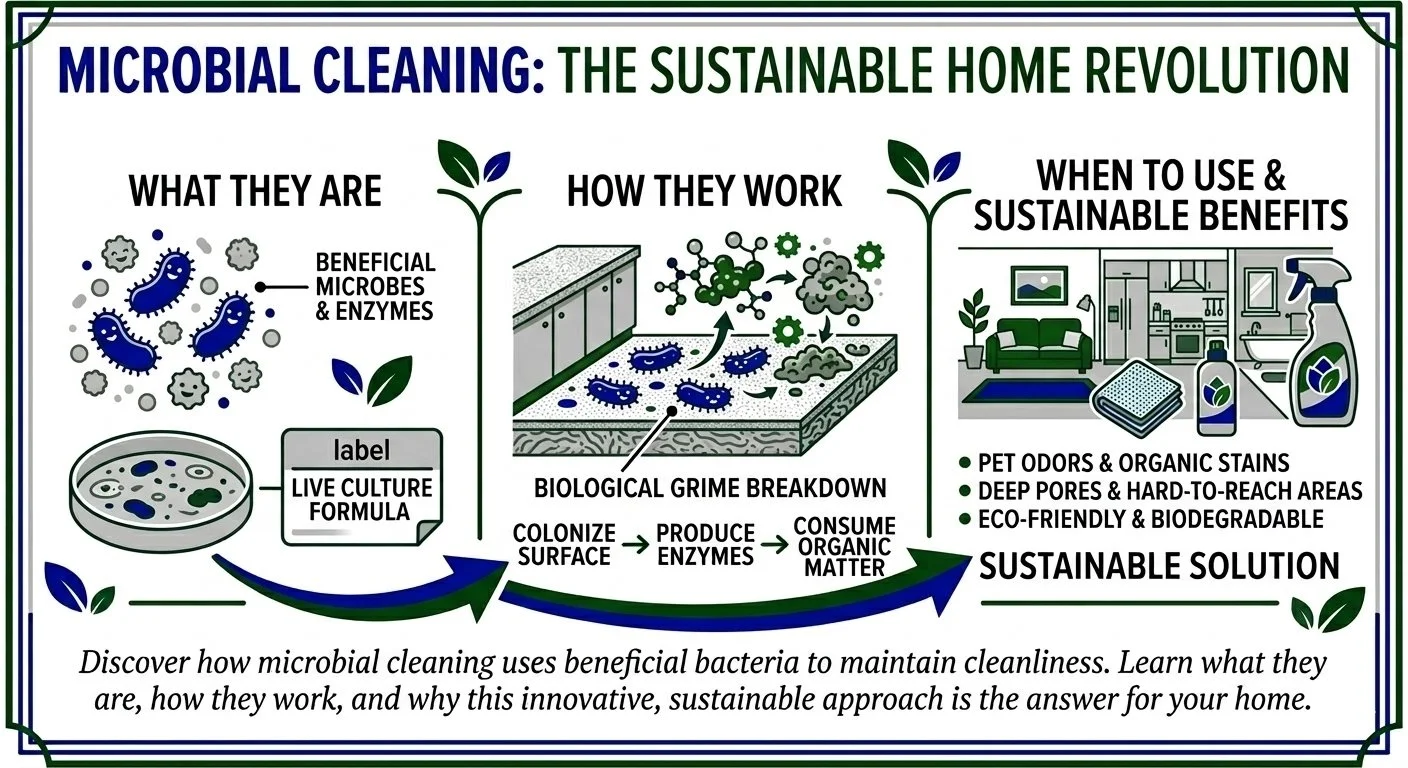
Discover how microbial cleaning uses beneficial bacteria to maintain cleanliness in your Toronto home. Learn what microbial cleaners are, how they work, when to use them, and why this innovative cleaning approach might be the sustainable solution you've been looking for.
In recent years, a new category of cleaning products has been gaining attention among environmentally conscious homeowners: microbial cleaners. If you've seen products labeled as "probiotic cleaners," "enzymatic cleaners," or "bacterial cleaners" on store shelves and wondered what they're all about, you're not alone.
The concept might seem counterintuitive at first. After all, haven't we spent decades trying to kill bacteria in our homes? Why would we intentionally introduce bacteria as part of our cleaning routine?
The answer lies in understanding that not all bacteria are harmful. In fact, beneficial bacteria play crucial roles in many aspects of our lives, from our digestive health to composting our organic waste. Microbial cleaning harnesses these helpful microorganisms to clean and maintain surfaces in ways that traditional chemical cleaners simply can't match.
Whether you're living in a downtown condo, a family home in the suburbs, or renting an apartment, understanding microbial cleaning can help you make informed decisions about maintaining a clean, healthy, and environmentally friendly home.
Let's explore what microbial cleaning actually is, how it works, what it's useful for, and whether it might be the right choice for your household.
What exactly is microbial cleaning?
Microbial cleaning refers to cleaning products and methods that use living microorganisms — primarily bacteria and their enzymes—to break down dirt, organic matter, and odour-causing compounds.
There are two main categories of microbial cleaning products you'll encounter:
Enzymatic cleaners contain enzymes, which are proteins that act as biological catalysts. These enzymes are produced by microorganisms but the cleaners themselves may not contain living bacteria. Instead, they contain concentrated enzymes that break down specific types of organic matter. Different enzymes target different substances: proteases break down proteins (like blood or food stains), lipases break down fats and oils, amylases break down starches, and cellulases break down plant-based materials.
Probiotic or bacterial cleaners contain live beneficial bacteria, often along with the enzymes these bacteria produce. When applied to a surface, these bacteria don't just clean once and disappear — they continue to colonize the area, producing enzymes and competing with harmful bacteria for resources. This creates an ongoing cleaning effect that can last for days after application.
The fundamental difference between microbial cleaning and traditional chemical cleaning is the mechanism of action. Chemical cleaners work through immediate chemical reactions — they break apart dirt and kill microorganisms on contact. Microbial cleaners, on the other hand, work biologically and often more slowly, using natural processes to break down organic matter at a molecular level.
Think of it this way: traditional cleaners are like a power washer that blasts everything away immediately. Microbial cleaners are more like having a team of microscopic workers that continue cleaning long after you've walked away, and in some cases, keep working for days.
This doesn't mean microbial cleaners replace all other cleaning methods — they're one tool in your cleaning toolkit, particularly well-suited for specific applications that we'll explore throughout this guide.
How does microbial cleaning actually work?
To understand how microbial cleaning works, it helps to think about what these products are actually doing at a microscopic level.
When you apply an enzymatic cleaner to a surface, you're depositing enzymes that immediately begin breaking down organic compounds. Each enzyme is highly specific — it only works on certain types of molecules. A protease enzyme, for instance, will break protein chains into smaller peptides and amino acids, but it won't affect fats or carbohydrates. This specificity is actually an advantage because it means the enzymes can target exactly the type of soil or stain you're dealing with.
The breakdown process happens through a mechanism that's remarkably elegant. The enzyme binds to its target molecule, breaks it apart, releases the fragments, and then moves on to break down another molecule. A single enzyme can perform this action thousands of times, which is why enzymatic cleaners can be effective even at relatively low concentrations.
Probiotic cleaners add another layer to this process. When you apply a probiotic cleaner, you're introducing millions of beneficial bacteria to the surface. These bacteria do several things simultaneously:
Produce enzymes continuously, creating a sustained cleaning effect rather than a one-time application. As long as the bacteria remain active on the surface, they keep producing the enzymes needed to break down organic matter.
Consume the organic material that the enzymes have broken down. This is important for odour control because many unpleasant smells come from organic compounds. By consuming these compounds, the bacteria eliminate the source of the odour rather than just masking it with fragrance.
Compete with potentially harmful bacteria for space and resources. This is called competitive exclusion. Surfaces in your home are never truly sterile — they're always colonized by some form of microorganism. The question is whether those microorganisms are beneficial or potentially problematic. By establishing populations of beneficial bacteria, probiotic cleaners can help prevent harmful bacteria from gaining a foothold.
This last point is particularly important to understand because it represents a fundamental shift in thinking about cleanliness. Traditional cleaning aims to create a sterile environment by killing all microorganisms. Microbial cleaning instead aims to create a balanced microbial ecosystem dominated by beneficial organisms.
The effectiveness of microbial cleaners depends on several factors. Temperature matters — most enzymes and bacteria work best at room temperature, which is why these cleaners are ideal for typical indoor conditions. Time is also crucial — microbial cleaners generally need more contact time than chemical cleaners to do their work. While a chemical disinfectant might work in seconds, an enzymatic cleaner might need 10-15 minutes, and probiotic cleaners work best when left to dry naturally rather than being wiped away immediately.
Moisture and pH also play roles. Enzymes and bacteria need some moisture to function, and they work best in relatively neutral pH conditions. This is why microbial cleaners are formulated to create optimal conditions for the microorganisms to do their work.
What microbial cleaning is genuinely useful for
Microbial cleaners excel in certain applications where their unique properties provide advantages over traditional cleaning methods. Understanding these specific uses will help you determine whether these products have a place in your home.
Pet odour and stain removal is perhaps the most popular application for enzymatic cleaners. If you have dogs or cats, you've likely dealt with urine accidents on carpets, upholstery, or floors. Pet urine contains uric acid crystals that are extremely difficult to remove with traditional cleaners — they may seem to disappear when wet but return as the area dries, bringing the odour back with them. Enzymatic cleaners specifically break down these uric acid crystals at the molecular level, permanently eliminating the odour rather than just masking it. This is particularly valuable for pet owners living in condos or apartments where lingering pet odours can be problematic for other tenants.
Drain maintenance is another excellent application. The biofilm and organic buildup that accumulates in drains — hair, soap scum, food particles, grease — is exactly what microbial cleaners are designed to address. Regular use of enzymatic drain cleaners can help prevent clogs and eliminate the musty odours that sometimes emanate from drains, especially in older homes where plumbing systems may have decades of accumulated buildup. These cleaners work continuously, slowly breaking down organic matter in pipes without the harsh chemicals that can damage plumbing or harm the environment when they enter the wastewater system.
Grease trap and septic system maintenance also benefits significantly from microbial products. For residents with septic systems, bacterial additives can help maintain healthy microbial populations in the tank, improving waste breakdown and system function. The bacteria in these products enhance the natural decomposition process that septic systems rely on.
Carpet and upholstery cleaning with enzymatic products can be particularly effective for organic stains — food, beverage spills, vomit, or other biological materials. These cleaners penetrate deep into fibres and continue working over time, breaking down staining compounds that traditional cleaners might leave behind. For families with young children or for anyone who's ever dealt with a stubborn wine or coffee stain, this prolonged action can make the difference between a permanent stain and complete removal.
Waste bins and composters benefit enormously from microbial cleaners. Enzymatic sprays designed for garbage bins can help break down the residue that accumulates, reducing odours without introducing harsh chemicals that might contaminate the organic waste stream.
Hard-to-reach areas where soil can accumulate but regular cleaning is difficult — behind appliances, in tight bathroom corners, or in grout lines — can benefit from probiotic cleaners that continue working after application. Since these products keep producing enzymes and breaking down organic matter over time, they can help maintain cleanliness in areas that don't get frequent attention.
Sports equipment and gym bags often develop stubborn odours from sweat and bacteria. Enzymatic cleaners specifically break down the proteins and organic compounds in sweat, eliminating odours at their source. This is particularly useful for families with active kids or adults who regularly use athletic gear.
Automotive interiors, especially cloth seats and carpets that have absorbed spills or developed odours, respond well to enzymatic treatment. The ability of these cleaners to penetrate fabrics and continue working makes them ideal for car cleaning tasks.
What microbial cleaning is not designed for
While microbial cleaners have genuine benefits for specific applications, it's equally important to understand their limitations and what they're not designed to do.
Microbial cleaners are not disinfectants in the traditional sense. If you need to kill harmful bacteria, viruses, or other pathogens — for instance, after handling raw meat in your kitchen or during flu season — enzymatic or probiotic cleaners are not the appropriate choice. While probiotic cleaners may reduce harmful bacteria through competitive exclusion over time, they don't provide the immediate pathogen kill that you get from disinfectants. This is particularly important for households to understand during cold and flu season or when dealing with potential foodborne illness concerns.
They're not designed for inorganic soils. Enzymatic cleaners break down organic matter — proteins, fats, carbohydrates. They don't work on mineral deposits, rust, soap scum (which is largely inorganic), or hard water stains. For these cleaning challenges, you'll still need traditional acidic cleaners or other chemical solutions.
Microbial cleaners are not fast-acting solutions for general cleaning. If you need to quickly wipe down your kitchen counters before dinner guests arrive, a spray-and-wipe enzymatic cleaner isn't your most efficient choice. These products work best with time — from 15 minutes to several hours. They're not ideal for routine quick cleaning tasks where immediate results are needed.
They typically don't provide visible cleaning power for greasy surfaces. While enzymes can break down fats and oils, this happens slowly and at a molecular level. For a stovetop covered in cooking grease or a greasy range hood, you'll get faster, more satisfying results with a traditional degreaser. The enzymatic approach is better suited for maintaining drains or breaking down grease over time rather than tackling heavy visible grease deposits.
Microbial cleaners don't work well in conditions that are too hot, too cold, or chemically extreme. The enzymes and bacteria in these products are living or biological molecules that denature (break down) at high temperatures and become inactive when frozen. Similarly, they don't function well in highly acidic or alkaline conditions. This means they're not appropriate for use with very hot water, in ovens, or in combination with strong chemical cleaners.
They won't remove physical debris or dirt. If your floor is covered in crumbs and visible dirt, an enzymatic spray won't make that disappear. You still need to sweep, vacuum, or physically remove debris. Microbial cleaners work on the microscopic level — breaking down organic residues and odour-causing compounds — not on visible dirt and particles.
These products are also not a replacement for proper ventilation and moisture control. If you have a mould problem in your home, the solution isn't a probiotic cleaner — it's fixing the underlying moisture issue. While some microbial products claim to help with mould, they don't address the root cause, which is excess humidity or water infiltration.
Understanding these limitations helps you use microbial cleaners appropriately as part of a comprehensive cleaning strategy rather than expecting them to replace all other cleaning methods.
The science behind microbial cleaning: What research tells us
The concept of using beneficial microorganisms for cleaning isn't new, but the commercial development of consumer products is relatively recent. Understanding what scientific research actually tells us about microbial cleaning can help you separate evidence-based benefits from marketing hype.
Enzymatic cleaners have the strongest scientific backing. The use of enzymes for cleaning has been well-established for decades, particularly in laundry detergents where they've been a standard ingredient since the 1960s. Research consistently shows that proteases, lipases, and amylases effectively break down their target organic compounds. This isn't controversial science — it's well-understood biochemistry. When you use an enzymatic pet stain remover, you're applying technology that has decades of research and practical application supporting it.
The evidence for probiotic cleaners is more nuanced and still developing. Several studies have shown that beneficial bacteria can colonize surfaces and compete with potentially harmful bacteria, which is the theoretical basis for these products. Research in healthcare settings has demonstrated that probiotic cleaning systems can reduce the presence of certain pathogens on surfaces, though results have been mixed and more research is needed.
One area where the science is particularly interesting is in the concept of the "home microbiome." Just as we now understand that our bodies are home to trillions of beneficial microorganisms, researchers are discovering that our homes have their own microbial ecosystems. Some research suggests that homes with more diverse microbial populations — including plenty of bacteria from the natural environment — may actually be healthier than homes where we attempt to maintain sterile conditions.
This research challenges the traditional notion that "cleaner" means "more sterile." Instead, it suggests that a balanced microbial ecosystem might be preferable to a constantly disinfected environment, particularly for immune system development in children. However, it's important to note that this research is still evolving, and the implications for cleaning practices aren't entirely clear yet.
Studies on enzymatic drain cleaners have shown they can effectively reduce organic buildup in pipes when used regularly. This maintenance approach — preventing buildup rather than clearing severe clogs — appears to be where these products are most effective. They're not a substitute for a plumber's snake when you have a complete blockage, but they can help prevent reaching that point.
Research has also confirmed what we know about enzyme specificity. A protease designed to break down blood won't help with a grease stain, and a lipase won't remove protein-based stains. This means the most effective enzymatic cleaners contain multiple types of enzymes to address various organic compounds.
What the research doesn't show is that microbial cleaners are universally superior to traditional cleaning methods for all applications. The scientific literature doesn't support replacing all your cleaning products with enzymatic or probiotic alternatives. Rather, it shows that these products have specific valuable applications where their unique properties provide advantages.
For anyone evaluating microbial cleaning products, the key is to look for products that make specific, scientifically defensible claims rather than vague promises about being "better" or "more natural." Products that clearly state what enzymes they contain and what those enzymes target are more trustworthy than those making broad, unsupported claims.
Environmental advantages of microbial cleaning
For environmentally conscious people, understanding the environmental impact of microbial cleaning products is crucial for making informed choices that align with your values.
The potential environmental benefits of microbial cleaners are significant. These products are generally biodegradable because they're based on biological rather than synthetic chemical processes. The enzymes and bacteria break down naturally, and when these products enter wastewater system through your drains, they're typically less harmful to aquatic ecosystems than traditional chemical cleaners.
Traditional cleaning chemicals can persist in the aquatic environment and harm fish and other wildlife. Enzymatic and probiotic cleaners, in contrast, break down into harmless components relatively quickly.
For homes with septic systems, microbial cleaners can actually be beneficial to the system rather than harmful. Traditional antibacterial cleaners can kill the beneficial bacteria that septic systems depend on to function properly. Enzymatic cleaners and bacterial additives support the biological processes that make septic systems work.
The reduced packaging and concentration of some enzymatic products can also provide environmental benefits. Some probiotic cleaning concentrates can be diluted to make multiple litres of cleaning solution, reducing plastic packaging waste compared to buying multiple bottles of ready-to-use traditional cleaners.
However, there are important caveats to consider. Not all products marketed as "natural" or "enzymatic" are created equal. Some contain enzymes or beneficial bacteria along with traditional chemical ingredients, synthetic fragrances, or other additives that may reduce the environmental benefits. Reading ingredient lists is crucial.
The production of enzymatic and probiotic cleaners also has environmental costs. Growing bacterial cultures requires resources, and the manufacturing processes, while potentially less toxic than producing synthetic chemicals, still require energy and inputs. The environmental benefit comes primarily in the use and disposal phase rather than production.
There's also the question of efficacy and resource use. If an enzymatic cleaner requires more product, more water, or more time and effort to achieve the same result as a traditional cleaner, the environmental calculation becomes more complex. The most environmentally friendly cleaning method is often the one that works efficiently, reducing the need for repeated applications or excessive water use.
For anybody serious about environmental impact, microbial cleaners can be part of a green cleaning strategy, but they should be evaluated alongside other factors: reducing overall product consumption, choosing concentrated formulas, avoiding single-use products, and selecting items with minimal packaging.
It's also worth noting that truly sustainable cleaning often involves the simplest methods: vinegar and water for windows, baking soda for scrubbing, and good old-fashioned elbow grease for many other tasks. Microbial cleaners have their place, but they're not automatically more environmentally friendly than basic, time-tested cleaning methods.
The most honest assessment is that enzymatic and probiotic cleaners can be more environmentally friendly than conventional chemical cleaners for specific applications where they're genuinely effective, but they're not a magic solution to all environmental concerns about household cleaning.
Choosing and using microbial cleaners effectively
If you've decided that microbial cleaners might be useful for specific applications in your home, here's what you need to know about selecting and using them effectively.
When shopping for enzymatic or probiotic cleaners, look for products that clearly state what enzymes they contain and what those enzymes are designed to break down. A pet stain remover should list proteases and possibly ureases (for breaking down urea in urine). A drain cleaner should contain lipases for fats and proteases for hair and organic matter. Transparency about ingredients is a good sign that a product is legitimate rather than just capitalizing on the "natural" cleaning trend.
Check for third-party certifications when possible. Products certified by organizations like EcoLogo or Green Seal have been independently verified to meet specific environmental and performance standards. These certifications provide some assurance that the product does what it claims.
Avoid products with added synthetic fragrances or harsh chemical additives. One of the benefits of enzymatic cleaners is that they're gentler on your indoor environment, but this advantage is lost if the product is loaded with artificial scents or other potentially problematic ingredients. Remember that truly effective odour removal comes from breaking down odour-causing compounds, not masking them with perfume.
When using enzymatic or probiotic cleaners, follow these guidelines for best results:
Give them time to work. Unlike spray-and-wipe chemical cleaners, enzymatic products need contact time with the soil or stain they're meant to break down. Follow product directions for application time — usually at least 10-15 minutes for enzymatic cleaners. For probiotic cleaners, allowing the product to air dry rather than wiping it away immediately lets the bacteria establish themselves on the surface.
Use appropriate amounts. More isn't always better, but you do need enough product to thoroughly saturate the affected area, especially for stain removal. For a pet urine spot on carpet, for instance, you need to get the enzymatic cleaner down to the carpet pad where the urine has soaked in, not just treat the surface.
Apply to clean surfaces when possible. For best results with probiotic cleaners, apply them to surfaces that have already been cleaned of visible soil. This gives the beneficial bacteria the best chance to colonize the area without competing with heavy organic buildup.
Store products properly. Enzymatic cleaners should be stored at room temperature — extreme heat or cold can damage the enzymes. Check expiration dates, as enzymes do lose activity over time. Probiotic cleaners containing live bacteria are even more sensitive to storage conditions.
Don't mix microbial cleaners with disinfectants or harsh chemicals. If you've just bleached a surface, don't immediately apply a probiotic cleaner — the bleach will kill the beneficial bacteria. Similarly, don't mix enzymatic cleaners with very acidic or alkaline products, as this can denature the enzymes.
Be patient with results. For some applications like drain maintenance or ongoing odour control, you won't see dramatic immediate results. The benefit comes from consistent use over time as the enzymes work to prevent buildup or the bacteria establish beneficial populations.
For Toronto-specific considerations, remember that our seasonal temperature variations can affect these products. In winter, if your home's temperature drops significantly (perhaps in a basement or mudroom), enzymatic cleaners may work more slowly. Conversely, they work very effectively at typical comfortable room temperatures, which is where most of us keep our homes.
Cost considerations and value assessment
Price is often a concern when considering microbial cleaning products, as they're frequently more expensive than traditional cleaners. Understanding the value proposition helps you make informed decisions about when these products are worth the investment.
Quality enzymatic and probiotic cleaners typically cost more per bottle than conventional cleaning products available at grocery stores or big-box retailers. A specialized enzymatic pet stain remover might cost $15-25 for a bottle that would last for several applications, while a general-purpose chemical cleaner might cost $5-8 for a similar-sized bottle.
However, several factors can offset this higher initial cost:
Enzymatic cleaners are often highly concentrated, meaning you dilute them before use. A single bottle might make multiple litres of working solution, making the per-use cost more comparable to traditional cleaners.
For specific problems — particularly pet odours or drain maintenance — enzymatic products may actually save you money in the long run. If an enzymatic pet cleaner permanently removes a urine odour that would otherwise require professional carpet cleaning or even carpet replacement, the $20 bottle is a bargain. If regular use of an enzymatic drain cleaner prevents a $200 plumber's call to clear a blocked drain, it pays for itself many times over.
Probiotic cleaners that continue working for days after application could potentially reduce cleaning frequency. If you're maintaining surfaces with beneficial bacteria that continuously produce enzymes and compete with harmful bacteria, you might be able to clean less frequently while maintaining the same level of actual cleanliness.
Some enzymatic products can replace multiple traditional cleaning products. A good multi-enzyme cleaner might work as a general cleaner, stain remover, and odour eliminator, potentially reducing the total number of products you need to purchase and store.
That said, it's important to be realistic about value:
Don't replace all your cleaning products with expensive enzymatic alternatives if they're not necessary for your specific needs. If you don't have pets, don't regularly deal with organic stains, and don't struggle with drain odours, you may not benefit from enzymatic cleaners at all.
For routine general cleaning, simple and inexpensive solutions like vinegar and water or basic soap solutions often work just as well as expensive enzymatic products and cost far less.
Generic or store-brand enzymatic cleaners can be significantly cheaper than name-brand products while containing similar enzymes. Compare ingredient lists rather than just brand names when shopping.
Consider making your own solutions for some applications. For drain maintenance, for instance, a simple routine of hot water, baking soda, and vinegar can be effective and costs virtually nothing, though it works through different mechanisms than enzymatic cleaners.
The best value approach is targeted use: employ enzymatic or probiotic cleaners for specific applications where they excel and where the alternatives are either ineffective or more expensive, while using simpler, cheaper methods for routine general cleaning.
Common misconceptions about microbial cleaning
As microbial cleaning products have gained popularity, several misconceptions have emerged that are worth addressing directly.
“Microbial cleaners will make your home sterile or kill all germs.”
This is actually the opposite of what probiotic cleaners do. They introduce beneficial bacteria rather than creating a sterile environment. While enzymatic cleaners break down organic matter, they're not disinfectants. If your goal is to kill pathogens, you need a disinfectant, not a microbial cleaner.
“These products are "all-natural" and therefore completely safe and non-toxic.”
While many enzymatic and probiotic cleaners are derived from biological sources, "natural" doesn't automatically mean safe for all uses or people. Some people may be allergic to specific enzymes or bacterial strains. Additionally, many commercial products contain other ingredients beyond the enzymes or bacteria, and these may not all be natural. Always read ingredient lists and follow safety instructions.
“Microbial cleaners will work instantly like chemical cleaners.”
This is perhaps the most common source of disappointment with these products. People expect the immediate visible results they're used to from traditional cleaners. Microbial cleaners work differently—they need time, and their effects may not be immediately visible even though important cleaning is happening at the molecular level.
“You should replace all your cleaning products with enzymatic or probiotic alternatives.”
This isn't practical or necessary. Microbial cleaners excel in specific applications but aren't ideal for everything. A balanced cleaning approach uses different products for different purposes based on what works best for each specific cleaning challenge.
“If you use probiotic cleaners, you never need to clean again because the bacteria keep working forever.”
While probiotic bacteria can persist on surfaces and continue producing enzymes for some time, they don't eliminate the need for regular cleaning. Populations eventually decline, and you still need to remove visible soil and debris through traditional cleaning methods.
“More expensive products are always better or more effective.”
Price doesn't always correlate with efficacy in enzymatic cleaners. Some expensive products are paying for marketing and packaging rather than superior formulations. Conversely, some very cheap products may contain insufficient enzymes to be effective. The key is looking at actual ingredients and concentrations rather than price tags.
“Enzymatic cleaners will fix serious plumbing clogs or septic system failures.”
While these products can help with maintenance and prevention, they're not miracle workers. A severely clogged drain needs mechanical clearing. A failing septic system needs professional repair. Enzymatic products work best as preventive maintenance, not emergency fixes.
“All ‘enzyme cleaners’ or ‘probiotic cleaners’ are the same.”
There's significant variation in product formulation, enzyme types and concentrations, bacterial strains used, and overall effectiveness. Generic grouping of all enzymatic products together ignores these important differences.
If you’re evaluating whether to try microbial cleaners, understanding these misconceptions will help you set realistic expectations about what these products can and can't do.
Making microbial cleaning work in your home
If you've decided that microbial cleaners have a place in your home, here's how to integrate them effectively into your cleaning routine.
Start with specific problem areas rather than trying to overhaul your entire cleaning approach at once. If you have a dog and periodically deal with accidents, begin with an enzymatic pet stain and odour remover. If your drains tend to develop odours or slow slightly, try an enzymatic drain maintainer. This targeted approach lets you evaluate effectiveness for your specific needs without significant investment.
Establish realistic expectations and give products adequate time to work. If you're treating a pet stain, understand that you might need to apply the product multiple times for complete odour removal, especially if the stain is old or has soaked deep into carpet padding. If you're maintaining drains, consistent weekly use over a month will give you better results than a one-time application.
Create a cleaning system that uses different methods for different purposes. You might use vinegar and water for windows and mirrors, a simple all-purpose cleaner for countertops and general surfaces, enzymatic cleaners for specific stain and odour issues, and traditional disinfectants when you actually need to kill pathogens (like after handling raw meat in the kitchen).
Keep records of what works and what doesn't for your specific situation. Homes vary widely and what works in one environment might not work as well in another. If an enzymatic drain cleaner keeps your bathroom drain fresh and flowing, note that success. If a probiotic surface cleaner doesn't seem to make any difference in your home, that's useful information too.
Consider the seasonal patterns in your home. During humid summers, you might find that microbial cleaners work particularly well. In the dry winter months when you're running the heat and indoor humidity drops, you might need to adjust your approach.
Be mindful of combining products and cleaning methods. If you're using probiotic cleaners to establish beneficial bacterial populations, don't immediately disinfect surfaces afterwards — you'll kill the bacteria you just applied. Similarly, if you've used a harsh chemical cleaner, wait before applying enzymatic products, as the residual chemicals might interfere with enzyme function.
Store products according to directions and use them before expiration dates. Enzymatic and probiotic cleaners have a shelf life. Check dates when purchasing, especially if buying from smaller retailers where products might sit on shelves longer, and don't stock up on so much that products expire before you use them.
Educate other household members about how to use these products correctly. If your partner or roommate is used to spray-and-wipe cleaning, they need to understand that enzymatic cleaners require different application methods. Brief everyone in your household on which products to use for what purposes and how to use them effectively.
Monitor your results over time. For maintenance applications like drain care, assess whether you're seeing the benefits you expected. Are your drains staying fresh and clear? If so, the product is working. If you're still experiencing problems, you might need to adjust your approach or try a different product.
The future of microbial cleaning
The microbial cleaning category is still evolving, and understanding where it might be heading can help you make forward-thinking decisions about these products.
Research is ongoing into more targeted and effective bacterial strains and enzyme formulations. As scientists better understand the specific mechanisms of soil breakdown and odour elimination, we're likely to see more specialized products designed for very specific applications. This could mean even more effective solutions for particular cleaning challenges.
The concept of managing your home's microbiome — rather than trying to sterilize it — is gaining scientific support. Future cleaning approaches might focus more on establishing beneficial microbial ecosystems in our homes rather than attempting to eliminate all bacteria. This represents a fundamental shift in thinking about domestic hygiene.
We may see broader adoption of probiotic cleaning systems in institutional and commercial settings, which could eventually influence residential products. Healthcare facilities, schools, and office buildings are experimenting with these systems, and as evidence accumulates about their effectiveness, residential applications may expand.
Regulation and standardization of microbial cleaning products is likely to improve. Currently, the lack of clear standards makes it difficult for consumers to compare products or verify claims. As the market matures, we may see better testing protocols, clearer labelling requirements, and more reliable third-party certifications.
Integration with other green cleaning technologies might create hybrid approaches that combine the best of multiple methods. We might see products that use enzymes for organic soil breakdown along with plant-based surfactants for general cleaning, creating more versatile solutions.
Greater transparency about ingredients and mechanisms of action is likely as consumers become more educated and demanding. The days of vague "proprietary enzyme blend" listings may give way to detailed disclosure of exactly which enzymes are included and what they're designed to break down.
Staying informed about these developments means you can make increasingly sophisticated choices about cleaning products that align with your health, environmental, and practical priorities.
The bottom line: Is microbial cleaning right for you?
After exploring what microbial cleaning is, how it works, and what it's useful for, the question remains: should you incorporate these products into your home's cleaning routine?
The answer depends on your specific circumstances and needs.
Microbial cleaners are worth considering if you deal with persistent pet odours or stains, experience slow or smelly drains, want to reduce harsh chemical use in your home, have specific applications where their prolonged action provides benefits, or are interested in supporting a more balanced home microbiome rather than attempting sterility.
They're probably not necessary if you don't deal with the specific issues they're designed to address, if you're satisfied with simple, inexpensive cleaning methods that work for your needs, if you're looking for fast-acting solutions for routine cleaning, or if your budget doesn't accommodate higher prices for specialized products.
The most sensible approach for most households is a selective strategy: use microbial cleaners where they genuinely excel—particularly for organic stains and odours, drain maintenance, and specific ongoing cleaning challenges—while continuing to use whatever methods work effectively for your other cleaning needs.
As the founder of EcoEthical Cleaning, I've integrated microbial cleaning products into every service I provide, where appropriate, across Toronto's Harbourfront District and surrounding neighbourhoods. Harnessing the same natural processes outlined in this guide, the products I use break down grease, grime, and organic matter without harsh chemicals — leaving your home genuinely clean at a microscopic level. If you're ready to put the science to work in your own space, reach out today for a free, no-obligation estimate.
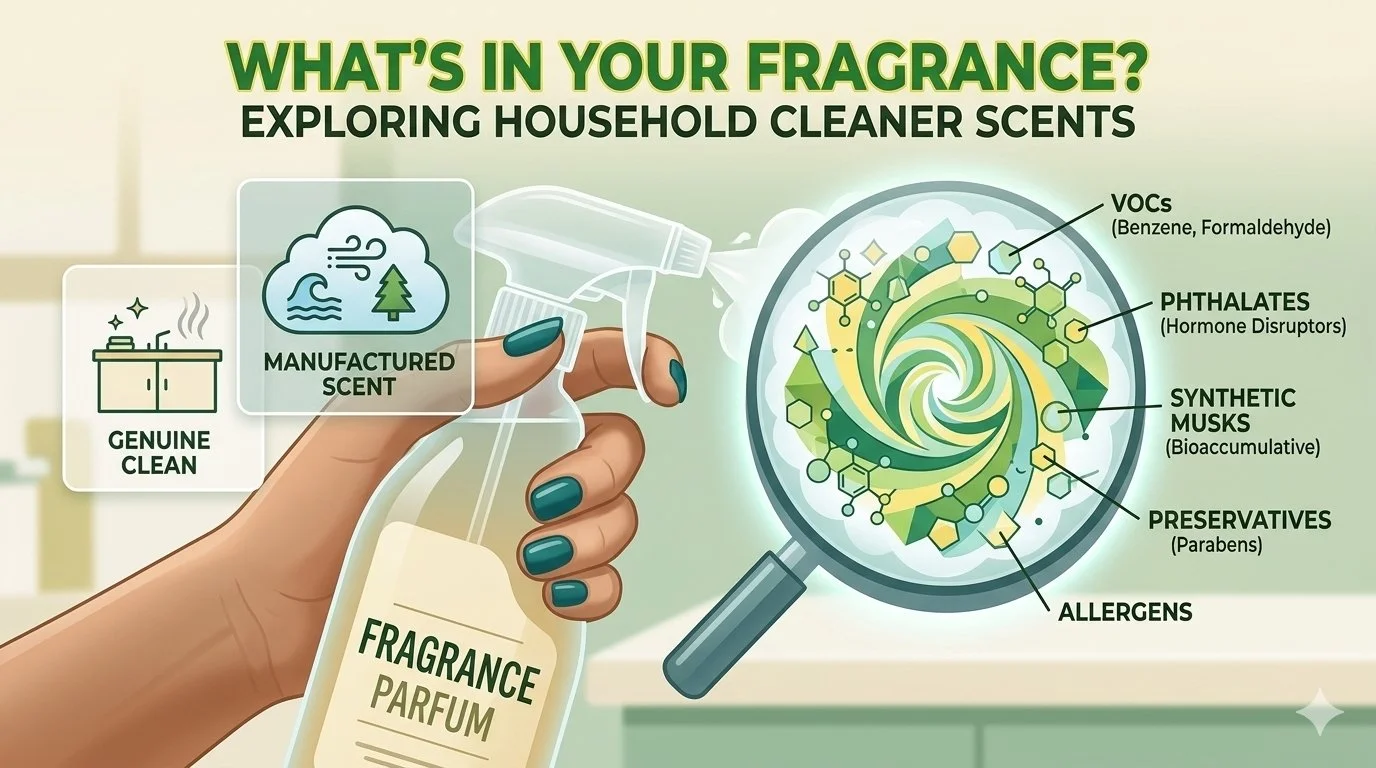
What to know about the fragrances in your household cleaners
Discover the truth about fragrances in household cleaners and why that "fresh" scent might be doing more harm than good. Learn about the health risks of synthetic fragrances, their environmental impact, and how marketing has convinced us that clean has a smell—when it actually doesn't.
If you've ever walked down the cleaning aisle at your local grocery store, you've likely been hit with an overwhelming wall of scent. Ocean breeze. Mountain fresh. Lavender fields. Spring rain. The options seem endless, and the marketing promises are enticing: these fragrances will make your home smell clean, feel fresh, and be more inviting.
That "fresh linen" scent wafting through your home after you've wiped down the counters? It's not cleanliness you're smelling — it's a complex cocktail of synthetic chemicals that could be affecting your health and the environment in ways you never imagined.
As we become increasingly conscious about what we bring into our homes, it's time to take a closer look at the fragrances lurking in our household cleaners and why they might be doing more harm than good.
What does clean actually smell like?
Let's start with a fundamental truth: cleanliness is odourless.
When you properly clean a surface (removing dirt, bacteria, grease, and grime) what you're left with is simply the natural scent of that material. A truly clean countertop smells like... nothing. A properly cleaned bathroom smells neutral. Freshly mopped floors shouldn't announce themselves from across the house.
The association between "clean" and "scented" is entirely manufactured. It's a marketing construct that's been so thoroughly embedded in our culture over the past several decades that we've collectively forgotten this basic reality. Think about it: before the mid-20th century and the explosion of synthetic chemistry in consumer products, people cleaned their homes with simple ingredients like vinegar, baking soda, and soap. These products cleaned effectively, without lingering artificial scents.
The equation of fragrance with cleanliness is so powerful that many of us feel like we haven't actually cleaned unless we can smell that telltale scent afterwards. We've been conditioned to believe that if it doesn't smell "fresh," it isn't truly clean. This perception is precisely what cleaning product manufacturers have spent billions of dollars cultivating.
The marketing machine behind scented cleaners
The fragrance industry and household cleaning product manufacturers have executed one of the most successful marketing campaigns in modern history. They've convinced millions of consumers that scent equals cleanliness, and they've done it so effectively that many of us don't even question the assumption.
Walk through any cleaning product advertisement, and you'll notice the patterns. Flowing curtains billowing in an ocean breeze. Sun-drenched meadows. Crisp mountain air. These are carefully crafted narratives designed to tap into our emotions and our desire for a fresh, healthy home environment.
The marketing language is equally calculated. Products promise to "eliminate odours," "refresh your home," and "bring the outdoors in." They use words like "pure," "natural," and "fresh" even when the ingredients are entirely synthetic. The labels feature images of lavender, lemons, and pine trees, creating a visual association with nature that the actual product formulation doesn't support.
Here in Toronto, where many of us live in condos or homes without immediate access to outdoor spaces, these marketing messages can be particularly appealing. The promise of bringing that "cottage country pine" or "ocean breeze" into our urban dwellings taps into our desire for connection with nature. But what we're actually bringing into our homes is far from natural.
Companies also leverage our trust in cleanliness as a form of care. The advertisements often feature families, children playing on freshly cleaned floors, and parents who want the best for their loved ones. The subtext is clear: if you care about your family, you'll choose products that make your home smell this particular way. It's a powerful emotional appeal that has little to do with actual cleaning efficacy.
What's particularly insidious about this marketing is that it's self-reinforcing. Once consumers are conditioned to associate scent with clean, they'll actually doubt whether their home is clean if it doesn't smell a certain way. This creates a cycle where people feel compelled to continue buying scented products, even if they're experiencing negative health effects, because the alternative feels like accepting a "less clean" home.
What's actually in those fragrances?
When you see "fragrance" or "parfum" listed on a cleaning product label, you might assume it's a single ingredient. In reality, that one word can represent a mixture of dozens or even hundreds of different chemicals, many of which you'll never know about.
This is where things get particularly concerning for Canadian consumers. While we have regulations through Health Canada regarding product safety, current labelling laws don't require manufacturers to disclose the specific components of their fragrance blends. These formulations are protected as "trade secrets," which means companies can include a wide range of synthetic chemicals without listing them individually on the label.
So what exactly goes into these mystery mixtures? Research has identified thousands of different chemicals used in fragrance formulations, but some of the most common categories include:
Phthalates are frequently used to make scents last longer. These chemicals have been linked to hormone disruption, reproductive issues, and developmental problems in children. Despite growing concerns, they're still widely used in many household products available on Toronto store shelves.
Synthetic musks are another common ingredient, designed to add depth and longevity to fragrances. Studies have found these compounds in human blood, breast milk, and body fat, raising concerns about bioaccumulation and long-term health effects.
Volatile organic compounds (VOCs) are chemicals that easily evaporate into the air. Many fragrance ingredients fall into this category, including substances like benzene, formaldehyde, and toluene—all of which have known health risks. When you spray that scented cleaner, you're releasing these VOCs into your indoor air, where they can linger for hours or even days.
Preservatives like parabens are often added to fragrance mixtures to prevent bacterial growth. However, parabens are endocrine disruptors that can mimic estrogen in the body and have been found in breast cancer tumours, though the connection remains under investigation.
Allergens are abundant in synthetic fragrances. The International Fragrance Association has identified 26 known fragrance allergens, but cleaning products can contain these without specific disclosure on Canadian labels. For Toronto residents dealing with allergies or sensitivities, this lack of transparency makes it nearly impossible to avoid problematic ingredients.
What makes this particularly troubling is that many of these chemicals haven't been thoroughly tested for safety, especially in combination with one another. While individual compounds might be present in small amounts, we're exposed to multiple fragranced products throughout the day—cleaners, laundry detergents, air fresheners, personal care products—and the cumulative effect of this chemical exposure is largely unknown.
The European Union has banned all CMR (Carcinogenic, Mutagenic, Reprotoxic) chemicals in personal care and household products, many of them fragrance ingredients. In Canada, our regulations are significantly less stringent, meaning products on our shelves may contain substances that aren't allowed in other developed countries.
Health risks associated with synthetic fragrances
The health implications of regular exposure to synthetic fragrances in household cleaners are more significant than many homeowners realize. While the cleaning product industry maintains that their formulations are safe, a growing body of research suggests otherwise.
Respiratory issues are among the most commonly reported problems. When you spray a scented cleaner, you're creating an aerosol of chemical compounds that you then inhale. For people with asthma, this can trigger attacks. One study found that individuals with asthma reported cleaning products as one of their top triggers. Even for those without pre-existing conditions, regular exposure to scented cleaners has been associated with the development of adult-onset asthma, particularly among professional cleaners and people who use these products frequently.
The impact on indoor air quality is substantial. Toronto homes, especially during our cold winters when windows stay closed for months, can develop particularly poor air quality when scented cleaners are used regularly. Research has shown that using household cleaning products can release as many volatile organic compounds into the air as driving a car—a startling comparison that highlights just how much these products affect the air we breathe in our homes.
Headaches and migraines are frequently triggered by synthetic fragrances. Many people report that exposure to scented cleaners leads to headaches, dizziness, or nausea. For those with chemical sensitivities or fragrance sensitivities, the effects can be debilitating, making it difficult to be in spaces where these products have been recently used.
Skin irritation and allergic reactions are also common. Contact with scented cleaning products can cause rashes, itching, and dermatitis. Because fragrances can contain dozens of potential allergens, identifying the specific cause of a reaction can be extremely difficult, leaving sufferers struggling to find products that won't irritate their skin.
The hormone disruption caused by many fragrance chemicals is particularly concerning for families with children. Endocrine-disrupting chemicals can interfere with normal hormone function, potentially affecting development, reproduction, and metabolism. While the full extent of these effects is still being studied, the precautionary principle suggests we should be cautious about regular exposure, especially for vulnerable populations like pregnant women and young children.
Neurological symptoms have also been reported. Some fragrance chemicals can cross the blood-brain barrier, and studies have linked exposure to issues with cognitive function, mood changes, and even neurodevelopmental problems in children exposed during critical developmental windows.
For Toronto residents living in multi-unit buildings, there's an additional concern: you may be exposed to your neighbours' cleaning products through shared ventilation systems. This means even if you choose fragrance-free products for your own home, you might still be breathing in chemicals from products used elsewhere in your building.
Perhaps most troubling is the emerging research on long-term health effects. Because many of these chemicals accumulate in the body over time and we're exposed to them chronically throughout our lives, researchers are only beginning to understand the potential long-term consequences. Some studies have suggested links between regular use of scented cleaning products and increased risks of certain cancers, though more research is needed to establish definitive causal relationships.
Environmental impact of fragranced cleaning products
The effects of fragranced household cleaners extend far beyond the walls of your home. These products have significant environmental implications that impact our local waterways, wildlife, and broader ecosystem.
When you pour scented cleaning products down your drain, those chemicals don't simply disappear. They enter the wastewater system and eventually make their way to water treatment facilities. While these facilities are designed to remove many contaminants, they weren't built to handle the complex cocktail of synthetic fragrance chemicals we're now sending through them regularly. Many of these compounds pass through the treatment process largely unchanged.
Once in the aquatic environment, these substances can have serious effects on fish and other wildlife. Studies have shown that synthetic musk compounds — common in fragranced products — accumulate in fish tissue and can affect their reproduction and development. These chemicals have been detected in fish in the Great Lakes, demonstrating that our consumer choices are directly impacting our local ecosystem.
Phthalates and other fragrance ingredients are also problematic for aquatic life. Research has shown these chemicals can act as endocrine disruptors in fish, amphibians, and other aquatic organisms, potentially affecting entire populations. When these chemicals enter the food chain, they can accumulate at higher concentrations as you move up trophic levels, ultimately affecting the birds and mammals (including humans) who consume fish.
The production of synthetic fragrances also has environmental costs. Manufacturing these chemicals requires petroleum-based ingredients and energy-intensive processes. The carbon footprint of producing, packaging, and transporting these products contributes to climate change — an issue that Toronto and all Canadian cities are grappling with as we work toward our emissions reduction targets.
Air pollution is another concern. The volatile organic compounds released when you use scented cleaners don't just affect your indoor air quality, they also contribute to outdoor air pollution. Once these VOCs are released into the atmosphere, they can react with other pollutants to form ground-level ozone and particulate matter, both of which are harmful to human health and the environment. In a city like Toronto, where air quality is already challenged by vehicle emissions and industrial activity, adding to the VOC load through unnecessary fragrance chemicals seems particularly unwise.
The packaging of scented cleaning products adds another environmental burden. Most of these products come in plastic bottles, contributing to the enormous amount of plastic waste our society generates. While Toronto has recycling programs, the reality is that much plastic isn't recycled and ends up in landfills or, worse, in our waterways and natural spaces.
There's also the issue of persistence. Many synthetic fragrance chemicals are designed to last, that's why your cleaning product promises "long-lasting freshness." But this persistence means these chemicals stick around in the environment for extended periods, accumulating in sediments, soils, and living organisms. We're creating a legacy of chemical contamination that will affect our local environment for years to come.
In order to protect our natural spaces, ravines, parks, and waterfront — understanding this connection between our cleaning product choices and environmental health is crucial. Every time we choose a heavily fragranced cleaner, we're contributing to the chemical burden on our local ecosystem.
Making the switch to fragrance-free cleaning
The good news is that you don't need synthetic fragrances to have a genuinely clean home. Making the transition to fragrance-free cleaning is easier than you might think, and many people who've made the switch report feeling better and noticing improvements in their health.
Start by reading labels carefully. In Canada, look for products labeled "fragrance-free" rather than "unscented." These terms aren't identical — unscented products may still contain fragrance chemicals used to mask the smell of other ingredients, whereas fragrance-free means no fragrance chemicals have been added at all. Certified products with eco-labels like EcoLogo or Green Seal have been independently verified to meet specific environmental and health standards.
Simple, effective alternatives are readily available at stores or can be made at home. White vinegar is an excellent all-purpose cleaner that kills many types of bacteria. Mixed with water, it's perfect for cleaning countertops, windows, and floors. Yes, it smells while wet, but that scent dissipates quickly, leaving no residual odour.
Baking soda is another powerhouse cleaner. It's mildly abrasive, making it great for scrubbing, and it naturally neutralizes odours rather than masking them with synthetic scents. You can use it on just about everything — from kitchen sinks to bathtubs.
Castile soap, available at many health food stores and some mainstream retailers, is a versatile plant-based soap that cleans effectively without synthetic additives. It can be diluted for various cleaning tasks around your home.
For those who miss having some scent but want to avoid synthetic fragrances, there are safer options. A few drops of pure essential oils can be added to homemade cleaners — but use them sparingly and choose high-quality, pure oils. Be aware that many essential oils are toxic to pets, can cause sensitivities in some people, and they're not necessary for cleaning effectiveness. If you do use them, less is more.
When shopping for commercial cleaning products, look for brands that prioritize transparency. Some companies now list all their ingredients, including fragrance components, on their labels or websites. These brands recognize that consumers have a right to know what they're bringing into their homes.
The transition period might feel strange at first. You've likely spent years associating an artificial scent with cleanliness, so a home that simply smells neutral may initially feel less clean to you. Give yourself time to adjust. Within a few weeks, most people find that they prefer the absence of synthetic scents and become more sensitive to them when encountering scented products elsewhere.
If you live in a condo or apartment with shared laundry facilities, consider requesting that your building switch to fragrance-free cleaning products in common areas. Many buildings are becoming more aware of chemical sensitivities and are willing to make changes when residents voice their concerns.
What about "natural" and "green" fragrances?
As awareness of synthetic fragrance issues grows, many cleaning product manufacturers have responded by marketing their products as "natural," "plant-based," or "green." While this might sound reassuring, it's important to approach these claims with a critical eye.
The term "natural" is largely unregulated in Canada when it comes to cleaning products. A product can be marketed as natural even if it contains predominantly synthetic ingredients, as long as some component is derived from natural sources. This greenwashing is rampant in the cleaning product industry, and consumers need to be aware that marketing claims don't always reflect reality.
Some products advertise "naturally derived fragrances" or "essential oil blends." While these are indeed different from purely synthetic fragrances, they're not necessarily safer or better for everyone. Natural fragrances can still contain allergens and irritants. Essential oils are highly concentrated plant compounds, and some can cause skin sensitization, respiratory issues, or other adverse reactions. They can also pose a risk to any pets in your home. The fact that something comes from a plant doesn't automatically make it safe for everyone.
Additionally, some "natural" fragrances are produced using processes that are far from environmentally friendly. The essential oil industry has its own set of environmental and ethical concerns, from unsustainable harvesting practices to the enormous amount of plant material required to produce small quantities of oil.
Products labeled "green" or "eco-friendly" may be better in some ways—perhaps they're biodegradable or come in recycled packaging—but they can still contain problematic fragrance ingredients. These environmental claims don't necessarily address health concerns related to fragrance chemicals.
The key is to look beyond marketing buzzwords and examine the actual ingredient list. If a product lists "natural fragrance" or "parfum" without disclosing what that fragrance consists of, you're still dealing with a lack of transparency that makes it impossible to make an informed decision about potential health effects.
For people with chemical sensitivities, fragrance allergies, or respiratory conditions, even "natural" fragrances can be problematic. The safest choice is still fragrance-free products, regardless of whether the fragrance would be natural or synthetic.
This doesn't mean all products marketed as green or natural are deceptive—many genuinely are better choices. But it does mean you need to do your homework, read labels carefully, and perhaps research brands before purchasing. Look for third-party certifications, complete ingredient disclosure, and a company track record of transparency.
Creating a healthier home environment
Beyond switching to fragrance-free cleaners, there are several other steps homeowners and tenants can take to create a healthier indoor environment.
Improve ventilation whenever possible. Even during Toronto's cold winters, opening windows for brief periods can significantly improve indoor air quality. If you live in a newer, tightly sealed home or condo, consider using your exhaust fans regularly, particularly when cleaning.
Consider an air purifier with a HEPA filter and activated carbon, which can help remove airborne particles and some chemical compounds. This can be particularly useful for residents living in high-traffic areas or near major roadways where outdoor air quality might also be a concern.
Reduce the number of scented products in your home overall. It's not just cleaners—air fresheners, scented candles, plug-in fragrances, and even some personal care products all contribute to your total chemical exposure. Creating a low-fragrance home environment can make a noticeable difference in how you feel.
Be mindful of what you're bringing into your space. When possible, choose furniture, mattresses, and other home goods that are made without added fragrances or harmful chemicals. That "new furniture smell" is actually off-gassing of chemicals—not something you want to be breathing in your home.
If you're sensitive to fragrances, don't hesitate to advocate for yourself. This might mean requesting that visitors to your home avoid wearing heavily scented products, or asking your workplace to consider fragrance-free policies. Toronto is becoming increasingly aware of these issues, and many public spaces and workplaces are implementing scent-free policies.
Educate your family members, roommates, or household members about why you're making these changes. When everyone understands the reasoning behind choosing fragrance-free products, they're more likely to support and maintain these healthier practices.
The bottom line: You deserve transparency
At the heart of the fragrance issue is a fundamental question of transparency and consumer rights. You have the right to know what chemicals you're bringing into your home and exposing your family to. The current system, where hundreds of potentially harmful ingredients can be hidden under the single word "fragrance," is simply not acceptable.
As we become more health-conscious and environmentally aware, we're seeing increased demand for product transparency. This consumer pressure is slowly beginning to change the market. Some companies are now voluntarily disclosing their fragrance ingredients, recognizing that transparency builds trust with customers.
But we shouldn't have to rely on voluntary corporate goodwill. Stronger regulations requiring full ingredient disclosure for all household products would give Canadian consumers the information they need to make informed choices about their health and their environment.
Until those regulations exist, voting with your wallet remains one of your most powerful tools. By choosing fragrance-free products and supporting companies that prioritize transparency and safety, you're sending a clear message to the industry that these values matter to consumers.
Remember: a truly clean home doesn't need to smell like anything. That neutral, fresh scent of genuinely clean spaces is far healthier and more honest than any synthetic fragrance trying to convince you otherwise. When you eliminate unnecessary fragrances from your cleaning routine, you're not sacrificing cleanliness — you're actually creating a healthier, safer environment for yourself and your family.
Your home should be your sanctuary, a place where you can breathe easily and feel safe. By understanding the truth about fragrances in household cleaners and making informed choices, you're taking an important step toward creating the healthy home environment you deserve.
As the founder of EcoEthical Cleaning, I've built my practice around everything you just read — and fragrance-free cleaning is only the beginning. Every ethically-sourced product I bring into your home is made from natural ingredients, and chosen with your family's health in mind. If you're ready to reclaim some time without compromising on what goes into your air and onto your surfaces, I'd love to help. Reach out today for a free, no-obligation estimate. Proudly serving Toronto’s Harbourfront District and surrounding neighbourhoods.
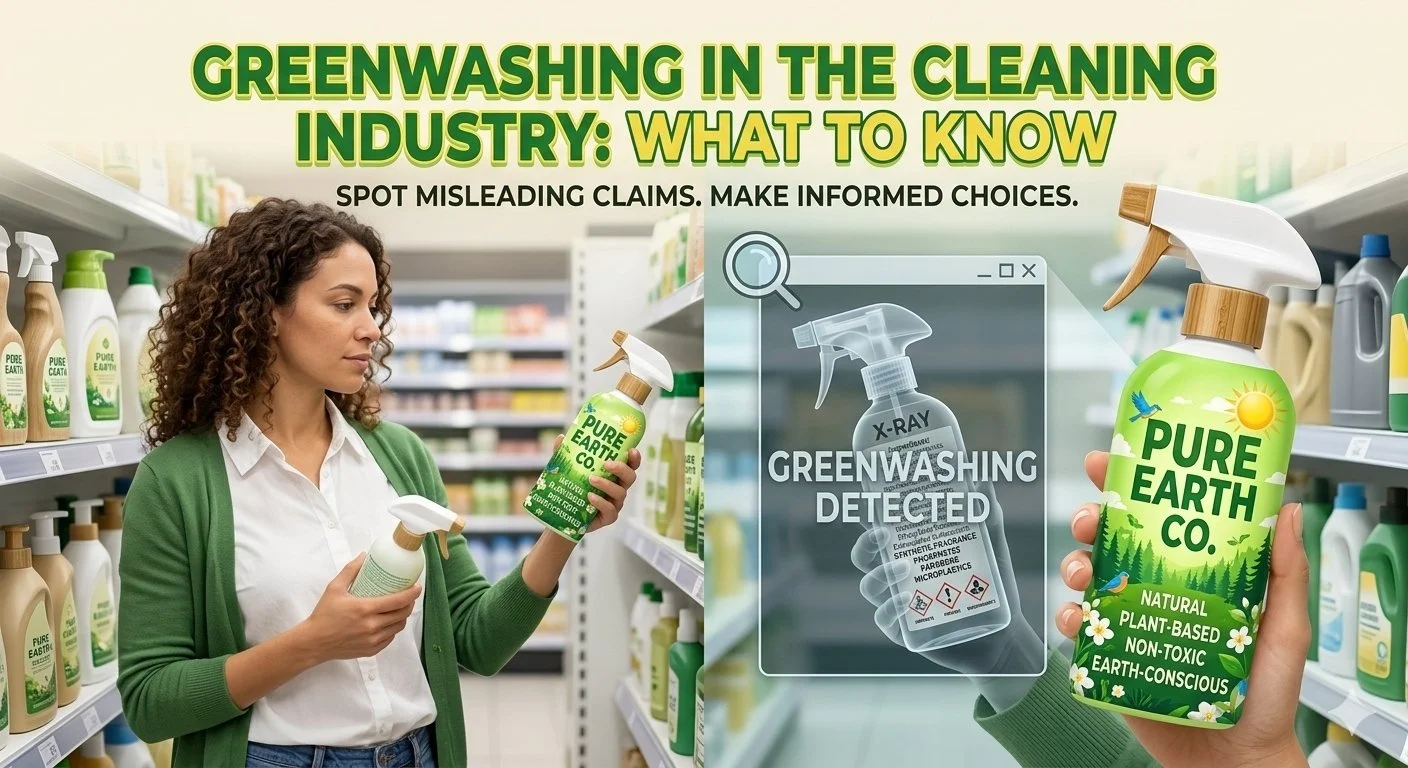
Greenwashing in the cleaning industry: what to know about this unethical practice
"Green" is everywhere — on labels, in taglines, and throughout marketing materials. But how much of it is real? Learn how to identify greenwashing in the cleaning industry, what warning signs to look for, and how to find a company that genuinely walks the walk.
Walk through any grocery store, scroll through any cleaning company’s website, or read a product label, and you’ll find the same language everywhere: "green," "natural," "eco-friendly," "non-toxic," "plant-based," "earth-conscious." The words are reassuring. They suggest that the company behind the product cares about the same things you do; your family’s health and the health of the planet.
Sadly though, Canada still lags behind other nations when it comes to regulating product labels. Many of these terms are entirely unregulated. At the time of this writing, any company can still use the word "natural" on a label without a single gram of a natural ingredient inside. The gap between what companies and products claim and what they actually do has a name: greenwashing.
This guide is designed to help you understand what greenwashing is, why the cleaning industry is particularly prone to it, how to spot it, and most importantly, how to find cleaning companies and products that genuinely do what they advertise.
What is greenwashing?
Greenwashing is the practice of using misleading, vague, or outright false environmental claims to create the impression that a product, service, or company is more sustainable or eco-friendly than it actually is. The term was coined in the 1980s by environmentalist Jay Westervelt, who noticed that hotels were promoting towel reuse programs as a conservation initiative, while simultaneously expanding their properties in environmentally destructive ways.
Today, greenwashing is far more sophisticated. It ranges from subtle misdirection (using the colour green and nature imagery with no substantive environmental claims) to outright deception (claiming a product is biodegradable when it isn’t). It can be intentional or the result of genuine ignorance about what “eco-friendly” actually requires.
What makes greenwashing particularly frustrating is that it actively harms the companies and individuals who are doing the right thing. When every cleaning product claims to be green, genuinely sustainable options become harder to identify, and consumers who want to make better choices have no reliable way to do so.
Why the cleaning industry is especially prone to greenwashing
Cleaning products are used in intimate spaces — kitchens, bathrooms, children’s bedrooms — which means health and safety claims resonate strongly with buyers. At the same time, the ingredients in cleaning products are complex, poorly understood by many consumers, and rarely scrutinized. This creates a perfect environment for vague claims to go unchallenged.
Add to this the fact that Canada has no single regulated definition for terms like “green,” “natural,” or “eco-friendly” in cleaning products, and the incentive to use this language without substantiating it becomes very strong.
The most common greenwashing tactics in the cleaning industry rarely looks like outright lying. It’s usually more subtle — a carefully chosen word here, an omission there. Here are the most common tactics to watch for:
Vague and unregulated language
Words like “natural,” “green,” “eco-friendly,” “earth-conscious,” and “plant-derived” have no legal definition in Canada when used on cleaning product labels.
This doesn’t mean every product using this language is greenwashing, but it does mean the words alone are not evidence of anything. They should prompt you to look deeper, not reassure you that the work is done.
Irrelevant claims
Some products trumpet the absence of something that was never present in the first place. "CFC-free" is a classic example — chlorofluorocarbons have been banned in Canadian consumer products since 1996, so advertising their absence is technically accurate but entirely meaningless.
Hidden trade-offs
A product might genuinely be better in one environmental dimension while being worse in others. A cleaning product might use biodegradable surfactants, and also contain synthetic fragrances that are harmful to aquatic life. A company might use recycled packaging, and also ship their products across the planet.
Hidden trade-offs are a form of greenwashing because they highlight a single positive attribute while obscuring the overall environmental picture. Genuine sustainability requires looking at the whole, not just the most flattering part.
Fake or misleading certifications
Certification logos and seals of approval carry a lot of weight with consumers, which is exactly why some companies create their own. A self-awarded badge that says "Eco-Approved" or "Green-Certified" may have no standards behind it whatsoever.
Even legitimate-looking certifications can be misleading. Some are awarded based on self-reported data with no third-party verification. Others have standards so low that almost any product would qualify. It’s worth taking a moment to look up any certification you see, who issues it, what the standards are, and whether verification is independent.
Greenwashing through imagery and design
Not all greenwashing is in the words. Green packaging, leaf imagery, earthy colour palettes, and nature photography are all design choices that signal environmental responsibility without making a single verifiable claim. This is sometimes called “visual greenwashing,” and it’s particularly effective because it operates below the level of conscious scrutiny.
Be aware that a bottle covered in leaves and printed in green ink may contain the same ingredients as a bottle printed in clinical white. Design is not evidence.
"Natural" fragrances
This one deserves its own mention because it’s so widespread. Many cleaning products advertise "natural" or "botanical" fragrances as a selling point, implying that they’re safer and more eco-friendly than synthetic alternatives.
The reality is more complicated. The word "fragrance" on an ingredient list, whether natural or synthetic, is a catch-all term that can conceal dozens of individual chemicals, none of which are required to be disclosed in cleaning products. Some naturally derived fragrances are perfectly harmless. Others are known allergens or irritants. And some products labelled "fragrance-free" still contain masking agents designed to neutralize odours without a detectable scent.
The most transparent products will either contain no fragrance at all, or will disclose the specific source and composition of any scent used.
Selective disclosure
A company might publish a list of ingredients that sounds impressive — highlighting the plant-based ones while omitting mention of synthetic additives, preservatives, or processing aids that are also present. Or they might disclose ingredients at a product level but not disclose the environmental and labour practices upstream in their supply chain.
Genuine transparency means sharing the full picture, including potential negatives.
Red flags to watch for
When you’re evaluating a cleaning product or company, here are the warning signs that should prompt closer scrutiny:
Unsubstantiated superlatives: Claims like "the most eco-friendly cleaner on the market" with no data or certification to back them up.
Buzzword overload: Descriptions that lean heavily on words like "green," "natural," "pure," and "clean" without any specifics.
No ingredient disclosure: A company that won’t tell you what’s in their products has no transparency to offer. Full ingredient lists should be readily available.
Self-issued certifications: Any seal or badge that was created and awarded by either the same company selling the product, or any entity that benefits from the sale of their certified products.
Vague "biodegradable" claims: True biodegradability is measurable and verifiable. "Biodegradable" without a timeframe or standard (such as OECD 301) is often meaningless.
No safety data: Reputable products have Safety Data Sheets (SDS) that are publicly available. If a company won’t provide one, that’s a significant red flag.
Greenwashing by association: A company that donates 1% of profits to an environmental charity while using harmful products in their core business is not an eco-friendly company — it’s a company with a charitable giving program.
Inconsistency between marketing and practice: A cleaning company that talks about the environment on their website but ships products from overseas in single-use plastic packaging, uses synthetic microfibre cloths, and drives long distances every day is not living up to its own claims.
Questions to ask a cleaning company
If you’re hiring a cleaning service and want to know whether their environmental claims are genuine, here are the questions most likely to separate the real from the performative. A transparent company should be able to answer all of these without hesitation.
About their products
Can they provide a full ingredient list or Safety Data Sheet for the products they use?
Are their products certified by a third-party organization? If so, which one, and what does that certification require?
Are their products biodegradable, and if so, to what standard?
Do their products contain synthetic fragrances, dyes, or preservatives?
Where are their products manufactured?
About their practices
What type of cloths and scrubbers do they use? Are they synthetic or natural fibre?
How do they dispose of wastewater from the cleaning process?
Do they reuse or refill product bottles, or use single-use packaging?
How do they travel to client homes? Do they account for the carbon footprint?
About their transparency
Can they provide a sample checklist or service summary from a previous job?
How do they handle it if a product they use turns out to have an ingredient that concerns a client?
What would they do if a product they currently use was found to have a harmful ingredient?
What a transparent answer looks like
A genuinely eco-conscious cleaner won’t be defensive about these questions, they’ll welcome them. They’ll be able to name their products, explain why they chose them, point you to the manufacturer’s website, and describe the specific properties that make them a better choice. Vague reassurances like “we only use the best green products” are not answers, they’re deflections.
What genuine sustainability actually looks like
Now that you know what greenwashing looks like, it’s equally important to understand what actually constitutes a viable sustainable option.
Full ingredient transparency
A truly transparent company will publish complete ingredient lists for every product they use, along with explanations of what each ingredient does and why it was chosen. They’ll be able to point you to third-party Safety Data Sheets and explain the biodegradability profile of each product.
Third-party certifications with real standards
Look for certifications issued by credible, independent bodies with publicly available and verifiable standards. In Canada, UL Solutions is one of the oldest and most rigorous environmental certification programs for cleaning products. Products bearing these marks have been evaluated against defined criteria by independent verifiers.
That said, the absence of a certification doesn’t necessarily mean a product isn’t genuinely sustainable — some excellent smaller manufacturers haven’t pursued certification for cost or administrative reasons. In those cases, ingredient transparency and a willingness to answer questions become even more important.
Natural fibre cleaning tools
One of the most overlooked aspects of sustainable cleaning is the tools used, not just the products. Synthetic microfibre cloths shed microplastics into wastewater with every wash. These microplastics pass through most municipal wastewater treatment systems and accumulate in waterways and aquatic life.
Genuinely eco-conscious cleaners use cloths, brushes, and scrubbers made from natural, compostable fibres such as cotton, coconut husk (coir), sisal, bamboo, and wood cellulose. These materials clean effectively, biodegrade naturally, and don’t contribute to microplastic pollution.
Locally sourced products
A cleaning company that sources products manufactured in Canada has a significantly smaller carbon footprint than one importing products from other countries. Local sourcing also supports domestic businesses and keeps money circulating in the community.
Intentional service geography
This one rarely comes up in conversations about sustainable cleaning, but it matters. A cleaner who operates within a small, walkable or transit-accessible geography produces far fewer emissions than one who drives long distances between clients every day. Proximity to clients is a genuine environmental advantage — and one that also tends to improve punctuality and reliability.
Consistent behaviour, not just marketing
The most reliable signal of genuine sustainability is consistency between what a company says and what they do. Do they use refillable product bottles or single-use packaging? Do they disclose the full environmental profile of their business, including the parts that aren’t flattering? Are they willing to be held accountable for their practices by clients who ask questions?
Genuine sustainability is a practice, not a marketing strategy. Companies that are truly committed to it are usually more interested in talking about what they do than in talking about how green they are.
The bigger picture: why this matters beyond your home
Greenwashing is not just an inconvenience for consumers trying to make good choices. It has real environmental consequences.
When cleaning products that claim to be biodegradable are washed down the drain and don’t actually biodegrade, those chemicals accumulate in waterways. When synthetic microfibre cloths shed microplastics into laundry wastewater, those particles pass through treatment systems and enter the food chain. When a company markets itself as sustainable and isn’t, it crowds out the companies that are — and makes it harder for consumers to reward genuine environmental leadership with their purchasing choices.
Consumer demand is one of the most powerful forces available to drive genuine sustainability improvements in industry. But that demand only creates the right incentives when consumers can tell the difference between companies that are genuinely sustainable and those that are merely performing it. Knowing how to spot greenwashing is, in a very practical sense, a form of environmental action.
The bottom line
"Green" is one of the most valuable words in consumer marketing, which is exactly why it’s so widely misused. As a homeowner or tenant hiring a cleaning service, you have every right to ask hard questions and expect straight answers.
The companies worth hiring are the ones that welcome those questions. They can tell you exactly what’s in every product they use, explain why they chose it, point you to third-party data, and describe their full practice — not just the flattering parts. They use natural fibre tools. They source locally. Their environmental commitment shows up in how they run their business, not just in their marketing copy.
If a company can’t answer basic questions about their products, that’s your answer.
About the author
Trevor Delaney is the founder of EcoEthical Cleaning, an independent residential cleaning service serving Toronto’s Harbourfront and surrounding downtown neighbourhoods. EcoEthical Cleaning prioritizes plant-based, biodegradable, Canadian-made products and natural fibre cleaning tools. Full product details, including ingredient breakdowns and manufacturer links, are available at https://www.ecoethicalcleaning.ca/products.
For a free, no-obligation estimate: https://www.ecoethicalcleaning.ca/estimate
📞 (416) 605-7549
📧 trevor.delaney@ecoethicalcleaning.ca
Sources & further reading
Competition Bureau Canada, “Environmental claims and greenwashing” (2025)
Terra Choice Environmental Marketing, “The Sins of Greenwashing” (2010)
U.S. EPA, Safer Choice Program
Complete guide to oven cleaning: The chemistry, the methods, and how to protect your investment
Oven cleaning requires understanding chemistry, appliance construction, and warranty protection. Learn the science behind how alkaline cleaners work through saponification, why self-cleaning ovens need different care than standard models, what components you can safely remove, and which cleaning methods protect your investment. This comprehensive guide covers everything Toronto homeowners need to know about maintaining their ovens without voiding warranties or causing damage.
Oven cleaning sits at the intersection of chemistry, appliance care, and household safety. Whether you own a self-cleaning model or a standard oven, understanding how different cleaning methods work — and more importantly, what can damage your appliance — makes the difference between maintaining your investment and voiding your warranty.
This comprehensive guide explains the science behind oven cleaning products, clarifies the critical differences between self-cleaning and non-self-cleaning ovens, and provides detailed guidance on what you can safely clean and what components should never be removed or exposed to certain chemicals.
Understanding oven construction and warranty considerations
Before discussing cleaning methods, it’s important to understand what you're working with, and what's at stake if you damage it.
What's covered by oven warranties
Most oven warranties cover functional components like heating elements, igniters, thermostats, burners, control boards, and oven sensors. However, warranties typically exclude cosmetic items including racks, hinges, shelves, door glass, and interior thermal shells.
More importantly, warranties can become void when:
Commercial oven cleaners are used on self-cleaning oven interiors
Unauthorized repair providers service the appliance
Components are improperly removed or modified
Cleaning products damage heating elements or sensors
The oven hasn't been properly maintained per manufacturer guidelines
Self-cleaning vs. non-self-cleaning ovens: fundamental differences
The construction of your oven determines what cleaning methods are safe to use.
Self-cleaning ovens have:
Special heat-resistant porcelain enamel coating on interior walls
Reinforced door locks that engage during cleaning cycles
Additional insulation to contain extreme heat
Temperature sensors that monitor the cleaning cycle
Non-self-cleaning ovens have:
Standard porcelain enamel or painted interior finish
Basic door seals without high-temperature locks
Standard insulation
Cannot withstand the extreme temperatures of a self-clean cycle
This fundamental construction difference means that self-cleaning ovens require different care than standard ovens, particularly regarding what chemicals you can use.
Newer vs. older ovens: removable components
Oven design has evolved significantly, affecting what you can safely remove for cleaning.
Older ovens (pre-2010):
Heating elements typically bolt to the oven back
Can usually be carefully unbolted and moved forward for cleaning behind them
Oven racks were heavy-duty steel, designed for high heat
Door often removable via simple hinge clips
Simpler electronic controls, easier to avoid during cleaning
Newer ovens (2010-present):
Many have hidden heating elements beneath the oven floor
"Continuous clean" or catalytic liners that shouldn't be scrubbed
Specialized racks with coatings that can't handle self-clean cycle heat
More complex door removal systems
Sensitive electronic control panels and displays
What should NOT be removed without professional help:
Heating elements - bake (lower) or broil (upper) elements
Temperature sensors
Door gaskets or seals
Control panel components
Interior light covers (unless the manual specifically states they are removable)
Catalytic liner panels
Removing components you shouldn't can void warranties and create safety hazards. When in doubt, consult your oven's manual or contact the manufacturer.
The chemistry of oven cleaning: how products actually work
Understanding the science behind oven cleaning helps you choose appropriate methods and avoid damaging your appliance.
The problem: baked-on grease and carbonized food
When you cook, especially at high temperatures, fats and oils polymerize — they transform from liquid oils into hard, solid substances bonded to oven surfaces. This process intensifies each time you use the oven, creating layers of increasingly difficult buildup.
Additionally, sugars caramelize and proteins denature, creating carbonized deposits that resist simple soap and water.
How alkaline cleaners work: saponification
Most commercial oven cleaners contain sodium hydroxide (NaOH), also known as caustic soda or lye. The primary cleaning action is saponification — converting fats and oils into soap.
When sodium hydroxide contacts grease, it causes a chemical reaction that transforms the baked-on fats into water-soluble soap-like substances. The reaction works because sodium hydroxide is highly alkaline (pH 14), and this extreme alkalinity breaks apart the molecular bonds in fats.
The process involves:
Hydroxide ions (OH⁻) break down the ester bonds in fats
This produces fatty acid salts and glycerol
The resulting soap is water-soluble and easily wiped away
The same reaction works on proteins and carbonized material, though less effectively than on fats.
Why this matters: Understanding saponification explains why alkaline cleaners work so effectively, but also why they're dangerous. The same chemical property that dissolves baked-on grease can also damage human skin and certain oven components.
Why oven cleaners require specific pH levels
Commercial oven cleaners maintain pH levels between 11 and 14:
pH 11-12: Effective for light to moderate buildup
pH 13-14: Required for severe, carbonized buildup
The higher the pH, the more aggressive the cleaner — but also the more dangerous to humans and potentially damaging to certain oven finishes.
The role of solvents in oven cleaners
Beyond alkaline ingredients, commercial oven cleaners contain organic solvents like:
Ethylene glycol: Helps dissolve polar molecules
Methylene chloride: Dilutes greasy grime
Monoethanolamine: Acts as a surfactant, helping the solution spread evenly
These solvents attack different components of oven soil than alkaline cleaners do, providing comprehensive cleaning action.
How high-heat pyrolytic cleaning works
Self-cleaning ovens use pyrolysis (thermal decomposition) to clean. When oven temperatures reach 800-900°F (425-480°C), organic materials (food, grease, carbon deposits) burn off and reduce to ash.
The chemistry:
Organic compounds break down at high temperature
Carbon bonds rupture, releasing carbon dioxide and water vapour
What remains is fine white or grey ash (primarily calcium carbonate and metal oxides)
This ash is easily wiped away with a damp cloth
Why this method works: Pyrolysis achieves what chemical cleaners cannot — complete breakdown of carbonized material. However, it requires specialized oven construction to safely contain these extreme temperatures.
How steam cleaning works
Steam-clean cycles use water and moderate heat (around 250-400°F / 120-200°C) to soften baked-on food.
The process:
Water placed in the oven bottom vaporizes
Steam condenses on cooler oven surfaces
Moisture penetrates and softens dried food particles
Softened debris can be wiped away
Limitation: Steam cleaning is effective only for light, recent soiling — not for carbonized, long-term buildup.
Self-cleaning ovens: proper use and protection
Self-cleaning ovens require specific care to maintain their specialized coating and ensure safe operation.
How the self-clean cycle works
The self-clean cycle heats the oven to approximately 800°F to 900°F (425-480°C) for 1.5 to 3 hours, depending on the soil level. At these temperatures, food residue incinerates into ash. The oven door automatically locks when internal temperature reaches 600°F (315°C) to prevent oxygen from entering the cavity and causing fire. The door remains locked until the oven cools to a safe temperature.
What NEVER to use in self-cleaning ovens
Commercial oven cleaners (containing sodium hydroxide): Never use commercial oven cleaners inside a self-cleaning oven's interior. Residue from oven cleaners will damage the inside of the oven during a self-cleaning operation. The extreme heat of the self-clean cycle causes oven cleaner residue to emit dangerous fumes and permanently damage the special porcelain enamel coating.
Even cleaners marketed as "safe for self-cleaning ovens" should be used with caution and rinsed completely before running a self-clean cycle.
Why this damages the oven: The porcelain enamel in self-cleaning ovens is formulated specifically for high-heat cleaning. Chemical residues alter this coating's properties, causing:
Discolouration and staining
Coating breakdown and flaking
Reduced effectiveness of future self-clean cycles
Release of toxic fumes during cleaning
Abrasive scrubbers: Metal scrapers, steel wool, and wire brushes damage the interior walls and make the self-cleaning process less effective. The porcelain enamel coating, once scratched, loses its smooth, non-stick properties and allows food to adhere more easily.
Remove the oven racks
Removing oven racks before self-clean cycles is crucial but often overlooked.
The intense heat of self-cleaning cycles can warp, discolour, and permanently damage oven racks. More critically, racks can expand and contract during the cycle, potentially damaging or completely ruining the porcelain oven cavities that the racks slide into — the grooves on the oven's side walls.
Exception: Some newer ovens have racks specifically designed to remain in place during self-clean cycles. Check your manual — if the racks aren't explicitly labelled "self-clean safe," remove them.
How to clean racks separately:
Remove racks before starting self-clean cycle
Soak them in hot water with dish soap, or place them in an air-tight bag and spray with a food-safe degreaser, and let sit for 4-6 hours
Scrub with non-abrasive brush or sponge
For stubborn buildup: create paste of baking soda and water, apply, let sit overnight, then scrub
Proper preparation for self-clean cycles
Before starting a self-clean cycle:
Remove everything:
All oven racks (unless the oven manual specifies they're self-clean safe)
Oven thermometer
Any cookware, foil, or liners
Food debris large enough to catch fire
Wipe up heavy spills: The self-clean cycle works best on baked-on residue, not large spills or chunks of food. Clean up everything you can manually, and let the self-clean cycle handle the rest.
Ensure ventilation:
Turn on range hood and set to highest setting
Open windows in kitchen and adjacent rooms
Consider using an air purifier during the cycle
Keep children and pets away from the kitchen
Never leave completely unattended: Check periodically for excessive smoke or unusual smells that might indicate a problem.
After the self-clean cycle
Once the cycle completes and the oven has cooled (the door will unlock automatically):
Wipe away white or grey ash with a damp cloth
Clean the door and areas around the gasket with mild detergent
The gasket itself should only be wiped gently, never scrubbed
Inspect for any damage to interior surfaces
How often to use self-clean cycles
Self-cleaning cycles should be used 2-3 times per year maximum. Overuse of the self-cleaning function may wear out heating elements or damage thermal fuses — the safety devices that prevent overheating.
Between self-clean cycles, spot-clean with baking soda paste or mild detergent to reduce buildup.
Steam-clean cycles: A gentler alternative
Many newer ovens offer steam-clean cycles as a less intensive option.
When to use steam clean:
Light, recent spills
Routine maintenance between deep cleans
When self-clean cycle isn't warranted
The process:
Add 1 cup of water to the oven bottom (or follow manual's specific instructions)
Start steam-clean cycle (usually 20-60 minutes)
After cycle completes, wipe interior with damp cloth
For stubborn spots, rub detergent into residue before starting cycle
Benefits:
Faster than self-clean (under 1 hour vs. 3+ hours)
Uses less energy
Lower temperatures mean less smoke and fumes
Safer for more frequent use
Limitations:
Only effective for light soiling
Won't handle carbonized, baked-on buildup
May require multiple cycles for moderate messes
Non-self-cleaning ovens: safe manual cleaning methods
Non-self-cleaning ovens require different approaches — and fortunately, you have more flexibility in product choices.
The safest, most eco-friendly method: baking soda paste
Baking soda (sodium bicarbonate) is mildly alkaline and works through a gentler version of the same chemical process as commercial cleaners — it breaks down fats and food residues without harsh corrosiveness.
The formula:
Mix ½ cup baking soda with 3 tablespoons water
Adjust ratio to create spreadable paste (consistency of toothpaste)
Application process:
Remove oven racks and set aside
Spread paste over entire interior, avoiding heating elements
Pay special attention to particularly greasy areas
Let sit overnight (12+ hours) to allow chemical reaction to complete
Use damp cloth to wipe away dried paste
Repeat if necessary for stubborn spots
Why this works: Baking soda's alkalinity (pH around 9) is sufficient to begin saponification of fats without the dangerous corrosiveness of sodium hydroxide cleaners. The longer dwell time compensates for its lower chemical strength.
When commercial cleaners are appropriate
For non-self-cleaning ovens with severe buildup, commercial cleaners may be necessary. However, choose carefully and use safely.
If using commercial oven cleaner:
Read and follow manufacturer’s instructions
Choose products with lower caustic soda content when possible (to minimize risks to personal safety, the oven, and the environment)
Always wear rubber gloves and safety goggles
Ensure excellent ventilation (open windows, use fans)
Keep children and pets away from the area
Follow product dwell time precisely — don't leave on longer than directed
Rinse thoroughly with clean water
Consider wearing a carbon filter mask if sensitive to fumes
Application for commercial cleaners:
Protect surrounding areas with newspaper or drop cloth
Remove everything from oven
Apply cleaner evenly, avoiding heating elements and sensors
Close oven door and let sit for time specified on label
Wipe away cleaner with damp sponges or cloths
Rinse multiple times with clean water
Turn oven on low (around 200°F / 95°C) for 10-15 minutes to burn off any remaining residue
Air out kitchen thoroughly
What to avoid on standard ovens
Even though non-self-cleaning ovens are more tolerant of various cleaners, some things still cause damage:
Never use:
Steel wool or metal scrapers (scratch the finish)
Harsh abrasive powders (damage enamel coating)
Bleach (doesn't break down grease effectively and is too harsh)
Ammonia (fumes are dangerous, less effective than alkaline cleaners)
Cleaning oven doors and glass
Oven door glass requires special attention because grease and condensation accumulate on both interior and exterior surfaces.
For exterior glass:
Glass cleaner or vinegar-water solution (1:1 ratio)
Wipe with clean, soft cloth
Buff dry for streak-free finish
For interior glass:
Create baking soda paste
Apply to glass, avoiding rubber gasket
Let sit 15-30 minutes
Scrub gently with non-abrasive sponge
Wipe clean with damp cloth
For between-the-glass cleaning: consult manual for disassembly instructions
Never scrub the door gasket (the rubber seal around the door). Clean it only by wiping gently with a damp cloth. Aggressive cleaning damages the seal, affecting oven efficiency and safety.
What you can and cannot remove for cleaning
Knowing what's safe to remove prevents warranty voidance and safety hazards.
Safe to remove (with care):
Oven racks: All models allow rack removal. To remove:
Wait for oven to cool completely
Pull rack forward until it stops
Lift front of rack slightly while pulling
Guide rack out of oven
Oven door (many models): Many oven doors can be removed for easier cleaning, but the process varies significantly by brand and model.
Common removal process:
Open door to first stop position (about 45 degrees)
Locate hinge locks or clips on both sides
Move locks to unlocked position
Close door slightly
Lift door up and out
Critical: Always consult your specific oven's manual before attempting door removal. Improper removal can damage hinges or cause the door to fall.
Never remove or disturb:
Heating elements: Both bake elements (bottom) and broil elements (top) are wired directly to the oven's electrical system. Clean around elements, not by removing them.
Temperature sensor: Usually a thin metal probe extending into the oven cavity. This controls oven temperature accuracy. Bending, removing, or cleaning it aggressively can make your oven temperature unreliable.
Door gasket: The rubber or silicone seal around the door should never be removed. Clean only by gentle wiping.
Catalytic liners: Some ovens have special self-cleaning panels on the side walls. These should never be removed or scrubbed—they're designed to clean themselves during oven operation.
Light cover: While some models allow light cover removal, many don't. Check your manual. Forcing removal can crack the cover or damage the mounting system.
Cleaning heating elements safely
You cannot remove heating elements for cleaning, but you can clean around them:
Wait for oven to cool completely
Wipe elements gently with damp cloth
Don't scrub or use chemicals directly on elements
Clean the area beneath and around elements carefully
If food has baked onto elements, run oven at 350°F (175°C) for 30 minutes—this will burn off most residue
Why elements burn clean: Heating elements reach temperatures high enough to carbonize food debris during normal operation. Most buildup burns off on its own.
Maintenance practices that protect your oven
Proper maintenance extends oven lifespan and maintains warranty coverage.
After each use:
Wipe up spills immediately: Fresh spills clean easily. Once they’ve been baked on, they become increasingly difficult to remove with each use of the oven.
Use the oven light to monitor cooking: Opening the door during cooking causes temperature fluctuation and potential spillovers. Use the oven light and window instead.
Place baking sheets under potentially messy dishes: Casseroles, pies, and dishes with liquid ingredients should sit on baking sheets to catch any overflow.
Weekly:
Wipe down interior with damp cloth and mild detergent
Clean door glass inside and out
Wipe control panel with damp cloth (never spray cleaner directly on controls)
Check that vents aren't blocked by grease or debris
Monthly:
Deep-clean oven racks
Check door seal for damage or gaps
Clean beneath and around oven (pull-out drawer or storage area)
Test that oven reaches correct temperature with oven thermometer
Quarterly:
Run self-clean cycle (if applicable)
Or perform thorough manual cleaning with baking soda
Inspect heating elements for damage
Check that oven light works
What voids warranties:
Understanding warranty restrictions helps you avoid costly mistakes:
Actions that void most oven warranties:
Using commercial oven cleaners in self-cleaning oven interiors
Lining oven bottom with aluminum foil (interferes with heat distribution and can damage heating elements)
Making unauthorized modifications or repairs
Failing to follow manufacturer's maintenance guidelines
Using the oven for purposes other than cooking (like storage or space heating)
Physical damage from impacts or dropping items
Always register your oven warranty and keep proof of purchase. If you need repairs, use only authorized service providers to maintain warranty validity.
Special considerations
Hard water and mineral buildup
Water hardness affects steam-clean cycles. Minerals in the water can leave deposits on oven surfaces after steam cleaning.
Prevention:
Use distilled water instead of tap water for steam-clean cycles
Wipe down oven thoroughly after steam-clean cycles
If mineral deposits appear (white, chalky residue), remove with vinegar-water solution
Winter considerations
Cold winters mean:
More oven use for holiday cooking
Kitchen ventilation challenges (can't always open windows)
Temperature fluctuations affecting oven performance
Winter oven care:
Plan self-clean cycles for mild days when you can ventilate properly
Consider breaking large self-clean jobs into smaller, more manageable sessions
Use range hood faithfully to capture moisture and prevent condensation
Small kitchen ventilation
Many condos and older homes have limited kitchen ventilation. This complicates oven cleaning, particularly self-clean cycles.
Solutions:
Run bathroom fan in addition to range hood during self-clean cycles
Use air purifiers with activated carbon filters
Schedule self-clean cycles when you can be away for a few hours but return to ventilate
Consider steam-clean cycles more frequently as alternative to less-frequent self-clean cycles
When to call professionals
Some oven cleaning situations require expert help.
Situations requiring professional oven cleaning:
Extreme buildup from years of neglect
Post-renovation cleaning (construction dust and debris)
Self-clean cycle has failed to clean adequately
Strong, persistent odours that won't clear
You have physical limitations preventing safe manual cleaning
You don't have time for the potentially hours long process manual cleaning requires
Situations requiring appliance repair:
Self-clean cycle won't start or complete
Door won't unlock after self-clean cycle
Heating elements visibly damaged or not glowing red
Error codes appearing on display
Oven not reaching correct temperature
The following situations require immediate professional attention:
Gas smell
Electrical issues or sparking
Choosing a professional oven cleaning service
Look for services that:
Use eco-friendly, non-toxic cleaning methods
Are fully insured
Understand the difference between self-cleaning and standard ovens
Remove oven racks and clean them separately
Protect your floors and surrounding areas
Offer satisfaction guarantees
Creating a sustainable oven cleaning routine
Effective oven maintenance doesn't require harsh chemicals or expensive products.
A sustainable approach:
Tier 1: Prevention (after each use)
Wipe up fresh spills immediately with a damp cloth
Use baking sheets to catch overflow
Keep oven interior as clean as possible through mindful cooking
Tier 2: Light maintenance (every 2-4 weeks)
Quick wipe-down with baking soda paste for any visible blemishes
Clean the door glass inside and out
10-minutes of routine maintenance will keep your oven reasonably clean
Tier 3: Deep cleaning (whenever heavier, baked-on deposits appear)
Run the self-clean cycle (for self-cleaning ovens)
Or do an overnight baking soda paste treatment (for standard ovens)
Deep-clean oven racks separately
Thorough door glass cleaning
Tier 4: Professional help (as needed)
For moves, major buildup, or thorough restoration
Particularly valuable before holidays when oven use increases and free time is limited
This tiered approach prevents buildup, reduces the need for harsh chemicals, and extends oven lifespan.
Common oven cleaning mistakes to avoid
Learning from others' mistakes saves you time, money, and potential oven damage.
Using self-clean cycle with racks inside
This is the most common error. The extreme heat warps metal racks and damages the porcelain coating on rack guides. Damage is permanent and reduces rack lifespan significantly.
Not allowing proper cool-down time
After self-clean cycles, ovens remain extremely hot—sometimes for hours. Forcing the door open risks:
Burns from escaping heat
Damage to door lock mechanism
Injury from sudden release of super-heated air
Wait until the oven automatically unlocks.
Mixing cleaning chemicals
Never mix different cleaning products, especially:
Ammonia + bleach = toxic chloramine gas
Vinegar + bleach = toxic chlorine gas
Commercial oven cleaner + anything else = unpredictable, dangerous reactions
Use one product at a time, rinse thoroughly between products if switching.
Spraying cleaners directly on controls
Liquid seeping into electronic controls can cause these components to fail. Always spray cleaner onto a cloth, then wipe the controls.
Forgetting to rinse thoroughly
Chemical residue left in ovens causes:
Fumes during cooking
Strange tastes in food
Potential health concerns
Damage to oven components from repeated heating of chemical residue
Always rinse multiple times with clean water, then run oven briefly to burn off any remaining traces.
Using commercial cleaners in self-cleaning ovens
This causes permanent damage to the special coating and creates dangerous fumes during the next self-clean cycle.
Lining oven bottom with foil
Many people line oven bottoms with foil to catch spills. This:
Blocks air circulation
Causes uneven heating
Can damage heating elements
Voids most warranties
Use baking sheets on the rack below your food instead.
Conclusions:
Effective oven cleaning requires understanding three key things:
The chemistry of how cleaners work
Your specific oven type and its limitations
What methods protect rather than damage your appliance
For self-cleaning ovens:
Never use commercial oven cleaners inside the cavity
Remove racks before self-clean cycles
Use the feature 2-3 times annually at most
Spot-clean between cycles with baking soda paste and a good rinse afterwards
For standard ovens:
Baking soda paste is safest and most eco-friendly
Commercial cleaners work for severe buildup but require careful use
Clean regularly to prevent extreme buildup
Consider professional help for move-in/move-out situations
For all ovens:
Consult your manual before removing any components
Never remove heating elements or temperature sensors
Maintain regular cleaning to prevent warranty-voiding neglect
Use appropriate products for your oven type
The goal isn't a sterile oven — it's an appliance that functions efficiently, cooks food without imparting strange tastes or odours, and lasts its expected 15-20 year lifespan. Chemical-free methods like baking soda achieve this without harsh fumes, environmental impact, or risk to your oven's specialized coatings.
As the founder of EcoEthical Cleaning, I understand that oven cleaning is one of those tasks many Toronto homeowners prefer to delegate. I use eco-friendly methods appropriate for your specific oven type, protect removable components, and never use chemicals that might void warranties or damage specialized coatings.
Whether you tackle oven cleaning yourself or hire professionals, understanding the science and safety considerations ensures you make informed decisions that protect your investment and your household.
Need professional oven cleaning in Toronto that respects your appliance and your health? EcoEthical Cleaning provides thorough, eco-friendly oven cleaning services throughout the Harbourfront District and surrounding neighbourhoods. Contact me for a free, no obligation estimate.
Sanitizing vs. Disinfecting: What's the Difference and When Does Each Actually Matter?
In recent years, household hygiene has taken center stage in our daily routines. Learn the crucial differences between cleaning, sanitizing, and disinfecting—and discover when each approach actually matters for your health. Most of the time, simple cleaning is enough. This science-based guide explains what Canadian public health actually recommends, which methods work for different situations, and how to keep your home appropriately clean without unnecessary chemicals or environmental harm.
In recent years, household hygiene has taken center stage in our daily routines. From high-touch surfaces like doorknobs and light switches to kitchen countertops and shared workspaces, the focus on maintaining a germ-free environment has never been higher. As we move toward more sustainable and long-term wellness habits, the priority is shifting from universal application to targeted hygiene — choosing the right level of clean for the right situation.
Applying the most powerful chemical solution isn't always the most effective strategy. To achieve a healthy balance between safety, environmental impact, and household budget, we must move beyond the "one size fits all" approach to cleaning.
The confusion starts with terminology. "Sanitizing" and "disinfecting" sound similar and are often used interchangeably, but they're actually quite different — with different purposes, different chemical requirements, and different appropriate applications.
Understanding the distinction matters for your health, your home, your budget, and the environment. Using disinfectants when you only need to sanitize means exposing your family to unnecessary chemicals. Not disinfecting when you actually need to could leave dangerous pathogens in place. And doing either when simple cleaning is sufficient wastes time, money, and creates environmental harm.
This guide will explain exactly what sanitizing and disinfecting mean, how they differ from basic cleaning, when each is actually necessary, and how to approach them sustainably. You'll learn what Canadian public health guidelines actually recommend, which methods work for different situations, and how to keep your home appropriately clean without creating other health problems in the process.
Defining the terms: Cleaning, sanitizing, and disinfecting
These three terms represent different levels of germ reduction, each with specific purposes and appropriate applications.
Cleaning
What cleaning does:
Removes visible and tactile soil and grime
Reduces germ count through physical removal
Makes surfaces look and feel clean
Cleaning germ reduction: Removes approximately 80-90% of germs through physical action (wiping, scrubbing)
When cleaning is appropriate: Most everyday situations in healthy households
Sanitizing
What sanitizing does:
Reduces bacteria to acceptable levels
Takes less time and uses less harsh chemicals than disinfecting
Appropriate for most food-contact and high-touch surfaces
Sanitizing germ reduction: Reduces bacteria by 99.9% (3-log reduction) within a short contact (dwell) time, depending on the product
Regulatory standard: In Canada, sanitizers must reduce bacteria by 99.9% to meet Health Canada standards when used as directed
When sanitizing is appropriate: Food preparation surfaces, children's toys, eating surfaces, areas with moderate contamination
Disinfecting
What disinfecting does:
Kills bacteria, viruses, and fungi
Eliminates pathogens that cause disease
Requires stronger chemicals and a longer contact time
Very thorough level of germ elimination
Disinfecting germ reduction: Kills 99.9999% of pathogens (6-log reduction) within 5-10 minutes, depending on the product and targeted organism
Regulatory standard: In Canada, disinfectants must be registered with Health Canada and prove efficacy against specific pathogens when used according to label directions
When disinfecting is appropriate: Situations with high contamination risk, illness in the household, immunocompromised individuals, or specific high-risk surfaces (toilets)
Note: There is a 4th level of germ reduction, sterilizing — which is the complete destruction of all microbial life. Sterilizing is almost always reserved for medical scenarios, making it beyond the scope of this guide.
The key differences: Side-by-side comparison
Understanding how these three approaches differ helps you choose the right one for each situation:
Cleaning
Primary goal: Remove dirt and grime
Germ reduction: 80-90% (removal)
Method: Physical removal
Dwell time: None
Products used: Cleaners, water
Chemical strength: Mild
Appropriate for: Daily maintenance
Environmental impact: Lowest
Cost: Lowest
Sanitizing
Primary goal: Reduce bacteria to safe levels
Germ reduction: 99.9%
Method: Chemical reduction
Dwell time: Typically 30 seconds - 5 minutes
Products used: Sanitizers, mild solutions
Chemical strength: Moderate
Appropriate for: Food areas, high-touch surfaces
Environmental impact: Moderate
Cost: Moderate
Disinfecting
Primary goal: Kill pathogens
Germ reduction: 99.9999%
Method: Chemical killing
Dwell time: Typically 5-10+ minutes
Products used: Disinfectants
Chemical strength: Strong
Appropriate for: High contamination zones (toilets), homes with illness
Environmental impact: Highest
Cost: Highest
Important: You must clean before sanitizing or disinfecting. Dirt, grease, and organic matter interfere with sanitizers and disinfectants, preventing them from working effectively.
When regular cleaning is sufficient
This is actually most of the time in most healthy households. Understanding when simple cleaning is enough prevents unnecessary chemical use.
Daily/Weekly household surfaces in healthy homes
These typically need only regular cleaning:
Floors (vacuum, sweep, damp mop)
Countertops (wiped with soap and water or all-purpose cleaner)
Tables and desks
Dusting surfaces
Appliance exteriors
Windows and mirrors
Most furniture
Why cleaning is enough: These surfaces don't typically harbor dangerous pathogens in healthy households. Regular cleaning removes dirt and reduces germs adequately for health.
When to upgrade to sanitizing: If preparing food, after handling raw meat, or weekly for high-touch surfaces.
When to resort to disinfecting: Only during illness or other high-risk situations.
When sanitizing is the right choice
Sanitizing hits the sweet spot for many household situations: effective germ reduction without the unnecessary chemical exposure of disinfection or risk to the environment.
Food preparation surfaces
When: After preparing food, especially raw meat, poultry, or eggs
Why cleaning is not enough: Raw animal products can carry Salmonella, E. coli, Campylobacter, and other foodborne pathogens. Sanitizing reduces these pathogens to safe levels.
How to do it sustainably:
Option 1: 3% Hydrogen peroxide
Clean surface first with soap and water
Spray hydrogen peroxide, let sit 2-3 minutes
If it is food-grade hydrogen peroxide, allow it to air dry. Non-food-grade hydrogen peroxide (what is found in first aid sections) should be rinsed off any surface that will come into contact with food.
Keep hydrogen peroxide in its original container until ready to use
Option 2: Commercial food-safe sanitizer
Choose products approved for food contact surfaces
Follow label directions for dilution and contact time
Look for eco-certified options when available
Option 3: Very hot water
Water above 77°C (170°F) can sanitize
Suitable for sanitizing via dishwasher
Children's toys and items that go in mouths
When: Regularly for infant/toddler toys, after illness, when visibly soiled
Why cleaning is not enough: Cleaning removes visible dirt but may not adequately reduce pathogens that cause common childhood illnesses (colds, stomach bugs, hand-foot-and-mouth disease).
How to do it sustainably:
Hard plastic toys:
Wash with soap and water first
Sanitize with hydrogen peroxide (as described above)
Or wash in dishwasher on ‘Sanitize’ setting
As with food contact surfaces, food-grade hydrogen peroxide can be left to air dry. Otherwise rinse thoroughly before next use.
Soft toys and fabric items:
Wash in washing machine with hot water
Use hot dryer cycle (the heat provides sanitization)
For items that can't be washed: steam clean or leave in direct sunlight for several hours (ultraviolet rays have sanitizing properties)
Teething toys and pacifiers:
Many can be boiled for 5 minutes (check manufacturer instructions)
Or sanitize with hydrogen peroxide, then rinse thoroughly with clean water
High-touch surfaces in healthy households
When: Weekly or as part of regular cleaning routine
Why cleaning is not enough: High-touch surfaces (door handles, light switches, faucets, etc.) collect bacteria and viruses from hands. Regular cleaning may not adequately reduce germ levels.
How to do it sustainably:
The approach:
Incorporate sanitizing into weekly cleaning routine
Clean first (remove visible dirt)
Then sanitize high-touch surfaces
Sustainable sanitizing methods:
Hydrogen peroxide - safe for most household surfaces
Hot water at a minimum sustained temperature of 66°C (150°F) for a minimum of 20 seconds - most sustainable way to sanitize, but caution required as water at this temperature can cause severe burns
70% Alcohol solution - for surfaces sensitive to heat, moisture, oxidation, or anything mildly acidic
Commercial eco-certified sanitizers
Which surfaces:
Door handles and knobs
Light switches
Faucet handles
Cabinet pulls
Stair railings
Remote controls
Phones and tablets (follow device manufacturer guidance)
Cutting boards after use
When: After every use, especially after raw meat, poultry, or fish
Why cleaning is not enough: Soap and water may not adequately penetrate the knife grooves on a cutting board, where bacteria hide.
How to do it sustainably:
Clean first by scrubbing with soap and hot water
Apply hydrogen peroxide and allow it to sit for 10 minutes, to give it time to penetrate the knife grooves
Rinse non-food-grade hydrogen peroxide
Wipe the surface dry, to prevent the wood from warping and splitting
Plastic, dishwasher-safe cutting boards can be sanitized via dishwasher
Replace cutting boards when they become heavily scored
When disinfecting is actually necessary
Disinfecting uses stronger chemicals and should be reserved for specific high-risk situations where sanitizing isn't sufficient.
Someone in the household is sick
When: During and immediately after illness, particularly with highly contagious conditions
Why disinfecting: Some viruses and bacteria are highly contagious and resistant to sanitizers. Disinfecting kills these pathogens to prevent household spread.
Conditions that warrant disinfection:
Norovirus (stomach flu) - extremely contagious, sanitizers may not kill it
Influenza - spreads easily through respiratory droplets and surface contact
COVID-19 - can survive on surfaces, though surface transmission is less common than airborne
MRSA or any other antibiotic-resistant infections
Which surfaces to disinfect:
Bathroom surfaces (toilets, sinks, faucets, counters)
Door handles and light switches throughout the home
Faucets and cabinet handles
Specific surfaces the sick person touched frequently
Shared items (remote controls, touchscreens, medicine bottles)
How to do it sustainably:
Ensure that the sustainable disinfectant you wish to use has a Drug Identification Number (DIN) and is listed in the Drug Product Database (DPD)
Important: Follow contact time requirements. Spraying and immediately wiping removes the disinfectant before it can work. The surface must stay wet with disinfectant for the time specified by the manufacturer.
After sewage backup or flood contamination
When: After any sewage exposure or flood water containing sewage
Why disinfecting: Sewage contains dangerous pathogens including E. coli, Hepatitis A, rotavirus, and many others. Sanitizing isn't sufficient for this level of contamination.
Approach:
Remove all porous materials that contacted sewage (carpets, drywall, insulation)
Clean hard surfaces thoroughly first
Disinfect with appropriate solution
May require professional remediation
Note: This is a situation where calling professionals is often warranted. Sewage cleanup involves serious health risks.
Immunocompromised household members
When: Someone in the home has a significantly weakened immune system
Why disinfecting: Individuals with compromised immunity are vulnerable to infections from pathogens that don't typically affect healthy people. Additional precautions are necessary.
Who this includes:
Cancer patients undergoing chemotherapy
Organ transplant recipients
People with HIV/AIDS
Those on long-term immunosuppressive medications
Elderly with significantly weakened immune systems
Approach:
Consult with their healthcare provider about specific recommendations
May need to disinfect bathroom surfaces and high-touch areas daily
More frequent than needed in healthy households
Focus on surfaces the vulnerable person contacts
Important: Work with healthcare providers to determine the necessary level of disinfecting. Over-disinfecting creates chemical exposure concerns; under-disinfecting creates infection risk.
Bathroom surfaces after vomiting or diarrhea
When: After incidents of vomiting or diarrhea, even if not from known illness
Why disinfecting: Vomit and diarrhea may contain highly contagious pathogens. Quick disinfection prevents potential spread.
Which surfaces:
Toilet (entire fixture, including exterior and floor around base)
Bathroom sink and counter
All high-touch surfaces (door handles, faucets, light switches, etc.)
Safety note: Wear gloves and wash hands (and reusable gloves) thoroughly after cleaning contamination.
Pet accidents involving diarrhea or vomit
When: After pet diarrhea or vomiting, especially if pet is ill
Why disinfecting: Pets can carry pathogens transmissible to humans (zoonotic diseases), including some that cause serious illness.
Approach:
Safely remove all solid matter
Clean the area thoroughly
Disinfect with pet-safe disinfectant (use as directed)
Note: Routine pet urine accidents on hard floors typically only require cleaning, not disinfection (unless the pet has a urinary tract infection).
The risks of over-disinfecting
Using disinfectants unnecessarily creates several problems:
Chemical exposure:
Disinfectants contain strong chemicals that can cause respiratory irritation, skin irritation, and other health effects
Children are particularly vulnerable to chemical exposures
Chronic exposure to strong disinfectants may have long-term health impacts
Environmental harm:
Disinfectants enter waterways through drains
Many are toxic to aquatic life
Many don't break down quickly in the environment
Antimicrobial resistance:
While less studied than antibiotic resistance, some research suggests the overuse of antimicrobial products may contribute to bacterial resistance
Creates selection pressure for resistant organisms
Immune system concerns:
Some researchers believe excessive disinfection may interfere with normal immune system development in children
"Hygiene hypothesis" suggests some pathogen exposure is beneficial for immune system training
Balance is key: protect against dangerous pathogens without creating a sterile environment
False sense of security:
Disinfecting surfaces doesn't address airborne transmission (the main route for many respiratory illnesses)
Hand hygiene and respiratory etiquette are often more important than surface disinfection
What Canadian public health actually recommends
Health Canada and Public Health Ontario guidelines emphasize:
For healthy households:
Regular cleaning with soap and water is sufficient for most surfaces
Hand hygiene (handwashing) is more important than surface disinfection
Ventilation (open windows, air circulation) matters more than chemical interventions
Reserve disinfection for specific situations (illness, contamination events)
The focus should be:
Regular cleaning to remove dirt and reduce germs
Handwashing frequently and properly
Avoiding touching face
Covering coughs and sneezes
Staying home when ill
Good ventilation
Surface disinfection ranks lower in importance for disease prevention than these behavioral and environmental interventions.
Best practices
Whatever product you choose:
Clean first: Always remove visible dirt before sanitizing or disinfecting. Organic matter interferes with chemical efficacy.
Follow contact time: Product must stay wet on surface for specified time. Spraying and immediately wiping doesn't work.
Use proper dilution: Concentrated products must be diluted according to instructions. More concentrated isn't better and may actually be less effective.
Ensure adequate ventilation: Open windows, use fans, especially when using bleach or strong disinfectants.
Wear gloves: Protects skin from irritation through exposure.
Store safely: Keep all products away from children and pets.
Check expiration dates: Effectiveness decreases with product age. Expired products can not be relied upon to provide adequate disinfection.
Practical scenarios: Choosing the right approach
Let's apply this knowledge to real-world situations:
Scenario 1: Daily kitchen counter maintenance
Situation: Wiping down kitchen counters after preparing daily meals
Right approach: Cleaning
Why: Daily light maintenance of surfaces without contamination doesn't require sanitizing or disinfecting. Cleaning removes crumbs, spills, and reduces germs adequately.
When to sanitize: After preparing raw meat, poultry, or eggs.
Scenario 2: Child's high chair after meals
Situation: Cleaning high chair tray and seat after each meal
Right approach: Cleaning, with periodic sanitizing
Why: Daily cleaning removes food and most germs. Weekly or after messy meals, sanitizing provides extra assurance.
Method:
Wipe with soap and water after each meal
Weekly: Spray with food-grade hydrogen peroxide, let sit 3 minutes, air dry (or rinse with clean water if using non-food-grade hydrogen peroxide)
Or wash removable parts in dishwasher’s sanitation cycle (if safe to do so)
Scenario 3: Bathroom surfaces
Situation: Weekly bathroom cleaning in a healthy household
Right approach:
Cleaning for low-touch items (mirrors, shelves, floors)
Sanitizing for high-touch items (counters, sinks, faucets, door knobs, light switches)
Disinfecting for toilets and surrounding area
Why: Bathrooms need regular cleaning. Toilets and adjacent areas come into direct contact with harmful pathogens from human waste and need disinfecting to remove these often more resilient germs
Method:
Clean all surfaces first
Disinfect toilet bowl and exterior, flush handle, adjacent surfaces
Sanitize remaining high-touch areas
Scenario 4: Child's daycare sends note about stomach flu outbreak
Situation: Several kids at daycare have norovirus; your child is healthy but was exposed
Right approach:
Increased sanitizing of high-touch surfaces
Upgrade to disinfecting if child develops symptoms
Scenario 5: Pets
Situation: Pet has an accident in the home
Right approach:
Cleaning to remove pet waste
Disinfect the area after cleaning
Why: Like human waste, pet waste contains unsafe pathogens requiring disinfection.
Method:
Clean pet waste with enzymatic pet cleaner or soap and water
Disinfect with an appropriate product
Wash hands thoroughly after dealing with pet waste
Teaching children about hygiene without creating anxiety
Balancing cleanliness education with appropriate attitudes helps children develop healthy relationships with hygiene.
What to teach
Emphasize handwashing:
Most important hygiene practice
Before eating, after bathroom, after playing outside, after touching pets
Proper technique:
Wet
Lather
Scrub for 20 seconds
Rinse
Dry
Explain basic cleanliness:
Food shouldn't stay on surfaces where bacteria can grow
Bathroom surfaces need regular cleaning
Living spaces should be kept clean and tidy
Age-appropriate germ concepts:
Germs exist and some can make us sick
Cleaning and handwashing help remove germs
Our bodies are good at fighting most germs
Many germs are good for us and help fight against the bad ones
What to avoid
Don't create germophobia:
Excessive focus on eliminating germs creates anxiety
Constant disinfecting teaches that everything is dangerous
Don't over-promise:
You can't eliminate all germs (nor should you want to)
Hand sanitizer doesn't replace handwashing
Being "too clean" may not be healthier
Model a balanced approach:
Children learn by watching
If you're constantly disinfecting and anxious about germs, they'll adopt that attitude
Show that normal living involves some exposure, and that's okay
The bottom line: Rational, science-based hygiene
The key takeaways for maintaining a healthy home:
1. Understand the hierarchy:
Cleaning → removes dirt and most germs → sufficient for most daily situations
Sanitizing → reduces bacteria to safe levels → appropriate for food surfaces, moderate risk areas
Disinfecting → kills pathogens → necessary for illness, contamination, high-risk situations
2. Reserve stronger interventions for situations that warrant them:
Don't sanitize when cleaning is sufficient
Don't disinfect when sanitizing is sufficient
3. Focus on what matters most:
Handwashing prevents more illness than surface disinfection
Ventilation (opening windows) reduces airborne transmission
Staying home when sick prevents spread better than disinfecting afterward
Covering coughs and sneezes (with elbows, not hands) matters more than sanitizing surfaces
4. Use chemicals purposefully, not routinely:
Every disinfectant has an environmental and health impact
Use them only when the benefits outweigh the costs
In healthy households, that's less often than product marketing suggests
5. Trust the science:
Canadian public health guidelines don't recommend routine disinfection for healthy households
Regular cleaning + handwashing + smart practices = adequate protection
Over-sanitizing/disinfecting doesn't necessarily make you healthier and may lead to other problems
The goal isn't a sterile home. It's a home that's clean enough to be healthy, maintained in a way that's sustainable for your family and the environment.
Looking for cleaning services that understand the difference between clean, sanitized, and disinfected — and apply each appropriately? As an independent cleaner and founder of EcoEthical Cleaning, I bring science-based, sustainable practices to every Toronto home I serve. Contact me for a free, no-obligation estimate. Proudly serving Toronto’s Harbourfront and surrounding neighbourhoods.
Sources & Further Reading
Public Health Ontario, "Best Practices for Environmental Cleaning for Prevention and Control of Infections"
Centers for Disease Control and Prevention (CDC), "When and How to Clean and Disinfect Your Home"
Journal of Hospital Infection, "Factors Affecting the Efficacy of Disinfection and Sterilization"
Bohaychuk VM, Gensler GE, King RK, Manninen KI, Sorensen O, Wu JT, Stiles ME, McMullen LM. “Occurrence of pathogens in raw and ready-to-eat meat and poultry products collected from the retail marketplace in Edmonton, Alberta, Canada”. J Food Prot. 2006 Sep;69(9):2176-82. doi: 10.4315/0362-028x-69.9.2176. PMID: 16995521.
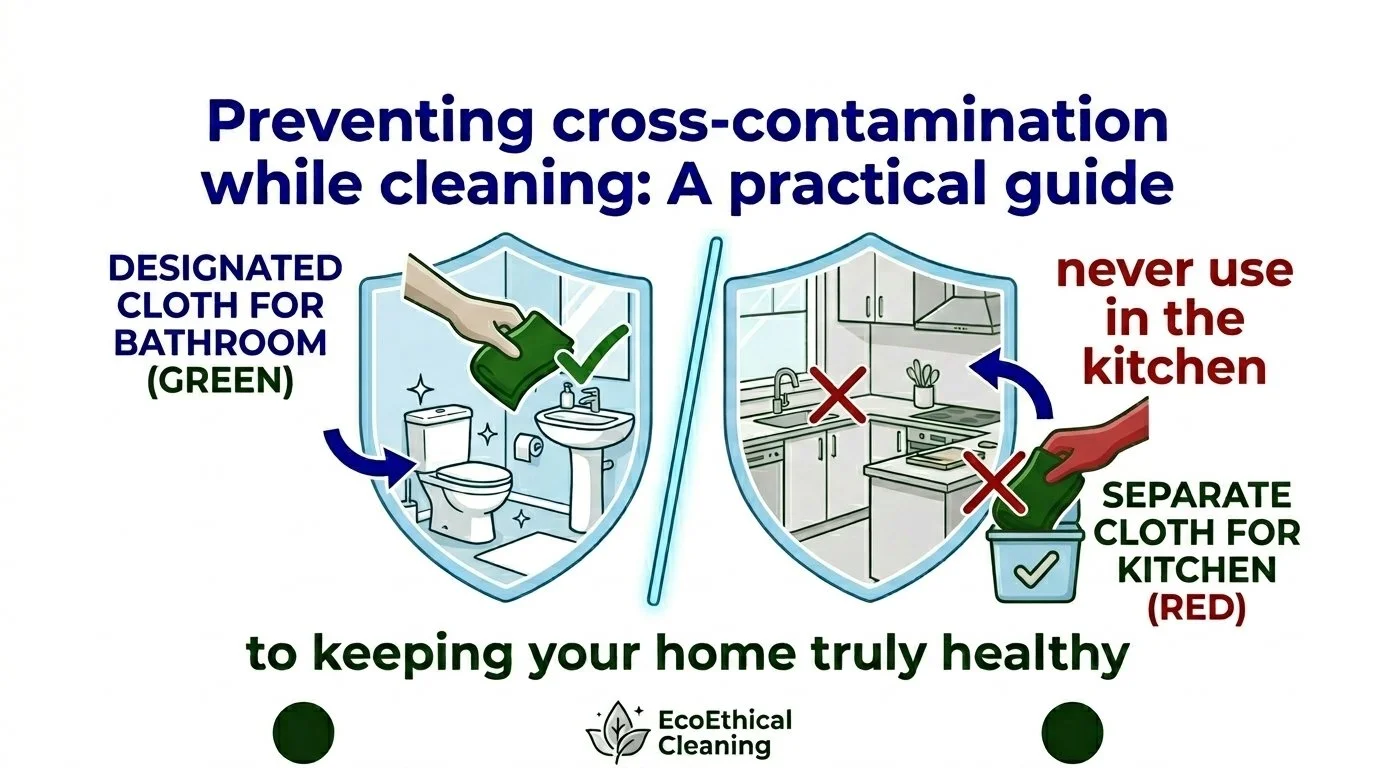
Preventing cross-contamination while cleaning: A practical guide to keeping your home truly healthy
Your cleaner just finished. Everything sparkles. But here's what you didn't see: the same cloth that wiped your toilet just cleaned your kitchen counters. The vacuum that cleaned your bathroom floor is now on your bedroom carpet. The mop water from the bathroom was used throughout your entire home. You've just paid someone to spread fecal bacteria, viruses, and pathogens everywhere. This is cross-contamination—the transfer of harmful microorganisms from one area to another—and it's standard practice for many cleaning services. Learn what it is, why it's dangerous, and what protocols help to prevent it.
Your cleaner just finished your home. The bathroom sparkles. The kitchen gleams. Everything looks spotless.
But here's what you didn't see: the same cloth that wiped your toilet was just used on your kitchen counters. The vacuum that cleaned your bathroom floor also ran across your living room carpet. The mop bucket that started in the bathroom finished in the kitchen — with the same water.
You've just paid someone to spread bacteria, viruses, and fecal matter throughout your entire home.
This is neither an exaggeration or worst-case scenario. It's standard practice for many cleaning services — and many homeowners have no idea it's happening.
Cross-contamination is one of the most overlooked problems in residential cleaning. While your home might look clean, it could actually be less hygienic than before the cleaner arrived.
This comprehensive guide will explain exactly what cross-contamination is, how it happens during cleaning, why it's dangerous, and most importantly — how to prevent it. You'll learn what questions to ask cleaning services, what practices to look for, and how professional protocols should actually work.
Because a truly clean home isn't just about removing visible dirt. It's about not spreading invisible dangers in the process.
What is cross-contamination?
Cross-contamination is the transfer of microorganisms (bacteria, viruses, fungi, parasites) from one surface, object, or area to another where they don't belong.
In the context of home cleaning, this typically means:
Transferring pathogens from bathrooms to kitchens
Spreading toilet bacteria to other surfaces throughout the home
Moving germs from high-contamination areas (toilets) to low-contamination areas (countertops, tables)
Carrying microorganisms between different homes on the same day
Why cross-contamination is dangerous
The health risks are significant:
Gastrointestinal illness: E. coli, Salmonella, Norovirus, and other pathogens from fecal matter cause vomiting, diarrhea, and serious illness—especially dangerous for young children, elderly, pregnant women, and immunocompromised individuals.
Skin infections: Staphylococcus aureus (including antibiotic-resistant MRSA) can cause skin infections, boils, and more serious systemic infections.
Respiratory infections: Viruses like influenza, common cold, and SARS-CoV-2 (Covid-19) can spread through contaminated surfaces touching faces, food preparation areas, or commonly touched objects.
Food poisoning: Kitchen cross-contamination with pathogens from bathrooms or raw food residue creates serious food safety risks.
Secondary infections: Open cuts, wounds, or compromised skin exposed to contaminated surfaces can lead to infections.
The high-risk areas in your home
Not all areas of your home pose equal contamination risk. Understanding this hierarchy is key to developing effective cleaning protocols.
Zone 1: Highest contamination (toilets)
Why it's high-risk:
Direct contact with fecal matter and urine
Aerosolized particles from flushing (toilet plume)
Handles, seats, and bowls harbour dangerous pathogens
Floors around toilets exposed to splatter and aerosolized matter
What should never touch other areas:
Toilet brushes
Cloths used on toilet bowl, seat, or base
Tools used to clean around toilet base
Mops used on bathroom floors
Zone 2: High contamination (bathrooms)
Why it's high-risk:
Body fluids: urine, feces (splatter), vomit, blood
High moisture = bacteria and mould growth
Sink drains contain biofilm with various pathogens
Floors contaminated from toilet aerosol, shower runoff, tracked particles
What should stay in bathrooms:
Bathroom-specific cloths
Bathroom floor mops
Cleaning tools for tubs, sinks, counters
Anything that touches bathroom floors
Zone 3: Moderate contamination (kitchens)
Why it requires caution:
Raw food contamination (meat, poultry, eggs)
Sink drains with food debris and biofilm
Garbage bins and areas
High-touch surfaces (handles, switches)
Why it needs protection:
Food preparation happens here
Cross-contamination directly leads to foodborne illness
Counters, cutting boards, and tables need to be truly hygienic
What should stay in kitchens:
Kitchen-specific cloths
Tools for counters, appliances, floors
Separate equipment from bathrooms
Zone 4: Low contamination (living areas)
Why it's lower risk:
Less exposure to body fluids
Lower moisture (less bacterial growth)
Primarily dust, dirt, and general grime
Why it still needs protection:
Vulnerable to contamination from bathrooms and kitchens if protocols aren't followed
People touch surfaces, then touch faces and food
Children play on floors and put hands/toys in mouths
How cross-contamination happens during cleaning
Most people assume professional cleaners follow protocols that prevent spreading germs. Unfortunately, many don't — often because they're rushing, untrained, or their employer prioritizes speed over safety.
Using the same cloth in different spaces
What happens:
The cleaner wipes a toilet with a cloth
That same cloth also wipes down the bathroom counter
Now the same cloth moves to bedroom, wiping nightstands and door handles
The same cloth finishes in the kitchen, wiping counters and other surfaces
The result: Fecal bacteria from the toilet are now on every surface touched by that cloth, including where you will prepare food.
Why cleaners do this: Using one cloth is faster than switching between designated cloths. Fewer cloths to launder. Less organization required.
The solution: Ensure that all cloths, brushes, and scrubbers are designated for use only in specific contamination zones. Ensure that all cloths, brushes, and scrubbers are cleaned and disinfected between uses.
Contaminated vacuums
What happens:
A vacuum is used on a bathroom floor (which is now exposed to fecal particles, urine splatter, body fluids)
The same vacuum immediately cleans a bedroom carpet
Then cleans the living room
The vacuum is never cleaned between services
Tomorrow, this vacuum goes to another client's home
The result: Bathroom contaminants are aerosolized and spread through every carpeted and hard floor surface. Your bedroom carpet now contains particles from the bathroom floor — and possibly from someone else's bathroom.
Why cleaners do this: Cleaning vacuums is time-consuming. Many services never even consider it necessary.
The solution: Ensure the contact points of the vacuum (cord, wheels, hose, handle, attachments) are disinfected between contamination zones and at the end of every service.
Dirty mop buckets
What happens:
A mop bucket is filled with water and cleaning solution
The mop cleans the bathroom floor first
Mop is returned to bucket (which is now contaminated with bathroom bacteria)
The same mop and water is used to clean the kitchen floor
By the end of the service, the water is visibly dirty and full of dangerous pathogens
The result: Kitchen floor is mopped with bathroom-contaminated water. When you walk from the kitchen to other rooms, you’ll track those pathogens throughout the home.
Why cleaners do this: Changing mop water multiple times takes time. Many cleaners are taught to use one bucket for the entire house.
The solution (between zones):
Empty mop bucket water and disinfect bucket
Remove dirty mop head from service and replace with clean one
Refill mop bucket with clean water
Ensure that mop bucket and all mop heads are cleaned and disinfected before their next use.
Unwashed hands
What happens:
Cleaner cleans toilet
Cleaner doesn't change gloves before moving to the next area
Cleaner touches door handles, countertops, faucets, etc. throughout the home
Everything the cleaner touched is now cross-contaminated with pathogens from the toilet
The result: High-touch surfaces throughout your home are contaminated with whatever was on the cleaner's hands.
Why cleaners do this: Hand-washing between tasks disrupts workflow. Gloves might not be used to "save time" or due to preference.
The solution: Make sure gloves are changed and hands are washed when moving from any area that contains dangerous pathogens (toilets, bathrooms, kitchen). Ensure that all reusable gloves are cleaned and disinfected before their next use.
Questions to ask your cleaning service
Not all cleaning services follow proper cross-contamination protocols. Here are specific questions to ask to evaluate whether they're protecting your home:
Essential questions
1. "Do you use separate cloths for different areas of the home?"
What you're looking for:
Clear "yes" with an explanation of their system
Mention of designated cloths for toilets, bathrooms, kitchens
Colour-coding or other clear organizational systems
Red flags:
Vague answers
"We rinse the cloth between areas"
"We use microfibre that doesn't spread germs" (false — microfibre spreads germs just like anything else)
Other defensive or dismissive responses
2. "How do you prevent bathroom germs from spreading to the kitchen?"
What you're looking for:
Specific protocols (separate tools, cleaning order, storage methods)
Understanding of why this matters
Details about their system
Red flags:
"We're very careful"
"We clean the kitchen first" (doesn't address equipment contamination)
"It's not really a problem"
They can't articulate specific procedures
3. "How are your cleaning tools cleaned between uses and between homes?"
What you're looking for:
Daily laundering of cloths
Equipment sanitization protocols
Vacuum cleaning process
Storage methods to prevent contamination
Red flags:
"We wash cloths weekly" (not frequently enough)
"We rinse the mop" (inadequate)
"We've never had a complaint" (doesn't answer the question)
Admission they don't clean equipment between clients
4. "Do you clean the vacuum, and if so, how often?"
What you're looking for:
After every service
A specific description of what's involved (emptying, wiping down, cleaning attachments)
Recognition that this matters
Red flags:
"When it looks dirty"
"Weekly" or "monthly" (too infrequent)
"We've never had to do that"
Being surprised by the question (shows they've never considered it)
5. "Do your staff wear gloves, and do they change gloves between areas?"
What you're looking for:
Gloves used for high-contamination tasks (toilets, bathroom floors)
Changed between zones or single-use for toilets
Hand hygiene protocols
Red flags:
No glove use
Same gloves worn entire service
Follow-up questions if you're not satisfied
"Can I observe your cross-contamination prevention during a service?"
Professional services should agree to this
You'll see exactly what happens
Actions speak louder than protocol claims
"Can you provide written documentation of your sanitation protocols?"
Established services should have documented procedures
Gives you something to reference and hold them accountable to
"What training do your staff receive on hygiene and cross-contamination?"
Professional services train staff specifically on this
"On-the-job" training often means no systematic instruction
"Are you willing to customize your service if I have specific health concerns?"
Reputable services will accommodate immunocompromised individuals or specific needs
Inflexibility suggests protocols aren't that strong to begin with
DIY cross-contamination prevention
If you clean your own home, following professional protocols protects your family just as effectively.
Set up your own zoned system
Implement colour-coded cloths:
Buy sets of cloths in different colours
Assign colours to zones (for example: red=toilet, yellow=bathroom, green=kitchen, blue=other less-contaminated areas)
Designate equipment:
If possible, use a separate mop for bathrooms vs. other areas
Or use washable mop pads and change between zones
Toilet brushes stay in their designated bathroom and never leave that space
Create storage system:
Dirty cloths go immediately into a hamper or bag
Clean cloths stored separately by colour/zone
Tools stored in a way that prevents cross-contamination
Follow proper cleaning order
Your cleaning sequence:
Dust and general cleaning (bedrooms, living room)
Kitchen (with kitchen-designated tools)
Bathrooms (with bathroom-designated tools)
Toilets last (with toilet-designated tools)
Between zones:
Wash hands
Switch to appropriate cloths/tools
Never backtrack to earlier zones with tools that were used in another zone
Proper cloth laundering
Wash contaminated cloths properly:
Hot water (60°C/140°F minimum)
Appropriate detergent
Dry completely before storage
Launder bathroom/toilet cloths separately from kitchen cloths if possible
Don't:
Let dirty cloths sit for days (bacteria multiply)
Wash contaminated cloths with regular laundry
Hand hygiene
Wash hands:
Between zones
After removing gloves
Before touching food, face, or personal items
Use gloves appropriately:
Always wear for toilet cleaning
Change between contamination zones
Remove gloves and wash hands before touching other surfaces
The bottom line: Clean shouldn't mean contaminated
You hire a cleaning service to make your home healthier, not to spread pathogens throughout it. Understanding cross-contamination helps you:
Evaluate cleaning services properly:
Ask the right questions
Recognize red flags
Choose services that actually protect your home
Understand what you're paying for:
Not just surface-level appearance
Actual hygiene and pathogen control
Professional protocols that prevent contamination
Advocate for proper practices:
You have the right to know how your home is being cleaned
Professional services should welcome questions about hygiene
Don't accept dismissive answers about contamination prevention
When you choose a cleaning service, you're inviting someone into your most intimate spaces. They should earn that trust by protecting your health, not just making things look tidy.
Ask questions. Expect standards. Demand protocols that actually prevent cross-contamination.
Because your family deserves a home that's truly clean.
Looking for cleaning that prioritize hygiene, not just appearance? As an independent cleaner and founder of EcoEthical Cleaning, I follow strict cross-contamination prevention protocols in every Toronto home I serve. Hospital-grade sanitation, zoned equipment systems, and transparency about every step. Contact me for a free, no-obligation estimate and experience cleaning done right. Proudly serving Toronto’s Harbourfront and surrounding neighbourhoods.
Sources & further reading
“Good Housekeeping”, William D. Frye
“The effects of different hygiene procedures in reducing bacterial contamination in a model domestic kitchen”, E. Røssvoll, S. Langsrud, S. Bloomfield, B. Moen, E. Heir, T. Møretrø
The real price of a cheap clean: What low-cost cleaning services really cost
You're comparing cleaning quotes and one is 40% cheaper than the rest. Sounds like a great deal, right? But here's what that low price usually means: workers paid below minimum wage, impossible schedules that force corner-cutting, cash payments to evade taxes, no insurance if something goes wrong, and rushed jobs that leave your home barely cleaner than before. That "bargain" often costs more in the long run through damaged surfaces, poor results, and supporting practices that hurt workers and burden taxpayers. Understanding what's behind rock-bottom pricing helps you choose services based on value, not just price.
You're comparing quotes from three cleaning companies. One is significantly cheaper than the others. It seems like an obvious choice. Why would you pay more for the same service?
But… is it the same service? How is that company able to charge so much less?
The answer usually isn't efficiency, innovation, or better business practices. More often, it's because they're cutting corners in ways that hurt workers, compromise quality, burden taxpayers, and ultimately cost you more in the long run. That "bargain" cleaning service might be underpaying staff, rushing through jobs, operating in the cash economy to avoid taxes, or all of the above.
This isn't about guilt-tripping anyone for being budget-conscious. It's about understanding what you're actually getting — and what you're inadvertently supporting — when you choose the lowest price. Because in the cleaning industry, the cheapest option rarely delivers the value it promises, and the hidden costs affect everyone from the workers to your community to you as the client.
Let's look at how rock-bottom pricing actually works and why it matters more than you might think.
The illusion of a bargain: What you think you're getting vs. what you actually get
When you see a cleaning quote that's significantly lower than competitors, it's natural to feel like you've found a great deal. The service description might look identical — "deep cleaning," "eco-friendly products," "experienced staff" — so why not save the money?
However, cleaning isn't like buying a standardized product where you can easily comparison shop. A $2 bottle of vinegar at one store is the same as a $2 bottle at another. But two cleaning services charging $80 and $120 for a "standard home clean" are providing fundamentally different services, even if the marketing sounds similar.
What the low price actually means
When a cleaning company offers rates significantly below market average, that discount has to come from somewhere. Companies can't defy basic economics. If their prices are much lower than competitors, they're reducing costs in one or more of these ways:
Underpaying workers: Paying below-market wages, misclassifying employees as contractors to avoid paying benefits, or operating partially or entirely in the shadow economy to avoid payroll taxes and employment standards.
Rushing through jobs: Scheduling so many clients per day that workers must work at an unsustainable pace, cutting corners and reducing quality.
Skipping proper training: Not investing in teaching employees proper techniques, safety protocols, or surface-specific care methods.
Using substandard or diluted products: Buying the cheapest cleaning products available or diluting them beyond manufacturer guidelines to reduce costs.
Avoiding insurance and proper business infrastructure: Operating without proper liability insurance, workers' compensation, or business licensing to minimize overhead.
Not paying taxes: Operating primarily or entirely in cash to avoid GST/HST, income tax, and payroll deductions — which shifts their tax burden onto everyone else.
None of these cost-cutting measures benefit you as the client. In fact, they create risks and problems that often cost more to fix than you saved on the original service.
The true cost of "savings"
Let's say you hire a cleaning service for $80 instead of $120, saving $40. Sounds good, right? But consider what often happens:
Scenario 1: The cleaner rushes through in 90 minutes instead of the 3 hours needed to do the job properly. You notice missed spots, poor attention to detail, and surfaces that don't feel truly clean. You spend your own time re-cleaning or call another service to fix it. Your time has value. If you value it at even $25/hour, spending 90 minutes re-cleaning costs you $37.50, nearly erasing your savings.
Scenario 2: The cleaner uses harsh chemicals on your natural stone countertops because they weren't trained on surface compatibility. Six months later, you discover etching and dullness that requires professional restoration costing $400-800. Your $40 savings just cost you hundreds of dollars. Worse still, you may never connect the damage to the cleaning and suffer the same fate again with future cleans.
Scenario 3: The cleaner, rushing and improperly trained, accidentally damages a piece of furniture or causes water damage. The company has no insurance. You're stuck covering the repair costs yourself or taking them to small claims court (good luck collecting from a cash-based business with no assets).
Scenario 4: The cleaner is injured on your property. If they're misclassified as a contractor instead of an employee, and the company has no workers' compensation coverage, you could potentially be held liable. Legal exposure aside, there's the ethical dimension of someone being hurt on your property with no safety net.
These aren't hypothetical worst-case scenarios — they're common outcomes of choosing services based solely on lowest price.
How low-price cleaning companies actually operate
Understanding the business model behind rock-bottom pricing reveals why these services rarely deliver good value. Let's break down the tactics commonly used.
Tactic 1: Underpayment and worker exploitation
The single largest expense for any cleaning company is labour. It typically accounts for 50-70% of operating costs. When you see a company with prices dramatically lower than competitors, they're almost certainly paying workers less — often significantly less.
Below-market wages: While the average wage for professional cleaners in Toronto ranges from $18-25 per hour for employees (plus benefits and employer taxes), some low-cost companies pay workers $12-15 per hour in cash, or structure payment per job at rates that work out to be below minimum wage when you factor in actual hours worked.
Misclassification as contractors: Many low-cost companies classify workers as independent contractors rather than employees. This allows them to avoid:
Employment Insurance (EI) premiums
Canada Pension Plan (CPP) contributions
Vacation pay and statutory holiday pay
Workers' compensation coverage
Health and safety obligations under the Occupational Health and Safety Act
The workers bear all these costs themselves—except many don't realize they should be setting aside money for CPP and EI, leaving them vulnerable when they retire or face job loss.
Cash payments: Paying workers in cash under the table is illegal tax evasion, but it's rampant in the cleaning industry. This means:
Workers aren't receiving Records of Employment for EI claims
No paper trail for CPP contributions toward their retirement
Workers can't prove income for mortgages, credit applications, or rental applications
The company avoids remitting income tax, employer EI/CPP, and GST/HST
Economic insecurity: Workers in these arrangements have no job security, no benefits, no sick days, and no predictable income. When they're injured, ill, or facing slow seasons, they have no safety net. This precarious employment creates a workforce that's stressed, financially vulnerable, and unable to speak up about poor working conditions for fear of losing income.
According to the Canadian Labour Congress, precarious work disproportionately affects women, immigrants, and racialized workers — demographics that make up a significant portion of the cleaning industry. Choosing low-cost services often means inadvertently supporting a system that perpetuates economic inequality.
Tactic 2: Maximizing volume at the expense of quality
Low-price cleaning companies operate on thin margins. To make their business model work, they need volume. This means scheduling as many jobs per day as possible, which translates to workers being given impossible timelines.
Unrealistic scheduling: A quality residential cleaning typically takes 2.5-4 hours depending on size and condition. Low-cost companies might schedule workers for 5-7 homes per day, meaning each clean gets 1-1.5 hours maximum, including travel time.
Physical toll: The Canadian Centre for Occupational Health and Safety (CCOHS) has documented that cleaning is physically demanding work involving repetitive motions, heavy lifting, awkward positions, and chemical exposure. When workers are forced to work at frantic speeds day after day, the risk of musculoskeletal injuries skyrockets. Rushed workers experience higher rates of back injuries, shoulder problems, knee issues, and repetitive strain injuries.
Mental health impact: The stress of impossible quotas, combined with economic insecurity and lack of control over working conditions, creates significant mental health challenges. Workers experience anxiety about meeting unrealistic expectations, guilt about not doing thorough work (many genuinely care about doing a good job), and burnout from unsustainable pace.
Quality suffers inevitably: When a worker has 75 minutes to clean a 1,200 square foot home, something has to give. Corner-cutting becomes necessary just to finish:
Dusting becomes a quick pass rather than thorough coverage
Floors get a cursory mop rather than proper cleaning
Bathrooms get quick surface wipes, without addressing buildup
Detail work is skipped entirely
Deep cleaning tasks are never completed
Clients get a surface-level clean that looks okay initially but doesn't address the actual dirt, grime, and pathogens that make spaces unhealthy.
Tactic 3: The cash (shadow) economy and tax evasion
This is the elephant in the room that rarely gets discussed openly, but it's a huge factor in how some cleaning services can undercut competitors so dramatically.
How cash-based operations work: A cleaning company operating in the cash economy doesn't report all (or any) of their revenue. They:
Don't charge GST/HST
Don't remit income tax on unreported revenue
Don't remit employee source deductions (income tax, CPP, EI)
Don't pay their corporate income taxes on hidden revenue
Often don't pay proper workers' compensation premiums
The math of tax evasion: Let's say a company charges $100 for a cleaning (cash, no receipt). A legitimate company charging the same would need to:
Collect $113 ($100 + 13% HST)
Remit the $13 HST to the Canada Revenue Agency (CRA)
Pay income tax on business profit
Pay employer portion of CPP and EI on employee wages
Pay Workplace Safety and Insurance Board (WSIB) premiums
By operating in cash and avoiding these obligations, an underground company saves approximately 25-35% on their tax burden alone. This is how they can charge $80 while legitimate companies charge $120.
They're not more efficient, they're just not paying what they legally owe.
Who actually pays for this? You do. We all do. When businesses evade taxes, governments collect less revenue for essential services — healthcare, education, infrastructure, social programs. That shortfall gets made up through:
Higher tax rates for compliant businesses and individuals
Reduced public services
Increased public debt
According to Statistics Canada, the underground economy in Canada is estimated at $45.6 billion annually, with service industries like cleaning being significant contributors. When you pay cash to save money, you're shifting your service provider's tax burden onto yourself and your neighbours.
The ethical dimension: Beyond the practical financial impact, there's a moral question: is it ethical to knowingly participate in tax evasion to save money? When a cleaner offers you a "discount for cash," you're not just getting a deal — you're becoming complicit in fraud that harms public services and shifts costs onto compliant taxpayers.
Tactic 4: Skipping insurance and proper business infrastructure
Legitimate cleaning companies carry several types of insurance and operate with proper business structures:
General liability insurance: Covers property damage or injuries that occur during cleaning (accidentally breaking a vase, scratching floors, etc.). Costs approximately $500-2,000 annually depending on coverage.
Workers' compensation (WSIB in Ontario): Mandatory insurance that covers workers if they're injured on the job. Costs approximately 2.5-4% of payroll for cleaning services.
Commercial auto insurance: If using vehicles for business, proper commercial coverage is required and costs more than personal auto insurance.
Bonding: Some professional cleaners carry bonding insurance that protects clients against theft by employees.
These protections aren't optional extras — they're fundamental to responsible business operation. But they cost money, which is why many low-cost operators skip them entirely.
What this means for you: If something goes wrong — damage occurs, someone is injured, property is stolen — you have no recourse. The company has no insurance to cover damages, and often has no assets to collect against in a lawsuit. You're left holding the bag.
The business licensing gap: Legitimate cleaning businesses register properly, obtain necessary business licenses, and comply with municipal bylaws. Underground operators skip these steps, avoiding fees and regulatory oversight. This means:
No accountability to regulatory bodies
No record if you need to file a complaint
No way to verify credentials or track record
Likely no actual business — just someone working informally
The costs that come back to haunt you
The true cost of choosing a cleaning service based solely on price often doesn't appear immediately. The consequences unfold over time in ways that can be expensive, frustrating, and even dangerous.
Poor quality and re-cleaning costs
When cleaning is rushed or performed by inadequately trained staff, the results are predictably subpar:
Surface-level only: Visible dirt might be removed, but deeper grime, allergens, and pathogens remain. Your space looks cleaner but isn't actually hygienically clean.
Inconsistent results: Different workers each time (due to high turnover) means no consistency. One week it's decent; the next week it's terrible.
Missed areas: Rushing means many areas get overlooked — behind appliances, baseboards, window tracks, light fixtures, vents. These areas accumulate grime that eventually becomes much harder to clean.
You end up cleaning anyway: When the service doesn't meet basic standards, you spend your own time touching up, which defeats the entire purpose of hiring help.
Eventually need a real deep clean: After months of surface-level cleaning, your space needs a proper deep clean to address accumulated buildup. This often costs 2-3x a regular cleaning, erasing any savings from the low-cost service.
Surface damage from improper methods
Inadequately trained cleaners often use wrong products or techniques that damage surfaces:
Natural stone etching: Using acidic cleaners (vinegar, lemon juice, harsh bathroom cleaners) on marble, granite, or limestone causes permanent etching. Repair requires professional restoration costing hundreds to thousands of dollars.
Wood floor damage: Excessive water, the wrong cleaning products, or abrasive tools can damage hardwood finishes. Refinishing floors costs $3-8 per square foot.
Countertop scratches: Using abrasive tools inappropriately (like Magic Erasers on glossy surfaces, or scouring pads on laminate) creates scratches and dullness.
Grout deterioration: Using bleach or acidic cleaners repeatedly breaks down grout structure, leading to crumbling that requires regrouting.
Finish removal: Abrasive cleaning on painted walls, especially glossy or semi-gloss finishes, removes the sheen permanently.
Appliance damage: Using wrong cleaners on stainless steel, glass cooktops, or special finishes can cause permanent damage.
Professional restoration companies see these types of damage constantly from improper cleaning methods. The repair costs can easily reach thousands of dollars.
Liability and legal exposure
When things go wrong with uninsured, improperly structured cleaning services, you can face serious problems:
Property damage with no recourse: If a cleaner damages something valuable and the company has no insurance, you might sue — but you can't collect from someone with no assets. You're left covering the loss yourself.
Workplace injury complications: If a worker is injured at your property and they're not properly covered by WSIB (because they're misclassified or the company isn't compliant), there's potential for you to be drawn into liability claims. While homeowner's insurance might provide some protection, it's not designed for regular business activity on your property.
Theft with no bonding: If items go missing and the worker isn't bonded, you have little recourse.
CRA implications: If you're paying cash for services and claiming them for tax credits (like the home accessibility tax credit or if you have a home office), you need proper receipts from a legitimate business. Cash payments without proper documentation can create problems if audited.
Health and safety concerns
Rushed, poorly trained cleaning with inadequate products creates health risks:
Ineffective disinfection: During flu season or concerns about illness, proper disinfection requires appropriate products used correctly with adequate contact time. Rushed cleaning with wrong products doesn't actually disinfect, leaving pathogens on surfaces.
Allergen removal failure: Effective allergen removal requires proper technique and tools. Inadequate cleaning leaves dust, dander, and other allergens that affect household members with sensitivities.
Chemical misuse: Improperly trained workers might mix incompatible chemicals (creating toxic fumes), use products on wrong surfaces, or fail to rinse properly, leaving chemical residues.
Cross-contamination: Using the same cloth or mop throughout the house without proper protocols spreads bacteria from bathrooms to kitchens and living areas.
For households with children, elderly residents, or anyone with compromised immune systems, inadequate cleaning isn't just unsatisfying—it's a genuine health risk.
The broader impact: How your choice affects your community
When you choose a cleaning service, you're not just making a personal consumer decision. You're influencing labour practices, tax revenue, and the overall business environment in your community.
Perpetuating exploitative labour practices
Every time someone chooses the cheapest cleaning option, they're voting with their wallet for a business model that depends on worker exploitation. This creates a race to the bottom:
Legitimate companies face pressure: When consumers consistently choose the lowest price, companies that pay fair wages and operate ethically struggle to compete. They face pressure to cut costs or lose business.
Bad actors proliferate: When exploitative practices are rewarded with business, more companies adopt those practices. The problem grows rather than shrinks.
Workers remain vulnerable: As long as there's demand for rock-bottom prices, there will be companies willing to exploit workers to meet that demand. The precarious employment cycle continues.
Industry standards deteriorate: When bad practices become normalized, overall industry standards decline. What was once considered unacceptable becomes commonplace.
This isn't abstract economic theory — it's happening in Toronto's cleaning industry right now. Companies that want to do right by their workers face constant pressure from competitors who undercut them through exploitation.
Starving public services through tax evasion
The underground economy isn't a victimless practice. When businesses evade taxes, essential public services suffer:
Healthcare: Ontario's healthcare system is funded by tax revenue. Lost tax revenue means less funding for hospitals, doctors, medical equipment, and research.
Education: Public schools, universities, and skills training programs depend on tax funding. Underground economic activity reduces the resources available for education.
Infrastructure: Roads, public transit, water systems, and other infrastructure requires investment funded by taxes. Tax evasion means deteriorating infrastructure or higher costs for compliant taxpayers.
Social safety nets: EI, CPP, disability supports, and other programs that provide security depend on proper contribution. When workers are paid under the table, they're not building these protections, and the system is weakened for everyone.
According to the Canada Revenue Agency, the tax gap (the difference between taxes owed and taxes collected) costs Canadians billions annually. Service industries operating in cash are significant contributors to this gap.
Toronto-specific impact: Toronto faces particular challenges with infrastructure funding, housing, and public services. When local businesses evade taxes, the city has less revenue for transit, housing initiatives, parks, community programs, and other services that make Toronto livable.
Enabling unfair competition and market distortion
When companies that evade taxes and exploit workers can charge 30-40% less than legitimate businesses, they're not competing fairly — they're cheating.
Legitimate businesses can't compete: A company that pays proper wages, remits all taxes, carries appropriate insurance, and invests in training simply cannot match the prices of companies that skip these obligations. No amount of efficiency makes up for a 30% advantage gained through illegal practices.
Innovation and quality suffer: When competition is based solely on price rather than service quality, there's no incentive to innovate, improve techniques, or invest in better training and equipment. The market rewards cost-cutting, not value creation.
Skilled workers leave the industry: When the only way to make money in cleaning is to either exploit workers or be exploited, talented people who could build careers in professional cleaning leave for other industries. This reduces overall professionalism and expertise.
Consumer trust deteriorates: When consumers are repeatedly disappointed by low-quality service, they begin to view all cleaning services with skepticism, harming even the companies doing good work.
The collective responsibility
Markets work well when consumers make informed decisions based on value, not just price. But when information is hidden, the market fails.
You have more power than you might realize. Your choices about which companies to support directly influence:
Whether fair-wage employers can survive and thrive
Whether workers have decent jobs or precarious exploitation
Whether tax revenue adequately funds public services
Whether industry standards rise or fall
You can choose to support business practices that build strong communities rather than extracting value from vulnerable workers while dodging social responsibilities.
What fair pricing actually represents
When a cleaning company charges fair market rates, that price reflects the true cost of operating a legitimate, ethical business.
What you're paying for
Sustainable wages: Workers earning $30-40/hour plus employer contributions to CPP, EI, and WSIB. This allows workers to support themselves and their families with dignity.
Adequate time to do the job properly: Realistic scheduling that allows 2.5-4 hours for a thorough residential cleaning, rather than a 90-minute rush job.
Professional training: Investment in teaching employees proper techniques, surface-specific care, safety protocols, and customer service. This means fewer mistakes and better results.
Quality products and equipment: Professional-grade cleaning products that are effective and appropriate for different surfaces. Well-maintained equipment that performs efficiently.
Insurance protection: Liability coverage that protects you if something goes wrong. WSIB coverage that protects workers if they're injured. Bonding that protects against theft.
Business legitimacy: Proper licensing, GST/HST remittance, tax compliance, and business structures that ensure accountability and recourse if problems arise.
Consistency and reliability: Lower turnover means you get the same workers who learn your home, your preferences, and your specific needs. Scheduling is reliable because workers aren't burning out.
Actual supervision and quality control: Management that checks work quality, responds to concerns, and maintains standards. Someone accountable if service doesn't meet expectations.
Long-term relationship: A company that will still be around next year and the year after, building a relationship and consistently delivering good service.
The true value proposition
Fair pricing isn't about paying more for the same thing — it's about paying appropriate amount for actual value:
Time savings that's real: When the job is done properly, you don't spend time re-cleaning or managing problems. Your time is freed up for work, family, or leisure.
Surfaces that last longer: Proper care means your floors, countertops, appliances, and finishes last longer, saving thousands in premature replacement or restoration.
Health and hygiene: Thorough, competent cleaning actually removes pathogens, allergens, and grime that affect your family's health.
Peace of mind: Knowing workers are insured, trained, and properly compensated. No ethical concerns about supporting exploitation. No liability worries.
Predictability: Consistent quality means you know what you're getting. No surprises, no disappointments, no need to manage or supervise.
Support for your community: Your money supports fair wages, contributes to tax revenue for public services, and encourages ethical business practices.
When you calculate the full value — including avoided costs, reduced risks, time saved, and community impact — fair pricing is actually the bargain. The "cheap" option is expensive when you account for everything it actually costs.
How to identify legitimate vs. problematic cleaning services
Not all lower-priced services are exploitative, and not all higher-priced ones are ethical. Here's how to evaluate what you're really getting:
Red flags that suggest problematic practices
Cash-only or "discount for cash": This is the biggest red flag. Legitimate businesses accept normal payment methods and provide proper receipts. "Cash discount" almost always means tax evasion.
No HST charged: In Canada, any business with revenue over $30,000/year must register for and charge HST. If they're not charging it, they're either very small (uncommon for non-solo cleaning services) or evading taxes.
No proper business name or GST/HST number: Vague business names, no website, no business number to verify — these suggest an informal or underground operation.
Can't provide insurance documentation: Legitimate companies readily provide certificates of insurance showing liability coverage and WSIB clearance. Evasiveness about insurance is a major red flag.
Prices dramatically below market rate: If quotes are 40-50% below competitors, ask yourself how that's possible. The answer is usually corner-cutting that hurts workers and quality.
Vague about worker classification: When you ask if workers are employees or contractors, legitimate companies answer clearly. Evasiveness suggests misclassification to avoid obligations.
High turnover/different people each time: While some variation is normal, constantly different workers suggests poor retention from low wages or bad conditions.
No contract or terms of service: Professional companies provide clear agreements outlining services, rates, cancellation policies, and responsibilities. Operating without documentation suggests informality that benefits the company, not you.
Reluctance to provide references: Established, legitimate services readily provide references or reviews. Evasiveness suggests problems.
Poor communication: Difficulty reaching the company, unreturned calls, lack of professionalism in interactions — these indicate future service problems.
Questions to ask when vetting services
Don't be afraid to ask direct questions. Legitimate companies welcome them:
"Are your workers employees or independent contractors? Why?"
Look for clear explanation. Employee classification is generally more protective of workers.
"Can you provide proof of liability insurance and WSIB clearance?"
They should readily provide certificates. If they hesitate, that's concerning.
"What's included in your quote, is HST additional?"
Professional services clearly state HST separately.
"How long do you schedule for a cleaning of my home's size?"
Should be realistic, not impossibly short.
"What's your training process for new cleaners?"
Professional companies have structured training, not just "learn as you go."
"How do you handle complaints or issues with service?"
Should have clear process with accountability.
"Can you provide references from long-term clients?"
Established services should easily provide references.
"What products do you use, and how do you ensure they're appropriate for different surfaces?"
Professional services understand surface compatibility and use appropriate products.
Trust your instincts. If answers are evasive, if something feels off, or if you're being pressured to "just pay cash," walk away.
Making the ethical choice: What you can do
If you're convinced that fair pricing matters but concerned about affordability, there are ways to balance budget with ethics:
Adjust service frequency
Rather than choosing a cheap service with poor results, consider quality service less frequently:
Bi-weekly instead of weekly
Monthly deep cleans with you handling light maintenance between
Seasonal deep cleans (spring and fall) with regular upkeep yourself
Less frequent professional service that's actually thorough often provides better value than frequent surface-level cleaning.
Prioritize specific areas
If full-home cleaning isn't affordable, focus on high-value areas:
Bathrooms
Kitchen
High-traffic areas (where dirt accumulates fastest)
Handle lower-priority areas yourself while investing in professional service where it matters most.
Research subsidies and programs
Some programs make professional cleaning more accessible:
Home care support for Toronto seniors or those with disabilities
Employment assistance programs that might cover cleaning for those returning to work
Support companies that pay fair wages
When you can afford professional cleaning, choose companies that:
Clearly communicate their commitment to fair wages
Provide employee benefits and proper classification
Charge HST and operate transparently
Invest in training and professional development
Treat workers with dignity and respect
Your business rewards ethical practices and helps legitimate companies compete against exploitative ones.
Spread awareness
Talk to friends, family, and neighbours about these issues:
Share information about why rock-bottom pricing is problematic
Recommend ethical cleaning services you've had good experiences with
Discuss the broader implications of supporting fair-wage employers
Challenge the assumption that "cheapest is best"
Changing how people think about service pricing creates market pressure for better practices.
Advocate for better enforcement
Support stronger enforcement of:
Labour standards and minimum wage laws
Tax compliance and underground economy crackdowns
Worker misclassification penalties
WSIB coverage requirements
Contact your MPP and local representatives to express support for protecting workers and enforcing fair business practices.
Conclusion: The choice is yours, and it matters
Every time you hire a cleaning service, you're making a choice that extends far beyond your own home. You're influencing:
Whether workers earn enough to support their families with dignity
Whether businesses can succeed while treating people fairly
Whether tax revenue adequately funds the public services we all depend on
Whether your community thrives or struggles with inequality and deteriorating standards
The lowest price isn't the best price. It's a signal that something is being sacrificed — usually worker welfare, service quality, tax compliance, or all three. That "bargain" comes at a cost that's hidden initially but eventually appears in damaged surfaces, poor results, public service shortfalls, and perpetuated exploitation.
Fair pricing reflects the true cost of ethical, professional service. It means workers earn living wages, businesses operate legitimately, customers receive quality work, and communities benefit from tax compliance and good employment practices.
This isn't about guilt or judgment if you've chosen low-cost services in the past. Most people don't understand what's behind those prices. But now you do. And with that knowledge comes the power to make different choices — choices that align your spending with your values.
Ready to experience professional cleaning that doesn't compromise on quality or ethics? EcoEthical Cleaning serves Toronto's Harbourfront District and surrounding areas with transparent, fair-wage service you can trust. Contact me for a free, no-obligation estimate and join my other clients who value both excellent results and ethical practices.
Sources & further reading
Canadian Centre for Occupational Health and Safety (CCOHS)
"The Underground Economy in Canada,", Statistics Canada
"Payment Tax Gap and Collection Efforts", Canada Revenue Agency
"Why companies who pay a living wage create wider societal benefits", World Economic Forum
"Your guide to the Employment Standards Act", Ontario Ministry of Labour, Immigration, Training and Skills Development
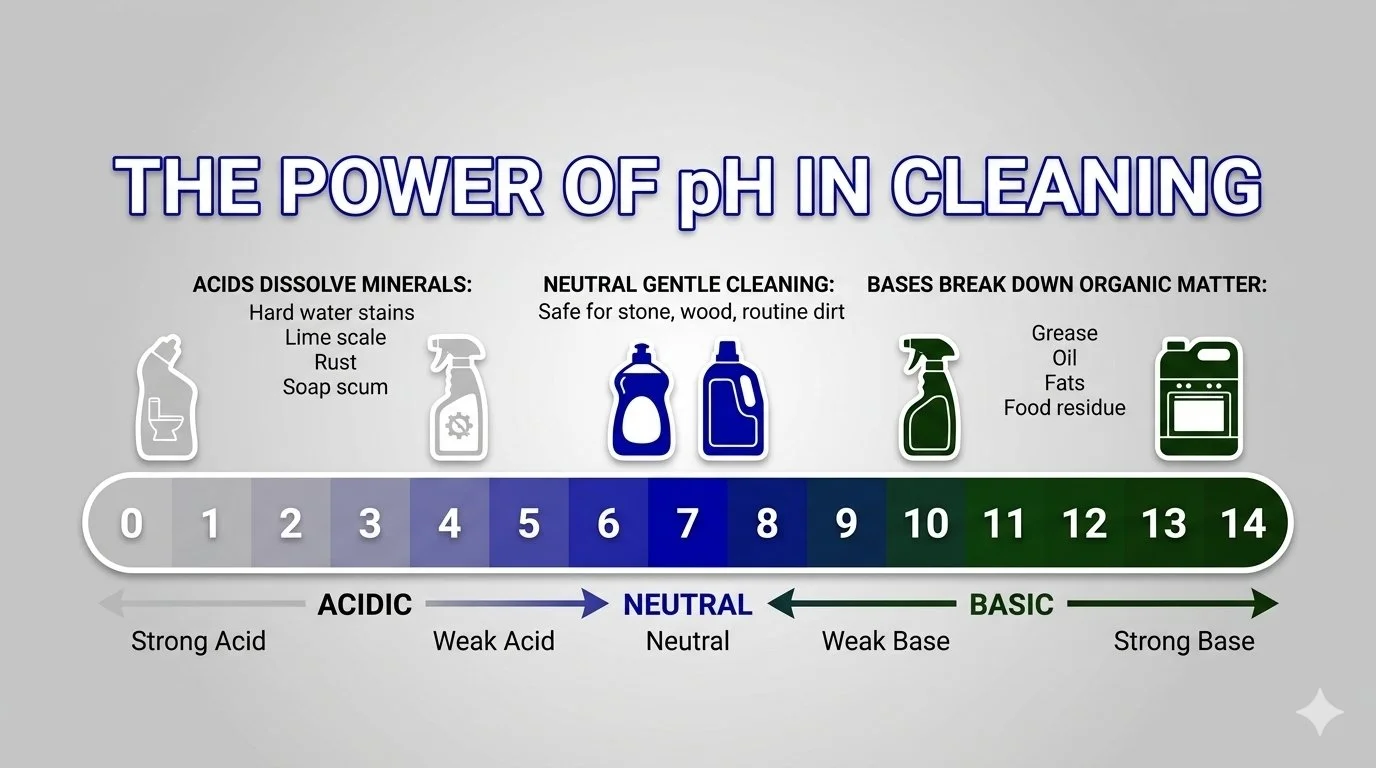
The power of pH: A guide to how acids and bases influence cleaning
Standing in the cleaning aisle, overwhelmed by dozens of products? The secret isn't buying more—it's understanding pH. Most cleaning challenges come down to chemistry: acids dissolve mineral deposits (hard water, lime scale, rust), while bases break down grease and organic matter. Using the wrong pH is like unscrewing a bolt with a hammer—you're applying force, but it's the wrong tool. Once you understand this one concept, cleaning stops being guesswork and becomes logical problem-solving. Learn which common products fall where on the pH scale, how to identify what you're cleaning, and match the right chemistry to every mess.
You're standing in the cleaning aisle, overwhelmed by dozens of products. Bathroom cleaner. Kitchen cleaner. All-purpose cleaner. Glass cleaner. Each bottle promises to tackle specific areas in your home, but you're not entirely sure why you need so many different products—or which one will actually solve your problem.
Most cleaning challenges come down to chemistry, specifically pH. Understanding this one simple concept will save you money, time, and frustration. You'll stop buying products you don't need, stop using the wrong cleaner for the job, and start actually solving problems instead of just scrubbing harder.
The secret isn't buying more products, it's understanding what you're actually trying to clean and matching it with the right chemical approach. Once you understand pH, cleaning stops being guesswork and becomes logical problem-solving.
This guide will teach you everything you need to know about pH in cleaning: what it means, why it matters, which common products fall where on the scale, and most importantly, how to identify what you're cleaning so you can choose the right product every single time.
What is pH? Understanding the scale
pH stands for "potential of hydrogen" and measures how acidic or basic a substance is on a scale from 0 to 14.
The pH scale:
0-6: Acidic (the lower the number, the stronger the acid)
7: Neutral (pure water)
8-14: Basic (the higher the number, the stronger the base)
Why this matters for cleaning: Different types of dirt, grime, and buildup respond to different pH levels. Acids dissolve certain substances. Bases dissolve others. Using the wrong pH is like trying to unscrew a bolt with a hammer — you're applying force, but it's the wrong tool for the job.
The pH scale with common household cleaners
Here's where everyday cleaning products actually fall on the pH scale. Note that a product’s pH can be found in Section 9 of their respective Safety Data Sheet.
Strong acids (pH 0-4):
Common toilet bowl cleaners (Lysol / Scrubbing Bubbles)
Oxalic acid (Bar Keeper's Friend)
Acetic acid (white vinegar)
Citric acid (lemon juice)
Weak acids (pH 4-6):
Bathroom cleaners designed for hard water (Seventh Generation / Method Daily Shower Spray)
Neutral range (pH 6-8):
Distilled water (pH 7.0 – true neutral)
Palmolive dish soap
pH-neutral cleaners (Bona Hard Surface Floor Cleaner / Zep Neutral pH Floor Cleaner / Method Hard Floor Cleaner)
Weak bases (pH 8-10):
Baking soda (sodium bicarbonate)
Borax (sodium borate)
Dawn Ultra dish soap
Strong bases (pH 11-14):
Oven cleaners (Easy Off Fume-Free / Zep
Drain cleaners (Drano Max Gel / Liquid Plumr)
Toilet bowl cleaners with bleach (Clorox)
Important note: The pH scale is logarithmic, not linear. This means each number represents a tenfold difference. pH 3 is ten times more acidic than pH 4, and one hundred times more acidic than pH 5. Small numerical differences represent huge differences in strength.
Not-so-important note (but still important to know going forward): Alkalis are bases that dissolve in water.
The chemistry behind how acids and bases actually clean
Understanding what acids and bases do at a molecular level explains why they work on different types of dirt.
What acids do
Acids donate hydrogen ionsto chemical reactions. This makes them excellent at:
Dissolving mineral deposits:
Hard water stains (calcium and magnesium carbonate)
Lime scale
Rust stains (iron oxide)
Soap scum (mineral soap residue)
Efflorescence (white mineral deposits on tile/concrete)
Why this works: Minerals are alkaline compounds. Acids react with them chemically, breaking their molecular bonds and dissolving them into solution. This is why acids work so well on hard water buildup — they're chemically breaking it down, not just scrubbing it away.
Acids also:
Brighten and restore shine to some surfaces (including ceramic, porcelain, stainless steel)
Remove tarnish from metals (brass, bronze, copper)
Neutralize alkaline residues
Kill certain bacteria
What acids DON'T do well:
Remove grease or oil
Cut through organic buildup
Dissolve proteins or fats
What bases do
Bases accept hydrogen ionsin chemical reactions. This makes them excellent at:
Breaking down organic matter:
Grease and oils
Fats (cooking residue, body oils)
Proteins (food residue, blood, organic stains)
Dirt and grime with organic components
Why this works: Bases cause a chemical reaction called saponification with fats and oils, essentially turning them into soap. This is why dish soap cuts through grease so effectively, and why oven cleaner dissolves baked-on grease.
Bases also:
Break down proteins and carbohydrates
Neutralize acidic residues
What bases DON'T do well:
Remove mineral deposits
Dissolve hard water stains
Clean rust
The neutral zone (pH 6-8)
True neutral cleaners:
Don't chemically react with most substances
Safe for almost all surfaces
Good for general dust and light dirt
Not effective for stubborn, chemically-bonded grime
When to use neutral cleaners:
Sensitive surfaces that acids or bases could damage
Routine maintenance cleaning
When you need safe, gentle cleaning
Identifying what you're actually cleaning
Before you can choose the right cleaner, you need to identify what you're trying to remove. Here's how to recognize common household messes by their characteristics:
Mineral-based buildup
Hard water stains:
Appearance: White, chalky, or cloudy deposits
Texture: Crusty, rough, difficult to scrub off
Common locations: Shower doors, faucets, sinks, toilets (waterline), tile, glass
What it is: Calcium and magnesium minerals left behind when water evaporates
Lime scale:
Appearance: White or off-white thick deposits, sometimes flaky
Texture: Very hard, almost rock-like where buildup is heavy
Common locations: Inside kettles, coffee makers, around faucet aerators, showerheads
What it is: Calcium carbonate buildup from repeated water exposure and heating
Rust stains:
Appearance: Orange, brown, or reddish stains
Texture: Can be surface-level or embedded in porous materials
Common locations: Toilets, sinks (where metal touches water), around old pipes
What it is: Iron oxide from metal corrosion or iron-rich water
Soap scum:
Appearance: White or gray filmy residue, sometimes with slight iridescence
Texture: Waxy, sticky feeling, difficult to remove with water alone
Common locations: Shower walls, tubs, shower doors, sinks
What it is: Combination of soap residue (fatty acids) + minerals from hard water. Contains both organic (soap) and inorganic (mineral) components, but the mineral component dominates
Efflorescence:
Appearance: White, powdery or crystalline deposits
Texture: Dry, powdery, easily brushed off when loose (but reappears)
Common locations: Brick, concrete, tile grout, basement walls
What it is: Salts brought to the surface through moisture evaporation
Organic/Grease-based buildup
Cooking grease and oil:
Appearance: Yellow to brown, glossy or sticky
Texture: Can be slippery (fresh buildup) or tacky (buildup that has been there a while)
Common locations: Stovetops, range hoods, backsplashes, oven interiors
What it is: Fats and oils from cooking that have condensed on surfaces
Baked-on food residue:
Appearance: Brown or black carbonized deposits
Texture: Very hard, crusty, difficult to scrape
Common locations: Oven interiors, baking sheets, pots and pans
What it is: Proteins, fats, and carbohydrates that have been repeatedly heated and carbonized
Body oils and soap residue:
Appearance: Slight film, often invisible until surface looks dull
Texture: Slightly greasy or waxy feeling
Common locations: Bathroom surfaces, tub ring, around sinks
What it is: Natural skin oils, body care products, soap residue
General dirt and grime:
Appearance: Gray or brown, dull appearance
Texture: Often slightly sticky or filmy
Common locations: Floors, walls, high-touch surfaces
What it is: Mix of dust, skin cells, oils, outdoor pollutants
Mould and mildew:
Appearance: Black, gray, green, or pink spots or patches
Texture: Can be surface-level (wipes away) or embedded (staining)
Common locations: Bathrooms, basements, window sills, anywhere with moisture
What it is: Fungal growth that thrives in moist, organic-rich environments
Mixed/Special Cases
Soap scum in hard water areas:
Contains both mineral deposits and organic soap residue
Best approach: Start with an acid to dissolve the minerals, then use a base if any organic residue remains
Or use a product specifically formulated for soap scum (contains both acid and surfactants to lift away the organic residue)
Toilet bowl rings:
Usually mineral deposits (hard water + waste minerals)
Sometimes combined with organic staining
Best approach: Acidic toilet bowl cleaner for minerals
Cloudy glassware from dishwasher:
Hard water etching (permanent damage) vs. mineral film (removable)
Test: If white vinegar removes it, it's mineral buildup. If not, it's etching.
Matching pH to the problem: An eco-friendly guide
Now that you can identify what you're cleaning, here's how to choose the right sustainable product:
For mineral deposits and hard water stains
Use acidic cleaners:
Mild hard water stains:
White vinegar -- cheap, effective, readily available
Apply, let sit 10-15 minutes, scrub, rinse
Safe for most non-porous surfaces
Toronto tip: Keep a spray bottle of vinegar in your bathroom for weekly shower door maintenance to prevent heavy mineral deposits.
Moderate buildup:
Make a paste of white vinegar and corn starch, apply, let sit for a few minutes, scrub gently, rinse thoroughly
Excellent for sinks, tubs, cookware
Mildly abrasive (helps with scrubbing action)
Heavy buildups may require multiple applications.
For rust stains:
Use a citric acid cleaner
Citric acid has the ability to “pull” rust from a surface (chelating), making it more effective than vinegar.
Important surface exceptions:
Never use acids on natural stone (marble, granite, limestone, travertine) - they will cause permanent damage through etching
Caution on metal fixtures - prolonged acid exposure can damage finishes
Test on grout - acids can break down grout sealant over time – leaving the grout vulnerable to erosion
For grease, oil, and organic buildup
Use alkaline cleaners (pH 8-14):
Light grease and daily grime:
Sustainable dish soap (my recommendation)
Dilute as directed by the product manufacturer, spray, let the solution sit for a couple of minutes, wipe clean
Moderate grease:
Sustainable all-purpose cleaner (my recommendation)
Apply, let sit as directed, scrub, rinse
Good for stovetops, kitchen surfaces, floors
Heavy baked-on grease:
Sustainable oven cleaner (my recommendation)
Follow directions carefully, including all safe handling precautions
Excellent for ovens, range hoods, barbecue grates
For mould and mildew:
Hydrogen peroxide / baking soda or a sustainable mould cleaner (my recommendation)
Address the cause of the excess moisture to prevent mould from returning
Protein-based stains:
Sustainable enzyme cleaner (my recommendation)
Use cold or lukewarm water (hot water can set protein stains)
For general/mixed Cleaning
Use neutral or mildly alkaline cleaners (pH 7-9):
Routine maintenance:
Dish soap and water (pH 7-9)
Mild all-purpose cleaners (pH 8-9)
Perfect for dust, fingerprints, light dirt
When surface sensitivity is a concern:
pH-neutral cleaners (pH 7)
Safe for wood, stone, and delicate finishes
Won't damage protective coatings
Surface-specific recommendations
Natural stone (marble, granite, limestone, travertine):
Only use pH-neutral cleaners (pH 7)
Acidic cleaners will etch the stone
Strong alkaline cleaners will strip the stone’s protective sealer
Hardwood floors:
pH-neutral for routine cleaning and slightly acidic (pH 6 or higher) for occasional deep cleaning
Alkaline cleaners can destroy the protective finish
Use minimal moisture
Stainless steel:
Neutral to slightly alkaline (pH 7-9)
Acids can damage the finish with prolonged contact
Strong alkalis can cause discolouration
Glass:
Mildly acidic (pH 4-6) for hard water stains
Use distilled water for streak-free cleaning
A diluted vinegar solution works beautifully
Ceramic tile:
Tolerates wide pH range (pH 2-11)
While the tile itself is durable, the grout surrounding it is not. Start with a mild base, and ensure the grout is properly sealed before escalating to a stronger product. Use acids only when targeting heavy mineral buildup (normally only in showers), and take precautions to prevent contact with grout.
Porcelain:
Very durable, tolerates strong acids and alkalis
Start with a mild acid or base, and only escalate if needed to minimize the risk of damaging the protective surface.
Common cleaning mistakes: Using the wrong pH
Understanding these common errors will save you hours of frustrated scrubbing:
Mistake 1: Using alkaline cleaner on mineral deposits
The scenario: You're scrubbing shower doors with an all-purpose cleaner, but the cloudy hard water stains won't budge no matter how hard you work.
Why it doesn't work: All-purpose cleaners are typically alkaline (pH 9-10). Hard water deposits are alkaline minerals. Bases don't react with bases—you're just pushing minerals around, not dissolving them.
The solution: Switch to an acidic cleaner (vinegar, citric acid). The stains will dissolve chemically with minimal scrubbing.
Mistake 2: Using acid on grease
The scenario: You try using vinegar to clean your greasy stovetop, but it just spreads the grease around and leaves a sticky mess.
Why it doesn't work: Acids don't react with fats and oils. You're just diluting the grease slightly, not breaking it down.
The solution: Use dish soap or an alkaline cleaner.
Alkalines chemically neutralize the fatty acids in the grease.
Surfactants in dish soap surround the oil molecules, "lifting" them off the stovetop so they can be rinsed away with water rather than just pushed around.
Mistake 3: Mixing acids and bases
The scenario: You hear that baking soda (base) and vinegar (acid) create a powerful cleaner, so you mix them together.
Why it doesn't work: They neutralize each other. The impressive fizzing is just carbon dioxide gas escaping as the two chemicals "cancel" each other out. Once the bubbles stop, you are left with water and a tiny amount of salt (sodium acetate). You’ve essentially turned two great cleaners into useless salt water.
The solution: Use them for their specific strengths, separately.
To scrub: Use a baking soda paste. Its high pH breaks down grease and its grit provides gentle abrasion.
To de-scale: Use vinegar. Its low pH dissolves hard water spots and soap scum.
The exception: If you have a slow drain, you can use the reaction for its mechanical energy. Pour the baking soda down first, then the vinegar, and plug the drain. The "fizzing" creates pressure that can physically dislodge hair or gunk—but it's the movement, not the chemistry, doing the work.
Mistake 4: Using acid on natural stone
The scenario: You use vinegar or acidic bathroom cleaner on marble countertops or shower tile to remove water spots.
Why it's a disaster: Acids react with calcium carbonate (which natural stone is made of), permanently etching the surface. Sadly, the damage is irreversible without professional restoration.
The solution: Only use pH-neutral cleaners on natural stone.
Mistake 5: Not letting the cleaner work
The scenario: You spray cleaner and immediately wipe, frustrated that it's not working.
Why it's inefficient: Chemical reactions take time. Spraying and immediately wiping doesn't give the cleaner time to break down the grime chemically.
The solution: Apply cleaner, let it sit (dwell time varies by product and buildup severity), then wipe. Dwell time allows the chemistry to do the work, so that your muscles don’t have to.
The right questions to ask
This is where understanding pH transforms your cleaning approach entirely.
Stop asking: "What will clean my [surface]?"
This question is too vague. It doesn't identify the actual problem.
Examples of vague questions:
"What will clean my bathtub?"
"How do I clean my glass shower door?"
"What's the best cleaner for my sink?"
Why they're too vague: The surface isn't the problem—the substance on the surface is the problem. Different substances require different solutions.
Start asking: "What will remove [substance] from my [surface]?"
This question identifies both the problem and any surface limitations.
Examples of specific questions:
"What will remove hard water stains from glass?" → Acid (vinegar or commercial descaler)
"What will remove grease from ceramic tile?" → Base (degreaser or alkaline all-purpose cleaner)
"What will remove soap scum from my acrylic tub?" → Mild acid with surfactants (a mixture of vinegar and dish soap or a specialized soap scum remover)
"What will remove water spots from marble?" → pH-neutral cleaner
The two-step thinking process:
Step 1: Identify what you're removing
Is it mineral-based? (cloudy, white, crusty) → Needs acid
Is it grease/oil-based? (sticky, greasy, brown) → Needs base
Is it general dirt? (dusty, filmy) → Neutral or mild base
Step 2: Identify surface limitations
Is the surface acid-sensitive? (grout, natural stone, some metals) → Avoid acids
Is the surface base-sensitive? (some wood finishes, soft metals like aluminum, brass, zinc) → Avoid strong bases
Is the surface generally durable? (ceramic, porcelain, glass) → Wide pH range acceptable
The answer: Choose the appropriate pH that removes the substance without damaging the material.
The substance determines the pH you need. The surface determines the pH you must avoid.
Practical application: Real-world scenarios
Let's apply this knowledge to common Toronto household cleaning challenges:
Scenario 1: Cloudy shower doors
What you see: White, hazy film on glass that won't wipe away with water
Identify the substance: Hard water mineral deposits (calcium and magnesium carbonate)
Surface considerations: Glass is durable and acid-resistant
Solution:
Use an acidic cleaner (white vinegar is cheapest, citric acid is more effective but typically costs more)
Spray generously, let sit for appropriate amount of time
Scrub with a non-abrasive sponge
Rinse thoroughly
Prevention: Squeegee doors after each shower, or spray with vinegar weekly
Scenario 2: Greasy range hood
What you see: Sticky, brown, glossy buildup that attracts dust
Identify the substance: Cooking grease and oil (organic fats)
Surface considerations: Usually stainless steel or painted metal (both tolerate alkaline)
Solution:
Use alkaline degreaser (pH 10-11)
Spray, let sit for appropriate amount of time
Wipe with a cloth or sponge
May need multiple applications for thick buildup
Rinse with hot water and dry
Prevention: Wipe weekly with alkaline cleaner before buildup becomes severe
Scenario 3: Toilet bowl ring
What you see: Brown or gray ring at water line, rough texture
Identify the substance: Mineral deposits from hard water, possibly with some organic staining
Surface considerations: Porcelain (very durable, acid-safe)
Solution:
Use acidic toilet bowl cleaner
Apply under rim and to ring, let sit for appropriate amount of time
Scrub with toilet brush
For stubborn rings: pumice stone (wet both stone and surface before use to reduce the risk of scratching the protective glaze)
Prevention: Flush daily to prevent buildup
Safety warning:Never mix a strong acid like an acidic toilet bowl cleaner with chlorine bleach! These 2 substances will react to create chlorine gas – which was literally used to kill soldiers during WWI.
Scenario 4: Soap scum on acrylic tub
What you see: White, filmy, slightly waxy buildup
Identify the substance: Soap scum (mixed: oils + hard water minerals)
Surface considerations: Acrylic can be scratched; avoid abrasives
Solution:
Use a mixture of vinegar and dish soap (I know what you’re thinking–”but the acidic vinegar will neutralize the alkaline dish soap!”--but in this case it’s the surfactants in the dish soap that are being relied on to lift the oils, not its alkalinity to dissolve them)
Prevention: Rinse tub after use, squeegee or wipe down weekly
Scenario 5: Hardwood floor dullness
What you see: Floor looks dingy, has lost shine
Identify the substance: Likely buildup of alkaline cleaner residue or dirt
Surface considerations: Hardwood finish is sensitive to both strong acids and bases
Solution:
First use pH-neutral wood floor cleaner
Damp mop only (never wet)
If residue remains, use a very dilute vinegar solution (1 part vinegar to 10 parts water), and rinse with plain water immediately
Prevention: Only use pH-neutral or manufacturer-recommended cleaners on hardwood to avoid future buildup
Scenario 6: Cloudy marble countertop
What you see: Dull, hazy appearance, possibly etching or residue
Identify the substance: Could be etching (permanent damage from acid) or alkaline residue buildup
Surface considerations: Natural stone—extremely acid-sensitive
Solution:
Clean with pH-neutral natural stone cleaner
If still dull: May be etching (requires professional restoration)
If it's residue: Dish soap and water, dry thoroughly
Prevention:Never use acidic or alkaline cleaners on marble (or any other natural stone). Only pH-neutral products.
Building a sustainable cleaning arsenal
You don't need 20 products. Here's a strategic, pH-based cleaning kit:
The Essential Four
1. Acidic cleaner:
White vinegar for biofilms and light mineral buildup
Citric acid for rust and heavy mineral buildup
Uses: Hard water stains, mineral deposits, rust, soap scum
2. Alkaline cleaner:
Sustainable all-purpose cleaner for routine cleaning and light grease buildup
Sustainable oven cleaner for heavy grease buildup
Uses: Grease, general grime, floors, most durable surfaces
3. pH-neutral cleaner:
pH neutral dish soap and water works for most needs
Consider sustainable cleaners formulated specifically for natural stone / hardwood floors
Uses: Delicate pH-sensitive surfaces, routine maintenance
4. Abrasive cleaner:
Corn starch for mild acidic cleaning
Baking soda for mild basic cleaning
Natural fibre brushes for pH neutral cleaning
Uses: Stubborn stains on durable surfaces, cookware, sinks
Safety considerations when working with pH
Understanding pH includes respecting the power of strong acids and bases.
General safety rules
Never mix cleaning products unless you know exactly what you're doing:
acid + bleach = toxic chlorine gas (fatal)
ammonia + bleach = toxic chloramine gas (fatal)
hydrogen peroxide + vinegar = peracetic acid (damages the eyes and respiratory system)
acid + base = neutralization (wastes both products, and creates potentially unwanted heat)
Wear appropriate protection:
Gloves for anything below pH 4 or above pH 10
Eye protection for spray products or anything below pH 3 or above pH 11
Ventilation for strong acids or bases (open windows, use fans)
Follow product directions:
Always follow the recommended dilution ratios
Dwell times are tested for effectiveness and safety
Following rinsing instructions help prevent surface damage
Store all cleaning products:
Separate from each other
Out of reach of children and pets
In original containers with labels
Away from heat sources
pH-specific cautions
Strong acids (pH < 3):
Can burn skin and eyes
Can corrode metals
Fumes can irritate respiratory system
Can permanently damage acid-sensitive surfaces
Strong bases (pH > 11):
Can cause severe chemical burns
More dangerous than acids of equivalent pH (bases penetrate human tissue deeper)
Can blind if splashed in eyes
The slippery feeling after touching a base is literally the base turning your skin oils into soap, and should be washed off immediately until that slippery feeling is gone
Test before using:
On new surfaces, test in inconspicuous area
Wait 24 hours to ensure no damage
This is especially important with acids on stone, grout, or metal
Toronto-specific considerations
Understanding your local water and environment helps you anticipate cleaning challenges.
Toronto's water hardness
Toronto water is moderately hard:
This means calcium and magnesium minerals are present
You will deal with hard water buildup regularly
What this means for you:
Keep acidic cleaners on hand
Expect mineral deposits on faucets, shower doors, appliances
More frequent cleaning needed in bathrooms and kitchen
Consider water softener if buildup is severe
Seasonal Humidity
Toronto's humid summers:
Increased mould and mildew risk
More organic growth in bathrooms
Keep alkaline cleaners or hydrogen peroxide ready
Increase ventilation (exhaust fans, dehumidifiers)
Toronto's dry winters:
Heating systems dry air
Dust accumulation increases
Static electricity attracts more dust to surfaces
General cleaning (neutral or mild alkaline) more important
High-rise condo living
Harbourfront and other condo-dense areas:
Sealed buildings with limited ventilation
Shared water systems (consistent water hardness across units)
Smaller spaces mean faster buildup concentration
Regular cleaning more important in confined spaces
Conclusion: From guesswork to strategy
Understanding pH transforms cleaning from trial-and-error frustration into logical problem-solving. You're no longer guessing which product might work or why something isn't cleaning despite your effort.
The simple framework:
Mineral deposits (hard water, lime scale, rust) → Acid
Grease and organic matter (cooking oil, body oils, food residue) → Base
Routine dust and light dirt → Neutral or mild base
Delicate surfaces → pH-neutral only
The right question isn't "What cleans my bathtub?"
The right question is "What removes hard water stains from ceramic?"
One identifies the surface. The other identifies both the problem and the solution.
Armed with this knowledge, you'll:
Save time by eliminating the guesswork
Save money by buying fewer products
Protect your surfaces
Get better results
The next time you face a cleaning challenge: Pause. Identify what you're trying to remove. Consider your surface. Choose the appropriate pH. Let the chemistry do the work for you.
Need help with proper surface care and cleaning in your Toronto home? At EcoEthical Cleaning, I understand the chemistry behind every surface and challenge. I choose products based on science, not marketing, ensuring your home is cleaned effectively without damage. Contact me for a free, no-obligation estimate and experience sustainable cleaning done right.
Sources & Further Reading
“The Chemistry of Cleaning”, American Cleaning Institute,
"Neutralization", LibreTexts Chemistry
"Tap Water Quality & System Reports", City of Toronto
The environmental impact of microfibre cloths
If you’ve switched to microfibre because it was marketed as a greener option, you’re not alone. Unfortunately, each microfibre wash releases plastic fibres that make their way into our waterways and ecosystems. Before you toss what you own, let’s explore what microfibre is made of, why it’s a problem, and how to move toward genuinely sustainable cleaning materials instead.
If you've been told that microfibre cloths are the sustainable cleaning solution, you're not alone. They've been marketed as reusable, effective, and even "eco-friendly" alternatives to disposable paper towels. And in some ways, they deliver — you can clean with just water, they last for years, and they genuinely work.
But here's the uncomfortable truth that's only recently come to light: microfibre cloths are shedding hundreds of thousands of tiny plastic fibres every time they are washed. These microscopic particles are flowing into our waterways, entering our food chain, and accumulating in ecosystems across the world. The very thing we thought was helping the planet is actually contributing to one of the most pressing environmental challenges we face — microplastic pollution.
Before you toss all your microfibre cloths in despair (please don't, I'll explain what to do with them later on), let's understand what's actually happening, why it matters, and what genuinely sustainable alternatives exist.
What are microfibre cloths?
Despite the natural-sounding name, microfibre is 100% synthetic plastic.
Most microfibre cloths are made from a blend of polyester (derived from petroleum) and polyamide, also known as nylon (another petroleum-based plastic). These materials are woven together to create ultra-fine fibres (typically 1/100th the diameter of a human hair) which gives microfibre its signature soft texture and cleaning ability.
While some microfibre is marketed as being "made from recycled materials," it may sound better but doesn't change the fundamental issue: it's still plastic that will shed more plastic.
Unlike cotton or other natural fibres, microfibres are plastic-based, which means they do not break down naturally in the environment.
How microfibre cloths actually work
Microfibre's cleaning power comes from its unique structure. Those ultra-fine plastic fibres create millions of tiny spaces and edges that:
Trap dirt mechanically — The fibres act like tiny hooks that grab and hold onto dust, dirt, and grime at a microscopic level. This is why you can often clean effectively with just water—the physical structure does most of the work.
Absorb moisture efficiently — The spaces between fibres allow microfibre to absorb up to seven times its weight in liquid.
Create static charge — When dry, microfibre builds up a static charge that attracts and holds dust particles, making it excellent for dusting without sprays.
Split and lift oils — Quality microfibre has "split" fibres with wedge-shaped edges that can penetrate and lift oil-based grime that would normally require soap.
It's not marketing hype, microfibre genuinely outperforms traditional cotton cloths for most cleaning tasks. The problem isn't that it doesn't work. The problem is what happens after you use it.
How microfibre cloths harm the environment
The microplastic pollution crisis
Each time a microfibre cloth is washed, it sheds thousands to hundreds of thousands of tiny synthetic fibres that enter wastewater systems. According to research published in Marine Pollution Bulletin, washing a single load of synthetic fabrics can release up to 700,000 microfibres into the water supply.
These fibres are too small for most wastewater treatment facilities to completely filter out, meaning they flow directly into rivers, lakes, and oceans. A study by Imogen Napper and Richard Thompson found that fabric type and washing conditions significantly affect microfibre release, with some materials shedding far more than others during routine washing.
For Canada, this is a particularly significant problem. The Great Lakes — which provide drinking water to millions of Canadians — are among the most contaminated bodies of water for microplastic pollution. Research by McGill University found that microplastics, including those from textiles, are present in the St. Lawrence River at levels comparable to the world's most polluted oceans.
Once in the water, these plastic fibres don't degrade — they just break down into smaller and smaller pieces, persisting in the environment for centuries.
Harm to marine life and Canada's food chain
Microfibre pollution doesn't just affect water quality; it's devastating to marine life. Small fish, plankton, and other aquatic organisms mistake microplastics for food, ingesting particles that provide no nutrition and can cause physical harm.
A study by Fisheries and Oceans Canada has shown that fish from Canadian waters contain microplastics in their digestive systems, which can lead to malnutrition, reproductive issues, and increased mortality rates.
More concerningly, microplastics bioaccumulate up the food chain. When small organisms ingest microfibres, those plastics travel through larger predators and, eventually, to humans. Since seafood is a dietary staple for many Canadians — particularly in coastal communities — this represents a direct threat to public health.
Research from Environment and Climate Change Canada indicates that microplastics have been found in table salt, drinking water, and even human feces, proving that plastic fibres have fully entered our food system. We're literally consuming the plastic pollution we've created.
Fossil fuel dependence and carbon emissions
Beyond the shedding problem, microfibre cloths contribute to climate change from the moment they're manufactured.
These cloths are derived from petroleum-based products — primarily polyester and nylon — which are made from fossil fuels. The production of these materials is energy-intensive, releasing large amounts of carbon dioxide into the atmosphere. According to Canada's Energy Regulator, the oil and gas sector accounts for a quarter of the nation's greenhouse gas emissions.
By supporting the production and use of synthetic fabrics like microfibre, we're indirectly contributing to Canada's carbon footprint. And unlike natural fibres such as cotton, hemp, or bamboo, microfibres cannot be composted or safely disposed of at the end of their life. They typically end up in landfills or incinerators, both of which contribute to environmental degradation.
Even dry use releases plastic
Microfibre cloths shed fibres even when you're using them dry. When you dust with microfibre, you're releasing plastic particles into the air in your home. These particles settle on surfaces and eventually make their way into indoor dust.
While indoor microplastic exposure is still being studied, researchers have already found microplastics in human lung tissue and blood samples. The full health implications aren't yet understood, but the trajectory isn't encouraging.
Why microfibre cloths aren't as "eco-friendly" as advertised
Many microfibre cloths are marketed as sustainable because they're reusable and reduce the need for paper towels or disposable cleaning products. While it's true that microfibre cloths reduce single-use waste, their overall environmental impact is far more damaging.
Here's why they're not a truly sustainable choice:
Plastic shedding — Each wash releases hundreds of thousands of microplastics into waterways—contributing to the estimated 35% of microplastic pollution in oceans that comes from synthetic textiles.
Non-biodegradability — They don't break down naturally and persist in the environment for centuries, continuing to fragment into smaller particles.
Petroleum-based production — They rely on fossil fuel extraction, contributing to greenhouse gas emissions and global warming.
End-of-life waste — They cannot be easily recycled or composted. Textile recycling infrastructure is limited, and mixed synthetic fabrics like microfibre are particularly difficult to process.
Invisible pollution — Unlike plastic bottles or bags that we can see and measure, microfibre pollution is invisible — which makes it easier to ignore but no less harmful.
Sustainable alternatives to microfibre cloths
The good news is that genuinely sustainable alternatives exist that clean just as effectively without the plastic pollution problem. Natural fibres have been cleaning homes effectively for centuries — we just got distracted by newer technology.
Natural fibre cloths
Cotton huck towels — These lint-free, tightly woven cotton towels are what professional window cleaners used for decades before microfibre existed. They're exceptionally absorbent, leave no streaks on glass, and can be washed hundreds of times.
Best for: Glass, mirrors, stainless steel, general wiping
Organic cotton — Biodegradable, durable, and can be washed repeatedly. Look for GOTS-certified organic cotton, which is free from harmful chemicals and pesticides.
Best for: All-purpose cleaning, kitchen surfaces
Swedish dishcloths — Made from cellulose (wood pulp) and cotton, these biodegradable cloths can absorb 15 times their weight in liquid. When they wear out after months of use, they can be composted.
Best for: Countertops, spills, general kitchen cleaning
Bamboo — A fast-growing, renewable resource that requires less water and no pesticides to grow. Bamboo cloths are naturally antibacterial, highly absorbent, and an excellent alternative to microfibre.
Best for: Bathrooms, kitchen surfaces, general cleaning
Hemp — One of the most sustainable textiles available. It requires minimal water and is naturally resistant to pests, meaning it doesn't rely on chemical treatments. Hemp cleaning cloths are exceptionally durable and biodegradable.
Best for: Heavy-duty cleaning, scrubbing
Linen — Naturally antimicrobial and highly durable, linen becomes softer and more absorbent with each wash. A bit of an investment upfront, but they'll last for years.
Best for: Kitchen surfaces, glassware, fine cleaning
Upcycled cotton rags -- Instead of purchasing new materials, consider using old t-shirts, towels, or linens as cleaning cloths. Not only does this reduce waste, but it also extends the life of existing fabrics. True sustainability isn't just about buying better; it’s about utilizing what already exists.
Best for: General cleaning, any household task
Wool — For dusting specifically, wool cloths naturally attract and trap dust particles through static electricity without synthetic fibres. Wool is compostable and does not release microplastics when washed.
Best for: Dusting furniture, electronics, delicate surfaces
Natural fibre sponges and brushes
For scrubbing tasks, consider:
Cellulose sponges — Made from wood pulp, they're biodegradable and work just as well as synthetic sponges
Coconut fibre scrubbers — Tough enough for stuck-on food without scratching surfaces
Natural bristle brushes — Perfect for grout, tile, and detail cleaning
Making the switch: Practical tips
Start with what you replace most often — If you're constantly reaching for microfibre for glass cleaning, replace those first with cotton huck towels. Test what works for your routine.
Use what you already have — Before buying anything new, repurpose old cotton t-shirts, towels, and linens. Cut them into cleaning-sized squares.
Designate cloths by task — Just like with microfibre, assign specific natural-fibre cloths to specific jobs (bathrooms, kitchen, dusting). This prevents cross-contamination and keeps things organized.
Adjust your technique slightly — Natural fibres work a bit differently than microfibre. You might need to:
Rinse and wring cloths more frequently during use
Use slightly more water for some tasks
Dampen cotton cloths before dusting (rather than using them dry)
Switch to a dry cloth for final buffing on glass
Wash properly — Natural fibres are easier on the environment, but you still want them to last:
Wash in warm or hot water
Avoid fabric softener (it reduces absorbency)
Hang dry when possible to extend their life
No special care needed—they're far more forgiving than synthetic materials
What if you already own microfibre cloths?
Don't throw them away — that just sends more plastic to the landfill immediately. Instead:
Use them until they wear out — The environmental damage from washing them is already happening, but manufacturing new products (whether microfibre or natural alternatives) also has an environmental cost. Get your use out of what you own.
Reduce microplastic shedding when washing them:
Wash in cold water (reduces fibre release)
Use liquid detergent instead of powder (less agitation)
Wash full loads (less friction between items)
Consider a microfibre-catching laundry bag like Guppyfriend or Cora Ball — they can capture many microplastics before they reach waterways
If you use a laundry filter, dispose of captured fibres by placing them in a sealed non-recyclable bag and adding to your household trash
Air dry instead of machine drying when possible
Repurpose for non-washing tasks — Use old microfibre for garage cleaning, car detailing, or other jobs where you won't wash them frequently.
Replace gradually with natural alternatives — As microfibre cloths wear out, replace them with natural fibre options. This spreads out the cost and lets you test what works best for your cleaning routine.
How Canadians can take action
If you're concerned about the environmental impact of microfibre cloths, here are practical steps you can take today:
Switch to sustainable alternatives — Opt for natural fibre cloths instead of microfibre. Even switching half your cleaning cloths makes a difference.
Use a laundry filter — If you must continue using microfibre, consider installing a microfibre filter in your washing machine to capture plastic fibres before they enter wastewater.
Support microplastic research and advocacy — Organizations like Ocean Wise and Oceana Canada are actively working to combat microplastic pollution. Consider supporting their work or staying informed about their initiatives.
Spread awareness — Educate friends and family about the environmental costs of microfibre products. Most people genuinely don't know about this issue. Sharing information facilitates change.
Support businesses making better choices — Choose cleaning services and products that prioritize natural materials over synthetics. Consumer demand drives industry change.
Advocate for better infrastructure — Contact your local representatives about improving wastewater treatment facilities to better filter microplastics, and support policies that address plastic pollution at the source.
Final thoughts: Progress over perfection
Here's the thing about sustainable living: it's complicated, and there's rarely a perfect solution. Microfibre cloths seemed like the right choice when we first learned about them. The fact that we're now discovering they have serious environmental downsides doesn't mean we failed — it just means our understanding evolved, and we're now responding to new information.
The goal isn't to shame anyone for using microfibre or to create anxiety about every cleaning choice. It's to make informed decisions with the information we now have.
Natural fibre cleaning cloths are a genuinely better alternative for the environment. They work beautifully for most cleaning tasks, they're biodegradable, and they don't shed plastic into our water systems. For the vast majority of home cleaning, you truly don't need synthetic materials.
Will switching your cleaning cloths single-handedly save the Great Lakes? No. But microplastic pollution is a massive problem that requires action at every level — from individuals to industries. Your choices do contribute to demand, and demand shapes what manufacturers produce and what becomes normalized.
Plus, there's something quietly satisfying about cleaning with simple, natural materials that humans have used effectively for centuries. Cotton, linen, and cellulose work. They've always worked. We just got enticed by technology that seemed more advanced.
If you're ready to make the switch, start small. Replace one type of cleaning cloth. See how it works. Adjust your routine. Then replace another. Before long, you'll have a cleaning kit that's genuinely sustainable — not just marketed that way.
Every small change helps in the fight against plastic pollution. Are you ready to make the switch?
Need help with sustainable, microfibre-free cleaning solutions for your home? As an independent cleaner and the founder of EcoEthical Cleaning, I understand the science behind every cleaning method and choose approaches that protect both your surfaces and our environment. Contact me for a free, no-obligation estimate and experience professional cleaning that's both effective and responsible. I serve Toronto’s Harbourfront-CityPlace district and surrounding areas.
Sources & further reading
Katie Okamoto, "Your Laundry Sheds Harmful Microfibers. Here's What You Can Do About It," Wirecutter, New York Times, August 5, 2021
Imogen E. Napper, Richard C. Thompson, "Release of synthetic microplastic plastic fibres from domestic washing machines: Effects of fabric type and washing conditions," Marine Pollution Bulletin, ScienceDirect, October 12, 2016
"Provincial and Territorial Energy Profiles," Canada Energy Regulator, September 10, 2024
"Science assessment of plastic pollution," Environment and Climate Change Canada, October 2020
McGill University research on microplastics in the St. Lawrence River
Fisheries and Oceans Canada studies on microplastics in Canadian fish populations
For more information on combating microplastic pollution:
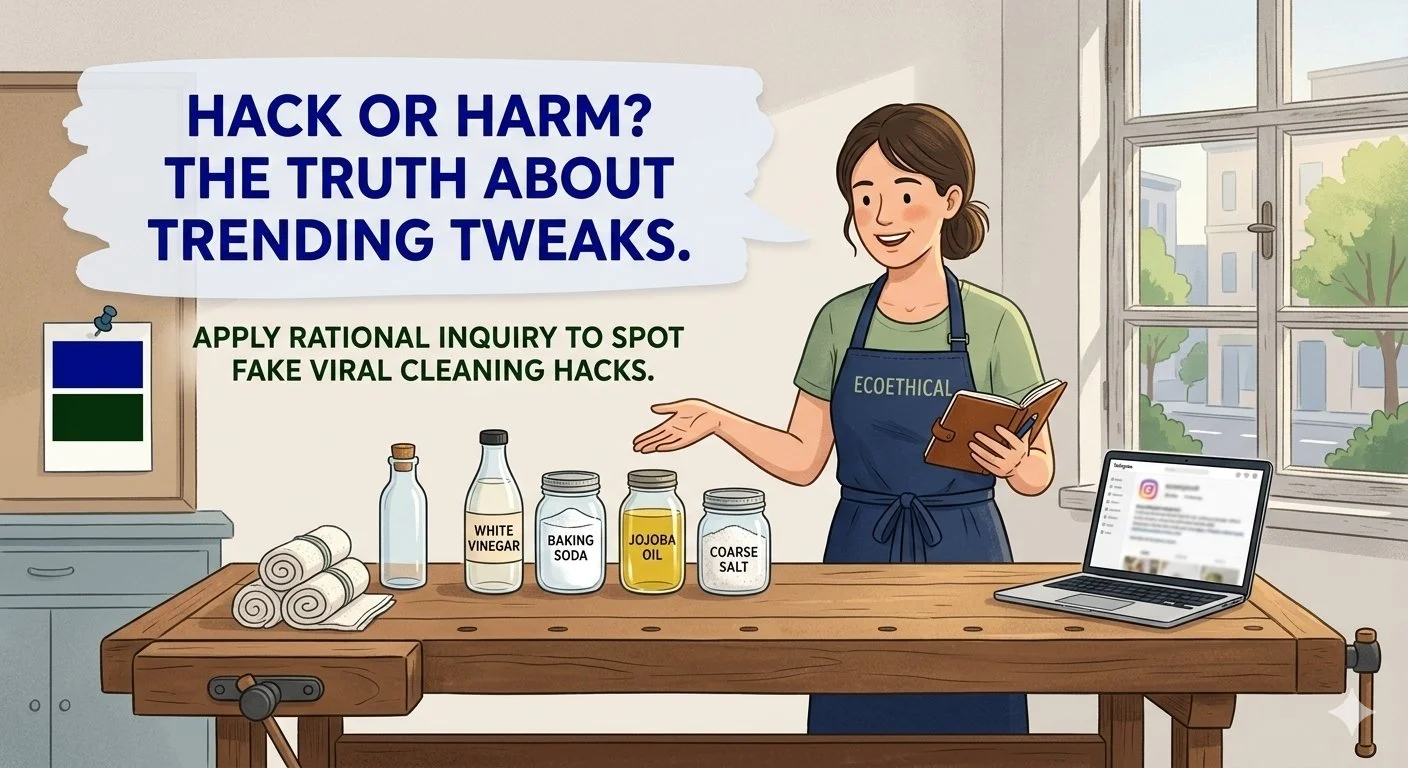
Why social media cleaning hacks are often wrong (and how to spot the bad advice)
You've seen them: viral cleaning hacks promising miracle results with common household items. But here's the uncomfortable truth—many of these tips don't work, and some can permanently damage your home. The problem isn't just uninformed creators; it's that social media's structure incentivizes engagement over accuracy. Algorithms reward novelty and controversy, not truth. Creators need constant content to earn money, which leads to untested methods going viral. Before trying that trending hack, learn to spot logical fallacies, understand basic chemistry, and apply rational inquiry. Your surfaces—and your wallet—will thank you.
You're scrolling through Instagram at 11 PM when you see it: a video of someone mixing dish soap, vinegar, and baking soda into a bottle, claiming it's the "ultimate all-purpose cleaner that professionals don't want you to know about." The comments are filled with fire emojis and people tagging their friends. It has 2.3 million views. It must work, right?
Not necessarily. In fact, probably not.
Welcome to the world of "cleanfluencers"—social media personalities who've built massive followings by sharing cleaning tips, hacks, and product recommendations. Some are knowledgeable professionals sharing genuinely helpful advice. But many are content creators who've discovered that cleaning videos get exceptional engagement, regardless of whether the advice actually works or could even damage your home.
The problem isn't just that bad cleaning advice wastes your time and money. It's that some of these viral hacks can make cleaning problems worse, permanently damage surfaces, or create dangerous chemical reactions that put your health at risk. And the very structure of social media—the algorithms, the monetization, the pressure to constantly create content—incentivizes quantity over accuracy.
If you've ever tried a viral cleaning hack that didn't work, damaged something, or left you wondering "wait, should I really be mixing those chemicals?", this article is for you. I’ll dig into how social media cleaning content actually works, why misinformation spreads so easily, and most importantly, how to tell the difference between legitimate advice and viral nonsense.
Let's start by understanding the landscape.
The cleanfluencer ecosystem: Where the content lives
Cleaning content has exploded across virtually every social media platform, but each one has its own flavour and format that shapes what gets shared.
TikTok: The viral hack factory
TikTok is ground zero for viral cleaning hacks, and it's easy to see why. The platform's algorithm is designed to surface engaging content to massive audiences quickly, regardless of the creator's follower count. A single video can go from zero to millions of views overnight.
What's trending: Quick transformations (often sped up), satisfying before-and-after reveals, "secret" product combinations, dramatic reactions to results, and controversial takes that spark debate in comments.
The format influence: TikTok videos max out at 10 minutes but perform best under 60 seconds. This creates pressure to oversimplify, skip important context (like safety warnings or surface compatibility), and prioritize visual drama over practical accuracy.
Popular cleanfluencers promote: Miracle product combinations (often chemically questionable), "forbidden" cleaning methods, extreme cleaning scenarios, and product "dupes" that supposedly work better than expensive alternatives.
Instagram reels: TikTok's slightly more polished cousin
Instagram Reels borrowed TikTok's format and many of the same trends have migrated over. The main difference is Instagram's slightly older, more affluent demographic.
What's trending: Aesthetic cleaning routines, product recommendations with affiliate links, home organization combined with cleaning, and luxury cleaning product showcases.
The format influence: Similar time constraints to TikTok, with added pressure for visual polish. This often means content is more styled but not necessarily more accurate.
Popular cleanfluencers promote: "Clean girl aesthetic" routines, expensive cleaning products positioned as investments, cleaning as self-care, and curated product collections.
YouTube: Long(er)-form content (but not always better)
YouTube allows for longer, more detailed content, which theoretically should mean more accurate information. Sometimes it does. Often it doesn't.
What's trending: Deep cleaning videos, product testing and reviews, cleaning routines, and "satisfying" cleaning compilations.
The format influence: Longer videos need to maintain engagement, which often leads to dramatic thumbnail promises ("I DIDN'T CLEAN MY OVEN FOR 5 YEARS"), clickbait titles, and stretched-out content with important information buried or omitted.
Popular cleanfluencers promote: Viral products (often the same ones being pushed on TikTok), cleaning product hauls, sponsored content disguised as genuine recommendations, and elaborate cleaning systems.
Facebook: Where misinformation gets shared by your aunt
Facebook cleaning content tends to be less about individual influencers and more about viral posts that get shared repeatedly through groups and personal networks.
What's trending: Text-based "miracle" cleaning recipes, before-and-after photos (often without methodology), cleaning group recommendations (some good, many questionable), and nostalgia-based cleaning methods ("my grandmother always did this").
The format influence: Facebook’s older demographic relies on different trust signals. People are more likely to trust advice that seems to come from peers or has been "tested" by their social network, even without verification.
Popular content promotes: DIY cleaner recipes (accuracy varies wildly), old wives' tales presented as proven methods, and products positioned as "chemical-free" alternatives.
Pinterest: The recipe card graveyard
Pinterest is where cleaning "recipes" go to be saved, reshared, and rarely fact-checked. It's a visual search engine where content gets divorced from its source and recirculated endlessly.
What's trending: Printable cleaning schedules, DIY cleaner recipes, infographics about cleaning methods, and "natural" cleaning solutions.
The format influence: Content is optimized for saving and sharing, not accuracy. Once a pin goes viral, it continues circulating regardless of whether it's been debunked.
Popular content promotes: All-purpose DIY cleaners (many chemically ineffective), cleaning "systems" and schedules, essential oil cleaning solutions, and visual before-and-after comparisons.
The economics of cleanfluencing: Why accuracy takes a back seat
Understanding why so much cleaning misinformation exists requires understanding how social media creators make money. The incentive structures don't reward accuracy, they reward engagement and volume.
How cleanfluencers actually make money
Creator fund payments (TikTok, YouTube): Platforms pay creators based on views and engagement. More videos = more views = more money. The accuracy of those videos? Not factored into payment.
Affiliate commissions:When a creator links to a product and you buy it, they earn a percentage (typically 3-10%). This creates incentive to recommend products whether they work well or not—the commission is the same either way.
Sponsored content: Brands pay creators directly to feature products. These deals can range from a few hundred dollars to tens of thousands for top creators. The creator's job is to make the product look good, not to provide unbiased assessment.
Ad revenue (YouTube): Longer videos with more ads generate more revenue. This incentivizes stretching content, adding drama, and creating series rather than comprehensive single videos.
Product lines and partnerships: Successful cleanfluencers often launch their own cleaning products or cleaning tools, creating financial incentive to drive followers toward those products specifically.
Course and e-book sales: Many cleanfluencers sell cleaning courses, guides, or systems—positioning themselves as experts, regardless of actual credentials.
The content treadmill problem
Social media algorithms reward consistency and frequency. Creators who post daily or multiple times per week get more algorithmic promotion than those who post weekly or monthly. This creates enormous pressure to constantly generate new content.
Here's the problem: there are only so many legitimate, tested, safe cleaning methods. Once you've covered the basics, you need to either:
Repeat yourself (which gets boring and hurts engagement)
Go deeper with proper research (time-consuming and doesn't guarantee virality)
Start making things up or sharing untested methods (fast, novel, and more likely to go viral)
Guess which option most creators choose?
The virality trap
Not all content performs equally. Social media algorithms prioritize content that generates engagement—comments, shares, saves, and watch time. What generates engagement?
Content that works moderately well: Gets a polite "thanks for sharing" and a few saves.
Content that's shocking, controversial, or seemingly revolutionary: Gets massive engagement as people debate, share with friends, and express surprise.
This creates perverse incentives. A video showing the correct way to clean hardwood floors (barely-damp mop, pH-neutral cleaner) might get 10,000 views. A video claiming you can clean hardwood floors with a mixture of vinegar, olive oil, and lemon juice (don't do this!) might get 5 million views because it's novel, surprising, and sparks debate in the comments.
The algorithm doesn't care that the second video will damage people's floors. It only cares that more people are engaging with it.
The credibility problem
Here's an unsettling truth: you don't need credentials, training, or expertise to become a cleanfluencer. You just need a camera and a willingness to create content.
Some popular cleaning content creators are former professional cleaners or have relevant education. Many are not. Some are simply people who like cleaning and started sharing videos. Some actively misrepresent their expertise to build authority.
The platforms don't verify credentials or fact-check content (except in narrow cases like medical or electoral misinformation). There's no quality control. Terrible advice and excellent advice look exactly the same in your feed—it's up to you to tell the difference.
The echo chamber effect
Once a creator builds an audience, they're surrounded by followers who trust them. Negative feedback gets filtered out (comments can be deleted, critics can be blocked), and the creator receives constant positive reinforcement regardless of content accuracy.
This creates an environment where creators can genuinely believe they're providing good advice even when they're not. They see thousands of comments saying "this worked great!" (often from people who haven't actually tried it, or who can't yet see the long-term damage), and dismiss the occasional "this damaged my countertop" comment as user error.
The bottom line
The economic model of social media content creation rewards:
Volume over accuracy
Novelty over effectiveness
Engagement over truth
Entertainment over education
This doesn't mean all cleanfluencers are intentionally spreading misinformation. Many believe they're helping. But the system they operate within actively incentivizes the spread of questionable advice, and that's what we need to understand to protect ourselves.
Common logical fallacies in viral cleaning content
Now that we understand why misinformation spreads, let's talk about how to spot it. Viral cleaning content relies heavily on logical fallacies—errors in reasoning that make bad arguments seem convincing. Here are the most common ones you'll encounter.
Appeal to nature ("it's natural, so it's better")
What it sounds like: "This all-natural cleaner uses only ingredients you can pronounce!" or "Why use harsh chemicals when vinegar and essential oils work just as well?"
Why it's a fallacy: "Natural" doesn't mean safe, effective, or appropriate. Arsenic is natural. So is poison ivy. Many synthetic cleaning products are safer and more effective than natural alternatives for specific tasks. The issue isn't whether something is natural or synthetic—it's whether it works safely for the intended purpose.
Example in the wild: A TikTok video promoting essential oil cleaning spray for disinfection. Essential oils smell nice, but they're not EPA-approved disinfectants and won't kill dangerous bacteria or viruses. Claiming they're "better because they're natural" is both misleading and potentially dangerous—especially if you have pets.
Appeal to tradition ("my grandmother did this")
What it sounds like: "This is how people cleaned before all these chemicals existed" or "Old-fashioned methods are always better."
Why it's a fallacy: Traditional methods aren't inherently better. We've developed new approaches because old ones often weren't effective or were unnecessarily labour-intensive. Yes, some traditional methods work well. Others persist despite being suboptimal. Tradition alone isn't evidence of effectiveness.
Example in the wild: Posts claiming you should clean everything with vinegar because "that's what people used to do." While vinegar has legitimate uses, it's not appropriate for all surfaces.
Anecdotal evidence ("it worked for me")
What it sounds like: "I've been doing this for years and never had a problem" or "Everyone in the comments says this worked for them!"
Why it's a fallacy: Individual experiences don't constitute reliable evidence. People might not notice slow damage, might be using different surfaces or products than you, might have different definitions of "clean," or might be experiencing placebo effect. Thousands of anecdotes still aren't the same as controlled testing.
Example in the wild: A viral post about using bleach on grout with hundreds of comments saying "this worked great!" Missing context: bleach can break down grout over time, but the damage isn't immediately visible. The people celebrating success might discover deteriorating grout years later without connecting it to the method.
False equivalence ("it's just like...")
What it sounds like: "If it can clean your toilet, imagine what it can do for your sink!" or "This removes stains from clothes, so it'll work on upholstery too."
Why it's a fallacy: Different surfaces have different properties, tolerances, and cleaning requirements. A method that works on one surface can damage another. Materials aren't interchangeable just because they seem similar.
Example in the wild: Videos suggesting you can clean natural stone countertops the same way you clean laminate. Stone is porous and acid-sensitive; many cleaners safe for laminate will permanently damage stone.
Cherry-picking ("look at this amazing result!")
What it sounds like: Before-and-after photos showing dramatic improvements, without mentioning failed attempts, time required, or special circumstances.
Why it's a fallacy: Showing only successes while hiding failures creates false impression of reliability. Maybe this method worked once out of ten tries. Maybe the "before" photo was staged to look worse. Maybe important context was omitted.
Example in the wild: A dramatic before-and-after of a "miracle" grout cleaner, without mentioning that the grout was sealed beforehand, the creator used professional-grade equipment, and it took four hours of work.
Appeal to authority (misrepresented)
What it sounds like: "Professional cleaners use this" or "This is what experts recommend" (without citing actual sources or when the creator isn't actually a professional).
Why it's a fallacy: Vague appeals to unnamed authorities aren't evidence. Even when sources are cited, they might be misrepresented or taken out of context. Credentials matter, but they need to be verifiable and relevant.
Example in the wild: A creator claiming "professional cleaners swear by this mixture" when promoting a homemade solution that most professionals would never use because better alternatives exist.
Hasty generalization ("this cleans everything")
What it sounds like: "The only cleaner you'll ever need!" or "Use this on literally any surface in your home."
Why it's a fallacy: No single cleaner is appropriate for every surface. Different materials require different approaches. Universal claims are almost always overstated.
Example in the wild: Videos promoting a single DIY mixture for cleaning everything from windows to hardwood floors to granite countertops. In reality, what's safe for glass might damage wood, and what's fine for sealed surfaces might etch stone.
Correlation implies causation ("I did this and that happened")
What it sounds like: "I started using this method and my surfaces look better than ever!" without considering other factors.
Why it's a fallacy: Just because two things happened together doesn't mean one caused the other. Maybe they also started cleaning more frequently. Maybe they replaced old sponges. Maybe seasonal humidity changed. Maybe they’re simply paying more attention now.
Example in the wild: Someone credits their DIY cleaner for improved results when they've also switched to better cloths and started cleaning twice as often. The improvement might have nothing to do with the cleaner itself.
Conspiracy thinking ("they don't want you to know this")
What it sounds like: "Big Cleaning doesn't want you to know about this simple solution" or "The cleaning industry hates this one simple trick."
Why it's a fallacy: Implying there's a conspiracy to hide effective methods positions questionable advice as "secret knowledge" while dismissing legitimate criticism as industry protection. It's a rhetorical shield against fact-checking.
Example in the wild: Videos claiming that mixing dish soap, vinegar, and baking soda is a "secret" that cleaning product companies don't want you to know—when actually, this mixture is chemically ineffective (the acid and base neutralize each other) and professionals don't use it because it doesn't work.
Recognizing fallacies in the wild
These fallacies rarely appear alone. A typical viral cleaning video might combine appeal to nature ("all-natural ingredients!"), anecdotal evidence ("worked perfectly for me!"), hasty generalization ("cleans everything!"), and conspiracy thinking ("they don't want you to know!") all in 60 seconds.
Learning to recognize these patterns helps you evaluate claims more critically, regardless of how many views or likes they have.
How to apply rational inquiry to cleaning hacks
Now that you can spot logical fallacies, let's talk about how to actually evaluate cleaning advice using rational inquiry—a systematic approach to determining what's likely true versus what's likely nonsense.
Step 1: Consider the source
Ask yourself:
Does this person have relevant credentials or professional experience?
Do they disclose potential conflicts of interest (sponsorships, affiliates, their own products)?
Do they cite sources for their claims or just present personal opinion?
What's their content history? Are they primarily an entertainer or educator?
Do they acknowledge limitations and risks, or only promote benefits?
Red flags:
No identifiable expertise in cleaning, chemistry, or materials science
Every video promotes products with affiliate links
Claims of being a "professional" without specifics about experience
Credential misrepresentation ("I worked in a cleaning company" could mean they were a receptionist)
Defensive or dismissive responses to legitimate questions
Green flags:
Verifiable professional experience (business name, years in industry)
Transparent about sponsorships and conflicts of interest
Cites specific sources (studies, manufacturers, industry standards)
Acknowledges when they don't know something
Discusses trade-offs and limitations of methods
Step 2: Understand the chemistry
You don't need a chemistry degree, but understanding basic principles helps immensely:
Acids and bases neutralize each other. Mixing vinegar (acid) with baking soda (base) creates mostly water and carbon dioxide. The bubbling looks impressive but actually reduces cleaning effectiveness. If a video promotes this combination as a miracle cleaner, the creator doesn't understand basic chemistry.
Not all cleaners are interchangeable. Surfactants (like dish soap) work differently than solvents (like alcohol) which work differently than abrasives (like baking soda) which work differently than oxidizers (like bleach). Different cleaning problems require different approaches.
"Natural" chemicals are still chemicals. Vinegar is acetic acid. Baking soda is sodium bicarbonate. Essential oils are complex chemical compounds. Being derived from nature doesn't change their chemical properties or make them universally safe.
Some chemical reactions are dangerous. Mixing bleach with vinegar or ammonia creates toxic gases. Combining certain cleaners can damage surfaces or create hazardous fumes. "Experiment and see what works" is dangerous advice.
pH matters for surfaces. Acidic cleaners (vinegar, lemon juice) will etch natural stone, damage grout sealant, and can strip wood finishes. Alkaline cleaners can damage some metals and finishes. The right cleaner depends on the surface.
Step 3: Think about surface compatibility
Before trying any cleaning method, ask:
What material am I cleaning? Natural stone? Sealed or unsealed wood? Laminate? Stainless steel? Glass? Ceramic? The answer determines what will be safe to use.
Does it have a protective coating? Many surfaces have finishes, sealants, or coatings that can be damaged even when the underlying material is durable. Abrasives can dull glossy paint. Acids and bases can strip sealants. Solvents can damage many finishes.
How hard is the surface? If a method involves abrasion (like Magic Erasers or powdered cleaners), is the abrasive softer or harder than the surface? Harder abrasives will scratch.
Is the surface porous or non-porous? Porous surfaces (unsealed stone, unfinished wood, grout) absorb liquids and can be damaged by too much moisture or stained by coloured cleaners.
What does the manufacturer recommend? If your flooring, countertops, or appliances came with care instructions, those should be your starting point. Warranty-voiding methods should raise red flags.
Step 4: Look for verifiable evidence
Strong evidence includes:
Peer-reviewed studies
Manufacturer testing and specifications
Industry standards and recommendations (from organizations like IICRC, ISSA, or BSCAI)
Repeated validation from independent sources
Long-term results documentation (not just immediate before-and-after)
Weak evidence includes:
"Everyone says this works" (appeal to popularity)
Before-and-after photos without methodology
Testimonials without verification
Viral spread without fact-checking
Claims without sources
Questions to ask:
Can I find this method recommended by multiple credible sources?
Do professional cleaners actually use this technique?
Are there any professional organizations or manufacturers that endorse this?
What happens if I search for "<method name> + damage" or "<method name> + doesn't work"?
Are there any long-term studies or tests of this method?
Step 5: Consider what's being left out
Viral content optimizes for engagement, not completeness. What important information might be missing?
Common omissions:
Safety warnings (ventilation, chemical reactions, protective equipment)
Surface compatibility limitations ("works great!" ...on what exactly?)
Time requirements (sped-up video hides that it took two hours)
Special conditions (their water is soft; yours is hard)
Product specifications (not all “dish soap" is identical)
Failure rate (how often does this not work?)
Long-term effects (it looks good now, how about in a week?)
Cost analysis (is this actually cheaper than the alternatives?)
Skill requirements (is this only easier for someone with lots of experience?)
Red flag questions:
Why isn't this person showing themselves doing this in real-time?
Why are there no cautionary statements about what not to do?
Why don't they specify which surfaces this works on?
Why isn't there any mention of what could go wrong?
Step 6: Test conservatively (if you decide to try it)
If a method seems plausible after your evaluation, test it cautiously:
Start with an inconspicuous area. Look for a hidden spot inside a cabinet, behind furniture, or in a low-traffic area. Never start with the most visible surface.
Use the mildest version first. If they recommend concentrated vinegar, try it diluted first. If they say scrub hard, try gentle pressure first.
Wait and observe. Immediate results aren't the only concern. Check again in 24 hours, one week, and one month for delayed damage like discolouration, dullness, or deterioration.
Document your test. Take photos before, immediately after, and during follow-up checks (under the same lighting conditions). This helps you notice subtle changes.
Stop at the first sign of problems. If you notice any dulling, discolouration, texture change, or surface damage, stop immediately. Don't assume it will get better or that you're "doing it wrong."
Compare to known-good methods. Test both the viral method and a conventional approach. Which actually works better? Is the viral method really superior, or just novel?
Step 7: Update your conclusions as you learn
Rational inquiry isn't about being right immediately—it's about being willing to change your mind when evidence warrants it.
Be willing to admit:
"I thought this would work, but it didn't"
"This seemed safe, but it caused damage"
"The viral video made this look easy, but it's actually complicated"
"I was wrong to recommend this to friends"
Keep learning:
Pay attention to long-term results of methods you've tried
Notice if professional cleaners avoid methods that are popular online
Stay updated on product recalls or safety warnings
Be skeptical of your own confirmation bias (wanting something to work because it's convenient or popular)
This process sounds like a lot of work, and sometimes it is. But it gets faster with practice, and it's far less work than repairing damaged surfaces or dealing with ineffective cleaning methods.
Case study: The viral dawn + vinegar shower cleaner
Let's apply everything we've discussed to one of the most viral cleaning hacks online: the Dawn dish soap and vinegar mixture for cleaning soap scum in showers.
The claim
Across TikTok, Instagram, and Pinterest, you'll find thousands of posts claiming that mixing equal parts Dawn dish soap with white vinegar creates an incredible shower cleaner that removes soap scum effortlessly. The promise: spray it on, wait 30 minutes, wipe off, and your shower will be spotless without scrubbing.
Step 1: Consider the source
What we find:
This hack appears across thousands of accounts, from professional cleaners to home accounts
Most posts don't explain why this works, just that it does
Many include affiliate links to spray bottles or cleaning supplies
Some sources have cleaning experience; many don't
Almost none discuss limitations or risks
Initial assessment: The widespread sharing suggests some people find it effective, but lack of expertise in many sources and absence of risk discussion is concerning.
Step 2: Understand the chemistry
Dawn dish soap is a surfactant that breaks down oils and grease. This is why it's excellent for dishes—it lifts away food oils.
White vinegar is acetic acid (typically around a 5% concentration), which can dissolve mineral deposits and cut through some types of buildup.
When combined: The acid (vinegar) and the surfactant (Dawn) don't neutralize each other the way an acid and base would, so theoretically both components could work in the mixture. The surfactant helps the vinegar spread and cling to surfaces, and the acid helps break down soap scum (which often contains mineral deposits).
Chemical plausibility: Unlike the baking soda + vinegar combination, this mixture isn't chemically nonsensical. The components can work together.
Concerns:
Vinegar is acidic and can damage certain surfaces
The mixture doesn't have any controlled ratio or standardized formulation
Different brands of dish soap have different formulations
"Wait 30 minutes" means prolonged acid exposure to surfaces
Step 3: Think about surface compatibility
Where this might be safe:
Ceramic tile (glazed)
Porcelain fixtures
Glass shower doors
Where this could cause damage:
Natural stone (marble, travertine, limestone, slate)—acid will etch
Grout —acid can break down both the sealant and binder of grout, making it more brittle
Some metal finishes (brushed nickel, chrome, oil-rubbed bronze)
Acrylic shower surrounds (the acid can dull the finish over time)
Key realization: Most viral posts don't specify which surfaces are safe. They present this as universal, but it's not appropriate for all shower types.
Step 4: Look for verifiable evidence
What we find:
Lots of anecdotal "this worked for me!" testimonials
Before-and-after photos (though cleaning methodology isn't always clear)
Some professional cleaners endorse modified versions
No manufacturer recommendations to combine these products
Some reports of damage to grout and stone surfaces
Mixed reviews on effectiveness—works well for some, not at all for others
Assessment: Evidence is mostly anecdotal. Success seems highly dependent on water hardness, shower surfaces, and severity of soap scum buildup.
Step 5: Consider what's being left out
Common omissions in viral posts:
No mention that this will damage natural stone
No mention that this works best on fresh soap scum, not years of buildup
No comparison to commercial soap scum removers
No discussion of grout sealant degradation with repeated use
No mention that different water types affect results
Why this matters: People try this on marble showers, expecting it to remove years of neglect, and wind up with damaged stone.
Step 6: The reality check
When we apply rational inquiry, here's what we learn:
What's accurate:
This mixture CAN remove soap scum from appropriate surfaces
The chemistry makes sense
It's less toxic than some commercial cleaners
For mild soap scum on safe surfaces, it can work reasonably well
What's overstated:
It's not a miracle solution—commercial soap scum removers often work better
It doesn't work "without scrubbing" for anything beyond light buildup
It's not safe for all shower surfaces
It's not a "professional secret"—professionals typically use variations of this approach daily
What's missing:
Surface safety warnings
Proper ventilation requirements
Realistic expectations about scrubbing needs
Long-term effects on grout sealant
Comparison to purpose-made products
Step 7: The informed conclusion
Is this hack completely wrong? No. It can work for certain applications.
Is it presented accurately online? No. It's oversold, limitations are hidden, and risks are ignored.
Should you use it? Maybe, with important caveats:
Safe for ceramic tile (keep if off grout) and glass shower doors
Effective for mild-to-moderate soap scum
Still requires scrubbing for tough buildup
Test in inconspicuous area first
Never use on natural stone showers
Not dramatically better than quality commercial cleaners
Can destroy unsealed grout and degrade grout sealant with frequent use
Better approach: For ceramic tile and glass showers, a quality commercial soap scum remover is often more effective, faster-acting, and formulated to be safe for typical bathroom surfaces. If you prefer DIY, this mixture can work—but understand its limitations and use it appropriately.
The lesson
Even when a viral hack has some legitimate basis, the way it's presented online often strips away crucial context, overstates benefits, and hides risks. Your job isn't to reject everything from social media—it's to evaluate it critically and understand what you're really doing.
Final thoughts: Becoming a smarter consumer of cleaning content
Social media has democratized information sharing, and that's brought both benefits and problems. Anyone can share cleaning tips—which means both expert professionals and complete amateurs have equal voices. The algorithm doesn't distinguish between them.
In my opinion, this isn’t going to change anytime soon. Platforms will continue to prioritize engagement over accuracy. Cleanfluencers will keep creating content under the same economic pressures. Viral misinformation will continue to spread as long as controversy and novelty gets more views than careful, measured advice.
What can change is how you engage with this content.
Remember these key principles:
Virality doesn't equal validity. A video with 10 million views isn't more accurate than one with 10,000. It's just more engaging—and sometimes misinformation is more engaging than truth.
Entertainment and education aren't the same thing. Enjoy satisfying cleaning videos for what they are, but don't assume dramatic transformations represent realistic, safe methods.
Credentials matter. A professional cleaner's advice generally carries more weight than a home content creator's, though neither is infallible. Look for verifiable expertise.
If it sounds too good to be true, it probably is. "One ingredient cleans everything!" No, it doesn't. "This miracle method professionals don't want you to know!" They're probably not using it because it doesn't work well.
Your surfaces are not worth risking. Replacing damaged countertops, refinishing floors, or repairing etched stone is expensive. When in doubt, err on the side of caution and use methods with established track records.
Chemical reactions are real. Mixing random products together is not "experimenting"—it's potentially creating dangerous situations or ineffective solutions. Understand what you're combining and why.
Context matters enormously. What works for someone with soft water might not work with hard water. What's safe for their floors might damage yours. Surface compatibility isn't optional information.
The good news is that you don't need to become a cleaning expert or chemistry major. You just need to think critically, ask good questions, and be willing to research before trying something that could cause harm or waste your time.
Professional cleaning isn't about secrets or tricks. It's about understanding surfaces, choosing appropriate methods and products, and applying them correctly. That knowledge comes from experience, training, and yes—sometimes from social media, when the source is credible and the advice is sound.
The next time you see a viral cleaning hack, you'll know how to evaluate it. That's real power—not the power to remove a stain in 10 seconds, but the power to distinguish what actually works from what just looks impressive in a 60-second video.
And that's worth more than any cleaning hack.
Tired of sorting through conflicting cleaning advice? EcoEthical Cleaning strives to bring professional expertise and planet-safe, science-based methods to every job. Contact me for a free, no-obligation estimate. Proudly serving Toronto’s Harbourfront and surrounding neighbourhoods.
Sources & further reading
"Does Influencer Marketing Really Pay Off?", Harvard Business Review
"Fallacies", Stanford Encyclopedia of Philosophy
"Use household chemicals safely", Health Canada
“Cleaning products—working safely”, Canadian Centre for Occupational Health and Safety
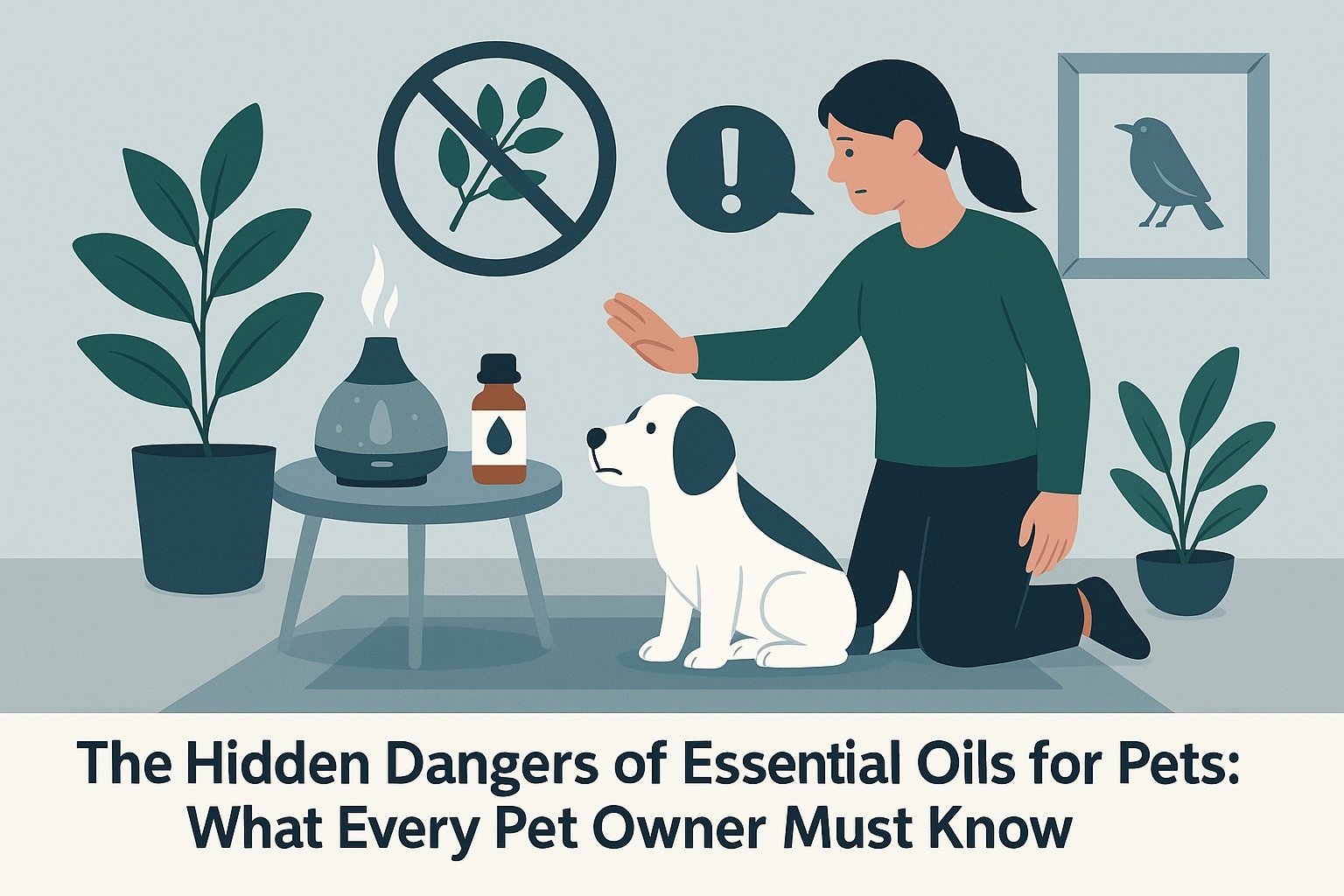
Not all natural scents are safe: A guide to essential oil use around pets
That lavender diffuser creating a calming atmosphere? It could be slowly poisoning your cat. Essential oils—marketed as natural and therapeutic—are metabolic toxins for pets, particularly cats and birds. Their bodies lack the enzymes to process these concentrated plant compounds, leading to toxic buildup even from low-level exposure. Symptoms range from drooling and vomiting to liver failure and death. The danger isn't just diffusers—essential oils hide in "natural" cleaning products, personal care items, and air fresheners throughout your home. Understanding these risks and switching to genuinely pet-safe alternatives can prevent tragedy and keep your companions healthy.
You've just set up your new lavender diffuser, enjoying the calming aroma filling your living room. Your cat walks in, sniffs the air, and retreats to another room. You think nothing of it—cats are particular creatures, after all.
But what you don't see is your cat's liver struggling to process phenolic compounds it has no ability to metabolize. What seems like a harmless wellness choice for you could be slowly poisoning your pet.
Essential oils have become ubiquitous in Toronto homes, marketed as natural solutions for everything from stress relief to household cleaning. The global essential oils market is booming, and wellness influencers promote them as safe, plant-based alternatives to synthetic products.
But there's a dangerous knowledge gap: what's therapeutic for humans can be toxic—even fatal—for pets. Many pet owners never connect their pet's declining health to the products they're using daily.
If you have pets and use essential oils—whether in diffusers, cleaning products, personal care items, or for aromatherapy—you need to understand the risks. This comprehensive guide will explain why essential oils are dangerous for animals, which ones pose the greatest threats, how to recognize toxicity symptoms, and what safer alternatives exist for pet-owning households.
Your pet's health may depend on understanding this information.
Why essential oils are dangerous for pets
The fundamental problem is that pets are not small humans. Their bodies process substances entirely differently, and what's safe for us can be toxic for them.
Metabolic differences
Cats lack crucial liver enzymes:Feline livers don't produce glucuronyl transferase, an enzyme necessary for metabolizing phenolic compounds and terpenes found in many essential oils. Without this enzyme, these compounds accumulate in the cat's system, causing progressive toxicity even from low-level exposure.
Dogs have limited detoxification capacity: While dogs have better metabolic capacity than cats, they're still far more sensitive than humans. Their livers are smaller relative to body weight, and they metabolize substances differently. What might cause mild irritation in a human can overwhelm a dog's system.
Birds have hyper-sensitive respiratory systems: Avian respiratory systems are incredibly efficient—which also makes them incredibly vulnerable. Birds lack a diaphragm and have air sacs throughout their bodies that make their entire system exposed to airborne toxins. This is why canaries were historically used in coal mines—they showed distress from toxic gases before humans did.
Even brief exposure to diffused essential oils can cause respiratory distress in birds. There's essentially no safe level of exposure for most pet birds.
Small mammals face dose-dependent risk: Rabbits, guinea pigs, ferrets, hamsters, and other small pets have tiny body masses and fast metabolisms. A concentration that seems insignificant to a 70kg human is massive to a 1kg rabbit. Their small size means faster absorption and more severe effects.
Reptiles and amphibians are also vulnerable: While less commonly discussed, reptiles and amphibians can suffer from essential oil exposure, particularly through skin absorption (for amphibians) or respiratory exposure (for reptiles). Their unique metabolisms provide no protection.
How essential oils enter your pet's system
Essential oils don't need to be ingested to cause harm. There are multiple exposure routes, many of which pet owners don't consider:
Inhalation (the most common route): When you run a diffuser, you're creating an aerosol of essential oil particles suspended in air. Pets breathing this air absorb compounds through their lungs directly into their bloodstream, bypassing some natural defenses. Cats and birds are particularly vulnerable to this route.
Dermal absorption: Essential oils applied to human skin can transfer to pets through petting. Oils spilled on surfaces where pets walk can be absorbed through paw pads (which have thinner skin than you might think). Direct application to pet fur or skin—sometimes done by well-meaning owners following bad advice—causes rapid absorption.
Ingestion: Pets groom themselves constantly. Any essential oil that lands on their fur gets ingested during grooming. Cats are particularly at risk here due to their meticulous grooming habits. Pets may also ingest oils by licking surfaces where oils have been used or spilled.
Environmental accumulation: Repeated low-level exposure from daily diffuser use, essential oil cleaning products, or oil-based air fresheners causes accumulation. The compounds build up faster than the pet can eliminate them, leading to chronic toxicity.
Concentration matters—And it's often unknown
Most essential oils are highly concentrated. Those concentrations are far beyond anything found in nature.
Pet owners often don't realize how potent these products are. "Just a few drops" in a diffuser might seem minimal, but it's creating an environment where your pet is constantly inhaling concentrated plant compounds their body cannot process.
Making matters worse, unless an essential oil is registered as a Natural Health Product in Canada, it is largely unregulated. For the vast majority of oils sold for aromatherapy or home use, there are no standardized concentration requirements or mandatory purity tests. The bottle might say 'pure lavender,' but without a natural product number (NPN) or third-party lab report, you have no way to verify if it contains synthetic additives, pesticides, or hidden solvents.
The "natural" fallacy
Perhaps the most dangerous misconception is that "natural equals safe." This thinking leads people to use essential oils liberally around pets, assuming plant-based products are automatically harmless.
But toxicity isn't about synthetic vs. natural—it's about chemistry and biology. Many of the most lethal substances known are completely natural: hemlock, death cap mushrooms, botulinum toxin, snake venom. All natural. All deadly.
Essential oils are natural, yes. They're also concentrated chemical compounds that evolved in plants as defense mechanisms against insects and herbivores. Their purpose is literally to deter or harm creatures that threaten the plant. Your pet's body recognizes them as the toxins they are.
Common symptoms of essential oil toxicity in pets
Recognizing toxicity symptoms quickly can make the difference between minor illness and tragic outcomes. However, symptoms vary widely depending on the oil, concentration, exposure route, and individual pet sensitivity.
Acute symptoms (immediate to several hours post-exposure)
Respiratory distress:
Difficulty breathing or laboured breathing
Coughing or wheezing
Rapid, shallow breathing
Open-mouth breathing in cats (a sign of severe distress)
Nasal discharge
In birds: tail bobbing with each breath, stretched neck, open beak breathing
Gastrointestinal symptoms:
Drooling or excessive salivation (particularly in cats)
Vomiting
Diarrhea
Lack of appetite
Abdominal pain (indicated by hunched posture, reluctance to move)
Neurological symptoms:
Lethargy or unusual tiredness
Weakness or difficulty walking
Tremors or muscle twitching
Lack of coordination or stumbling
Seizures
Depression or unresponsiveness
Dermal symptoms (from direct contact):
Redness or irritation at application site
Excessive scratching or licking at affected area
Skin burns or chemical burns in severe cases
Hair loss at contact point
Other acute signs:
Excessive pawing at face or mouth
Dilated pupils
Low body temperature
Elevated heart rate
Collapse
Chronic symptoms (from repeated low-level exposure)
Many pet owners never connect chronic health issues to essential oil use because the decline is gradual. Watch for:
Progressive liver damage (particularly in cats):
Jaundice (yellowing of eyes, gums, or skin)
Increased thirst and urination
Weight loss despite normal appetite
Vomiting
Behavior changes
Eventually progressing to liver failure
Respiratory issues:
Chronic coughing
Recurring respiratory infections
Reduced activity tolerance (tiring easily)
Persistent nasal discharge
Behavioral changes:
Avoiding certain rooms (where diffusers run)
Increased hiding behavior
Reduced grooming (feeling unwell)
Aggression or irritability from discomfort
Changes in vocalization patterns
Reduced quality of life indicators:
Decreased appetite over time
Weight loss
Reduced playfulness or interaction
Sleeping more than usual
General malaise
Species-specific warning signs
Cats: Watch for any behavior change, hiding, reduced grooming, excessive drooling, difficulty jumping, or avoiding areas where you use oils. Cats hide illness instinctively, so subtle changes matter.
Dogs: Vomiting, drooling, weakness, and tremors are common early signs. Dogs may also show food aversion or refuse to enter rooms where oils are diffused.
Birds: Any respiratory change is an emergency. Watch for tail bobbing, open-beak breathing, listlessness, loss of voice, regurgitation, or fluffed-up appearance. Birds deteriorate quickly—what looks like mild distress can become fatal within hours.
Small mammals: Lethargy, decreased appetite, laboured breathing, or unusual stillness are concerning. These animals are prey species that hide illness, so any visible symptom represents a serious problem.
When to seek emergency veterinary care
Immediate emergencies (go to an emergency vet right away):
Difficulty breathing or respiratory distress
Seizures or tremors
Collapse or inability to stand
Severe vomiting or diarrhea
Unresponsiveness or extreme lethargy
Known ingestion of essential oils
Any symptom in birds (they decline rapidly)
Urgent care (contact vet as soon as possible):
Persistent vomiting or diarrhea
Excessive drooling
Lack of appetite for more than 12 hours
Weakness or difficulty walking
Unusual behavior changes
Any other symptom that concerns you—trust your instincts
For reference: Keep the Pet Poison Helpline number readily available: 1-800-213-6680 (available 24/7, fees apply). In Toronto, emergency veterinary hospitals include Toronto Veterinary Emergency Hospital, Veterinary Emergency Clinic, and others.
Don't wait to see if symptoms resolve. With essential oil toxicity, early intervention dramatically improves outcomes.
Essential oils that are particularly harmful to pets
While virtually all essential oils pose some risk, certain ones are especially toxic and should be completely avoided in homes with pets.
The most dangerous essential oils
Tea tree oil (Melaleuca): Perhaps the most commonly implicated in pet poisonings. Even small amounts cause severe toxicity in both cats and dogs. Symptoms include muscle tremors, weakness, difficulty walking, hypothermia, and depression. Cats are particularly vulnerable—as little as 7-8 drops can be fatal. Tea tree oil is commonly found in cleaning products, shampoos, skin treatments, and diffuser blends, making accidental exposure common.
Eucalyptus oil: Highly toxic to cats and dangerous to dogs and birds. Causes drooling, vomiting, diarrhea, weakness, and breathing difficulties. Particularly dangerous because it's commonly used in cleaning products, cold remedies, and aromatherapy, meaning pets encounter it frequently.
Citrus oils (lemon, orange, lime, grapefruit, bergamot): Contain d-limonene and linalool, both toxic to cats and dogs. Cause gastrointestinal upset, central nervous system depression, skin irritation, and potential liver damage with chronic exposure. The appealing scent leads many people to use these oils liberally, increasing risk.
Peppermint and spearmint oils: Contain menthol and pulegone, which cause vomiting, diarrhea, nervous system issues, and liver damage. Particularly problematic because these oils are popular for cleaning and air freshening, creating constant low-level exposure.
Pine oil: Frequently found in cleaning products, especially those marketed as "natural" or "forest fresh." Causes liver damage, kidney damage, respiratory irritation, and central nervous system depression. The widespread use in household cleaners makes this a hidden danger.
Pennyroyal oil: Extremely toxic. Even small amounts cause liver failure and can be fatal. Sometimes used in flea repellent products—never use these on or around pets.
Wintergreen oil: Contains high concentrations of methyl salicylate (similar to aspirin). Causes severe gastrointestinal upset, respiratory failure, and can be fatal. As little as one teaspoon can kill a cat.
Ylang ylang oil: Causes breathing difficulty, weakness, and central nervous system depression in both cats and dogs. Sometimes used in calming blends, ironically causing distress in pets.
Oils that are commonly thought "safe" but still risky
Lavender oil: Often promoted as pet-friendly, but this is misleading. While less immediately toxic than tea tree or eucalyptus, lavender still contains linalool and linalyl acetate, which cats metabolize very slowly. Chronic exposure causes toxicity, particularly liver stress. In dogs, large amounts cause depression and digestive upset. For birds, any exposure to diffused lavender is dangerous.
Chamomile oil: Contains coumarins and other compounds that can cause contact dermatitis, digestive upset, and allergic reactions. Less acutely toxic than some oils, but not safe for regular use around pets.
Cedarwood oil: Can cause vomiting, changes in heart rate, and skin irritation. Sometimes used in natural flea products, but poses toxicity risk with regular use.
Clove oil: Contains eugenol, which is toxic to pets at relatively low concentrations. Causes liver damage, respiratory distress, and nervous system issues.
Why "pet-safe" essential oil marketing is misleading
Many companies market essential oil products as "pet-safe" or "pet-friendly." This is often irresponsible marketing that prioritizes sales over safety. Here's what you need to know:
There are no truly safe essential oils for cats: Due to their metabolic deficiency, cats cannot safely process essential oils. There is no "safe" option for regular exposure—only oils that cause acute toxicity more slowly. Saying an oil is "safe for cats" is like saying a food is "safe for someone with severe allergies" because it takes longer to cause anaphylaxis.
"Less toxic" doesn't mean "safe": Some oils are less immediately dangerous, but chronic exposure still causes problems. Marketing them as "safe" ignores cumulative toxicity.
Dilution doesn't eliminate risk: While dilution reduces immediate toxicity risk, it doesn't eliminate the fundamental problem that pets cannot metabolize these compounds. Diluted oils in diffusers still create inhalable exposure.
Hydrosols aren't necessarily safe either: Hydrosols (floral waters from essential oil production) are less concentrated, but they still contain aromatic compounds that can affect pets, particularly with regular exposure. They're somewhat safer than pure essential oils, but not risk-free.
Hidden sources of essential oil exposure
Many pet owners think they don't use essential oils because they don't have a diffuser. But essential oils are ubiquitous in modern products, creating exposure you might not recognize.
Household cleaning products
"Natural", "green", or DIY cleaners: Products and recipes marketed as eco-friendly or natural often contain essential oils as fragrances or active ingredients. Labels might list "plant-based ingredients" or specific oils like pine, citrus, or tea tree.
All-purpose cleaners: Many brands add essential oils for scent and antimicrobial properties. Your pet walks on floors cleaned with these products, then grooms their paws.
Dish soaps: Some eco-friendly dish soaps contain essential oils. Residue on dishes can be licked by pets, or they may lick cleaned surfaces.
Laundry detergents and fabric softeners: Essential oils in laundry products transfer to pet bedding, blankets, and any fabrics your pet contacts. Cats sleeping on lavender-scented bedding are continuously exposed.
Wood cleaners and polishes: Often contain citrus or pine oils. Pets walking on treated floors absorb oils through paw pads.
Personal care and wellness products
Lotions, creams, and body oils: Essential oils in products you apply to your skin transfer to your pet when you pet them. This is a significant exposure route for cats who groom after contact.
Shampoos and soaps: Residue on your skin transfers to pets. Some people also use essential oil soaps to wash their pets—a dangerous practice.
Massage oils: If you use essential oil blends for massage and then interact with pets, you're creating exposure through contact.
Bath products: Essential oils in bath salts, bubble bath, or bath oils create airborne exposure as they evaporate, affecting pets in nearby areas.
Air quality products
Diffusers: The obvious source, but worth emphasizing. Ultrasonic, nebulizing, heat-based, and evaporative diffusers all create inhalable essential oil particles.
Air fresheners: Many plug-in air fresheners, sprays, and automatic dispensers use essential oils or essential oil compounds as active ingredients.
Scented candles: Some contain essential oils that are released when burned. Even if not pure essential oils, many contain synthetic versions of the same compounds.
Potpourri and sachets: Both dried and oil-based potpourri releases aromatic compounds. Pets may also directly chew on or ingest these items.
Reed diffusers: These continuously release essential oils into the air through passive evaporation.
Car air fresheners: If you transport your pet in a vehicle with essential oil air fresheners, they're being exposed in a confined space.
Pest control products
"Natural" flea and tick treatments: Many contain essential oils like cedarwood, peppermint, or citronella. While marketed as safer alternatives to chemical pesticides, they can cause toxicity, especially with regular application.
Rodent and insect repellents: Natural pest control products often use essential oils like peppermint or citronella. These create exposure for household pets.
Other surprising sources
Yoga mats and props: Some are treated with or made from materials containing tea tree or eucalyptus oil for antimicrobial properties.
Craft supplies: Soap-making supplies, candle-making materials, and potpourri ingredients contain concentrated essential oils pets might access.
Aromatherapy jewelry: Lockets and bracelets that hold essential oils for personal aromatherapy can be dangerous if pets chew on them or if oils transfer through contact.
Essential oil diffusing jewelry for pets: These products are marketed directly for pets and are particularly dangerous. Never use them.
Reading labels for hidden essential oils
Look for these ingredients on labels:
Specific oil names (lavender oil, tea tree oil, etc.)
"Plant-based fragrance" or "botanical fragrance"
"Natural fragrance" (often code for essential oils)
"Essential oil blend"
Scientific names of plants (Melaleuca alternifolia = tea tree)
Terms like "aromatherapy formula"
When in doubt, contact the manufacturer to ask specifically about essential oil content. If they can't or won't answer clearly, avoid using the product around pets.
Steps to prevent accidental exposure
Creating a safe home for pets doesn't mean you need to eliminate every scent or never clean. It means being intentional about products and understanding risk management.
Eliminate or minimize direct essential oil use
Stop using diffusers entirely: This is the single most important step. Diffusers create constant, inescapable exposure. If you must use aromatherapy, restrict it to a room pets never access, run it for very short periods (15-30 minutes maximum), ventilate thoroughly afterward, and ensure pets can't enter for several hours after use.
Never apply essential oils to or near pets: No matter what social media, wellness bloggers, or even some poorly informed sources suggest, never apply essential oils to your pet's skin, fur, collar, bedding, or toys. This includes "diluted" applications.
Store essential oils securely: If you keep essential oils in your home, store them in locked cabinets that pets cannot access. Treat them like medication—locked away and out of reach. Remember that pets can open cabinets, knock over bottles, and are persistent when curious.
Handle spills as emergencies: If you spill essential oils, treat it as a contamination event:
Remove pets from the area immediately
Ventilate heavily (open windows, use fans)
For hard surfaces: absorb with paper towels or corn starch, then clean thoroughly with dish soap and water
For carpets or fabric: blot (don't rub) with clean dry cloths, then use baking soda to absorb remaining oils before vacuuming
Keep pets away from the area for at least several hours or until the scent is completely gone
Switch to pet-safe cleaning and personal care products
Use fragrance-free products when possible: Unscented cleaners, detergents, and personal care products eliminate essential oil exposure entirely. Many effective cleaning products contain no fragrances.
Read labels carefully: Become vigilant about checking ingredient lists. Avoid products listing essential oils, even in "natural" or "eco-friendly" brands.
Make your own simple cleaners: Basic cleaning solutions using vinegar (diluted properly for appropriate surfaces), baking soda, and unscented dish soap effectively handle most household cleaning without essential oil risks. Note: vinegar is safe around pets when used properly for cleaning—the issue is applying it to acid-sensitive surfaces, not pet safety.
Choose truly pet-safe commercial cleaners: Some brands specifically formulate products to be safe around pets. Look for certifications from veterinary organizations when available.
Check EcoLogo or Green Seal certifications: While these don't guarantee essential oil-free formulas, certified products generally list ingredients transparently, making it easier to identify and avoid essential oils.
Create essential oil-free zones
If you absolutely must use essential oils for personal use, designate specific areas:
Keep oils confined to one room: Use essential oils only in a bathroom or bedroom where pets are completely excluded. Ensure the door seals well.
Ventilate before allowing pet access: After using essential oils, ventilate the space for several hours before allowing pets to enter. The scent being gone to your nose doesn't mean it's safe—pets detect concentrations far below our threshold.
Wash hands thoroughly: After handling essential oils or using products containing them, wash your hands thoroughly with soap before touching your pets or their belongings.
Change clothing: If you've been in an environment with heavy essential oil use (like a yoga class using aromatherapy), change clothes before interacting with pets to avoid transferring oils through fabric contact.
Be cautious with guests and service providers
Inform visitors: Let guests know you don't use essential oils around your pets, and ask them not to bring essential oil products into your home or apply them before visiting.
Vet your house cleaners: If you hire cleaning services, explicitly ask about their products. Many cleaning companies use essential oils in their supplies. Provide your own pet-safe products or choose services that specifically cater to pet-owning households.
Check grooming and boarding facilities: If you board your pet or use grooming services, ask what products they use. Some facilities use essential oil diffusers or essential oil-based shampoos. Find providers who understand and respect pet safety concerns.
Monitor your pet's environment
Ensure escape routes: If essential oils are in use anywhere in your home (even temporarily), ensure pets can freely move to other areas. Never diffuse oils in a room where a pet is confined.
Watch for behavior changes: If your pet starts avoiding certain rooms, seems reluctant to enter areas they previously enjoyed, or shows any behavior changes, consider whether essential oils might be the cause.
Provide fresh air access: Ensure pets always have access to well-ventilated areas or rooms where no essential oils are used.
Educate family members and roommates
Everyone in your household needs to understand the risks:
No diffusing essential oils in shared spaces
No using essential oil products on themselves before interacting with pets
No giving pets access to essential oils or products containing them
What symptoms to watch for in case of exposure
Children especially need clear rules, as they might not understand why their lavender lotion or peppermint lip balm is dangerous for the cat.
What to do if your pet is exposed to essential oils
Despite precautions, accidents happen. Knowing how to respond can significantly improve outcomes.
Immediate response steps
1. Remove your pet from exposure source immediately
If a diffuser is running, turn it off and move your pet to fresh air
If oils are on their skin or fur, address that next
If they've ingested oils, don't give them anything by mouth without veterinary guidance
2. If essential oils are on your pet's skin or fur:
Do not use water alone; oil and water don't mix, and rinsing with only water will simply spread the oil across more of your pet's skin, increasing the area of absorption.
Use a mild, unscented, grease-cutting dish soap to break down the oils
Gently work the soap into the affected area without adding water initially
Once the soap has emulsified the oils, rinse thoroughly with lukewarm water
Pat dry with clean towels
This is especially important for cats, who will groom and ingest oils if not removed
3. Contact your veterinarian immediately
Call even if symptoms seem mild—toxicity can progress quickly
Provide specific information: which essential oil, how much, route of exposure (inhaled, skin contact, ingested), when exposure occurred, and current symptoms
If your regular vet isn't available, contact an emergency veterinary clinic
4. Call the Pet Poison Helpline if needed: 1-800-213-6680
Available 24/7
Staffed by veterinary toxicologists
They provide specific treatment recommendations based on the exact exposure
They can also consult with your veterinarian for optimal care
Fees apply and are stated on their homepage, but the consultation can be lifesaving
5. Bring the essential oil bottle to the vet
The specific oil and brand helps veterinarians determine treatment
If you used a blend, bring that as well
If the exposure was from a product (cleaner, lotion), bring the container with ingredient list
What NOT to do
Don't induce vomiting unless specifically instructed: Essential oils can cause additional damage coming back up, and aspiration into lungs is extremely dangerous. Only induce vomiting if a veterinary professional specifically instructs you to do so.
Don't give milk or food: This old remedy can actually speed absorption of some substances. Wait for veterinary guidance.
Don't use home remedies: Internet advice about activated charcoal, coconut oil, or other home treatments can make things worse. Follow professional veterinary advice only.
Don't delay seeking care: "Wait and see" can mean the difference between successful treatment and tragedy, especially with cats and birds who deteriorate rapidly.
Don't assume they're fine because symptoms are mild: Essential oil toxicity often presents with mild symptoms initially, then progresses hours later. Early intervention prevents progression.
What to expect at the veterinary clinic
Treatment depends on exposure type and severity but may include:
Decontamination: Bathing to remove oils from skin/fur, or drugs to safely empty the stomach if ingestion was recent.
Supportive care: IV fluids to help flush toxins, temperature regulation, oxygen support for respiratory distress.
Liver support: Medications to support liver function, especially critical for cats. This might include SAMe, silymarin (milk thistle), or other hepatoprotective drugs.
Symptomatic treatment: Anti-nausea medications, anti-seizure drugs if needed, pain management.
Monitoring: Blood work to assess liver and kidney function, observation period to watch for delayed symptoms.
Hospitalization: Moderate to severe cases often require 24-48 hours of hospital care for monitoring and intensive treatment.
Follow-up care
Even after initial treatment:
Follow all veterinary instructions for at-home care and medication
Attend all recommended follow-up appointments
Monitor for recurring or worsening symptoms
Have liver function rechecked as recommended (especially important for cats)
Completely eliminate the source of exposure to prevent recurrence
Prevention after an incident
An exposure incident should be a wake-up call to completely audit your home:
Remove all essential oil products
Check all cleaning supplies, personal care items, air fresheners
Replace anything containing essential oils with pet-safe alternatives
Inform all household members about what happened and new protocols
Pet-safe alternatives for aromatherapy, cleaning, and air freshening
You don't have to sacrifice a clean, pleasant-smelling home to keep your pets safe. Many effective alternatives exist.
For aromatherapy and relaxation
Explore other relaxation methods:
Meditation apps without aromatherapy components
Music or white noise
Weighted blankets
Herbal teas (for your consumption, not aromatherapy)
Massage without essential oils
Stress-reduction techniques like deep breathing
If you must use aromatherapy: Restrict it to times when pets are out of the house (at a boarder, at the park, etc.), ventilate thoroughly before their return, and ensure no residual scent remains.
For air freshening
Baking soda: Simple but effective. Place open boxes in areas needing odour absorption—litter box areas, near garbage cans, in closets. Replace regularly.
White vinegar: Absorbs odours without leaving a strong scent. Place bowls of vinegar in rooms overnight to remove odours. The vinegar smell dissipates as it dries, taking other odours with it.
Activated charcoal: Excellent for odour absorption. Available in bags designed for closets, refrigerators, and rooms. Completely pet-safe.
Fresh air: Open windows regularly for ventilation. This is the healthiest air freshening method for everyone, including pets.
HEPA air purifiers: Remove odours, allergens, and particulates without adding any chemicals or scents to the air. Choose models without ionizers or ozone generation.
Houseplants (pet-safe varieties): Many plants naturally filter air and add freshness. Ensure you choose non-toxic varieties: spider plants, Boston ferns, African violets, and certain palms are safe for most pets. Avoid toxic plants like lilies (extremely toxic to cats), pothos, philodendron, and many others.
Pet-safe commercial air fresheners: Some brands specifically formulate odour eliminators without essential oils or harmful chemicals. Look for enzyme-based odour eliminators or products specifically labeled safe for use around pets.
For cleaning
Unscented commercial cleaners: Many effective cleaning products contain no fragrances at all. These work just as well as scented versions.
DIY cleaning solutions:
Glass cleaner: Vinegar and water solution
Floor cleaner: Appropriate pH-balanced cleaner for your floor type (many are unscented)
Bathroom cleaner: Baking soda paste for scrubbing, vinegar for mineral deposits
All-purpose cleaner: Dish soap and water for most surfaces
Steam cleaning: Steam cleaning uses only heat and water to sanitize and clean surfaces, making it completely pet-safe for appropriate applications.
Professional pet-safe cleaning services: Some cleaning companies (myself included) specifically formulate their approach to be completely safe for pets, avoiding essential oils and other harmful ingredients.
For laundry
Fragrance-free detergent: Many brands offer completely unscented options that clean effectively without any added fragrances.
Skip fabric softener: Often contains fragrances (including essential oils). Use 1/2 cup of white vinegar in the rinse cycle instead—it softens fabrics naturally and the scent dissipates completely during drying.
Wool dryer balls: Replace scented dryer sheets with unscented wool dryer balls to reduce static and soften clothes without any chemical additives.
For pest control
Professional pest control: Consult professional exterminators who use pet-safe methods. Many modern pest control approaches are very pet-friendly.
Physical barriers: Seal entry points, use screens, fix cracks and gaps to prevent pest entry without chemical intervention.
Diatomaceous earth (food-grade): For certain pests like fleas, food-grade diatomaceous earth is mechanical rather than chemical and pet-safe when used properly. Diatomaceous earth can irritate the lungs, so consult your vet before use.
Veterinarian-approved flea and tick prevention: Modern flea and tick medications from your vet are safe and effective. Avoid "natural" products containing essential oils—they're less effective and potentially harmful.
For personal care
Fragrance-free personal products: Choose unscented lotions, soaps, shampoos, and other personal care items. These work just as well and eliminate transfer risk to your pets.
If you use scented products: Apply them, wash your hands thoroughly with soap, and wait at least 30-60 minutes (or until the smell is completely gone from your hands) before close pet contact to allow for full absorption/evaporation.
Special considerations for different types of pets
While the general principles apply across species, different pets have specific vulnerabilities worth understanding.
Cats: Very vulnerable
Why cats are very high risk:
Lack critical liver enzymes
Meticulous groomers (anything on their fur gets ingested)
Curious and agile (access to high shelves, counters)
Hide illness until it's severe
Small body size means even tiny amounts have major impact
Cat-specific precautions:
Zero tolerance approach—avoid all essential oils in homes with cats
Be especially vigilant about products you apply to yourself that cats might come into contact with
Watch for any behavior changes—hiding, reduced grooming, lethargy
Dogs: Variable risk based on size and exposure
Why dogs face risk:
Curious nature leads to investigation of novel scents and products
Varying sizes create dose-dependent risk (small dogs are higher risk)
Some breeds have underlying conditions affecting metabolism
May deliberately consume products if they find them accessible
Dog-specific precautions:
Small dogs (under 10kg) face higher risk—treat with cat-level caution
Watch for drooling as an early warning sign
Secure essential oil bottles—dogs can chew through containers
Be cautious with topical products marketed for dogs—check ingredients carefully
Monitor for behavioral avoidance of rooms or areas
Birds: Extremely vulnerable
Why birds are critically vulnerable:
Unique respiratory system with air sacs throughout the body
No diaphragm—their entire body cavity is exposed to air
Extremely efficient gas exchange means rapid absorption of airborne toxins
Small body size and fast metabolism
Excellent at hiding illness until they're critically ill
Bird-specific precautions:
Never use diffusers in homes with birds—even in other rooms
Avoid all aerosol products and air fresheners
Be cautious with personal care products—birds can be affected by what's on your hands when handling them
Ensure excellent ventilation always
Any respiratory symptom is an emergency—birds decline rapidly
Consider that candles, non-stick cookware fumes, and cleaning product fumes are also dangerous
If you must use any scented product, remove birds from the home entirely during use and ventilate for 24+ hours before returning them
Small mammals: Size-dependent risk
Rabbits, guinea pigs, ferrets, hamsters, mice, rats, chinchillas:
Why small mammals face risk:
Tiny body mass means very low threshold for toxicity
Fast metabolism processes substances quickly but also reaches toxic levels faster
Limited research on many species makes safe exposure levels unknown
Prey animals hide illness instinctively
Small mammal precautions:
Treat with similar caution as cats—avoid essential oils entirely
Never use essential oil-based bedding or cage products
Ensure ventilation in their housing area
Watch for respiratory issues—these are often the first sign
Have an exotic vet who knows your specific species
Reptiles and amphibians: Often overlooked
Why reptiles and amphibians are also at risk from essential oils:
Reptiles have different metabolic pathways—toxicity information is limited
Amphibians absorb substances directly through permeable skin
Both have specific temperature and humidity requirements that can concentrate airborne substances
Limited research means safe levels aren't established
Reptile and amphibian precautions:
Never use essential oils in products that contact enclosures or animals
Be cautious with room fresheners—enclosed tanks can concentrate airborne substances
Amphibians are especially vulnerable through skin absorption—use extreme caution with any products near their environment
Find an exotic vet familiar with your species for advice
Multi-pet households: Protecting the most vulnerable
If you have multiple types of pets, your safety standards must accommodate the most vulnerable species. For example:
A home with both dogs and cats should follow cat protocols
A home with birds should have zero tolerance for any airborne substances
Don't assume that because your dog seems fine, your cat is also fine—cats may be silently developing toxicity
Regulations, resources, and veterinary guidance
Toronto and other Canadian pet owners have specific resources and considerations for navigating essential oil safety.
Limited regulation of essential oils in Canada
Health Canada regulations: Essential oils fall into a grey area of regulation. When marketed for therapeutic purposes, they may be regulated as Natural Health Products (NHPs) and require licensing. However, many essential oils are sold for aromatherapy or as cosmetic ingredients, which have less stringent oversight.
No pet safety requirements: Products containing essential oils aren't required to carry pet safety warnings, even when those products are commonly used in homes with pets. This means the burden of research falls entirely on consumers.
Lack of standardization: Essential oil purity, concentration, and sourcing aren't standardized. You can't reliably know exactly what you're getting or how strong it is.
Canadian veterinary resources
Canadian Veterinary Medical Association (CVMA): Provides resources on household toxins and pet safety. Their website includes information on toxic substances, though specific essential oil guidance is limited. They can help you find veterinarians in your area.
Ontario Veterinary Medical Association (OVMA): For Ontario residents, provides resources and vet finder tools. Many provincial associations have similar resources.
Pet Poison Helpline: While U.S.-based, this 24/7 resource serves Canadian pet owners. The number again: 1-800-213-6680. Consultation fees apply but can be lifesaving.
Local emergency veterinary hospitals: Toronto has several 24-hour emergency veterinary facilities:
Keep emergency contact information readily accessible—in your phone, on your refrigerator, saved in your car.
Finding pet-informed professionals
Ask your veterinarian: Your vet is your best resource for pet-specific advice. Ask them:
Which household products are safe for your specific pet
What symptoms to watch for
What to do in case of exposure
Whether your pet has any underlying conditions that create additional vulnerability
Choose cleaning services carefully: When hiring household cleaning services, ask explicitly about their products. I personally avoid essential oils in all of my formulations because I know many of my clients have pets. Disclosure of product use should be standard, but it isn't—ask every time.
Vet grooming products: Whether you groom at home or use professional services, check every product. "Natural" grooming products often contain essential oils. Choose fragrance-free options or those specifically vetted by your veterinarian.
Research boarding and daycare facilities: If you board your pet or use daycare, ask what products they use in their facilities. Essential oil diffusers in boarding facilities put vulnerable pets at constant risk.
Growing awareness in Canada
Canadian pet owners are increasingly aware of household toxins, but essential oils remain under-recognized as dangers. Veterinary organizations are beginning to emphasize this, but public awareness lags behind the science.
You can help by:
Sharing accurate information with other pet owners
Asking pet-related businesses about their essential oil policies
Supporting companies that prioritize pet safety
Requesting clearer labeling and pet safety warnings on products
Conclusion: Your pet's safety is in your hands
Essential oils are marketed as natural, therapeutic, and safe. For humans, with proper use, they might be. For pets, they're toxic substances that their bodies cannot process safely.
This isn't about judging anyone who's used essential oils around pets unknowingly. Most pet owners who've done so genuinely didn't know the risks—the information isn't prominently shared, and marketing actively downplays dangers while emphasizing benefits.
But now you know. And with that knowledge comes responsibility and power.
The responsibility: To protect your pet by eliminating or strictly controlling essential oil exposure in your home. To read labels, ask questions, and make informed choices. To spread this information to other pet owners who may not know.
The power: To make choices that keep your pets healthy and safe. To demand better labeling and more responsible marketing. To support businesses that prioritize pet safety. To advocate for clearer regulations.
Your pets depend on you to keep them safe from threats they can't understand or avoid. That seemingly harmless lavender diffuser, the natural-scented floor cleaner, the peppermint oil you apply to your temples—these are dangers they can't recognize or escape without your intervention.
The good news: creating a pet-safe home doesn't require sacrifice. You can have a clean, fresh-smelling space using alternatives that work just as well without the risk. You can find relaxation and wellness through methods that don't endanger your companions. The solutions exist—it's just about making informed choices.
If you take away nothing else from this article, remember these critical points:
Essential oils are toxic to pets, particularly cats and birds, because their bodies cannot metabolize these concentrated compounds.
There are no truly "safe" essential oils for regular pet exposure—some are just less immediately toxic than others.
Exposure happens through multiple routes: inhalation (diffusers), skin contact (transfer from your hands or treated surfaces), and ingestion (grooming, licking surfaces).
Even "natural" and "eco-friendly" products often contain essential oils—read every label carefully.
Symptoms can be delayed and progress rapidly—seek veterinary care immediately if you suspect exposure.
Effective alternatives exist for every use case—cleaning, air freshening, aromatherapy, and personal care can all be done safely.
Your pets give you unconditional love, companionship, and trust. They trust you to keep them safe from dangers they cannot understand. Honouring that trust means making informed choices about what products you bring into your shared home.
Your pet's safety starts with your choices. Choose wisely, choose safely, and choose products and services that respect the trust your pets place in you.
Have pets and need professional cleaning you can trust? EcoEthical Cleaning serves Toronto's Harbourfront District and surrounding areas with completely pet-safe products and methods. No essential oils. No harmful chemicals. Just effective, safe cleaning for homes with furry, feathered, and scaled family members. Contact me for a free, no-obligation estimate.
Sources & further reading
“Considerations When Using Essential Oils With Dogs”, American Kennel Club
“The Essentials of Essential Oils Around Pets”, ASPCA
"Toxicoses From Essential Oils in Animals", MSD Veterinary Manual
“Essential Oils and Cats”, Pet Poison Helpline
“Concentrated tea tree oil toxicosis in dogs and cats”, Safdar A. Khan DVM, PhD, Mary Kay McLean MS, and Margaret R. Slater DVM, PhD
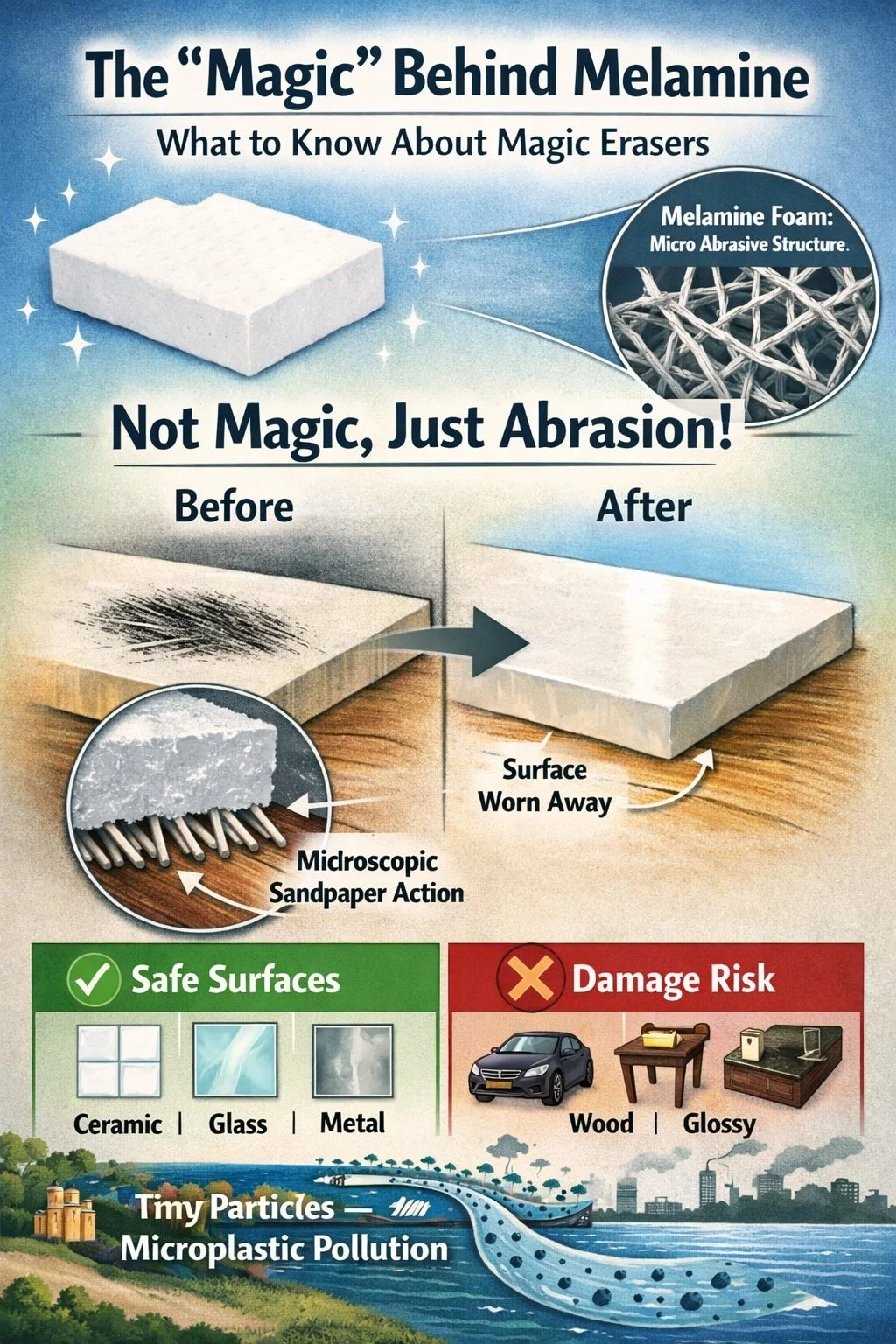
The "magic" behind melamine: What to know about Magic Erasers
Magic Erasers seem to work like, well, magic—removing stubborn scuff marks and stains with just water. But here's the truth: there's no magic involved. These white sponges are made from melamine foam, which works through abrasion—essentially acting as very fine sandpaper. While they're brilliant for certain tasks, they can also damage glossy finishes, strip protective coatings, and dull polished surfaces. Understanding what Magic Erasers actually are and how they work will help you use them effectively without accidentally ruining your walls, appliances, or furniture. The real magic? Knowing when not to reach for one.
If you've ever used a Magic Eraser to remove a stubborn scuff mark and watched it disappear like, well, magic — you've probably wondered what sorcery is actually happening. These unassuming white sponges seem to defy the laws of cleaning, removing marks that resist everything else you've tried. No chemicals needed. Just water and a bit of elbow grease.
But here's the thing: there's no magic involved. What's actually happening is both interesting and important to understand. Magic Erasers aren't cleaning in the traditional sense at all — they're essentially very fine sandpaper that's abrading away the top layer of whatever you're cleaning. Sometimes that's exactly what you need. Other times? You're slowly destroying your surfaces without realizing it.
If you've been using Magic Erasers on everything in your home, or if you're curious about what these miracle sponges actually are and whether they're safe for all of your surfaces, this deep dive will answer all your questions. I'll explore what melamine foam is, how it actually works, its environmental impact, and most importantly — which surfaces you should never, ever use it on.
What are Magic Erasers? A brief history
Magic Erasers are the brand name for cleaning sponges made from melamine foam, originally developed by the German company BASF in 1984. The foam was initially created for industrial applications — primarily as thermal insulation and soundproofing material in construction and automotive industries. It wasn't until the early 1990s that Japan realized this industrial foam had remarkable cleaning properties when wet.
Procter & Gamble (the company behind Mr. Clean) gave it an inspired name, and launched the Magic Eraser in 2003. The product became an instant phenomenon, generating hundreds of millions in sales and spawning countless generic melamine foam competitors.
The genius of the Magic Eraser wasn't inventing something new — it was recognizing that an existing industrial material could solve a common household problem. Marketing it as "magic" certainly didn't hurt either.
What makes them different from regular sponges?
Unlike traditional cleaning sponges made from cellulose or polyurethane, Magic Erasers are made from melamine resin that's been foamed into an extremely porous, open-cell structure. Under a microscope, melamine foam looks like a three-dimensional network of incredibly hard, thin strands — almost like a rigid spider web made of plastic.
This structure is what gives Magic Erasers their unique properties:
Extreme porosity: About 99% of the sponge is air, with only 1% being actual melamine material. This creates millions of microscopic edges and surfaces.
Hardness: Melamine resin is significantly harder than typical sponge materials, which is why it can abrade surfaces.
Microstructure: Each strand in the foam acts like a tiny abrasive fibre, collectively creating a very fine "sandpaper" effect.
Water activation: When dampened, the foam becomes slightly more flexible while maintaining its abrasive properties, making it effective without being overly aggressive.
It's essentially a highly engineered abrasive cleaning tool disguised as a soft, innocent-looking sponge.
How Magic Erasers actually clean: The science of abrasion
Magic Erasers don't clean through chemistry — they clean through physics. Specifically, through a process called mechanical abrasion.
What is abrasion?
Abrasion is the process of wearing away material through friction and scraping. It's the same principle behind sandpaper, nail files, and exfoliating scrubs. When you rub an abrasive material against a surface, you're physically removing microscopic layers of that surface.
Think of it this way: if you have a mark on a piece of wood, you could either dissolve it with a chemical cleaner (which breaks down the stain molecules) or you could sand away the top layer of wood that contains the mark. Magic Erasers take the second approach.
How melamine foam abrades surfaces
When you wet a Magic Eraser and rub it against a surface, here's what's actually happening at a microscopic level:
The foam compresses: Water makes the melamine foam slightly more pliable, allowing it to conform to the surface you're cleaning.
Millions of hard edges engage: Those microscopic melamine strands I mentioned earlier? Each one has sharp edges that act like tiny cutting tools.
Material is abraded away: As you scrub, these edges physically scrape away the top layer of material — whether that's a scuff mark, dried food, crayon, marker, or even a thin layer of paint or finish.
Abraded material fills the sponge: The removed material (along with dirt and grime) gets trapped in the sponge's porous structure, which is why Magic Erasers disintegrate and turn grey as you use them — they're literally filling up with whatever you're removing.
The surface appears "clean": Once the marked or stained layer is removed, the clean layer underneath is revealed. It looks like magic, but you've actually just sanded away the problem.
Why water matters
You might notice that Magic Erasers work much better when damp. This isn't because water is doing any cleaning — it's because:
Water lubricates the abrasive action, making it more efficient
It softens the foam slightly, allowing better surface contact
It helps carry away abraded material from the surface
It prevents the foam from crumbling too quickly
The water itself isn't dissolving or breaking down stains. It's just facilitating the mechanical abrasion process.
What this means for your surfaces
Understanding that Magic Erasers work through abrasion is crucial because it fundamentally changes how you should think about using them. You're not applying a cleaner that will evaporate and leave surfaces unharmed — you're removing material from your surfaces.
Sometimes this is perfectly fine. Light mineral buildup on a glass shower door? A Magic Eraser is softer than glass, so mineral deposits can be abraded away without risk of damaging the glass. But using a Magic Eraser on a glossy finish? You're abrading away the gloss itself, leaving behind a dull spot.
This is why Magic Erasers seem to work miracles on some surfaces and create disasters on others.
The environmental impact of melamine foam
Now that we understand what Magic Erasers are and how they work, let's talk about their environmental footprint. Spoiler: it's not great, and the problems span from manufacturing to disposal.
Manufacturing: The chemical process
Melamine foam is produced through a chemical process that combines melamine resin with formaldehyde and other compounds. Here's why this matters:
Petroleum-based product: Melamine is synthesized from urea, which is typically derived from natural gas or petroleum. This ties Magic Erasers to fossil fuel extraction and all its associated environmental impacts.
Energy-intensive production: Creating melamine resin requires high temperatures and significant energy input, contributing to greenhouse gas emissions.
Chemical concerns: The manufacturing process involves formaldehyde, a known carcinogen. While the finished foam contains minimal formaldehyde (it mostly reacts during production), the manufacturing process creates environmental and worker safety concerns.
Water and resource use: Industrial chemical production requires substantial water and generates chemical waste that must be properly managed.
While companies like BASF have improved the environmental efficiency of melamine foam production over the years, it remains a resource-intensive, petrochemical-based product.
During use: Microplastic pollution
As you use a Magic Eraser, it disintegrates. Those tiny pieces aren't just disappearing — they're contributing to microplastic pollution.
Melamine is plastic: Despite its sponge-like appearance, melamine resin is a thermoset plastic. It doesn't biodegrade.
Particles wash down drains: As the foam breaks apart during use, microscopic and small visible particles flow down your drain with rinse water. These particles are too small for most wastewater treatment plants to filter effectively.
They enter waterways: Those melamine particles end up in rivers, lakes, and oceans, where they persist indefinitely.
They contribute to microplastic accumulation: Like microfibre cloth, melamine foam adds to the growing burden of microplastics in aquatic ecosystems.
Disposal: Landfill burden
When a Magic Eraser is worn out (which happens quickly — they're designed to only be used a few times), where does it go?
Not recyclable: Melamine foam cannot be recycled through standard municipal recycling programs. The material doesn't fit into any recyclable plastic category.
Not biodegradable: In a landfill, melamine foam will persist for hundreds of years. It doesn't break down into harmless components — it just fragments into smaller pieces over time.
Volume considerations: Because Magic Erasers are 99% air, they take up disproportionate landfill space relative to their actual mass. While they compress somewhat, they still contribute to landfill volume.
No circular economy: Unlike materials that can be composted, recycled, or repurposed, used Magic Erasers are essentially one-way tickets to permanent waste.
The broader picture
When you consider the full lifecycle — resource extraction, manufacturing, shipping, brief use period, and permanent disposal — Magic Erasers have a significant environmental footprint relative to their utility.
For occasional use on specific challenging stains, this might be an acceptable trade-off. But many people use Magic Erasers as their primary cleaning tool for routine tasks that could be handled with reusable cloths and appropriate cleaners — essentially generating plastic waste unnecessarily.
This doesn't mean Magic Erasers should never be used, but understanding their environmental cost will help you make more informed decisions about when they're truly the best tool for the job.
Understanding the Mohs Scale: Which surfaces are safe?
Understanding the Mohs Hardness Scale will help you avoid expensive mistakes with your Magic Eraser.
What is the Mohs Scale?
The Mohs Hardness Scale, developed in 1812 by German mineralogist Friedrich Mohs, ranks materials from 1 (softest) to 10 (hardest) based on their scratch resistance. The principle is simple: a harder material can scratch a softer material, but not vice versa.
Here's the scale for reference:
Talc (softest)
Gypsum
Calcite
Fluorite
Apatite
Orthoclase feldspar
Quartz
Topaz
Corundum
Diamond (hardest)
Melamine foam ranks approximately 3-4 on the Mohs scale. This means it's harder than gypsum but softer than most stones and harder minerals.
The Scratch Rule
Key takeaway: Magic Erasers can scratch any surface softer than approximately 3-4 on the Mohs scale.
If what you're cleaning is softer than melamine foam, the Magic Eraser will abrade it. If it's harder, the Magic Eraser will wear away without damaging the surface (though it still might remove their protective coatings or finishes — more on this below).
Surfaces that are safe for Magic Eraser use
These materials are generally harder than melamine foam or have matte finishes where light abrasion won't be noticeable:
Ceramic tile (unglazed or matte): Ceramic rates around 5-7 on the Mohs scale, making it harder than melamine. Matte or textured tiles can handle Magic Erasers well.
Porcelain: Similar to ceramic but denser, porcelain is safe from scratching by melamine foam.
Natural stone (most types): Granite (6-7), quartzite (7), and other hard stones are safe. However, polished finishes can be dulled — more on this below.
Concrete and cement: These are harder than melamine and can be cleaned safely with Magic Erasers.
Glass: Glass rates 5.5 on the Mohs scale, so it won't be scratched by Magic Erasers.
Stainless steel (unpolished): Stainless steel is harder than melamine, though you can dull brushed finishes if you scrub against the grain.
Bathtubs and showers (most): Porcelain, ceramic, and fiberglass tubs can generally handle Magic Erasers. They're effective at removing soap scum and hard water stains.
Surfaces to avoid
These materials are either softer than melamine foam or have finishes that will be damaged by abrasion:
Painted walls: The Magic Eraser will dull the shine of glossy sheens, creating noticeable matte spots. Matte finishes rely on microscopic peaks and valleys to scatter light across their surface. Magic Erasers will remove these peaks and valleys, causing light to instead be reflected — ruining the matte effect.
Wood furniture and floors (finished): Even if the wood itself is relatively hard, the finish (polyurethane, varnish, wax) is softer and will be abraded away, leaving dull spots and potentially exposing bare wood.
Stainless steel appliances (polished): While you won't scratch the steel itself, you could destroy the polished finish, leaving visible dull streaks.
Car exteriors: Automotive paint and clear coats are definitely softer than melamine foam. Using a Magic Eraser on your car will remove clear coat and dull the finish — an expensive mistake.
Acrylic and plastic surfaces: Most plastics are softer than melamine foam. This includes acrylic bathtubs, plastic laminate countertops, phone screens, eyeglasses, and plastic appliance surfaces.
Granite and marble (polished): While the stone itself is hard enough, the polished finish can be dulled by abrasion. You might not scratch the stone, but you'll create matte spots in the shine.
Leather and vinyl: Both materials will be damaged by the abrasive action. You'll remove colour and protective coatings.
Non-stick cookware: Magic Erasers will absolutely destroy non-stick coatings. Never use them on Teflon or ceramic non-stick surfaces.
Fiberglass (gelcoat finishes): While fiberglass itself might withstand Magic Erasers, gelcoat finishes (common on bathtubs and boats) will be dulled or damaged.
Screens and displays: Phone screens, TV screens, monitor screens — all are coated with materials softer than melamine foam. You'll scratch them.
Stone countertops with sealant: Even if the stone is hard enough, you'll abrade away the protective sealant, leaving the stone vulnerable to future staining.
The finish problem
Here's a critical nuance: even on surfaces that are theoretically hard enough to resist scratching, Magic Erasers can still cause damage by removing protective finishes, polishes, or coatings.
Think of it this way: your granite countertop might be hard (6-7 on Mohs scale), but the sealant protecting it could be much softer. The stainless steel on your appliances is hard, but the polished finish could be more vulnerable. The wood floor is protected by polyurethane, which is softer than the wood itself.
Magic Erasers don't discriminate — they abrade whatever they touch, including protective layers you can't see.
How to test safely
If you're unsure whether a Magic Eraser is safe for a particular surface, always test in an inconspicuous area first:
Choose a hidden spot (inside a cabinet, behind furniture, low on a wall)
Dampen the Magic Eraser and use light pressure
Scrub a small area (2-3 inches)
Dry the area completely and examine it in good lighting
Look for dullness, scratches, or changes in sheen
Wait 24 hours and check again (some damage becomes more apparent when fully dry)
If you see any change in appearance, don't use the Magic Eraser on visible areas of that surface.
When Magic Erasers are a suitable last-resort
Despite all these warnings, Magic Erasers do have legitimate uses when other sustainable methods have been unsuccessful. The key is using them strategically on appropriate surfaces for appropriate tasks.
Ideal use cases
Crayon and marker on hard surfaces: On ceramic tile, porcelain, or glass, Magic Erasers remove crayon and permanent marker better than almost anything else.
Soap scum on shower doors and tile: The abrasive action cuts through built-up soap scum on glass shower doors and ceramic tile without harsh chemicals.
Hard water stains on glass: Magic Erasers excel at removing mineral deposits from glass surfaces where abrasion won't cause visible damage.
Adhesive residue on appropriate surfaces: Sticky residue from labels, tape, or stickers comes off easily with Magic Erasers.
Grout cleaning: White grout between tiles can be brightened with Magic Erasers (though a proper grout brush and cleaner is often more effective and less wasteful).
Rubber sole marks on floors: Those black streaks on tile or linoleum floors from shoe soles can be removed with a Magic Eraser, although the risk of damage to the floor’s protective sealant is high.
Smart usage tips
If you're going to use Magic Erasers, use them wisely:
Use the lightest pressure possible: Don't scrub aggressively. Let the abrasive action do the work with gentle pressure.
Keep them damp, not soaking: A damp Magic Eraser is more effective and lasts longer than a dripping wet one.
Work in small sections: This gives you better control and helps you notice if any damage is occurring.
Stop if you see shine changes: If a surface is becoming duller or shinier where you're cleaning, stop immediately—you're damaging the finish.
Consider alternatives first: Before reaching for a Magic Eraser, ask yourself if a less abrasive method might work. Often the right cleaner and a clean cloth will handle the job without generating plastic waste or risking surface damage.
Cut them into smaller pieces: A full Magic Eraser is often more than you need. Cutting them into quarters makes them last longer and reduces waste.
Better alternatives for most cleaning tasks
The truth is, for the vast majority of cleaning tasks, you don't need Magic Erasers at all. Here are some sustainable, surface-safe alternatives:
For general cleaning
Baking soda paste: Mix baking soda with a small amount of water to create a paste. This provides gentle abrasion (baking soda ranks about 2.5 on Mohs scale — softer than melamine) for cleaning without the plastic waste. Works beautifully on sinks, tubs, and tile.
White vinegar: For hard water stains, soap scum, and mineral deposits, vinegar's acidity often works better than abrasion — and it's reusable and biodegradable. Just exercise caution when using vinegar (or any acid for that matter) around surfaces prone to acid damage (grout, natural stone, and wood to name a few).
Plant-based dish soap and warm water: Never underestimate the cleaning power of good old-fashioned surfactants. A quality dish soap and a natural-fibre cloth handle most household cleaning tasks effectively.
For specific problems
Scuff marks on walls: Try a damp cloth first. For stubborn scuffs, a damp cloth with a tiny bit of baking soda often works. I personally recommend investing in a powder-sprayer (often used in salons/barbers) and filling it with baking soda — so that you always have a quick burst on hand.
Crayon and marker: Rubbing alcohol (grain alcohol is an excellent, sustainable alternative) on a cloth removes most marker. For crayon, try a bit of mayonnaise or vegetable oil (it dissolves the wax), followed by a soap and water cleanup.
Adhesive residue: Rubbing alcohol, vegetable oil, or commercial adhesive removers dissolve sticky residue without abrasion.
Soap scum: A mixture of white vinegar and dish soap in a spray bottle, left to sit for 10 minutes, cuts through soap scum on most surfaces without scrubbing.
Hard water stains on glass: Vinegar soaks work wonders. For extreme buildup, a clean razor blade held at a low angle safely removes deposits from glass without scratching.
The reusable approach
For genuinely sustainable cleaning that doesn't generate plastic waste:
Natural-fibre scrub brushes for grout and textured surfaces
Cellulose sponges for general scrubbing
Coconut fibre scrubbers for tough jobs on appropriate surfaces
Cotton cloths with appropriate cleaners for most tasks
Pumice stones for toilet bowl rings and extreme mineral buildup (on porcelain only)
These tools do require appropriate cleaners (unlike the "just add water" appeal of Magic Erasers), but they last much longer, generate far less waste, and don't contribute to microplastic pollution.
Final thoughts: The magic is understanding, not mystery
Magic Erasers are a brilliant example of marketing meeting materials science. By rebranding industrial melamine foam as a household cleaning miracle, Procter & Gamble (Mr. Clean) created a product category that generates hundreds of millions in annual sales.
But understanding what's really happening when a Magic Eraser is used helps you:
Protect your surfaces from unintended damage
Use them strategically only when appropriate
Consider the environmental impact in your purchasing decisions
Explore better alternatives for most cleaning tasks
Are Magic Erasers sometimes the right tool for the job? Absolutely. They excel at specific tasks on appropriate surfaces where their abrasive properties are beneficial rather than destructive.
Should they be your go-to cleaning solution for everything? Definitely not.
The real magic isn't in the sponge — it's in understanding how cleaning actually works, choosing the right tool for each job, and making informed decisions about which products deserve a place in your cleaning routine.
Next time you reach for a Magic Eraser, you'll know exactly what you're doing to your surfaces. And that knowledge — that's the real magic.
Need help with sustainable, surface-safe cleaning solutions for your home? As an independent cleaner and the founder of EcoEthical Cleaning, I understand the science behind every cleaning method and choose approaches that protect your surfaces and the environment. Contact me for a free estimate and experience professional cleaning that's both effective and responsible. I serve Toronto’s Harbourfront-CityPlace district and surrounding areas.
Sources & further reading
“Mr. Clean”, Wikipedia
"The Mohs Hardness Scale" International Gem Society
"Microplastics: more than a drop in the ocean" Environment and Climate Change Canada
Mitigating the risk: A guide to preventing dryer fires in your home
Toronto experiences 39 dryer fires every year. Across Canada, home appliances cause over 700 residential fires annually, with 92% involving clothes dryers. The leading cause? Lint buildup. That soft, fluffy material you pull from the lint trap is highly flammable—and when it accumulates in your dryer or vent system, it creates perfect conditions for fire: fuel, heat, and oxygen. The devastating truth: 32% of dryer fires are caused by lack of cleaning and maintenance. This isn't bad luck—it's neglect. Learn the warning signs, proper maintenance schedule, and exactly how to protect your home from this completely preventable tragedy.
When was the last time you cleaned your dryer's lint trap? Yesterday? Last week? Can't quite remember?
Across Canada, home appliances account for over 700 residential fires annually, with the vast majority of fires (92 percent) involving clothes dryers. 32% of these fires are caused by a lack of cleaning and maintenance. The city of Toronto averages nearly 40 dryer fires per year.
The leading cause? Lint buildup. Something so seemingly harmless—those soft, fluffy fibres you pull off the lint screen—is directly responsible for fires that destroy homes, cause injuries, and claim lives every single year.
This isn't about being paranoid or adding another chore to your overwhelming to-do list. This is about a genuine, preventable fire hazard that exists in virtually every home with a dryer. A hazard that most people don't think twice about until it's too late.
If you use a dryer (and statistically, you probably do), you need to understand how quickly lint can go from minor maintenance issue to life-threatening emergency. More importantly, you need to know exactly how to protect your home and family.
This comprehensive guide will explain why dryer lint is so dangerous, how fires start, what warning signs to watch for, and precisely what you need to do to prevent a tragedy in your home.
Why lint is so dangerous: Understanding the fire triangle
To understand why lint poses such a serious fire risk, you need to understand the three elements required for any fire: fuel, heat, and oxygen. Remove any one of these, and fire can't exist. Unfortunately, your dryer provides all three in abundance.
Lint is highly flammable fuel
Lint consists of tiny textile fibres—cotton, polyester, wool, and synthetic materials—that shed from your clothes during the drying process. These fibres are:
Extremely combustible: Lint ignites easily and burns rapidly. The fine, fluffy structure creates enormous surface area relative to mass, allowing it to catch fire almost instantly when exposed to sufficient heat.
Fast-burning: Once ignited, lint burns quickly and intensely. What starts as a small ember can become a raging fire in seconds, not minutes.
Accumulates quickly: Every single load of laundry produces lint. Even if you clean your lint trap religiously after every load, lint still accumulates in places you can't easily see—inside the dryer cabinet, in the vent ductwork, and around mechanical components.
Contains accelerants: If you've dried clothes that had any exposure to flammable substances—cooking oils, gasoline, paint thinners, cleaning solvents—those compounds absorb into the fabric and transfer to the lint. This makes already-flammable lint even more dangerous.
Your dryer generates significant heat
Dryers operate at temperatures ranging from 120-160°F (49-71°C) under normal conditions. The heating element itself reaches much higher temperatures. When airflow is restricted by lint buildup:
Heat cannot dissipate properly: Blocked vents trap heat inside the dryer, causing temperatures to rise well above normal operating levels.
Safety mechanisms can fail: Dryers have thermostats and thermal fuses designed to shut down the appliance if it overheats. However, if these components are covered in lint or fail to detect rising temperatures quickly enough, the dryer continues running at dangerous temperatures.
Sustained heat exposure ignites lint: Given enough time at elevated temperatures, lint will ignite. It doesn't require an open flame—just sustained heat in an oxygen-rich environment.
Oxygen is abundant
Your dryer needs airflow to function—it pulls in fresh air, heats it, circulates it through wet clothes to absorb moisture, and exhausts the humid air outside. This constant air movement provides plenty of oxygen to fuel combustion once lint ignites.
When these three elements—flammable lint, excessive heat, and abundant oxygen—come together in a blocked or poorly maintained dryer, you have the perfect conditions for fire.
How dryer fires actually start
Understanding how dryer fires ignite helps illustrate why regular maintenance is so critical. Here are the most common scenarios:
Blocked vents
When dryers are not cleaned on a regular basis, lint buildup restricts airflow, and when the airflow is restricted, clothes take longer to dry.
What happens:
Lint accumulates in the exhaust duct over time
Airflow becomes progressively restricted
The dryer works harder and runs hotter to compensate
With no airflow, the heat in the heater box will continue to rise
Lint in or near the heating element reaches ignition temperature
Fire starts inside the dryer or ductwork
Why it's dangerous: Lint buildup inside a dryer can be a potential fire hazard—if lint gets inside around thermostats, motors or heating elements, it can catch fire. By the time you notice something wrong (smell smoke, see flames), the fire may already be well-established inside walls or ductwork where you can't easily access it.
Crushed ducts
How ducts get crushed:
Items are placed on top of duct or tucked in behind a dryer, flattening the flexible tube
The dryer gets pushed back too far against the wall
Improper dryer installation causes kinked or crushed exhaust hose.
What happens:
Hot, lint-laden air can't escape properly
Lint and heat build up in the restricted area
Eventually, accumulated lint ignites
Why it's dangerous: You may not realize the duct is compromised. The dryer still runs, clothes eventually dry (though it takes longer), and there's no obvious sign of problem until a fire starts.
Wrong duct material
Dryer manufacturers clearly state in their manuals to not use plastic or flexible dryer ducts between the vent and the clothes dryer, as they can be a fire hazard.
What happens:
Plastic or vinyl ductwork is installed (often by previous homeowners or landlords)
These materials are not designed to withstand sustained heat exposure
Lint accumulates more easily in flexible ducts' ridged interior
When lint ignites, the duct material itself burns
Fire spreads rapidly through flammable ductwork
Why it's dangerous: Not only does the vinyl burn very quickly but it exposes the fire to everything around it, which could set your wall on fire or whatever you have around your dryer. The duct becomes fuel for the fire rather than simply a pathway.
Contaminated laundry
Clothes or rags that have been exposed to flammable substances pose extreme risk, even after washing.
What happens:
Kitchen towel with cooking oil, shop rag with gasoline, or painter's drop cloth gets laundered
Standard detergent doesn't fully remove flammable residues
Item goes into the dryer with residual accelerants
Heat causes spontaneous combustion or significantly lowers ignition temperature
Fire starts in the drum, often very quickly
Why it's dangerous: These fires can start while you're running the dryer—you might be home, smell something off, and suddenly have an active fire in your laundry room with almost no warning.
Interior lint accumulation
Many dryer users clean the lint trap frequently and the vent regularly but aren’t aware that lint can build up inside the dryer.
What happens:
Over years of use, lint sneaks past the lint trap
It accumulates inside the dryer cabinet around mechanical components
This internal lint is exposed to heat continuously
Eventually reaches ignition temperature during normal operation
Fire starts inside the appliance
Why it's dangerous: There can be a massive amount of lint inside the dryer itself, hidden from view. You think you're maintaining the appliance properly, but a fire hazard is building unseen.
The devastating statistics: This is happening right now
Let's be clear about the scope of this problem. These aren't isolated incidents or freak occurrences—dryer fires are common, predictable, and preventable.
National and local canadian data
Apart from heating and cooking equipment, home appliances account for over 700 residential fires across Canada each year, with the vast majority of fires (92 percent) involving clothes dryers.
Statistics Canada reports that dryers and other appliances contribute to about 7% of all residential fires, with Toronto seeing an average of 39 dryer fires annually.
These numbers represent only reported fires attended by fire departments. Many smaller incidents—dryers that start smoking, small interior fires that are caught immediately, near-misses—never get reported but still represent serious risks.
The human and financial cost
While Canadian-specific casualty data is limited, U.S. statistics provide insight into the serious consequences of dryer fires:
The National Fire Protection Association (NFPA) reports that dryers and washing machines cause an average of 15,970 fires each year across the U.S., leading to an average of 10 fatalities and $200 million in property damage.
These are preventable tragedies. Every death, every injury, every destroyed home represents a maintenance task that didn't get done, a warning sign that was ignored, or information that the homeowner simply didn't have.
Why winter months are highest risk
Particularly during the colder months, when dryer usage peaks, the risk of fires caused by clogged vents and poor maintenance becomes even more pronounced.
In winter, Canadians:
Dry more loads (heavier clothes, less opportunity for outdoor line-drying)
Run dryers longer (thicker fabrics like jeans, towels, and sweaters)
May delay maintenance tasks until spring
Have windows closed, meaning fires aren't detected as quickly by smell due to lack of airflow
January consistently shows the highest incidence of dryer fires—a direct correlation with increased winter laundry loads and heavier fabrics that produce more lint.
Warning signs your dryer is a fire hazard
Your dryer will often give you warning signs before a fire starts. Recognizing these early indicators can prevent disaster.
Critical warning signs (address immediately)
Burning smell during operation:
This is your most urgent warning. If your clothing is very hot at the end of a cycle or the dryer is hot to touch, this warning sign means the vent is not exhausting properly—lint can build up and catch fire, causing a burning smell. This is a warning sign to get your vents cleaned ASAP!
If you smell burning:
Stop the dryer immediately
Unplug it
Do not use it again until it's been professionally inspected
Check for visible lint accumulation or damage
Excessive heat:
The outside of the dryer should be warm during operation, not hot to the touch. If:
The dryer exterior is too hot to comfortably rest your hand on
The laundry room becomes excessively hot during operation
Clothes are very hot at the end of the cycle
These indicate blocked airflow and dangerous overheating.
Visible smoke or sparks:
This is an active emergency. If you see smoke or sparks:
Stop the dryer immediately
Unplug it if you can do so safely
Evacuate and call 911 if you cannot quickly determine the source
Do not use the dryer again until professionally inspected
Serious warning signs (address immediately)
Significantly longer drying times: When airflow is restricted, clothes take longer to dry. This is the first indication that there is a problem.
If loads that used to take 45 minutes now take 90+ minutes, your vent system is likely compromised.
Clothes feel damp at the end of a normal cycle: This indicates insufficient airflow to properly remove moisture—the same airflow restriction that traps heat and creates fire risk.
Lint accumulation around the dryer or vent opening: Excessive lint around the dryer, on the floor, or around the exterior vent indicates that lint is escaping somewhere it shouldn't be—often due to disconnected or damaged ductwork.
The exterior vent flap doesn't open during operation: An outside vent that doesn't open when the dryer is running means air flow has been restricted due to lint buildup.
Stand outside while the dryer is running and check the exterior vent. The flap should open noticeably with strong airflow. If it barely moves or doesn't open at all, you have a serious blockage.
Excessive lint on clothing after drying: While some lint is normal, if clothes come out covered in lint or the lint trap fills up abnormally fast, it suggests airflow problems that cause lint to circulate rather than properly exhaust.
Moderate warning signs (address soon)
You can't remember the last time you cleaned the vent: If it's been more than a year—or you're not sure when it was last done—schedule a cleaning ASAP.
The dryer is more than 10 years old: Older dryers have components that may fail, allowing lint to accumulate in places it shouldn't. Have it professionally inspected.
You've never had the dryer professionally serviced: Just like your furnace or HVAC system, dryers benefit from periodic professional maintenance to clean internal components and verify safe operation.
You use dryer sheets or fabric softener regularly: Chemical residues from dryer sheets can create a film that reduces airflow. The lint trap screen may look clean but be coated with residue that blocks air.
How to properly clean your lint trap and vent system
Prevention is straightforward: keep lint from accumulating to dangerous levels. Here's exactly how to maintain your dryer safely.
After every load:
Clean the lint trap screen:
Before starting a new load, remove the lint trap from its slot
Peel off accumulated lint with your fingers
For stubborn lint, use a soft brush or vacuum attachment
Inspect the screen for any damage or residue buildup
Reinsert the screen completely before starting the dryer
Why this matters: This removes the majority of lint before it can enter the vent system. It takes 10 seconds and prevents most problems.
Check the area around the dryer: Quickly scan for lint accumulation on the floor, behind the dryer, or around the vent connection. Excessive lint in these areas indicates a problem.
Weekly: Deep clean the lint trap
Wash the lint trap screen: Even with regular lint removal, residue from dryer sheets or fabric softeners can create a film that reduces airflow.
Remove the lint screen
Wash with warm water and dish soap or laundry detergent
Use a soft brush to scrub both sides, paying attention to the mesh
Rinse thoroughly under running water
Dry completely before reinserting (run the dryer empty briefly if needed, or air dry overnight)
Test for residue buildup: Pour a small amount of water on the screen. If water pools instead of flowing through, residue is blocking airflow. Wash more thoroughly with dish soap.
Clean the lint trap slot:
With the lint screen removed, use a vacuum crevice attachment
Reach as deep into the slot as possible
Remove any lint accumulation inside the housing
Use a dryer vent brush (long, flexible brush designed for this purpose) to dislodge stubborn lint
Vacuum again to remove dislodged debris
Every 6 months: Clean the vent system
Dryer vent ducts should be cleaned at least once a year to reduce the risk of fires and carbon monoxide poisoning. Many experts recommend cleaning twice yearly—especially important for Canadian households with heavy winter usage.
DIY Vent Cleaning (for simple, short vent runs):
You'll need:
Dryer vent brush kit (available at hardware stores)
Vacuum with hose attachment
Screwdriver
Possibly pliers or wrench
Steps:
Disconnect the dryer: Unplug from electrical outlet. If gas-powered, turn off the gas supply valve.
Pull the dryer away from the wall: You need access to the vent connection at the back of the dryer.
Disconnect the vent hose: Loosen the clamp connecting the vent hose to the dryer. If corroded or damaged, replace it.
Inspect the vent hose: Look for kinks, damage, or crushing. When your dryer is too close to the wall, or when the piping has a kink, it can be hazardous. Check that the hose isn't compressed.
Clean the vent hose: Use the vent brush to scrub the interior, working from both ends. Vacuum out dislodged lint.
Clean the dryer's vent opening: At the back of the dryer where the vent connects, use a brush and vacuum to remove lint buildup.
Clean the ductwork to exterior: Insert the vent brush into the duct leading to outside. Work it back and forth, rotating as you go. Some kits have extendable handles or attachments for drills. Work from inside, then repeat from the exterior vent if accessible.
Clean the exterior vent: Remove the exterior vent cover if possible. Clean lint from the cover, flap, and opening. External venting creates pre-built "homes" for nest builders—when the duct is clogged with a nest, the lint can't blow past, increasing the danger of a dryer fire. Check for bird nests, rodent nests, or other blockages.
Vacuum everything: Use the vacuum to clean up all dislodged lint from both ends.
Inspect for damage: Check the entire visible duct system for holes, disconnections, or damage. Check that the duct is made of rigid metal—if you find plastic or vinyl ductwork, replace it immediately with rigid or semi-rigid metal ducting.
Reassemble: Reconnect the vent hose, ensuring tight, secure connections. Restore gas or electrical connections. Push the dryer back into place, being careful not to crush the vent hose.
Test operation: Run the dryer on air-only or low heat for a few minutes. Go outside and verify strong airflow from the exterior vent.
When to call a professional:
Your vent run is longer than 8-10 feet
The vent has multiple bends or turns
The vent runs through walls, ceilings, or attics where you can't access it
You're physically unable to move the dryer or access connections
You discover damage that needs repair
You're uncomfortable with any part of this process
One advantage to hiring an experienced professional is they likely have seen just about every make and model of dryer. They will likely have the appropriate brush and equipment to effectively do the job.
Professional vent cleaning typically costs $100-200 and includes:
Complete duct cleaning from dryer to exterior
Inspection for damage, improper installation, or code violations
Verification of proper airflow
Often includes cleaning interior dryer components
Peace of mind that it's done thoroughly and safely
Annually: Professional interior cleaning
It's a good idea to have the interior of the dryer checked periodically. If you haven't been cleaning your vents and you're just listening to this now, in all likelihood, it's probably a mess inside your dryer. To be safe you should be looking inside or having a qualified technician look inside and cleaning out what's in there because that is just going to continue to build up over time.
Professional interior cleaning involves:
Opening the dryer cabinet (not something most homeowners can or should do)
Removing lint from around the drum, motor, heating element, and other components
Inspecting for worn parts or potential failures
Cleaning areas the lint trap doesn't catch
Verifying safety systems (thermostats, thermal fuses) are functioning
This is especially important for:
Dryers more than 5 years old
Dryers that have never been professionally serviced
After purchasing a used dryer or moving into a home with an existing dryer
If you've experienced any warning signs
Cost typically ranges from $100-150 and can extend your dryer's life while significantly reducing fire risk.
Additional safety measures every homeowner should take
Beyond regular cleaning, these practices further reduce your dryer fire risk:
Use the right duct material
Cheap plastic external venting can be inviting for nest builders and is a fire hazard. Only flexible transition ducts that are listed by UL or another approved product safety testing agency should be used.
What to use:
Rigid metal ductwork (aluminum or galvanized steel) for the main vent run
Semi-rigid metal duct for the short connection from dryer to wall (if rigid isn't feasible)
UL-listed flexible metal duct only for the final connection (4 feet maximum)
What to NEVER use:
White plastic or vinyl ductwork (highly flammable)
Foil duct tape (deteriorates over time)
Excessively long or convoluted duct runs
The National Building Code of Canada provides guidelines: Dryer ducts must be made of rigid metal, extending to the building's exterior with a backdraft damper to prevent re-entry of air.
If you have plastic ductwork, replace it immediately.
Don't overload the dryer
Overloading:
Produces more lint per cycle
Restricts airflow through the drum
Causes the dryer to run longer (more heat exposure)
Prevents clothes from tumbling freely (less efficient drying)
Increases wear on the appliance
Follow the manufacturer's load size recommendations. A good rule: fill the drum no more than 3/4 full, leaving room for clothes to tumble.
Be extremely cautious with contaminated laundry
There are materials that are not to be dried in a clothes dryer—look at the product labels and instructions for washing and drying. There are certain plastics, rubbers, and synthetic foam materials that should not be dried in the dryer.
Never put these in the dryer:
Anything that has contacted gasoline, paint thinner, or other solvents
Rags used with stains, oils, or finishing products
Mops or cleaning cloths used with flammable cleaning products
Anything with foam rubber backing
Items labeled "air dry only"
For items that have contacted cooking oils or grease:
Wash in the hottest water safe for the fabric
Use extra detergent
Run through an extra rinse cycle
Consider line-drying instead of machine drying
If you must machine dry, use low heat and monitor closely
Cooking oils can spontaneously combust when subjected to heat, even after washing. Multiple washing cycles may be needed to fully remove oils from fabrics.
Install proper safety devices
Smoke detectors: Install a smoke detector in the area where the dryer is located so homeowners are alerted as soon as a fire starts. If natural gas powers the dryer, use a combination smoke/carbon monoxide detector.
Test monthly and replace batteries annually (or install 10-year sealed battery units).
Lint alarm (optional but recommended): Devices are available that monitor airflow and alert you when the vent becomes restricted. These provide early warning before fire risk becomes critical. Cost: $30-100.
ABC fire extinguisher: Keep a properly rated fire extinguisher in or near your laundry room. Know how to use it BEFORE you need it. Inspect annually and replace as needed.
Never run the dryer unsupervised
Don't run the dryer before bed or when no-one is home.
Why this matters:
If a fire starts, you can respond immediately
Early detection dramatically reduces damage
You can prevent the fire from spreading
You can safely evacuate family members if needed
Best practices:
Run the dryer only when you're home and awake
Stay on the same floor of the house
Be alert to unusual sounds or smells
Never leave the house with the dryer running
Never go to bed with a load running
Many dryer fires start during or shortly after the cycle ends when residual heat can ignite accumulated lint.
Switch from dryer sheets to dryer balls
Dryer sheets and liquid fabric softeners leave residue on the lint trap that reduces airflow and creates buildup inside the dryer.
Better alternatives:
Wool dryer balls (reduce drying time, soften naturally, no residue)
Add white vinegar to the rinse cycle of your washer (natural softener, no dryer residue)
Skip fabric softener entirely (many modern fabrics don't need it)
If you do use dryer sheets, wash your lint trap screen weekly (as described above) to remove residue buildup.
Regular inspection schedule
Create a simple maintenance schedule:
After every load: Clean lint trap
Weekly: Wash lint trap screen, clean trap slot
Every 3 months: Visual inspection of vent connections, exterior vent
Every 6 months: Full vent system cleaning (DIY or professional)
Annually: Professional interior dryer inspection and cleaning
Set calendar reminders. Most smartphone calendar apps allow recurring tasks—set them up and get automatic reminders.
What to do if your dryer catches fire
Despite best efforts, fires can still occur. Knowing how to respond can prevent tragedy.
If you smell smoke or see flames
Immediate actions:
Stop the dryer immediately - Hit the off button or pull the plug if you can reach it safely
Close the dryer door - Don't open it if there are flames inside (oxygen feeds fire)
Evacuate everyone from the home
Call 911 from outside or a neighbour's home
Do NOT attempt to fight the fire unless it's very small, contained, and you have a fire extinguisher AND you've been trained to use it AND you have a clear exit path
If using a fire extinguisher:
Only if the fire is small (smaller than a garbage can)
Stand between the fire and your exit
Use P.A.S.S. method: Pull pin, Aim at base of fire, Squeeze handle, Sweep side to side
If the fire doesn't go out immediately or grows, evacuate and wait for fire department
What NOT to do:
Don't open the dryer door if you see flames (adds oxygen)
Don't use water on an electrical or dryer fire (electrocution risk)
Don't waste time trying to save belongings
Don't go back inside for any reason once you've evacuated
If there's heavy smoke but no visible flames
Turn off the dryer
Evacuate everyone
Call 911
Wait for fire department
Smoke means something is burning. Even if you don't see flames, fire may be inside the dryer cabinet, in walls, or in ductwork. Let professionals handle it.
After a dryer fire
Do not use the dryer again until it has been:
Inspected by fire department or fire marshal
Professionally cleaned and repaired
Verified safe by a qualified appliance technician
Even small fires can damage safety components, wiring, or create hidden fire hazards. Using a dryer after a fire without proper inspection risks another fire.
Document everything for insurance:
Take photos of damage
Keep all receipts for repairs or replacement
Get copies of fire department reports
Follow your insurance company's claims process
The bottom line: Dryer lint fires are preventable
Here's what you need to remember:
Dryer lint fires are common. Toronto alone experiences an average of 39 dryer fires annually. Across Canada, home appliances account for over 700 residential fires each year, with the vast majority (92 percent) involving clothes dryers.
They're caused by neglect, not bad luck. 32% of dryer fires are caused by lack of cleaning and maintenance. This isn't about defective appliances or freak accidents—it's about basic maintenance that doesn't get done.
They're preventable. Simply put, the leading cause of dryer fires is the failure to clean them. Clean your lint trap after every load. Clean your vent system twice yearly. Have your dryer professionally inspected annually. Follow safety guidelines. That's it.
The consequences of ignoring this are severe. Homes destroyed. Families displaced. Injuries. Deaths. All from something as mundane and preventable as lint buildup.
You likely spent thousands of dollars on your dryer. You probably spend hours every week doing laundry. But if you're not maintaining the appliance properly, you're gambling with your family's safety and your home's security.
Take action today:
Clean your lint trap right now (seriously, go do it)
Check when you last cleaned your vent system (if you can't remember, it's overdue)
Schedule professional vent cleaning if it's been more than 6 months
Inspect your duct material (replace immediately if plastic or vinyl)
Set up recurring calendar reminders for ongoing maintenance
Share this information with family, friends, and neighbours
The ten minutes it takes to properly maintain your dryer could literally save your life and your home. That's not hyperbole—that's reality backed by statistics and fire department data from across Canada.
Don't become another statistic. Don't wait until you smell smoke or see flames. Don't assume "it won't happen to me."
Take dryer lint seriously. Maintain your appliance. Protect your home and family.
It's that simple, and that important.
Need help maintaining a safe, clean home? At EcoEthical Cleaning, I'm committed to educating my clients about all aspects of home safety and maintenance. While I don't provide the specialized service of professional dryer vent cleaning, I do ensure your home's most essential lint collection points are addressed. For thorough, eco-friendly house cleaning, including proper cleaning of dryer lint screens and appliance drums, contact me for a free, no-obligation estimate. Serving Toronto's Harbourfront District and surrounding areas.
Sources & further reading
“Home Dryer Fires”, National Fire Protection Association (NFPA)
"Clothes Dryer Fires in Residential Buildings", U.S. Fire Administration
“What to know about portable fire extinguishers”, Canadian Centre for Occupational Health and Safety (CCOHS)