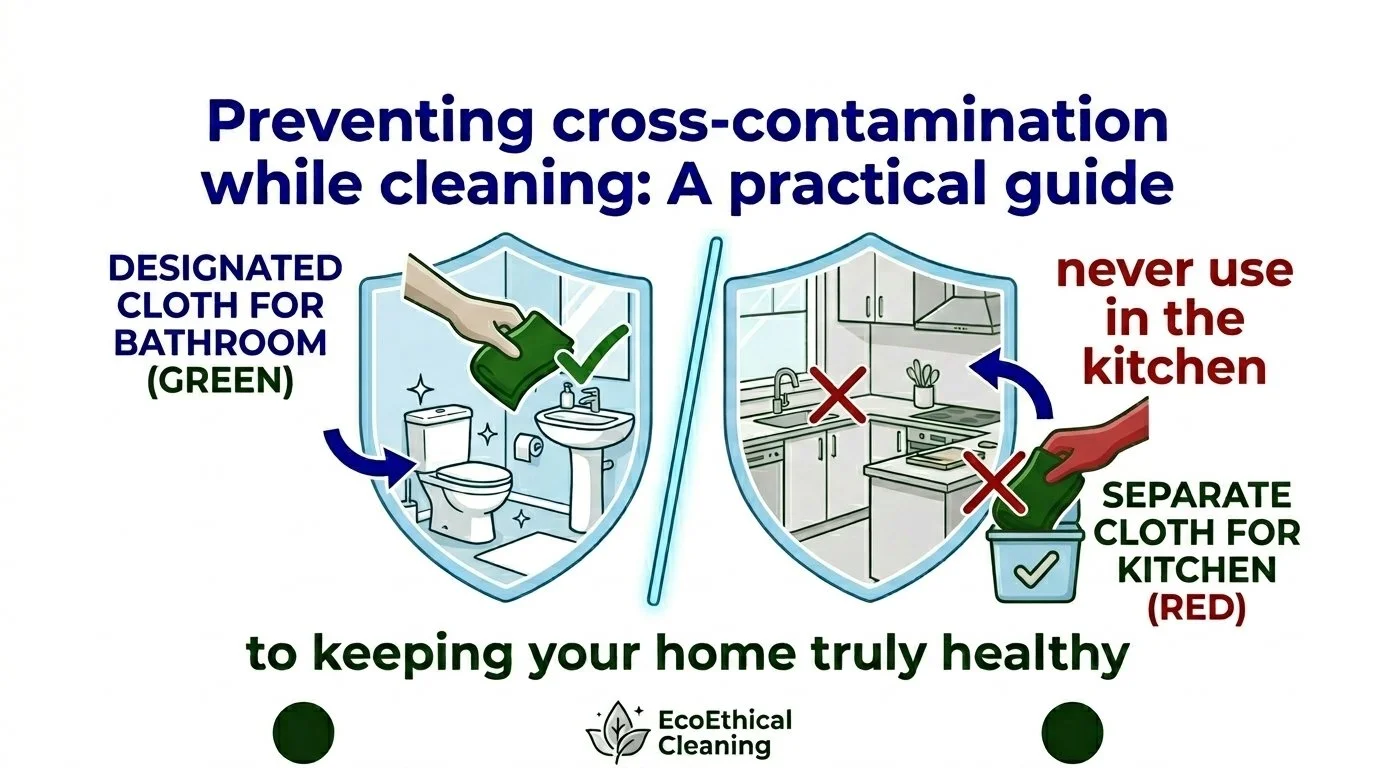
Preventing cross-contamination while cleaning: A practical guide to keeping your home truly healthy
Your cleaner just finished. Everything sparkles. But here's what you didn't see: the same cloth that wiped your toilet just cleaned your kitchen counters. The vacuum that cleaned your bathroom floor is now on your bedroom carpet. The mop water from the bathroom was used throughout your entire home. You've just paid someone to spread fecal bacteria, viruses, and pathogens everywhere. This is cross-contamination—the transfer of harmful microorganisms from one area to another—and it's standard practice for many cleaning services. Learn what it is, why it's dangerous, and what protocols help to prevent it.
Your cleaner just finished your home. The bathroom sparkles. The kitchen gleams. Everything looks spotless.
But here's what you didn't see: the same cloth that wiped your toilet was just used on your kitchen counters. The vacuum that cleaned your bathroom floor also ran across your living room carpet. The mop bucket that started in the bathroom finished in the kitchen — with the same water.
You've just paid someone to spread bacteria, viruses, and fecal matter throughout your entire home.
This is neither an exaggeration or worst-case scenario. It's standard practice for many cleaning services — and many homeowners have no idea it's happening.
Cross-contamination is one of the most overlooked problems in residential cleaning. While your home might look clean, it could actually be less hygienic than before the cleaner arrived.
This comprehensive guide will explain exactly what cross-contamination is, how it happens during cleaning, why it's dangerous, and most importantly — how to prevent it. You'll learn what questions to ask cleaning services, what practices to look for, and how professional protocols should actually work.
Because a truly clean home isn't just about removing visible dirt. It's about not spreading invisible dangers in the process.
What is cross-contamination?
Cross-contamination is the transfer of microorganisms (bacteria, viruses, fungi, parasites) from one surface, object, or area to another where they don't belong.
In the context of home cleaning, this typically means:
Transferring pathogens from bathrooms to kitchens
Spreading toilet bacteria to other surfaces throughout the home
Moving germs from high-contamination areas (toilets) to low-contamination areas (countertops, tables)
Carrying microorganisms between different homes on the same day
Why cross-contamination is dangerous
The health risks are significant:
Gastrointestinal illness: E. coli, Salmonella, Norovirus, and other pathogens from fecal matter cause vomiting, diarrhea, and serious illness—especially dangerous for young children, elderly, pregnant women, and immunocompromised individuals.
Skin infections: Staphylococcus aureus (including antibiotic-resistant MRSA) can cause skin infections, boils, and more serious systemic infections.
Respiratory infections: Viruses like influenza, common cold, and SARS-CoV-2 (Covid-19) can spread through contaminated surfaces touching faces, food preparation areas, or commonly touched objects.
Food poisoning: Kitchen cross-contamination with pathogens from bathrooms or raw food residue creates serious food safety risks.
Secondary infections: Open cuts, wounds, or compromised skin exposed to contaminated surfaces can lead to infections.
The high-risk areas in your home
Not all areas of your home pose equal contamination risk. Understanding this hierarchy is key to developing effective cleaning protocols.
Zone 1: Highest contamination (toilets)
Why it's high-risk:
Direct contact with fecal matter and urine
Aerosolized particles from flushing (toilet plume)
Handles, seats, and bowls harbour dangerous pathogens
Floors around toilets exposed to splatter and aerosolized matter
What should never touch other areas:
Toilet brushes
Cloths used on toilet bowl, seat, or base
Tools used to clean around toilet base
Mops used on bathroom floors
Zone 2: High contamination (bathrooms)
Why it's high-risk:
Body fluids: urine, feces (splatter), vomit, blood
High moisture = bacteria and mould growth
Sink drains contain biofilm with various pathogens
Floors contaminated from toilet aerosol, shower runoff, tracked particles
What should stay in bathrooms:
Bathroom-specific cloths
Bathroom floor mops
Cleaning tools for tubs, sinks, counters
Anything that touches bathroom floors
Zone 3: Moderate contamination (kitchens)
Why it requires caution:
Raw food contamination (meat, poultry, eggs)
Sink drains with food debris and biofilm
Garbage bins and areas
High-touch surfaces (handles, switches)
Why it needs protection:
Food preparation happens here
Cross-contamination directly leads to foodborne illness
Counters, cutting boards, and tables need to be truly hygienic
What should stay in kitchens:
Kitchen-specific cloths
Tools for counters, appliances, floors
Separate equipment from bathrooms
Zone 4: Low contamination (living areas)
Why it's lower risk:
Less exposure to body fluids
Lower moisture (less bacterial growth)
Primarily dust, dirt, and general grime
Why it still needs protection:
Vulnerable to contamination from bathrooms and kitchens if protocols aren't followed
People touch surfaces, then touch faces and food
Children play on floors and put hands/toys in mouths
How cross-contamination happens during cleaning
Most people assume professional cleaners follow protocols that prevent spreading germs. Unfortunately, many don't — often because they're rushing, untrained, or their employer prioritizes speed over safety.
Using the same cloth in different spaces
What happens:
The cleaner wipes a toilet with a cloth
That same cloth also wipes down the bathroom counter
Now the same cloth moves to bedroom, wiping nightstands and door handles
The same cloth finishes in the kitchen, wiping counters and other surfaces
The result: Fecal bacteria from the toilet are now on every surface touched by that cloth, including where you will prepare food.
Why cleaners do this: Using one cloth is faster than switching between designated cloths. Fewer cloths to launder. Less organization required.
The solution: Ensure that all cloths, brushes, and scrubbers are designated for use only in specific contamination zones. Ensure that all cloths, brushes, and scrubbers are cleaned and disinfected between uses.
Contaminated vacuums
What happens:
A vacuum is used on a bathroom floor (which is now exposed to fecal particles, urine splatter, body fluids)
The same vacuum immediately cleans a bedroom carpet
Then cleans the living room
The vacuum is never cleaned between services
Tomorrow, this vacuum goes to another client's home
The result: Bathroom contaminants are aerosolized and spread through every carpeted and hard floor surface. Your bedroom carpet now contains particles from the bathroom floor — and possibly from someone else's bathroom.
Why cleaners do this: Cleaning vacuums is time-consuming. Many services never even consider it necessary.
The solution: Ensure the contact points of the vacuum (cord, wheels, hose, handle, attachments) are disinfected between contamination zones and at the end of every service.
Dirty mop buckets
What happens:
A mop bucket is filled with water and cleaning solution
The mop cleans the bathroom floor first
Mop is returned to bucket (which is now contaminated with bathroom bacteria)
The same mop and water is used to clean the kitchen floor
By the end of the service, the water is visibly dirty and full of dangerous pathogens
The result: Kitchen floor is mopped with bathroom-contaminated water. When you walk from the kitchen to other rooms, you’ll track those pathogens throughout the home.
Why cleaners do this: Changing mop water multiple times takes time. Many cleaners are taught to use one bucket for the entire house.
The solution (between zones):
Empty mop bucket water and disinfect bucket
Remove dirty mop head from service and replace with clean one
Refill mop bucket with clean water
Ensure that mop bucket and all mop heads are cleaned and disinfected before their next use.
Unwashed hands
What happens:
Cleaner cleans toilet
Cleaner doesn't change gloves before moving to the next area
Cleaner touches door handles, countertops, faucets, etc. throughout the home
Everything the cleaner touched is now cross-contaminated with pathogens from the toilet
The result: High-touch surfaces throughout your home are contaminated with whatever was on the cleaner's hands.
Why cleaners do this: Hand-washing between tasks disrupts workflow. Gloves might not be used to "save time" or due to preference.
The solution: Make sure gloves are changed and hands are washed when moving from any area that contains dangerous pathogens (toilets, bathrooms, kitchen). Ensure that all reusable gloves are cleaned and disinfected before their next use.
Questions to ask your cleaning service
Not all cleaning services follow proper cross-contamination protocols. Here are specific questions to ask to evaluate whether they're protecting your home:
Essential questions
1. "Do you use separate cloths for different areas of the home?"
What you're looking for:
Clear "yes" with an explanation of their system
Mention of designated cloths for toilets, bathrooms, kitchens
Colour-coding or other clear organizational systems
Red flags:
Vague answers
"We rinse the cloth between areas"
"We use microfibre that doesn't spread germs" (false — microfibre spreads germs just like anything else)
Other defensive or dismissive responses
2. "How do you prevent bathroom germs from spreading to the kitchen?"
What you're looking for:
Specific protocols (separate tools, cleaning order, storage methods)
Understanding of why this matters
Details about their system
Red flags:
"We're very careful"
"We clean the kitchen first" (doesn't address equipment contamination)
"It's not really a problem"
They can't articulate specific procedures
3. "How are your cleaning tools cleaned between uses and between homes?"
What you're looking for:
Daily laundering of cloths
Equipment sanitization protocols
Vacuum cleaning process
Storage methods to prevent contamination
Red flags:
"We wash cloths weekly" (not frequently enough)
"We rinse the mop" (inadequate)
"We've never had a complaint" (doesn't answer the question)
Admission they don't clean equipment between clients
4. "Do you clean the vacuum, and if so, how often?"
What you're looking for:
After every service
A specific description of what's involved (emptying, wiping down, cleaning attachments)
Recognition that this matters
Red flags:
"When it looks dirty"
"Weekly" or "monthly" (too infrequent)
"We've never had to do that"
Being surprised by the question (shows they've never considered it)
5. "Do your staff wear gloves, and do they change gloves between areas?"
What you're looking for:
Gloves used for high-contamination tasks (toilets, bathroom floors)
Changed between zones or single-use for toilets
Hand hygiene protocols
Red flags:
No glove use
Same gloves worn entire service
Follow-up questions if you're not satisfied
"Can I observe your cross-contamination prevention during a service?"
Professional services should agree to this
You'll see exactly what happens
Actions speak louder than protocol claims
"Can you provide written documentation of your sanitation protocols?"
Established services should have documented procedures
Gives you something to reference and hold them accountable to
"What training do your staff receive on hygiene and cross-contamination?"
Professional services train staff specifically on this
"On-the-job" training often means no systematic instruction
"Are you willing to customize your service if I have specific health concerns?"
Reputable services will accommodate immunocompromised individuals or specific needs
Inflexibility suggests protocols aren't that strong to begin with
DIY cross-contamination prevention
If you clean your own home, following professional protocols protects your family just as effectively.
Set up your own zoned system
Implement colour-coded cloths:
Buy sets of cloths in different colours
Assign colours to zones (for example: red=toilet, yellow=bathroom, green=kitchen, blue=other less-contaminated areas)
Designate equipment:
If possible, use a separate mop for bathrooms vs. other areas
Or use washable mop pads and change between zones
Toilet brushes stay in their designated bathroom and never leave that space
Create storage system:
Dirty cloths go immediately into a hamper or bag
Clean cloths stored separately by colour/zone
Tools stored in a way that prevents cross-contamination
Follow proper cleaning order
Your cleaning sequence:
Dust and general cleaning (bedrooms, living room)
Kitchen (with kitchen-designated tools)
Bathrooms (with bathroom-designated tools)
Toilets last (with toilet-designated tools)
Between zones:
Wash hands
Switch to appropriate cloths/tools
Never backtrack to earlier zones with tools that were used in another zone
Proper cloth laundering
Wash contaminated cloths properly:
Hot water (60°C/140°F minimum)
Appropriate detergent
Dry completely before storage
Launder bathroom/toilet cloths separately from kitchen cloths if possible
Don't:
Let dirty cloths sit for days (bacteria multiply)
Wash contaminated cloths with regular laundry
Hand hygiene
Wash hands:
Between zones
After removing gloves
Before touching food, face, or personal items
Use gloves appropriately:
Always wear for toilet cleaning
Change between contamination zones
Remove gloves and wash hands before touching other surfaces
The bottom line: Clean shouldn't mean contaminated
You hire a cleaning service to make your home healthier, not to spread pathogens throughout it. Understanding cross-contamination helps you:
Evaluate cleaning services properly:
Ask the right questions
Recognize red flags
Choose services that actually protect your home
Understand what you're paying for:
Not just surface-level appearance
Actual hygiene and pathogen control
Professional protocols that prevent contamination
Advocate for proper practices:
You have the right to know how your home is being cleaned
Professional services should welcome questions about hygiene
Don't accept dismissive answers about contamination prevention
When you choose a cleaning service, you're inviting someone into your most intimate spaces. They should earn that trust by protecting your health, not just making things look tidy.
Ask questions. Expect standards. Demand protocols that actually prevent cross-contamination.
Because your family deserves a home that's truly clean.
Looking for cleaning that prioritize hygiene, not just appearance? As an independent cleaner and founder of EcoEthical Cleaning, I follow strict cross-contamination prevention protocols in every Toronto home I serve. Hospital-grade sanitation, zoned equipment systems, and transparency about every step. Contact me for a free, no-obligation estimate and experience cleaning done right. Proudly serving Toronto’s Harbourfront and surrounding neighbourhoods.
Sources & further reading
“Good Housekeeping”, William D. Frye
“The effects of different hygiene procedures in reducing bacterial contamination in a model domestic kitchen”, E. Røssvoll, S. Langsrud, S. Bloomfield, B. Moen, E. Heir, T. Møretrø
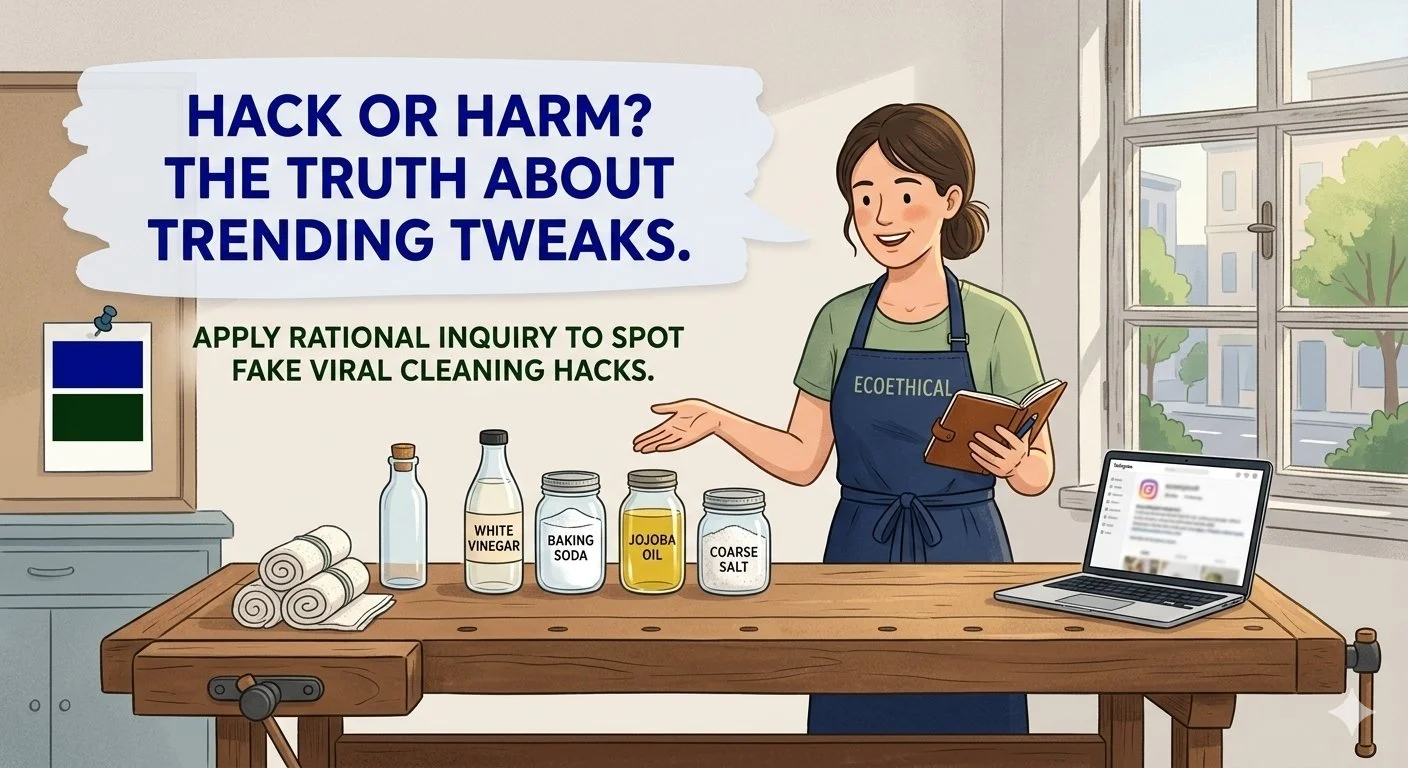
Why social media cleaning hacks are often wrong (and how to spot the bad advice)
You've seen them: viral cleaning hacks promising miracle results with common household items. But here's the uncomfortable truth—many of these tips don't work, and some can permanently damage your home. The problem isn't just uninformed creators; it's that social media's structure incentivizes engagement over accuracy. Algorithms reward novelty and controversy, not truth. Creators need constant content to earn money, which leads to untested methods going viral. Before trying that trending hack, learn to spot logical fallacies, understand basic chemistry, and apply rational inquiry. Your surfaces—and your wallet—will thank you.
You're scrolling through Instagram at 11 PM when you see it: a video of someone mixing dish soap, vinegar, and baking soda into a bottle, claiming it's the "ultimate all-purpose cleaner that professionals don't want you to know about." The comments are filled with fire emojis and people tagging their friends. It has 2.3 million views. It must work, right?
Not necessarily. In fact, probably not.
Welcome to the world of "cleanfluencers"—social media personalities who've built massive followings by sharing cleaning tips, hacks, and product recommendations. Some are knowledgeable professionals sharing genuinely helpful advice. But many are content creators who've discovered that cleaning videos get exceptional engagement, regardless of whether the advice actually works or could even damage your home.
The problem isn't just that bad cleaning advice wastes your time and money. It's that some of these viral hacks can make cleaning problems worse, permanently damage surfaces, or create dangerous chemical reactions that put your health at risk. And the very structure of social media—the algorithms, the monetization, the pressure to constantly create content—incentivizes quantity over accuracy.
If you've ever tried a viral cleaning hack that didn't work, damaged something, or left you wondering "wait, should I really be mixing those chemicals?", this article is for you. I’ll dig into how social media cleaning content actually works, why misinformation spreads so easily, and most importantly, how to tell the difference between legitimate advice and viral nonsense.
Let's start by understanding the landscape.
The cleanfluencer ecosystem: Where the content lives
Cleaning content has exploded across virtually every social media platform, but each one has its own flavour and format that shapes what gets shared.
TikTok: The viral hack factory
TikTok is ground zero for viral cleaning hacks, and it's easy to see why. The platform's algorithm is designed to surface engaging content to massive audiences quickly, regardless of the creator's follower count. A single video can go from zero to millions of views overnight.
What's trending: Quick transformations (often sped up), satisfying before-and-after reveals, "secret" product combinations, dramatic reactions to results, and controversial takes that spark debate in comments.
The format influence: TikTok videos max out at 10 minutes but perform best under 60 seconds. This creates pressure to oversimplify, skip important context (like safety warnings or surface compatibility), and prioritize visual drama over practical accuracy.
Popular cleanfluencers promote: Miracle product combinations (often chemically questionable), "forbidden" cleaning methods, extreme cleaning scenarios, and product "dupes" that supposedly work better than expensive alternatives.
Instagram reels: TikTok's slightly more polished cousin
Instagram Reels borrowed TikTok's format and many of the same trends have migrated over. The main difference is Instagram's slightly older, more affluent demographic.
What's trending: Aesthetic cleaning routines, product recommendations with affiliate links, home organization combined with cleaning, and luxury cleaning product showcases.
The format influence: Similar time constraints to TikTok, with added pressure for visual polish. This often means content is more styled but not necessarily more accurate.
Popular cleanfluencers promote: "Clean girl aesthetic" routines, expensive cleaning products positioned as investments, cleaning as self-care, and curated product collections.
YouTube: Long(er)-form content (but not always better)
YouTube allows for longer, more detailed content, which theoretically should mean more accurate information. Sometimes it does. Often it doesn't.
What's trending: Deep cleaning videos, product testing and reviews, cleaning routines, and "satisfying" cleaning compilations.
The format influence: Longer videos need to maintain engagement, which often leads to dramatic thumbnail promises ("I DIDN'T CLEAN MY OVEN FOR 5 YEARS"), clickbait titles, and stretched-out content with important information buried or omitted.
Popular cleanfluencers promote: Viral products (often the same ones being pushed on TikTok), cleaning product hauls, sponsored content disguised as genuine recommendations, and elaborate cleaning systems.
Facebook: Where misinformation gets shared by your aunt
Facebook cleaning content tends to be less about individual influencers and more about viral posts that get shared repeatedly through groups and personal networks.
What's trending: Text-based "miracle" cleaning recipes, before-and-after photos (often without methodology), cleaning group recommendations (some good, many questionable), and nostalgia-based cleaning methods ("my grandmother always did this").
The format influence: Facebook’s older demographic relies on different trust signals. People are more likely to trust advice that seems to come from peers or has been "tested" by their social network, even without verification.
Popular content promotes: DIY cleaner recipes (accuracy varies wildly), old wives' tales presented as proven methods, and products positioned as "chemical-free" alternatives.
Pinterest: The recipe card graveyard
Pinterest is where cleaning "recipes" go to be saved, reshared, and rarely fact-checked. It's a visual search engine where content gets divorced from its source and recirculated endlessly.
What's trending: Printable cleaning schedules, DIY cleaner recipes, infographics about cleaning methods, and "natural" cleaning solutions.
The format influence: Content is optimized for saving and sharing, not accuracy. Once a pin goes viral, it continues circulating regardless of whether it's been debunked.
Popular content promotes: All-purpose DIY cleaners (many chemically ineffective), cleaning "systems" and schedules, essential oil cleaning solutions, and visual before-and-after comparisons.
The economics of cleanfluencing: Why accuracy takes a back seat
Understanding why so much cleaning misinformation exists requires understanding how social media creators make money. The incentive structures don't reward accuracy, they reward engagement and volume.
How cleanfluencers actually make money
Creator fund payments (TikTok, YouTube): Platforms pay creators based on views and engagement. More videos = more views = more money. The accuracy of those videos? Not factored into payment.
Affiliate commissions:When a creator links to a product and you buy it, they earn a percentage (typically 3-10%). This creates incentive to recommend products whether they work well or not—the commission is the same either way.
Sponsored content: Brands pay creators directly to feature products. These deals can range from a few hundred dollars to tens of thousands for top creators. The creator's job is to make the product look good, not to provide unbiased assessment.
Ad revenue (YouTube): Longer videos with more ads generate more revenue. This incentivizes stretching content, adding drama, and creating series rather than comprehensive single videos.
Product lines and partnerships: Successful cleanfluencers often launch their own cleaning products or cleaning tools, creating financial incentive to drive followers toward those products specifically.
Course and e-book sales: Many cleanfluencers sell cleaning courses, guides, or systems—positioning themselves as experts, regardless of actual credentials.
The content treadmill problem
Social media algorithms reward consistency and frequency. Creators who post daily or multiple times per week get more algorithmic promotion than those who post weekly or monthly. This creates enormous pressure to constantly generate new content.
Here's the problem: there are only so many legitimate, tested, safe cleaning methods. Once you've covered the basics, you need to either:
Repeat yourself (which gets boring and hurts engagement)
Go deeper with proper research (time-consuming and doesn't guarantee virality)
Start making things up or sharing untested methods (fast, novel, and more likely to go viral)
Guess which option most creators choose?
The virality trap
Not all content performs equally. Social media algorithms prioritize content that generates engagement—comments, shares, saves, and watch time. What generates engagement?
Content that works moderately well: Gets a polite "thanks for sharing" and a few saves.
Content that's shocking, controversial, or seemingly revolutionary: Gets massive engagement as people debate, share with friends, and express surprise.
This creates perverse incentives. A video showing the correct way to clean hardwood floors (barely-damp mop, pH-neutral cleaner) might get 10,000 views. A video claiming you can clean hardwood floors with a mixture of vinegar, olive oil, and lemon juice (don't do this!) might get 5 million views because it's novel, surprising, and sparks debate in the comments.
The algorithm doesn't care that the second video will damage people's floors. It only cares that more people are engaging with it.
The credibility problem
Here's an unsettling truth: you don't need credentials, training, or expertise to become a cleanfluencer. You just need a camera and a willingness to create content.
Some popular cleaning content creators are former professional cleaners or have relevant education. Many are not. Some are simply people who like cleaning and started sharing videos. Some actively misrepresent their expertise to build authority.
The platforms don't verify credentials or fact-check content (except in narrow cases like medical or electoral misinformation). There's no quality control. Terrible advice and excellent advice look exactly the same in your feed—it's up to you to tell the difference.
The echo chamber effect
Once a creator builds an audience, they're surrounded by followers who trust them. Negative feedback gets filtered out (comments can be deleted, critics can be blocked), and the creator receives constant positive reinforcement regardless of content accuracy.
This creates an environment where creators can genuinely believe they're providing good advice even when they're not. They see thousands of comments saying "this worked great!" (often from people who haven't actually tried it, or who can't yet see the long-term damage), and dismiss the occasional "this damaged my countertop" comment as user error.
The bottom line
The economic model of social media content creation rewards:
Volume over accuracy
Novelty over effectiveness
Engagement over truth
Entertainment over education
This doesn't mean all cleanfluencers are intentionally spreading misinformation. Many believe they're helping. But the system they operate within actively incentivizes the spread of questionable advice, and that's what we need to understand to protect ourselves.
Common logical fallacies in viral cleaning content
Now that we understand why misinformation spreads, let's talk about how to spot it. Viral cleaning content relies heavily on logical fallacies—errors in reasoning that make bad arguments seem convincing. Here are the most common ones you'll encounter.
Appeal to nature ("it's natural, so it's better")
What it sounds like: "This all-natural cleaner uses only ingredients you can pronounce!" or "Why use harsh chemicals when vinegar and essential oils work just as well?"
Why it's a fallacy: "Natural" doesn't mean safe, effective, or appropriate. Arsenic is natural. So is poison ivy. Many synthetic cleaning products are safer and more effective than natural alternatives for specific tasks. The issue isn't whether something is natural or synthetic—it's whether it works safely for the intended purpose.
Example in the wild: A TikTok video promoting essential oil cleaning spray for disinfection. Essential oils smell nice, but they're not EPA-approved disinfectants and won't kill dangerous bacteria or viruses. Claiming they're "better because they're natural" is both misleading and potentially dangerous—especially if you have pets.
Appeal to tradition ("my grandmother did this")
What it sounds like: "This is how people cleaned before all these chemicals existed" or "Old-fashioned methods are always better."
Why it's a fallacy: Traditional methods aren't inherently better. We've developed new approaches because old ones often weren't effective or were unnecessarily labour-intensive. Yes, some traditional methods work well. Others persist despite being suboptimal. Tradition alone isn't evidence of effectiveness.
Example in the wild: Posts claiming you should clean everything with vinegar because "that's what people used to do." While vinegar has legitimate uses, it's not appropriate for all surfaces.
Anecdotal evidence ("it worked for me")
What it sounds like: "I've been doing this for years and never had a problem" or "Everyone in the comments says this worked for them!"
Why it's a fallacy: Individual experiences don't constitute reliable evidence. People might not notice slow damage, might be using different surfaces or products than you, might have different definitions of "clean," or might be experiencing placebo effect. Thousands of anecdotes still aren't the same as controlled testing.
Example in the wild: A viral post about using bleach on grout with hundreds of comments saying "this worked great!" Missing context: bleach can break down grout over time, but the damage isn't immediately visible. The people celebrating success might discover deteriorating grout years later without connecting it to the method.
False equivalence ("it's just like...")
What it sounds like: "If it can clean your toilet, imagine what it can do for your sink!" or "This removes stains from clothes, so it'll work on upholstery too."
Why it's a fallacy: Different surfaces have different properties, tolerances, and cleaning requirements. A method that works on one surface can damage another. Materials aren't interchangeable just because they seem similar.
Example in the wild: Videos suggesting you can clean natural stone countertops the same way you clean laminate. Stone is porous and acid-sensitive; many cleaners safe for laminate will permanently damage stone.
Cherry-picking ("look at this amazing result!")
What it sounds like: Before-and-after photos showing dramatic improvements, without mentioning failed attempts, time required, or special circumstances.
Why it's a fallacy: Showing only successes while hiding failures creates false impression of reliability. Maybe this method worked once out of ten tries. Maybe the "before" photo was staged to look worse. Maybe important context was omitted.
Example in the wild: A dramatic before-and-after of a "miracle" grout cleaner, without mentioning that the grout was sealed beforehand, the creator used professional-grade equipment, and it took four hours of work.
Appeal to authority (misrepresented)
What it sounds like: "Professional cleaners use this" or "This is what experts recommend" (without citing actual sources or when the creator isn't actually a professional).
Why it's a fallacy: Vague appeals to unnamed authorities aren't evidence. Even when sources are cited, they might be misrepresented or taken out of context. Credentials matter, but they need to be verifiable and relevant.
Example in the wild: A creator claiming "professional cleaners swear by this mixture" when promoting a homemade solution that most professionals would never use because better alternatives exist.
Hasty generalization ("this cleans everything")
What it sounds like: "The only cleaner you'll ever need!" or "Use this on literally any surface in your home."
Why it's a fallacy: No single cleaner is appropriate for every surface. Different materials require different approaches. Universal claims are almost always overstated.
Example in the wild: Videos promoting a single DIY mixture for cleaning everything from windows to hardwood floors to granite countertops. In reality, what's safe for glass might damage wood, and what's fine for sealed surfaces might etch stone.
Correlation implies causation ("I did this and that happened")
What it sounds like: "I started using this method and my surfaces look better than ever!" without considering other factors.
Why it's a fallacy: Just because two things happened together doesn't mean one caused the other. Maybe they also started cleaning more frequently. Maybe they replaced old sponges. Maybe seasonal humidity changed. Maybe they’re simply paying more attention now.
Example in the wild: Someone credits their DIY cleaner for improved results when they've also switched to better cloths and started cleaning twice as often. The improvement might have nothing to do with the cleaner itself.
Conspiracy thinking ("they don't want you to know this")
What it sounds like: "Big Cleaning doesn't want you to know about this simple solution" or "The cleaning industry hates this one simple trick."
Why it's a fallacy: Implying there's a conspiracy to hide effective methods positions questionable advice as "secret knowledge" while dismissing legitimate criticism as industry protection. It's a rhetorical shield against fact-checking.
Example in the wild: Videos claiming that mixing dish soap, vinegar, and baking soda is a "secret" that cleaning product companies don't want you to know—when actually, this mixture is chemically ineffective (the acid and base neutralize each other) and professionals don't use it because it doesn't work.
Recognizing fallacies in the wild
These fallacies rarely appear alone. A typical viral cleaning video might combine appeal to nature ("all-natural ingredients!"), anecdotal evidence ("worked perfectly for me!"), hasty generalization ("cleans everything!"), and conspiracy thinking ("they don't want you to know!") all in 60 seconds.
Learning to recognize these patterns helps you evaluate claims more critically, regardless of how many views or likes they have.
How to apply rational inquiry to cleaning hacks
Now that you can spot logical fallacies, let's talk about how to actually evaluate cleaning advice using rational inquiry—a systematic approach to determining what's likely true versus what's likely nonsense.
Step 1: Consider the source
Ask yourself:
Does this person have relevant credentials or professional experience?
Do they disclose potential conflicts of interest (sponsorships, affiliates, their own products)?
Do they cite sources for their claims or just present personal opinion?
What's their content history? Are they primarily an entertainer or educator?
Do they acknowledge limitations and risks, or only promote benefits?
Red flags:
No identifiable expertise in cleaning, chemistry, or materials science
Every video promotes products with affiliate links
Claims of being a "professional" without specifics about experience
Credential misrepresentation ("I worked in a cleaning company" could mean they were a receptionist)
Defensive or dismissive responses to legitimate questions
Green flags:
Verifiable professional experience (business name, years in industry)
Transparent about sponsorships and conflicts of interest
Cites specific sources (studies, manufacturers, industry standards)
Acknowledges when they don't know something
Discusses trade-offs and limitations of methods
Step 2: Understand the chemistry
You don't need a chemistry degree, but understanding basic principles helps immensely:
Acids and bases neutralize each other. Mixing vinegar (acid) with baking soda (base) creates mostly water and carbon dioxide. The bubbling looks impressive but actually reduces cleaning effectiveness. If a video promotes this combination as a miracle cleaner, the creator doesn't understand basic chemistry.
Not all cleaners are interchangeable. Surfactants (like dish soap) work differently than solvents (like alcohol) which work differently than abrasives (like baking soda) which work differently than oxidizers (like bleach). Different cleaning problems require different approaches.
"Natural" chemicals are still chemicals. Vinegar is acetic acid. Baking soda is sodium bicarbonate. Essential oils are complex chemical compounds. Being derived from nature doesn't change their chemical properties or make them universally safe.
Some chemical reactions are dangerous. Mixing bleach with vinegar or ammonia creates toxic gases. Combining certain cleaners can damage surfaces or create hazardous fumes. "Experiment and see what works" is dangerous advice.
pH matters for surfaces. Acidic cleaners (vinegar, lemon juice) will etch natural stone, damage grout sealant, and can strip wood finishes. Alkaline cleaners can damage some metals and finishes. The right cleaner depends on the surface.
Step 3: Think about surface compatibility
Before trying any cleaning method, ask:
What material am I cleaning? Natural stone? Sealed or unsealed wood? Laminate? Stainless steel? Glass? Ceramic? The answer determines what will be safe to use.
Does it have a protective coating? Many surfaces have finishes, sealants, or coatings that can be damaged even when the underlying material is durable. Abrasives can dull glossy paint. Acids and bases can strip sealants. Solvents can damage many finishes.
How hard is the surface? If a method involves abrasion (like Magic Erasers or powdered cleaners), is the abrasive softer or harder than the surface? Harder abrasives will scratch.
Is the surface porous or non-porous? Porous surfaces (unsealed stone, unfinished wood, grout) absorb liquids and can be damaged by too much moisture or stained by coloured cleaners.
What does the manufacturer recommend? If your flooring, countertops, or appliances came with care instructions, those should be your starting point. Warranty-voiding methods should raise red flags.
Step 4: Look for verifiable evidence
Strong evidence includes:
Peer-reviewed studies
Manufacturer testing and specifications
Industry standards and recommendations (from organizations like IICRC, ISSA, or BSCAI)
Repeated validation from independent sources
Long-term results documentation (not just immediate before-and-after)
Weak evidence includes:
"Everyone says this works" (appeal to popularity)
Before-and-after photos without methodology
Testimonials without verification
Viral spread without fact-checking
Claims without sources
Questions to ask:
Can I find this method recommended by multiple credible sources?
Do professional cleaners actually use this technique?
Are there any professional organizations or manufacturers that endorse this?
What happens if I search for "<method name> + damage" or "<method name> + doesn't work"?
Are there any long-term studies or tests of this method?
Step 5: Consider what's being left out
Viral content optimizes for engagement, not completeness. What important information might be missing?
Common omissions:
Safety warnings (ventilation, chemical reactions, protective equipment)
Surface compatibility limitations ("works great!" ...on what exactly?)
Time requirements (sped-up video hides that it took two hours)
Special conditions (their water is soft; yours is hard)
Product specifications (not all “dish soap" is identical)
Failure rate (how often does this not work?)
Long-term effects (it looks good now, how about in a week?)
Cost analysis (is this actually cheaper than the alternatives?)
Skill requirements (is this only easier for someone with lots of experience?)
Red flag questions:
Why isn't this person showing themselves doing this in real-time?
Why are there no cautionary statements about what not to do?
Why don't they specify which surfaces this works on?
Why isn't there any mention of what could go wrong?
Step 6: Test conservatively (if you decide to try it)
If a method seems plausible after your evaluation, test it cautiously:
Start with an inconspicuous area. Look for a hidden spot inside a cabinet, behind furniture, or in a low-traffic area. Never start with the most visible surface.
Use the mildest version first. If they recommend concentrated vinegar, try it diluted first. If they say scrub hard, try gentle pressure first.
Wait and observe. Immediate results aren't the only concern. Check again in 24 hours, one week, and one month for delayed damage like discolouration, dullness, or deterioration.
Document your test. Take photos before, immediately after, and during follow-up checks (under the same lighting conditions). This helps you notice subtle changes.
Stop at the first sign of problems. If you notice any dulling, discolouration, texture change, or surface damage, stop immediately. Don't assume it will get better or that you're "doing it wrong."
Compare to known-good methods. Test both the viral method and a conventional approach. Which actually works better? Is the viral method really superior, or just novel?
Step 7: Update your conclusions as you learn
Rational inquiry isn't about being right immediately—it's about being willing to change your mind when evidence warrants it.
Be willing to admit:
"I thought this would work, but it didn't"
"This seemed safe, but it caused damage"
"The viral video made this look easy, but it's actually complicated"
"I was wrong to recommend this to friends"
Keep learning:
Pay attention to long-term results of methods you've tried
Notice if professional cleaners avoid methods that are popular online
Stay updated on product recalls or safety warnings
Be skeptical of your own confirmation bias (wanting something to work because it's convenient or popular)
This process sounds like a lot of work, and sometimes it is. But it gets faster with practice, and it's far less work than repairing damaged surfaces or dealing with ineffective cleaning methods.
Case study: The viral dawn + vinegar shower cleaner
Let's apply everything we've discussed to one of the most viral cleaning hacks online: the Dawn dish soap and vinegar mixture for cleaning soap scum in showers.
The claim
Across TikTok, Instagram, and Pinterest, you'll find thousands of posts claiming that mixing equal parts Dawn dish soap with white vinegar creates an incredible shower cleaner that removes soap scum effortlessly. The promise: spray it on, wait 30 minutes, wipe off, and your shower will be spotless without scrubbing.
Step 1: Consider the source
What we find:
This hack appears across thousands of accounts, from professional cleaners to home accounts
Most posts don't explain why this works, just that it does
Many include affiliate links to spray bottles or cleaning supplies
Some sources have cleaning experience; many don't
Almost none discuss limitations or risks
Initial assessment: The widespread sharing suggests some people find it effective, but lack of expertise in many sources and absence of risk discussion is concerning.
Step 2: Understand the chemistry
Dawn dish soap is a surfactant that breaks down oils and grease. This is why it's excellent for dishes—it lifts away food oils.
White vinegar is acetic acid (typically around a 5% concentration), which can dissolve mineral deposits and cut through some types of buildup.
When combined: The acid (vinegar) and the surfactant (Dawn) don't neutralize each other the way an acid and base would, so theoretically both components could work in the mixture. The surfactant helps the vinegar spread and cling to surfaces, and the acid helps break down soap scum (which often contains mineral deposits).
Chemical plausibility: Unlike the baking soda + vinegar combination, this mixture isn't chemically nonsensical. The components can work together.
Concerns:
Vinegar is acidic and can damage certain surfaces
The mixture doesn't have any controlled ratio or standardized formulation
Different brands of dish soap have different formulations
"Wait 30 minutes" means prolonged acid exposure to surfaces
Step 3: Think about surface compatibility
Where this might be safe:
Ceramic tile (glazed)
Porcelain fixtures
Glass shower doors
Where this could cause damage:
Natural stone (marble, travertine, limestone, slate)—acid will etch
Grout —acid can break down both the sealant and binder of grout, making it more brittle
Some metal finishes (brushed nickel, chrome, oil-rubbed bronze)
Acrylic shower surrounds (the acid can dull the finish over time)
Key realization: Most viral posts don't specify which surfaces are safe. They present this as universal, but it's not appropriate for all shower types.
Step 4: Look for verifiable evidence
What we find:
Lots of anecdotal "this worked for me!" testimonials
Before-and-after photos (though cleaning methodology isn't always clear)
Some professional cleaners endorse modified versions
No manufacturer recommendations to combine these products
Some reports of damage to grout and stone surfaces
Mixed reviews on effectiveness—works well for some, not at all for others
Assessment: Evidence is mostly anecdotal. Success seems highly dependent on water hardness, shower surfaces, and severity of soap scum buildup.
Step 5: Consider what's being left out
Common omissions in viral posts:
No mention that this will damage natural stone
No mention that this works best on fresh soap scum, not years of buildup
No comparison to commercial soap scum removers
No discussion of grout sealant degradation with repeated use
No mention that different water types affect results
Why this matters: People try this on marble showers, expecting it to remove years of neglect, and wind up with damaged stone.
Step 6: The reality check
When we apply rational inquiry, here's what we learn:
What's accurate:
This mixture CAN remove soap scum from appropriate surfaces
The chemistry makes sense
It's less toxic than some commercial cleaners
For mild soap scum on safe surfaces, it can work reasonably well
What's overstated:
It's not a miracle solution—commercial soap scum removers often work better
It doesn't work "without scrubbing" for anything beyond light buildup
It's not safe for all shower surfaces
It's not a "professional secret"—professionals typically use variations of this approach daily
What's missing:
Surface safety warnings
Proper ventilation requirements
Realistic expectations about scrubbing needs
Long-term effects on grout sealant
Comparison to purpose-made products
Step 7: The informed conclusion
Is this hack completely wrong? No. It can work for certain applications.
Is it presented accurately online? No. It's oversold, limitations are hidden, and risks are ignored.
Should you use it? Maybe, with important caveats:
Safe for ceramic tile (keep if off grout) and glass shower doors
Effective for mild-to-moderate soap scum
Still requires scrubbing for tough buildup
Test in inconspicuous area first
Never use on natural stone showers
Not dramatically better than quality commercial cleaners
Can destroy unsealed grout and degrade grout sealant with frequent use
Better approach: For ceramic tile and glass showers, a quality commercial soap scum remover is often more effective, faster-acting, and formulated to be safe for typical bathroom surfaces. If you prefer DIY, this mixture can work—but understand its limitations and use it appropriately.
The lesson
Even when a viral hack has some legitimate basis, the way it's presented online often strips away crucial context, overstates benefits, and hides risks. Your job isn't to reject everything from social media—it's to evaluate it critically and understand what you're really doing.
Final thoughts: Becoming a smarter consumer of cleaning content
Social media has democratized information sharing, and that's brought both benefits and problems. Anyone can share cleaning tips—which means both expert professionals and complete amateurs have equal voices. The algorithm doesn't distinguish between them.
In my opinion, this isn’t going to change anytime soon. Platforms will continue to prioritize engagement over accuracy. Cleanfluencers will keep creating content under the same economic pressures. Viral misinformation will continue to spread as long as controversy and novelty gets more views than careful, measured advice.
What can change is how you engage with this content.
Remember these key principles:
Virality doesn't equal validity. A video with 10 million views isn't more accurate than one with 10,000. It's just more engaging—and sometimes misinformation is more engaging than truth.
Entertainment and education aren't the same thing. Enjoy satisfying cleaning videos for what they are, but don't assume dramatic transformations represent realistic, safe methods.
Credentials matter. A professional cleaner's advice generally carries more weight than a home content creator's, though neither is infallible. Look for verifiable expertise.
If it sounds too good to be true, it probably is. "One ingredient cleans everything!" No, it doesn't. "This miracle method professionals don't want you to know!" They're probably not using it because it doesn't work well.
Your surfaces are not worth risking. Replacing damaged countertops, refinishing floors, or repairing etched stone is expensive. When in doubt, err on the side of caution and use methods with established track records.
Chemical reactions are real. Mixing random products together is not "experimenting"—it's potentially creating dangerous situations or ineffective solutions. Understand what you're combining and why.
Context matters enormously. What works for someone with soft water might not work with hard water. What's safe for their floors might damage yours. Surface compatibility isn't optional information.
The good news is that you don't need to become a cleaning expert or chemistry major. You just need to think critically, ask good questions, and be willing to research before trying something that could cause harm or waste your time.
Professional cleaning isn't about secrets or tricks. It's about understanding surfaces, choosing appropriate methods and products, and applying them correctly. That knowledge comes from experience, training, and yes—sometimes from social media, when the source is credible and the advice is sound.
The next time you see a viral cleaning hack, you'll know how to evaluate it. That's real power—not the power to remove a stain in 10 seconds, but the power to distinguish what actually works from what just looks impressive in a 60-second video.
And that's worth more than any cleaning hack.
Tired of sorting through conflicting cleaning advice? EcoEthical Cleaning strives to bring professional expertise and planet-safe, science-based methods to every job. Contact me for a free, no-obligation estimate. Proudly serving Toronto’s Harbourfront and surrounding neighbourhoods.
Sources & further reading
"Does Influencer Marketing Really Pay Off?", Harvard Business Review
"Fallacies", Stanford Encyclopedia of Philosophy
"Use household chemicals safely", Health Canada
“Cleaning products—working safely”, Canadian Centre for Occupational Health and Safety
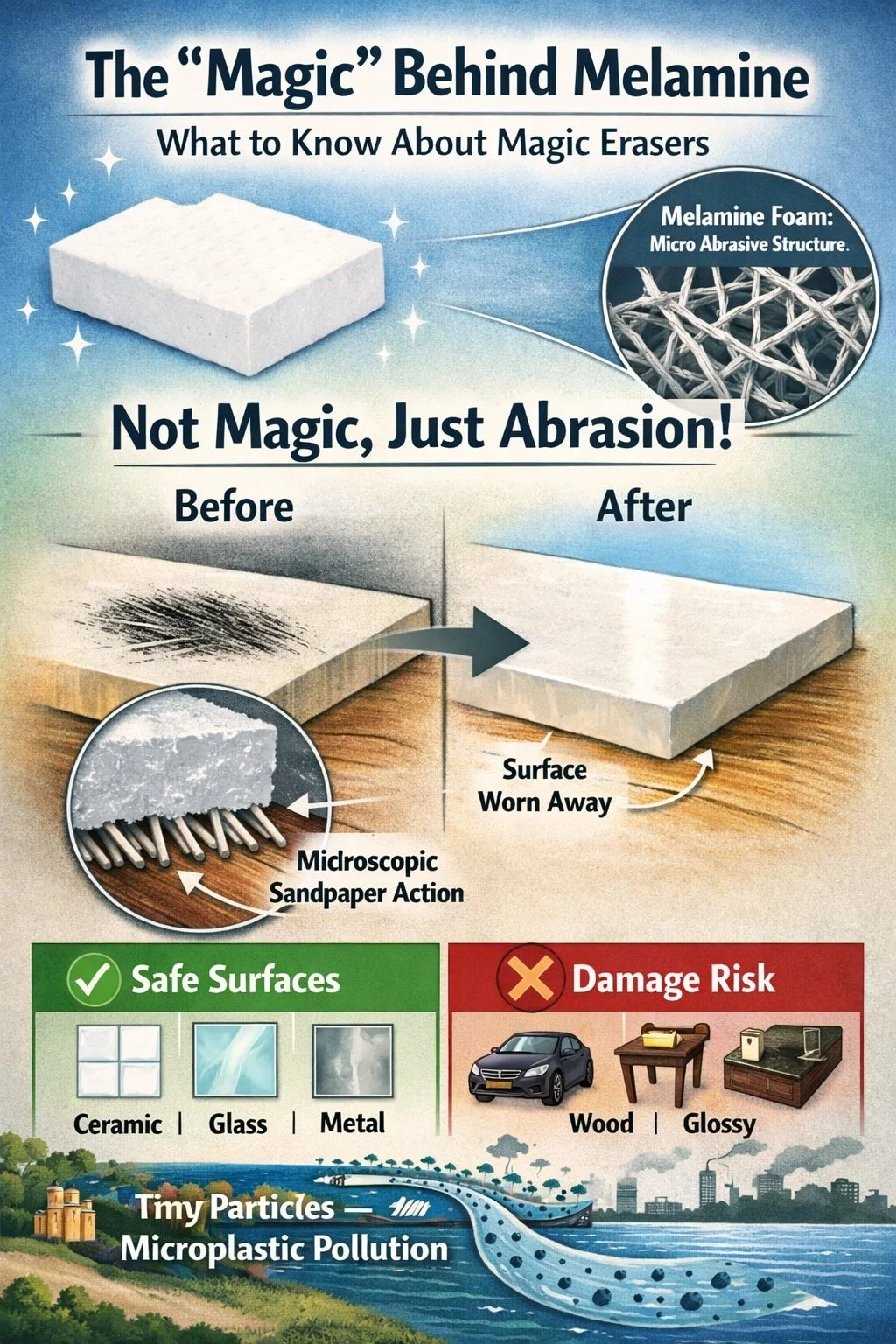
The "magic" behind melamine: What to know about Magic Erasers
Magic Erasers seem to work like, well, magic—removing stubborn scuff marks and stains with just water. But here's the truth: there's no magic involved. These white sponges are made from melamine foam, which works through abrasion—essentially acting as very fine sandpaper. While they're brilliant for certain tasks, they can also damage glossy finishes, strip protective coatings, and dull polished surfaces. Understanding what Magic Erasers actually are and how they work will help you use them effectively without accidentally ruining your walls, appliances, or furniture. The real magic? Knowing when not to reach for one.
If you've ever used a Magic Eraser to remove a stubborn scuff mark and watched it disappear like, well, magic — you've probably wondered what sorcery is actually happening. These unassuming white sponges seem to defy the laws of cleaning, removing marks that resist everything else you've tried. No chemicals needed. Just water and a bit of elbow grease.
But here's the thing: there's no magic involved. What's actually happening is both interesting and important to understand. Magic Erasers aren't cleaning in the traditional sense at all — they're essentially very fine sandpaper that's abrading away the top layer of whatever you're cleaning. Sometimes that's exactly what you need. Other times? You're slowly destroying your surfaces without realizing it.
If you've been using Magic Erasers on everything in your home, or if you're curious about what these miracle sponges actually are and whether they're safe for all of your surfaces, this deep dive will answer all your questions. I'll explore what melamine foam is, how it actually works, its environmental impact, and most importantly — which surfaces you should never, ever use it on.
What are Magic Erasers? A brief history
Magic Erasers are the brand name for cleaning sponges made from melamine foam, originally developed by the German company BASF in 1984. The foam was initially created for industrial applications — primarily as thermal insulation and soundproofing material in construction and automotive industries. It wasn't until the early 1990s that Japan realized this industrial foam had remarkable cleaning properties when wet.
Procter & Gamble (the company behind Mr. Clean) gave it an inspired name, and launched the Magic Eraser in 2003. The product became an instant phenomenon, generating hundreds of millions in sales and spawning countless generic melamine foam competitors.
The genius of the Magic Eraser wasn't inventing something new — it was recognizing that an existing industrial material could solve a common household problem. Marketing it as "magic" certainly didn't hurt either.
What makes them different from regular sponges?
Unlike traditional cleaning sponges made from cellulose or polyurethane, Magic Erasers are made from melamine resin that's been foamed into an extremely porous, open-cell structure. Under a microscope, melamine foam looks like a three-dimensional network of incredibly hard, thin strands — almost like a rigid spider web made of plastic.
This structure is what gives Magic Erasers their unique properties:
Extreme porosity: About 99% of the sponge is air, with only 1% being actual melamine material. This creates millions of microscopic edges and surfaces.
Hardness: Melamine resin is significantly harder than typical sponge materials, which is why it can abrade surfaces.
Microstructure: Each strand in the foam acts like a tiny abrasive fibre, collectively creating a very fine "sandpaper" effect.
Water activation: When dampened, the foam becomes slightly more flexible while maintaining its abrasive properties, making it effective without being overly aggressive.
It's essentially a highly engineered abrasive cleaning tool disguised as a soft, innocent-looking sponge.
How Magic Erasers actually clean: The science of abrasion
Magic Erasers don't clean through chemistry — they clean through physics. Specifically, through a process called mechanical abrasion.
What is abrasion?
Abrasion is the process of wearing away material through friction and scraping. It's the same principle behind sandpaper, nail files, and exfoliating scrubs. When you rub an abrasive material against a surface, you're physically removing microscopic layers of that surface.
Think of it this way: if you have a mark on a piece of wood, you could either dissolve it with a chemical cleaner (which breaks down the stain molecules) or you could sand away the top layer of wood that contains the mark. Magic Erasers take the second approach.
How melamine foam abrades surfaces
When you wet a Magic Eraser and rub it against a surface, here's what's actually happening at a microscopic level:
The foam compresses: Water makes the melamine foam slightly more pliable, allowing it to conform to the surface you're cleaning.
Millions of hard edges engage: Those microscopic melamine strands I mentioned earlier? Each one has sharp edges that act like tiny cutting tools.
Material is abraded away: As you scrub, these edges physically scrape away the top layer of material — whether that's a scuff mark, dried food, crayon, marker, or even a thin layer of paint or finish.
Abraded material fills the sponge: The removed material (along with dirt and grime) gets trapped in the sponge's porous structure, which is why Magic Erasers disintegrate and turn grey as you use them — they're literally filling up with whatever you're removing.
The surface appears "clean": Once the marked or stained layer is removed, the clean layer underneath is revealed. It looks like magic, but you've actually just sanded away the problem.
Why water matters
You might notice that Magic Erasers work much better when damp. This isn't because water is doing any cleaning — it's because:
Water lubricates the abrasive action, making it more efficient
It softens the foam slightly, allowing better surface contact
It helps carry away abraded material from the surface
It prevents the foam from crumbling too quickly
The water itself isn't dissolving or breaking down stains. It's just facilitating the mechanical abrasion process.
What this means for your surfaces
Understanding that Magic Erasers work through abrasion is crucial because it fundamentally changes how you should think about using them. You're not applying a cleaner that will evaporate and leave surfaces unharmed — you're removing material from your surfaces.
Sometimes this is perfectly fine. Light mineral buildup on a glass shower door? A Magic Eraser is softer than glass, so mineral deposits can be abraded away without risk of damaging the glass. But using a Magic Eraser on a glossy finish? You're abrading away the gloss itself, leaving behind a dull spot.
This is why Magic Erasers seem to work miracles on some surfaces and create disasters on others.
The environmental impact of melamine foam
Now that we understand what Magic Erasers are and how they work, let's talk about their environmental footprint. Spoiler: it's not great, and the problems span from manufacturing to disposal.
Manufacturing: The chemical process
Melamine foam is produced through a chemical process that combines melamine resin with formaldehyde and other compounds. Here's why this matters:
Petroleum-based product: Melamine is synthesized from urea, which is typically derived from natural gas or petroleum. This ties Magic Erasers to fossil fuel extraction and all its associated environmental impacts.
Energy-intensive production: Creating melamine resin requires high temperatures and significant energy input, contributing to greenhouse gas emissions.
Chemical concerns: The manufacturing process involves formaldehyde, a known carcinogen. While the finished foam contains minimal formaldehyde (it mostly reacts during production), the manufacturing process creates environmental and worker safety concerns.
Water and resource use: Industrial chemical production requires substantial water and generates chemical waste that must be properly managed.
While companies like BASF have improved the environmental efficiency of melamine foam production over the years, it remains a resource-intensive, petrochemical-based product.
During use: Microplastic pollution
As you use a Magic Eraser, it disintegrates. Those tiny pieces aren't just disappearing — they're contributing to microplastic pollution.
Melamine is plastic: Despite its sponge-like appearance, melamine resin is a thermoset plastic. It doesn't biodegrade.
Particles wash down drains: As the foam breaks apart during use, microscopic and small visible particles flow down your drain with rinse water. These particles are too small for most wastewater treatment plants to filter effectively.
They enter waterways: Those melamine particles end up in rivers, lakes, and oceans, where they persist indefinitely.
They contribute to microplastic accumulation: Like microfibre cloth, melamine foam adds to the growing burden of microplastics in aquatic ecosystems.
Disposal: Landfill burden
When a Magic Eraser is worn out (which happens quickly — they're designed to only be used a few times), where does it go?
Not recyclable: Melamine foam cannot be recycled through standard municipal recycling programs. The material doesn't fit into any recyclable plastic category.
Not biodegradable: In a landfill, melamine foam will persist for hundreds of years. It doesn't break down into harmless components — it just fragments into smaller pieces over time.
Volume considerations: Because Magic Erasers are 99% air, they take up disproportionate landfill space relative to their actual mass. While they compress somewhat, they still contribute to landfill volume.
No circular economy: Unlike materials that can be composted, recycled, or repurposed, used Magic Erasers are essentially one-way tickets to permanent waste.
The broader picture
When you consider the full lifecycle — resource extraction, manufacturing, shipping, brief use period, and permanent disposal — Magic Erasers have a significant environmental footprint relative to their utility.
For occasional use on specific challenging stains, this might be an acceptable trade-off. But many people use Magic Erasers as their primary cleaning tool for routine tasks that could be handled with reusable cloths and appropriate cleaners — essentially generating plastic waste unnecessarily.
This doesn't mean Magic Erasers should never be used, but understanding their environmental cost will help you make more informed decisions about when they're truly the best tool for the job.
Understanding the Mohs Scale: Which surfaces are safe?
Understanding the Mohs Hardness Scale will help you avoid expensive mistakes with your Magic Eraser.
What is the Mohs Scale?
The Mohs Hardness Scale, developed in 1812 by German mineralogist Friedrich Mohs, ranks materials from 1 (softest) to 10 (hardest) based on their scratch resistance. The principle is simple: a harder material can scratch a softer material, but not vice versa.
Here's the scale for reference:
Talc (softest)
Gypsum
Calcite
Fluorite
Apatite
Orthoclase feldspar
Quartz
Topaz
Corundum
Diamond (hardest)
Melamine foam ranks approximately 3-4 on the Mohs scale. This means it's harder than gypsum but softer than most stones and harder minerals.
The Scratch Rule
Key takeaway: Magic Erasers can scratch any surface softer than approximately 3-4 on the Mohs scale.
If what you're cleaning is softer than melamine foam, the Magic Eraser will abrade it. If it's harder, the Magic Eraser will wear away without damaging the surface (though it still might remove their protective coatings or finishes — more on this below).
Surfaces that are safe for Magic Eraser use
These materials are generally harder than melamine foam or have matte finishes where light abrasion won't be noticeable:
Ceramic tile (unglazed or matte): Ceramic rates around 5-7 on the Mohs scale, making it harder than melamine. Matte or textured tiles can handle Magic Erasers well.
Porcelain: Similar to ceramic but denser, porcelain is safe from scratching by melamine foam.
Natural stone (most types): Granite (6-7), quartzite (7), and other hard stones are safe. However, polished finishes can be dulled — more on this below.
Concrete and cement: These are harder than melamine and can be cleaned safely with Magic Erasers.
Glass: Glass rates 5.5 on the Mohs scale, so it won't be scratched by Magic Erasers.
Stainless steel (unpolished): Stainless steel is harder than melamine, though you can dull brushed finishes if you scrub against the grain.
Bathtubs and showers (most): Porcelain, ceramic, and fiberglass tubs can generally handle Magic Erasers. They're effective at removing soap scum and hard water stains.
Surfaces to avoid
These materials are either softer than melamine foam or have finishes that will be damaged by abrasion:
Painted walls: The Magic Eraser will dull the shine of glossy sheens, creating noticeable matte spots. Matte finishes rely on microscopic peaks and valleys to scatter light across their surface. Magic Erasers will remove these peaks and valleys, causing light to instead be reflected — ruining the matte effect.
Wood furniture and floors (finished): Even if the wood itself is relatively hard, the finish (polyurethane, varnish, wax) is softer and will be abraded away, leaving dull spots and potentially exposing bare wood.
Stainless steel appliances (polished): While you won't scratch the steel itself, you could destroy the polished finish, leaving visible dull streaks.
Car exteriors: Automotive paint and clear coats are definitely softer than melamine foam. Using a Magic Eraser on your car will remove clear coat and dull the finish — an expensive mistake.
Acrylic and plastic surfaces: Most plastics are softer than melamine foam. This includes acrylic bathtubs, plastic laminate countertops, phone screens, eyeglasses, and plastic appliance surfaces.
Granite and marble (polished): While the stone itself is hard enough, the polished finish can be dulled by abrasion. You might not scratch the stone, but you'll create matte spots in the shine.
Leather and vinyl: Both materials will be damaged by the abrasive action. You'll remove colour and protective coatings.
Non-stick cookware: Magic Erasers will absolutely destroy non-stick coatings. Never use them on Teflon or ceramic non-stick surfaces.
Fiberglass (gelcoat finishes): While fiberglass itself might withstand Magic Erasers, gelcoat finishes (common on bathtubs and boats) will be dulled or damaged.
Screens and displays: Phone screens, TV screens, monitor screens — all are coated with materials softer than melamine foam. You'll scratch them.
Stone countertops with sealant: Even if the stone is hard enough, you'll abrade away the protective sealant, leaving the stone vulnerable to future staining.
The finish problem
Here's a critical nuance: even on surfaces that are theoretically hard enough to resist scratching, Magic Erasers can still cause damage by removing protective finishes, polishes, or coatings.
Think of it this way: your granite countertop might be hard (6-7 on Mohs scale), but the sealant protecting it could be much softer. The stainless steel on your appliances is hard, but the polished finish could be more vulnerable. The wood floor is protected by polyurethane, which is softer than the wood itself.
Magic Erasers don't discriminate — they abrade whatever they touch, including protective layers you can't see.
How to test safely
If you're unsure whether a Magic Eraser is safe for a particular surface, always test in an inconspicuous area first:
Choose a hidden spot (inside a cabinet, behind furniture, low on a wall)
Dampen the Magic Eraser and use light pressure
Scrub a small area (2-3 inches)
Dry the area completely and examine it in good lighting
Look for dullness, scratches, or changes in sheen
Wait 24 hours and check again (some damage becomes more apparent when fully dry)
If you see any change in appearance, don't use the Magic Eraser on visible areas of that surface.
When Magic Erasers are a suitable last-resort
Despite all these warnings, Magic Erasers do have legitimate uses when other sustainable methods have been unsuccessful. The key is using them strategically on appropriate surfaces for appropriate tasks.
Ideal use cases
Crayon and marker on hard surfaces: On ceramic tile, porcelain, or glass, Magic Erasers remove crayon and permanent marker better than almost anything else.
Soap scum on shower doors and tile: The abrasive action cuts through built-up soap scum on glass shower doors and ceramic tile without harsh chemicals.
Hard water stains on glass: Magic Erasers excel at removing mineral deposits from glass surfaces where abrasion won't cause visible damage.
Adhesive residue on appropriate surfaces: Sticky residue from labels, tape, or stickers comes off easily with Magic Erasers.
Grout cleaning: White grout between tiles can be brightened with Magic Erasers (though a proper grout brush and cleaner is often more effective and less wasteful).
Rubber sole marks on floors: Those black streaks on tile or linoleum floors from shoe soles can be removed with a Magic Eraser, although the risk of damage to the floor’s protective sealant is high.
Smart usage tips
If you're going to use Magic Erasers, use them wisely:
Use the lightest pressure possible: Don't scrub aggressively. Let the abrasive action do the work with gentle pressure.
Keep them damp, not soaking: A damp Magic Eraser is more effective and lasts longer than a dripping wet one.
Work in small sections: This gives you better control and helps you notice if any damage is occurring.
Stop if you see shine changes: If a surface is becoming duller or shinier where you're cleaning, stop immediately—you're damaging the finish.
Consider alternatives first: Before reaching for a Magic Eraser, ask yourself if a less abrasive method might work. Often the right cleaner and a clean cloth will handle the job without generating plastic waste or risking surface damage.
Cut them into smaller pieces: A full Magic Eraser is often more than you need. Cutting them into quarters makes them last longer and reduces waste.
Better alternatives for most cleaning tasks
The truth is, for the vast majority of cleaning tasks, you don't need Magic Erasers at all. Here are some sustainable, surface-safe alternatives:
For general cleaning
Baking soda paste: Mix baking soda with a small amount of water to create a paste. This provides gentle abrasion (baking soda ranks about 2.5 on Mohs scale — softer than melamine) for cleaning without the plastic waste. Works beautifully on sinks, tubs, and tile.
White vinegar: For hard water stains, soap scum, and mineral deposits, vinegar's acidity often works better than abrasion — and it's reusable and biodegradable. Just exercise caution when using vinegar (or any acid for that matter) around surfaces prone to acid damage (grout, natural stone, and wood to name a few).
Plant-based dish soap and warm water: Never underestimate the cleaning power of good old-fashioned surfactants. A quality dish soap and a natural-fibre cloth handle most household cleaning tasks effectively.
For specific problems
Scuff marks on walls: Try a damp cloth first. For stubborn scuffs, a damp cloth with a tiny bit of baking soda often works. I personally recommend investing in a powder-sprayer (often used in salons/barbers) and filling it with baking soda — so that you always have a quick burst on hand.
Crayon and marker: Rubbing alcohol (grain alcohol is an excellent, sustainable alternative) on a cloth removes most marker. For crayon, try a bit of mayonnaise or vegetable oil (it dissolves the wax), followed by a soap and water cleanup.
Adhesive residue: Rubbing alcohol, vegetable oil, or commercial adhesive removers dissolve sticky residue without abrasion.
Soap scum: A mixture of white vinegar and dish soap in a spray bottle, left to sit for 10 minutes, cuts through soap scum on most surfaces without scrubbing.
Hard water stains on glass: Vinegar soaks work wonders. For extreme buildup, a clean razor blade held at a low angle safely removes deposits from glass without scratching.
The reusable approach
For genuinely sustainable cleaning that doesn't generate plastic waste:
Natural-fibre scrub brushes for grout and textured surfaces
Cellulose sponges for general scrubbing
Coconut fibre scrubbers for tough jobs on appropriate surfaces
Cotton cloths with appropriate cleaners for most tasks
Pumice stones for toilet bowl rings and extreme mineral buildup (on porcelain only)
These tools do require appropriate cleaners (unlike the "just add water" appeal of Magic Erasers), but they last much longer, generate far less waste, and don't contribute to microplastic pollution.
Final thoughts: The magic is understanding, not mystery
Magic Erasers are a brilliant example of marketing meeting materials science. By rebranding industrial melamine foam as a household cleaning miracle, Procter & Gamble (Mr. Clean) created a product category that generates hundreds of millions in annual sales.
But understanding what's really happening when a Magic Eraser is used helps you:
Protect your surfaces from unintended damage
Use them strategically only when appropriate
Consider the environmental impact in your purchasing decisions
Explore better alternatives for most cleaning tasks
Are Magic Erasers sometimes the right tool for the job? Absolutely. They excel at specific tasks on appropriate surfaces where their abrasive properties are beneficial rather than destructive.
Should they be your go-to cleaning solution for everything? Definitely not.
The real magic isn't in the sponge — it's in understanding how cleaning actually works, choosing the right tool for each job, and making informed decisions about which products deserve a place in your cleaning routine.
Next time you reach for a Magic Eraser, you'll know exactly what you're doing to your surfaces. And that knowledge — that's the real magic.
Need help with sustainable, surface-safe cleaning solutions for your home? As an independent cleaner and the founder of EcoEthical Cleaning, I understand the science behind every cleaning method and choose approaches that protect your surfaces and the environment. Contact me for a free estimate and experience professional cleaning that's both effective and responsible. I serve Toronto’s Harbourfront-CityPlace district and surrounding areas.
Sources & further reading
“Mr. Clean”, Wikipedia
"The Mohs Hardness Scale" International Gem Society
"Microplastics: more than a drop in the ocean" Environment and Climate Change Canada