The power of pH: A guide to how acids and bases influence cleaning
Standing in the cleaning aisle, overwhelmed by dozens of products? The secret isn't buying more—it's understanding pH. Most cleaning challenges come down to chemistry: acids dissolve mineral deposits (hard water, lime scale, rust), while bases break down grease and organic matter. Using the wrong pH is like unscrewing a bolt with a hammer—you're applying force, but it's the wrong tool. Once you understand this one concept, cleaning stops being guesswork and becomes logical problem-solving. Learn which common products fall where on the pH scale, how to identify what you're cleaning, and match the right chemistry to every mess.
You're standing in the cleaning aisle, overwhelmed by dozens of products. Bathroom cleaner. Kitchen cleaner. All-purpose cleaner. Glass cleaner. Each bottle promises to tackle specific areas in your home, but you're not entirely sure why you need so many different products—or which one will actually solve your problem.
Most cleaning challenges come down to chemistry, specifically pH. Understanding this one simple concept will save you money, time, and frustration. You'll stop buying products you don't need, stop using the wrong cleaner for the job, and start actually solving problems instead of just scrubbing harder.
The secret isn't buying more products, it's understanding what you're actually trying to clean and matching it with the right chemical approach. Once you understand pH, cleaning stops being guesswork and becomes logical problem-solving.
This guide will teach you everything you need to know about pH in cleaning: what it means, why it matters, which common products fall where on the scale, and most importantly, how to identify what you're cleaning so you can choose the right product every single time.
What is pH? Understanding the scale
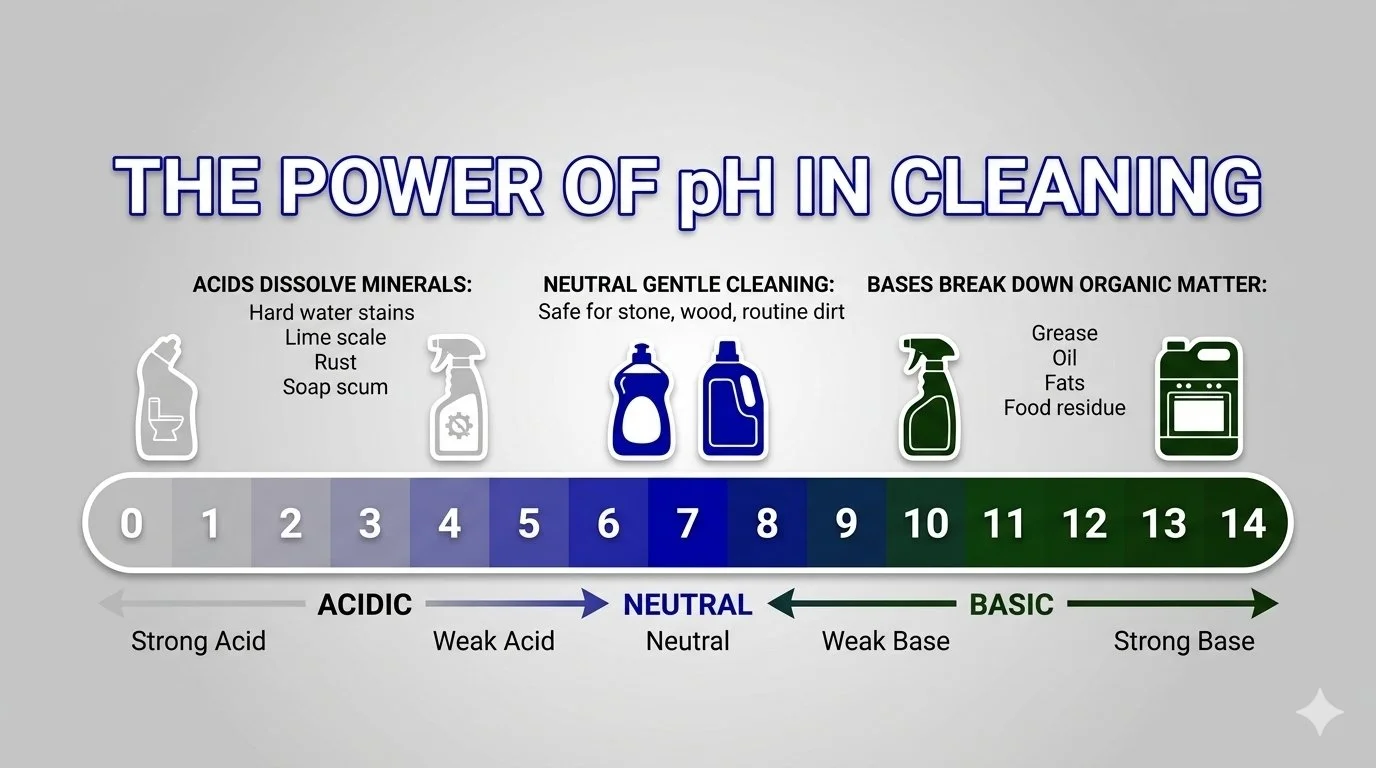
pH stands for "potential of hydrogen" and measures how acidic or basic a substance is on a scale from 0 to 14.
The pH scale:
0-6: Acidic (the lower the number, the stronger the acid)
7: Neutral (pure water)
8-14: Basic (the higher the number, the stronger the base)
Why this matters for cleaning: Different types of dirt, grime, and buildup respond to different pH levels. Acids dissolve certain substances. Bases dissolve others. Using the wrong pH is like trying to unscrew a bolt with a hammer — you're applying force, but it's the wrong tool for the job.
The pH scale with common household cleaners
Here's where everyday cleaning products actually fall on the pH scale. Note that a product’s pH can be found in Section 9 of their respective Safety Data Sheet.
Strong acids (pH 0-4):
Common toilet bowl cleaners (Lysol / Scrubbing Bubbles)
Oxalic acid (Bar Keeper's Friend)
Acetic acid (white vinegar)
Citric acid (lemon juice)
Weak acids (pH 4-6):
Bathroom cleaners designed for hard water (Seventh Generation / Method Daily Shower Spray)
Neutral range (pH 6-8):
Distilled water (pH 7.0 – true neutral)
Palmolive dish soap
pH-neutral cleaners (Bona Hard Surface Floor Cleaner / Zep Neutral pH Floor Cleaner / Method Hard Floor Cleaner)
Weak bases (pH 8-10):
Baking soda (sodium bicarbonate)
Borax (sodium borate)
Dawn Ultra dish soap
Strong bases (pH 11-14):
Oven cleaners (Easy Off Fume-Free / Zep
Drain cleaners (Drano Max Gel / Liquid Plumr)
Toilet bowl cleaners with bleach (Clorox)
Important note: The pH scale is logarithmic, not linear. This means each number represents a tenfold difference. pH 3 is ten times more acidic than pH 4, and one hundred times more acidic than pH 5. Small numerical differences represent huge differences in strength.
Not-so-important note (but still important to know going forward): Alkalis are bases that dissolve in water.
The chemistry behind how acids and bases actually clean
Understanding what acids and bases do at a molecular level explains why they work on different types of dirt.
What acids do
Acids donate hydrogen ionsto chemical reactions. This makes them excellent at:
Dissolving mineral deposits:
Hard water stains (calcium and magnesium carbonate)
Lime scale
Rust stains (iron oxide)
Soap scum (mineral soap residue)
Efflorescence (white mineral deposits on tile/concrete)
Why this works: Minerals are alkaline compounds. Acids react with them chemically, breaking their molecular bonds and dissolving them into solution. This is why acids work so well on hard water buildup — they're chemically breaking it down, not just scrubbing it away.
Acids also:
Brighten and restore shine to some surfaces (including ceramic, porcelain, stainless steel)
Remove tarnish from metals (brass, bronze, copper)
Neutralize alkaline residues
Kill certain bacteria
What acids DON'T do well:
Remove grease or oil
Cut through organic buildup
Dissolve proteins or fats
What bases do
Bases accept hydrogen ionsin chemical reactions. This makes them excellent at:
Breaking down organic matter:
Grease and oils
Fats (cooking residue, body oils)
Proteins (food residue, blood, organic stains)
Dirt and grime with organic components
Why this works: Bases cause a chemical reaction called saponification with fats and oils, essentially turning them into soap. This is why dish soap cuts through grease so effectively, and why oven cleaner dissolves baked-on grease.
Bases also:
Break down proteins and carbohydrates
Neutralize acidic residues
What bases DON'T do well:
Remove mineral deposits
Dissolve hard water stains
Clean rust
The neutral zone (pH 6-8)
True neutral cleaners:
Don't chemically react with most substances
Safe for almost all surfaces
Good for general dust and light dirt
Not effective for stubborn, chemically-bonded grime
When to use neutral cleaners:
Sensitive surfaces that acids or bases could damage
Routine maintenance cleaning
When you need safe, gentle cleaning
Identifying what you're actually cleaning
Before you can choose the right cleaner, you need to identify what you're trying to remove. Here's how to recognize common household messes by their characteristics:
Mineral-based buildup
Hard water stains:
Appearance: White, chalky, or cloudy deposits
Texture: Crusty, rough, difficult to scrub off
Common locations: Shower doors, faucets, sinks, toilets (waterline), tile, glass
What it is: Calcium and magnesium minerals left behind when water evaporates
Lime scale:
Appearance: White or off-white thick deposits, sometimes flaky
Texture: Very hard, almost rock-like where buildup is heavy
Common locations: Inside kettles, coffee makers, around faucet aerators, showerheads
What it is: Calcium carbonate buildup from repeated water exposure and heating
Rust stains:
Appearance: Orange, brown, or reddish stains
Texture: Can be surface-level or embedded in porous materials
Common locations: Toilets, sinks (where metal touches water), around old pipes
What it is: Iron oxide from metal corrosion or iron-rich water
Soap scum:
Appearance: White or gray filmy residue, sometimes with slight iridescence
Texture: Waxy, sticky feeling, difficult to remove with water alone
Common locations: Shower walls, tubs, shower doors, sinks
What it is: Combination of soap residue (fatty acids) + minerals from hard water. Contains both organic (soap) and inorganic (mineral) components, but the mineral component dominates
Efflorescence:
Appearance: White, powdery or crystalline deposits
Texture: Dry, powdery, easily brushed off when loose (but reappears)
Common locations: Brick, concrete, tile grout, basement walls
What it is: Salts brought to the surface through moisture evaporation
Organic/Grease-based buildup
Cooking grease and oil:
Appearance: Yellow to brown, glossy or sticky
Texture: Can be slippery (fresh buildup) or tacky (buildup that has been there a while)
Common locations: Stovetops, range hoods, backsplashes, oven interiors
What it is: Fats and oils from cooking that have condensed on surfaces
Baked-on food residue:
Appearance: Brown or black carbonized deposits
Texture: Very hard, crusty, difficult to scrape
Common locations: Oven interiors, baking sheets, pots and pans
What it is: Proteins, fats, and carbohydrates that have been repeatedly heated and carbonized
Body oils and soap residue:
Appearance: Slight film, often invisible until surface looks dull
Texture: Slightly greasy or waxy feeling
Common locations: Bathroom surfaces, tub ring, around sinks
What it is: Natural skin oils, body care products, soap residue
General dirt and grime:
Appearance: Gray or brown, dull appearance
Texture: Often slightly sticky or filmy
Common locations: Floors, walls, high-touch surfaces
What it is: Mix of dust, skin cells, oils, outdoor pollutants
Mould and mildew:
Appearance: Black, gray, green, or pink spots or patches
Texture: Can be surface-level (wipes away) or embedded (staining)
Common locations: Bathrooms, basements, window sills, anywhere with moisture
What it is: Fungal growth that thrives in moist, organic-rich environments
Mixed/Special Cases
Soap scum in hard water areas:
Contains both mineral deposits and organic soap residue
Best approach: Start with an acid to dissolve the minerals, then use a base if any organic residue remains
Or use a product specifically formulated for soap scum (contains both acid and surfactants to lift away the organic residue)
Toilet bowl rings:
Usually mineral deposits (hard water + waste minerals)
Sometimes combined with organic staining
Best approach: Acidic toilet bowl cleaner for minerals
Cloudy glassware from dishwasher:
Hard water etching (permanent damage) vs. mineral film (removable)
Test: If white vinegar removes it, it's mineral buildup. If not, it's etching.
Matching pH to the problem: An eco-friendly guide
Now that you can identify what you're cleaning, here's how to choose the right sustainable product:
For mineral deposits and hard water stains
Use acidic cleaners:
Mild hard water stains:
White vinegar -- cheap, effective, readily available
Apply, let sit 10-15 minutes, scrub, rinse
Safe for most non-porous surfaces
Toronto tip: Keep a spray bottle of vinegar in your bathroom for weekly shower door maintenance to prevent heavy mineral deposits.
Moderate buildup:
Make a paste of white vinegar and corn starch, apply, let sit for a few minutes, scrub gently, rinse thoroughly
Excellent for sinks, tubs, cookware
Mildly abrasive (helps with scrubbing action)
Heavy buildups may require multiple applications.
For rust stains:
Use a citric acid cleaner
Citric acid has the ability to “pull” rust from a surface (chelating), making it more effective than vinegar.
Important surface exceptions:
Never use acids on natural stone (marble, granite, limestone, travertine) - they will cause permanent damage through etching
Caution on metal fixtures - prolonged acid exposure can damage finishes
Test on grout - acids can break down grout sealant over time – leaving the grout vulnerable to erosion
For grease, oil, and organic buildup
Use alkaline cleaners (pH 8-14):
Light grease and daily grime:
Sustainable dish soap (my recommendation)
Dilute as directed by the product manufacturer, spray, let the solution sit for a couple of minutes, wipe clean
Moderate grease:
Sustainable all-purpose cleaner (my recommendation)
Apply, let sit as directed, scrub, rinse
Good for stovetops, kitchen surfaces, floors
Heavy baked-on grease:
Sustainable oven cleaner (my recommendation)
Follow directions carefully, including all safe handling precautions
Excellent for ovens, range hoods, barbecue grates
For mould and mildew:
Hydrogen peroxide / baking soda or a sustainable mould cleaner (my recommendation)
Address the cause of the excess moisture to prevent mould from returning
Protein-based stains:
Sustainable enzyme cleaner (my recommendation)
Use cold or lukewarm water (hot water can set protein stains)
For general/mixed Cleaning
Use neutral or mildly alkaline cleaners (pH 7-9):
Routine maintenance:
Dish soap and water (pH 7-9)
Mild all-purpose cleaners (pH 8-9)
Perfect for dust, fingerprints, light dirt
When surface sensitivity is a concern:
pH-neutral cleaners (pH 7)
Safe for wood, stone, and delicate finishes
Won't damage protective coatings
Surface-specific recommendations
Natural stone (marble, granite, limestone, travertine):
Only use pH-neutral cleaners (pH 7)
Acidic cleaners will etch the stone
Strong alkaline cleaners will strip the stone’s protective sealer
Hardwood floors:
pH-neutral for routine cleaning and slightly acidic (pH 6 or higher) for occasional deep cleaning
Alkaline cleaners can destroy the protective finish
Use minimal moisture
Stainless steel:
Neutral to slightly alkaline (pH 7-9)
Acids can damage the finish with prolonged contact
Strong alkalis can cause discolouration
Glass:
Mildly acidic (pH 4-6) for hard water stains
Use distilled water for streak-free cleaning
A diluted vinegar solution works beautifully
Ceramic tile:
Tolerates wide pH range (pH 2-11)
While the tile itself is durable, the grout surrounding it is not. Start with a mild base, and ensure the grout is properly sealed before escalating to a stronger product. Use acids only when targeting heavy mineral buildup (normally only in showers), and take precautions to prevent contact with grout.
Porcelain:
Very durable, tolerates strong acids and alkalis
Start with a mild acid or base, and only escalate if needed to minimize the risk of damaging the protective surface.
Common cleaning mistakes: Using the wrong pH
Understanding these common errors will save you hours of frustrated scrubbing:
Mistake 1: Using alkaline cleaner on mineral deposits
The scenario: You're scrubbing shower doors with an all-purpose cleaner, but the cloudy hard water stains won't budge no matter how hard you work.
Why it doesn't work: All-purpose cleaners are typically alkaline (pH 9-10). Hard water deposits are alkaline minerals. Bases don't react with bases—you're just pushing minerals around, not dissolving them.
The solution: Switch to an acidic cleaner (vinegar, citric acid). The stains will dissolve chemically with minimal scrubbing.
Mistake 2: Using acid on grease
The scenario: You try using vinegar to clean your greasy stovetop, but it just spreads the grease around and leaves a sticky mess.
Why it doesn't work: Acids don't react with fats and oils. You're just diluting the grease slightly, not breaking it down.
The solution: Use dish soap or an alkaline cleaner.
Alkalines chemically neutralize the fatty acids in the grease.
Surfactants in dish soap surround the oil molecules, "lifting" them off the stovetop so they can be rinsed away with water rather than just pushed around.
Mistake 3: Mixing acids and bases
The scenario: You hear that baking soda (base) and vinegar (acid) create a powerful cleaner, so you mix them together.
Why it doesn't work: They neutralize each other. The impressive fizzing is just carbon dioxide gas escaping as the two chemicals "cancel" each other out. Once the bubbles stop, you are left with water and a tiny amount of salt (sodium acetate). You’ve essentially turned two great cleaners into useless salt water.
The solution: Use them for their specific strengths, separately.
To scrub: Use a baking soda paste. Its high pH breaks down grease and its grit provides gentle abrasion.
To de-scale: Use vinegar. Its low pH dissolves hard water spots and soap scum.
The exception: If you have a slow drain, you can use the reaction for its mechanical energy. Pour the baking soda down first, then the vinegar, and plug the drain. The "fizzing" creates pressure that can physically dislodge hair or gunk—but it's the movement, not the chemistry, doing the work.
Mistake 4: Using acid on natural stone
The scenario: You use vinegar or acidic bathroom cleaner on marble countertops or shower tile to remove water spots.
Why it's a disaster: Acids react with calcium carbonate (which natural stone is made of), permanently etching the surface. Sadly, the damage is irreversible without professional restoration.
The solution: Only use pH-neutral cleaners on natural stone.
Mistake 5: Not letting the cleaner work
The scenario: You spray cleaner and immediately wipe, frustrated that it's not working.
Why it's inefficient: Chemical reactions take time. Spraying and immediately wiping doesn't give the cleaner time to break down the grime chemically.
The solution: Apply cleaner, let it sit (dwell time varies by product and buildup severity), then wipe. Dwell time allows the chemistry to do the work, so that your muscles don’t have to.
The right questions to ask
This is where understanding pH transforms your cleaning approach entirely.
Stop asking: "What will clean my [surface]?"
This question is too vague. It doesn't identify the actual problem.
Examples of vague questions:
"What will clean my bathtub?"
"How do I clean my glass shower door?"
"What's the best cleaner for my sink?"
Why they're too vague: The surface isn't the problem—the substance on the surface is the problem. Different substances require different solutions.
Start asking: "What will remove [substance] from my [surface]?"
This question identifies both the problem and any surface limitations.
Examples of specific questions:
"What will remove hard water stains from glass?" → Acid (vinegar or commercial descaler)
"What will remove grease from ceramic tile?" → Base (degreaser or alkaline all-purpose cleaner)
"What will remove soap scum from my acrylic tub?" → Mild acid with surfactants (a mixture of vinegar and dish soap or a specialized soap scum remover)
"What will remove water spots from marble?" → pH-neutral cleaner
The two-step thinking process:
Step 1: Identify what you're removing
Is it mineral-based? (cloudy, white, crusty) → Needs acid
Is it grease/oil-based? (sticky, greasy, brown) → Needs base
Is it general dirt? (dusty, filmy) → Neutral or mild base
Step 2: Identify surface limitations
Is the surface acid-sensitive? (grout, natural stone, some metals) → Avoid acids
Is the surface base-sensitive? (some wood finishes, soft metals like aluminum, brass, zinc) → Avoid strong bases
Is the surface generally durable? (ceramic, porcelain, glass) → Wide pH range acceptable
The answer: Choose the appropriate pH that removes the substance without damaging the material.
The substance determines the pH you need. The surface determines the pH you must avoid.
Practical application: Real-world scenarios
Let's apply this knowledge to common Toronto household cleaning challenges:
Scenario 1: Cloudy shower doors
What you see: White, hazy film on glass that won't wipe away with water
Identify the substance: Hard water mineral deposits (calcium and magnesium carbonate)
Surface considerations: Glass is durable and acid-resistant
Solution:
Use an acidic cleaner (white vinegar is cheapest, citric acid is more effective but typically costs more)
Spray generously, let sit for appropriate amount of time
Scrub with a non-abrasive sponge
Rinse thoroughly
Prevention: Squeegee doors after each shower, or spray with vinegar weekly
Scenario 2: Greasy range hood
What you see: Sticky, brown, glossy buildup that attracts dust
Identify the substance: Cooking grease and oil (organic fats)
Surface considerations: Usually stainless steel or painted metal (both tolerate alkaline)
Solution:
Use alkaline degreaser (pH 10-11)
Spray, let sit for appropriate amount of time
Wipe with a cloth or sponge
May need multiple applications for thick buildup
Rinse with hot water and dry
Prevention: Wipe weekly with alkaline cleaner before buildup becomes severe
Scenario 3: Toilet bowl ring
What you see: Brown or gray ring at water line, rough texture
Identify the substance: Mineral deposits from hard water, possibly with some organic staining
Surface considerations: Porcelain (very durable, acid-safe)
Solution:
Use acidic toilet bowl cleaner
Apply under rim and to ring, let sit for appropriate amount of time
Scrub with toilet brush
For stubborn rings: pumice stone (wet both stone and surface before use to reduce the risk of scratching the protective glaze)
Prevention: Flush daily to prevent buildup
Safety warning:Never mix a strong acid like an acidic toilet bowl cleaner with chlorine bleach! These 2 substances will react to create chlorine gas – which was literally used to kill soldiers during WWI.
Scenario 4: Soap scum on acrylic tub
What you see: White, filmy, slightly waxy buildup
Identify the substance: Soap scum (mixed: oils + hard water minerals)
Surface considerations: Acrylic can be scratched; avoid abrasives
Solution:
Use a mixture of vinegar and dish soap (I know what you’re thinking–”but the acidic vinegar will neutralize the alkaline dish soap!”--but in this case it’s the surfactants in the dish soap that are being relied on to lift the oils, not its alkalinity to dissolve them)
Prevention: Rinse tub after use, squeegee or wipe down weekly
Scenario 5: Hardwood floor dullness
What you see: Floor looks dingy, has lost shine
Identify the substance: Likely buildup of alkaline cleaner residue or dirt
Surface considerations: Hardwood finish is sensitive to both strong acids and bases
Solution:
First use pH-neutral wood floor cleaner
Damp mop only (never wet)
If residue remains, use a very dilute vinegar solution (1 part vinegar to 10 parts water), and rinse with plain water immediately
Prevention: Only use pH-neutral or manufacturer-recommended cleaners on hardwood to avoid future buildup
Scenario 6: Cloudy marble countertop
What you see: Dull, hazy appearance, possibly etching or residue
Identify the substance: Could be etching (permanent damage from acid) or alkaline residue buildup
Surface considerations: Natural stone—extremely acid-sensitive
Solution:
Clean with pH-neutral natural stone cleaner
If still dull: May be etching (requires professional restoration)
If it's residue: Dish soap and water, dry thoroughly
Prevention:Never use acidic or alkaline cleaners on marble (or any other natural stone). Only pH-neutral products.
Building a sustainable cleaning arsenal
You don't need 20 products. Here's a strategic, pH-based cleaning kit:
The Essential Four
1. Acidic cleaner:
White vinegar for biofilms and light mineral buildup
Citric acid for rust and heavy mineral buildup
Uses: Hard water stains, mineral deposits, rust, soap scum
2. Alkaline cleaner:
Sustainable all-purpose cleaner for routine cleaning and light grease buildup
Sustainable oven cleaner for heavy grease buildup
Uses: Grease, general grime, floors, most durable surfaces
3. pH-neutral cleaner:
pH neutral dish soap and water works for most needs
Consider sustainable cleaners formulated specifically for natural stone / hardwood floors
Uses: Delicate pH-sensitive surfaces, routine maintenance
4. Abrasive cleaner:
Corn starch for mild acidic cleaning
Baking soda for mild basic cleaning
Natural fibre brushes for pH neutral cleaning
Uses: Stubborn stains on durable surfaces, cookware, sinks
Safety considerations when working with pH
Understanding pH includes respecting the power of strong acids and bases.
General safety rules
Never mix cleaning products unless you know exactly what you're doing:
acid + bleach = toxic chlorine gas (fatal)
ammonia + bleach = toxic chloramine gas (fatal)
hydrogen peroxide + vinegar = peracetic acid (damages the eyes and respiratory system)
acid + base = neutralization (wastes both products, and creates potentially unwanted heat)
Wear appropriate protection:
Gloves for anything below pH 4 or above pH 10
Eye protection for spray products or anything below pH 3 or above pH 11
Ventilation for strong acids or bases (open windows, use fans)
Follow product directions:
Always follow the recommended dilution ratios
Dwell times are tested for effectiveness and safety
Following rinsing instructions help prevent surface damage
Store all cleaning products:
Separate from each other
Out of reach of children and pets
In original containers with labels
Away from heat sources
pH-specific cautions
Strong acids (pH < 3):
Can burn skin and eyes
Can corrode metals
Fumes can irritate respiratory system
Can permanently damage acid-sensitive surfaces
Strong bases (pH > 11):
Can cause severe chemical burns
More dangerous than acids of equivalent pH (bases penetrate human tissue deeper)
Can blind if splashed in eyes
The slippery feeling after touching a base is literally the base turning your skin oils into soap, and should be washed off immediately until that slippery feeling is gone
Test before using:
On new surfaces, test in inconspicuous area
Wait 24 hours to ensure no damage
This is especially important with acids on stone, grout, or metal
Toronto-specific considerations
Understanding your local water and environment helps you anticipate cleaning challenges.
Toronto's water hardness
Toronto water is moderately hard:
This means calcium and magnesium minerals are present
You will deal with hard water buildup regularly
What this means for you:
Keep acidic cleaners on hand
Expect mineral deposits on faucets, shower doors, appliances
More frequent cleaning needed in bathrooms and kitchen
Consider water softener if buildup is severe
Seasonal Humidity
Toronto's humid summers:
Increased mould and mildew risk
More organic growth in bathrooms
Keep alkaline cleaners or hydrogen peroxide ready
Increase ventilation (exhaust fans, dehumidifiers)
Toronto's dry winters:
Heating systems dry air
Dust accumulation increases
Static electricity attracts more dust to surfaces
General cleaning (neutral or mild alkaline) more important
High-rise condo living
Harbourfront and other condo-dense areas:
Sealed buildings with limited ventilation
Shared water systems (consistent water hardness across units)
Smaller spaces mean faster buildup concentration
Regular cleaning more important in confined spaces
Conclusion: From guesswork to strategy
Understanding pH transforms cleaning from trial-and-error frustration into logical problem-solving. You're no longer guessing which product might work or why something isn't cleaning despite your effort.
The simple framework:
Mineral deposits (hard water, lime scale, rust) → Acid
Grease and organic matter (cooking oil, body oils, food residue) → Base
Routine dust and light dirt → Neutral or mild base
Delicate surfaces → pH-neutral only
The right question isn't "What cleans my bathtub?"
The right question is "What removes hard water stains from ceramic?"
One identifies the surface. The other identifies both the problem and the solution.
Armed with this knowledge, you'll:
Save time by eliminating the guesswork
Save money by buying fewer products
Protect your surfaces
Get better results
The next time you face a cleaning challenge: Pause. Identify what you're trying to remove. Consider your surface. Choose the appropriate pH. Let the chemistry do the work for you.
Need help with proper surface care and cleaning in your Toronto home? At EcoEthical Cleaning, I understand the chemistry behind every surface and challenge. I choose products based on science, not marketing, ensuring your home is cleaned effectively without damage. Contact me for a free, no-obligation estimate and experience sustainable cleaning done right.
Sources & Further Reading
“The Chemistry of Cleaning”, American Cleaning Institute,
"Neutralization", LibreTexts Chemistry
"Tap Water Quality & System Reports", City of Toronto
The environmental impact of microfibre cloths
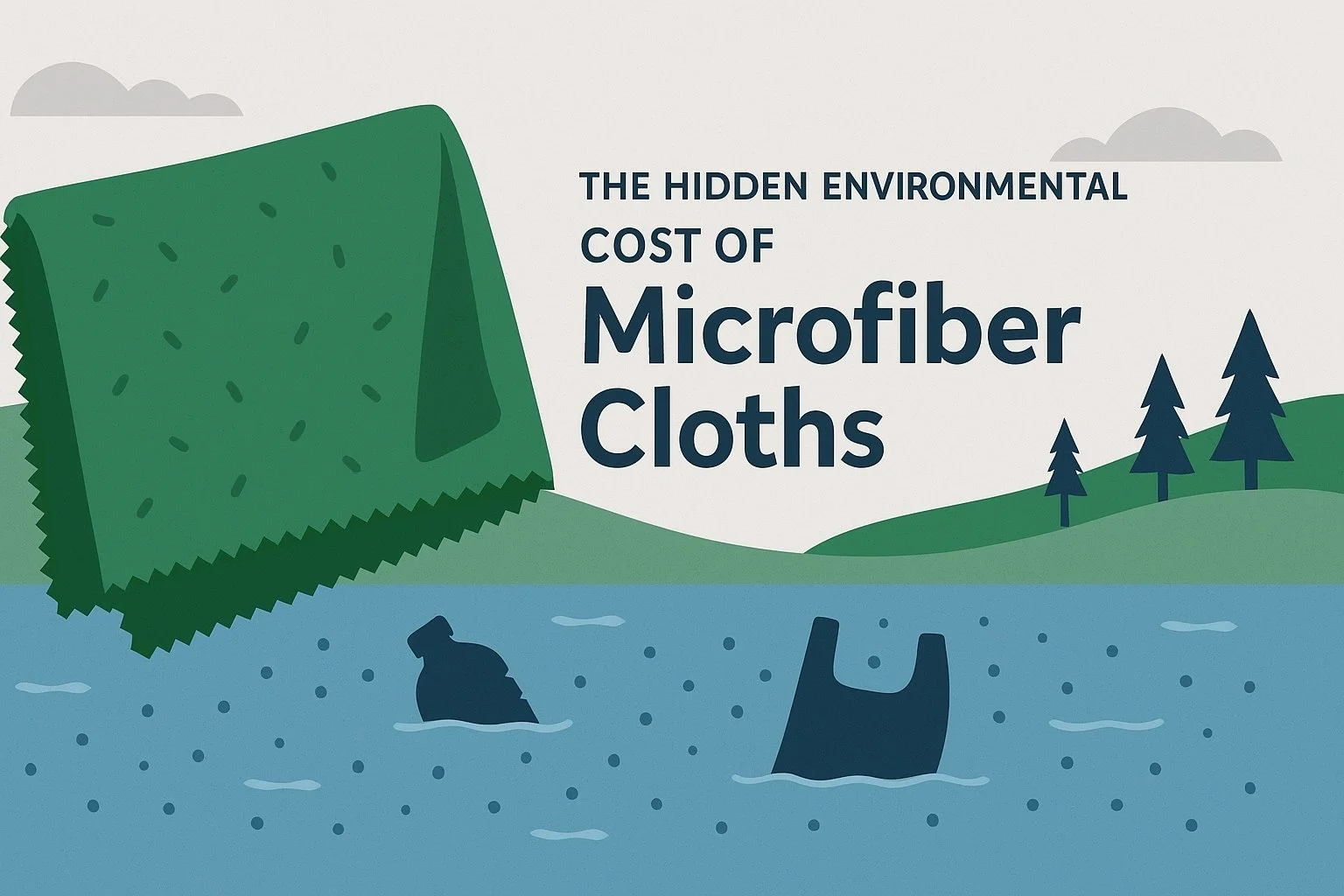
If you’ve switched to microfibre because it was marketed as a greener option, you’re not alone. Unfortunately, each microfibre wash releases plastic fibres that make their way into our waterways and ecosystems. Before you toss what you own, let’s explore what microfibre is made of, why it’s a problem, and how to move toward genuinely sustainable cleaning materials instead.
If you've been told that microfibre cloths are the sustainable cleaning solution, you're not alone. They've been marketed as reusable, effective, and even "eco-friendly" alternatives to disposable paper towels. And in some ways, they deliver — you can clean with just water, they last for years, and they genuinely work.
But here's the uncomfortable truth that's only recently come to light: microfibre cloths are shedding hundreds of thousands of tiny plastic fibres every time they are washed. These microscopic particles are flowing into our waterways, entering our food chain, and accumulating in ecosystems across the world. The very thing we thought was helping the planet is actually contributing to one of the most pressing environmental challenges we face — microplastic pollution.
Before you toss all your microfibre cloths in despair (please don't, I'll explain what to do with them later on), let's understand what's actually happening, why it matters, and what genuinely sustainable alternatives exist.
What are microfibre cloths?
Despite the natural-sounding name, microfibre is 100% synthetic plastic.
Most microfibre cloths are made from a blend of polyester (derived from petroleum) and polyamide, also known as nylon (another petroleum-based plastic). These materials are woven together to create ultra-fine fibres (typically 1/100th the diameter of a human hair) which gives microfibre its signature soft texture and cleaning ability.
While some microfibre is marketed as being "made from recycled materials," it may sound better but doesn't change the fundamental issue: it's still plastic that will shed more plastic.
Unlike cotton or other natural fibres, microfibres are plastic-based, which means they do not break down naturally in the environment.
How microfibre cloths actually work
Microfibre's cleaning power comes from its unique structure. Those ultra-fine plastic fibres create millions of tiny spaces and edges that:
Trap dirt mechanically — The fibres act like tiny hooks that grab and hold onto dust, dirt, and grime at a microscopic level. This is why you can often clean effectively with just water—the physical structure does most of the work.
Absorb moisture efficiently — The spaces between fibres allow microfibre to absorb up to seven times its weight in liquid.
Create static charge — When dry, microfibre builds up a static charge that attracts and holds dust particles, making it excellent for dusting without sprays.
Split and lift oils — Quality microfibre has "split" fibres with wedge-shaped edges that can penetrate and lift oil-based grime that would normally require soap.
It's not marketing hype, microfibre genuinely outperforms traditional cotton cloths for most cleaning tasks. The problem isn't that it doesn't work. The problem is what happens after you use it.
How microfibre cloths harm the environment
The microplastic pollution crisis
Each time a microfibre cloth is washed, it sheds thousands to hundreds of thousands of tiny synthetic fibres that enter wastewater systems. According to research published in Marine Pollution Bulletin, washing a single load of synthetic fabrics can release up to 700,000 microfibres into the water supply.
These fibres are too small for most wastewater treatment facilities to completely filter out, meaning they flow directly into rivers, lakes, and oceans. A study by Imogen Napper and Richard Thompson found that fabric type and washing conditions significantly affect microfibre release, with some materials shedding far more than others during routine washing.
For Canada, this is a particularly significant problem. The Great Lakes — which provide drinking water to millions of Canadians — are among the most contaminated bodies of water for microplastic pollution. Research by McGill University found that microplastics, including those from textiles, are present in the St. Lawrence River at levels comparable to the world's most polluted oceans.
Once in the water, these plastic fibres don't degrade — they just break down into smaller and smaller pieces, persisting in the environment for centuries.
Harm to marine life and Canada's food chain
Microfibre pollution doesn't just affect water quality; it's devastating to marine life. Small fish, plankton, and other aquatic organisms mistake microplastics for food, ingesting particles that provide no nutrition and can cause physical harm.
A study by Fisheries and Oceans Canada has shown that fish from Canadian waters contain microplastics in their digestive systems, which can lead to malnutrition, reproductive issues, and increased mortality rates.
More concerningly, microplastics bioaccumulate up the food chain. When small organisms ingest microfibres, those plastics travel through larger predators and, eventually, to humans. Since seafood is a dietary staple for many Canadians — particularly in coastal communities — this represents a direct threat to public health.
Research from Environment and Climate Change Canada indicates that microplastics have been found in table salt, drinking water, and even human feces, proving that plastic fibres have fully entered our food system. We're literally consuming the plastic pollution we've created.
Fossil fuel dependence and carbon emissions
Beyond the shedding problem, microfibre cloths contribute to climate change from the moment they're manufactured.
These cloths are derived from petroleum-based products — primarily polyester and nylon — which are made from fossil fuels. The production of these materials is energy-intensive, releasing large amounts of carbon dioxide into the atmosphere. According to Canada's Energy Regulator, the oil and gas sector accounts for a quarter of the nation's greenhouse gas emissions.
By supporting the production and use of synthetic fabrics like microfibre, we're indirectly contributing to Canada's carbon footprint. And unlike natural fibres such as cotton, hemp, or bamboo, microfibres cannot be composted or safely disposed of at the end of their life. They typically end up in landfills or incinerators, both of which contribute to environmental degradation.
Even dry use releases plastic
Microfibre cloths shed fibres even when you're using them dry. When you dust with microfibre, you're releasing plastic particles into the air in your home. These particles settle on surfaces and eventually make their way into indoor dust.
While indoor microplastic exposure is still being studied, researchers have already found microplastics in human lung tissue and blood samples. The full health implications aren't yet understood, but the trajectory isn't encouraging.
Why microfibre cloths aren't as "eco-friendly" as advertised
Many microfibre cloths are marketed as sustainable because they're reusable and reduce the need for paper towels or disposable cleaning products. While it's true that microfibre cloths reduce single-use waste, their overall environmental impact is far more damaging.
Here's why they're not a truly sustainable choice:
Plastic shedding — Each wash releases hundreds of thousands of microplastics into waterways—contributing to the estimated 35% of microplastic pollution in oceans that comes from synthetic textiles.
Non-biodegradability — They don't break down naturally and persist in the environment for centuries, continuing to fragment into smaller particles.
Petroleum-based production — They rely on fossil fuel extraction, contributing to greenhouse gas emissions and global warming.
End-of-life waste — They cannot be easily recycled or composted. Textile recycling infrastructure is limited, and mixed synthetic fabrics like microfibre are particularly difficult to process.
Invisible pollution — Unlike plastic bottles or bags that we can see and measure, microfibre pollution is invisible — which makes it easier to ignore but no less harmful.
Sustainable alternatives to microfibre cloths
The good news is that genuinely sustainable alternatives exist that clean just as effectively without the plastic pollution problem. Natural fibres have been cleaning homes effectively for centuries — we just got distracted by newer technology.
Natural fibre cloths
Cotton huck towels — These lint-free, tightly woven cotton towels are what professional window cleaners used for decades before microfibre existed. They're exceptionally absorbent, leave no streaks on glass, and can be washed hundreds of times.
Best for: Glass, mirrors, stainless steel, general wiping
Organic cotton — Biodegradable, durable, and can be washed repeatedly. Look for GOTS-certified organic cotton, which is free from harmful chemicals and pesticides.
Best for: All-purpose cleaning, kitchen surfaces
Swedish dishcloths — Made from cellulose (wood pulp) and cotton, these biodegradable cloths can absorb 15 times their weight in liquid. When they wear out after months of use, they can be composted.
Best for: Countertops, spills, general kitchen cleaning
Bamboo — A fast-growing, renewable resource that requires less water and no pesticides to grow. Bamboo cloths are naturally antibacterial, highly absorbent, and an excellent alternative to microfibre.
Best for: Bathrooms, kitchen surfaces, general cleaning
Hemp — One of the most sustainable textiles available. It requires minimal water and is naturally resistant to pests, meaning it doesn't rely on chemical treatments. Hemp cleaning cloths are exceptionally durable and biodegradable.
Best for: Heavy-duty cleaning, scrubbing
Linen — Naturally antimicrobial and highly durable, linen becomes softer and more absorbent with each wash. A bit of an investment upfront, but they'll last for years.
Best for: Kitchen surfaces, glassware, fine cleaning
Upcycled cotton rags -- Instead of purchasing new materials, consider using old t-shirts, towels, or linens as cleaning cloths. Not only does this reduce waste, but it also extends the life of existing fabrics. True sustainability isn't just about buying better; it’s about utilizing what already exists.
Best for: General cleaning, any household task
Wool — For dusting specifically, wool cloths naturally attract and trap dust particles through static electricity without synthetic fibres. Wool is compostable and does not release microplastics when washed.
Best for: Dusting furniture, electronics, delicate surfaces
Natural fibre sponges and brushes
For scrubbing tasks, consider:
Cellulose sponges — Made from wood pulp, they're biodegradable and work just as well as synthetic sponges
Coconut fibre scrubbers — Tough enough for stuck-on food without scratching surfaces
Natural bristle brushes — Perfect for grout, tile, and detail cleaning
Making the switch: Practical tips
Start with what you replace most often — If you're constantly reaching for microfibre for glass cleaning, replace those first with cotton huck towels. Test what works for your routine.
Use what you already have — Before buying anything new, repurpose old cotton t-shirts, towels, and linens. Cut them into cleaning-sized squares.
Designate cloths by task — Just like with microfibre, assign specific natural-fibre cloths to specific jobs (bathrooms, kitchen, dusting). This prevents cross-contamination and keeps things organized.
Adjust your technique slightly — Natural fibres work a bit differently than microfibre. You might need to:
Rinse and wring cloths more frequently during use
Use slightly more water for some tasks
Dampen cotton cloths before dusting (rather than using them dry)
Switch to a dry cloth for final buffing on glass
Wash properly — Natural fibres are easier on the environment, but you still want them to last:
Wash in warm or hot water
Avoid fabric softener (it reduces absorbency)
Hang dry when possible to extend their life
No special care needed—they're far more forgiving than synthetic materials
What if you already own microfibre cloths?
Don't throw them away — that just sends more plastic to the landfill immediately. Instead:
Use them until they wear out — The environmental damage from washing them is already happening, but manufacturing new products (whether microfibre or natural alternatives) also has an environmental cost. Get your use out of what you own.
Reduce microplastic shedding when washing them:
Wash in cold water (reduces fibre release)
Use liquid detergent instead of powder (less agitation)
Wash full loads (less friction between items)
Consider a microfibre-catching laundry bag like Guppyfriend or Cora Ball — they can capture many microplastics before they reach waterways
If you use a laundry filter, dispose of captured fibres by placing them in a sealed non-recyclable bag and adding to your household trash
Air dry instead of machine drying when possible
Repurpose for non-washing tasks — Use old microfibre for garage cleaning, car detailing, or other jobs where you won't wash them frequently.
Replace gradually with natural alternatives — As microfibre cloths wear out, replace them with natural fibre options. This spreads out the cost and lets you test what works best for your cleaning routine.
How Canadians can take action
If you're concerned about the environmental impact of microfibre cloths, here are practical steps you can take today:
Switch to sustainable alternatives — Opt for natural fibre cloths instead of microfibre. Even switching half your cleaning cloths makes a difference.
Use a laundry filter — If you must continue using microfibre, consider installing a microfibre filter in your washing machine to capture plastic fibres before they enter wastewater.
Support microplastic research and advocacy — Organizations like Ocean Wise and Oceana Canada are actively working to combat microplastic pollution. Consider supporting their work or staying informed about their initiatives.
Spread awareness — Educate friends and family about the environmental costs of microfibre products. Most people genuinely don't know about this issue. Sharing information facilitates change.
Support businesses making better choices — Choose cleaning services and products that prioritize natural materials over synthetics. Consumer demand drives industry change.
Advocate for better infrastructure — Contact your local representatives about improving wastewater treatment facilities to better filter microplastics, and support policies that address plastic pollution at the source.
Final thoughts: Progress over perfection
Here's the thing about sustainable living: it's complicated, and there's rarely a perfect solution. Microfibre cloths seemed like the right choice when we first learned about them. The fact that we're now discovering they have serious environmental downsides doesn't mean we failed — it just means our understanding evolved, and we're now responding to new information.
The goal isn't to shame anyone for using microfibre or to create anxiety about every cleaning choice. It's to make informed decisions with the information we now have.
Natural fibre cleaning cloths are a genuinely better alternative for the environment. They work beautifully for most cleaning tasks, they're biodegradable, and they don't shed plastic into our water systems. For the vast majority of home cleaning, you truly don't need synthetic materials.
Will switching your cleaning cloths single-handedly save the Great Lakes? No. But microplastic pollution is a massive problem that requires action at every level — from individuals to industries. Your choices do contribute to demand, and demand shapes what manufacturers produce and what becomes normalized.
Plus, there's something quietly satisfying about cleaning with simple, natural materials that humans have used effectively for centuries. Cotton, linen, and cellulose work. They've always worked. We just got enticed by technology that seemed more advanced.
If you're ready to make the switch, start small. Replace one type of cleaning cloth. See how it works. Adjust your routine. Then replace another. Before long, you'll have a cleaning kit that's genuinely sustainable — not just marketed that way.
Every small change helps in the fight against plastic pollution. Are you ready to make the switch?
Need help with sustainable, microfibre-free cleaning solutions for your home? As an independent cleaner and the founder of EcoEthical Cleaning, I understand the science behind every cleaning method and choose approaches that protect both your surfaces and our environment. Contact me for a free, no-obligation estimate and experience professional cleaning that's both effective and responsible. I serve Toronto’s Harbourfront-CityPlace district and surrounding areas.
Sources & further reading
Katie Okamoto, "Your Laundry Sheds Harmful Microfibers. Here's What You Can Do About It," Wirecutter, New York Times, August 5, 2021
Imogen E. Napper, Richard C. Thompson, "Release of synthetic microplastic plastic fibres from domestic washing machines: Effects of fabric type and washing conditions," Marine Pollution Bulletin, ScienceDirect, October 12, 2016
"Provincial and Territorial Energy Profiles," Canada Energy Regulator, September 10, 2024
"Science assessment of plastic pollution," Environment and Climate Change Canada, October 2020
McGill University research on microplastics in the St. Lawrence River
Fisheries and Oceans Canada studies on microplastics in Canadian fish populations
For more information on combating microplastic pollution:
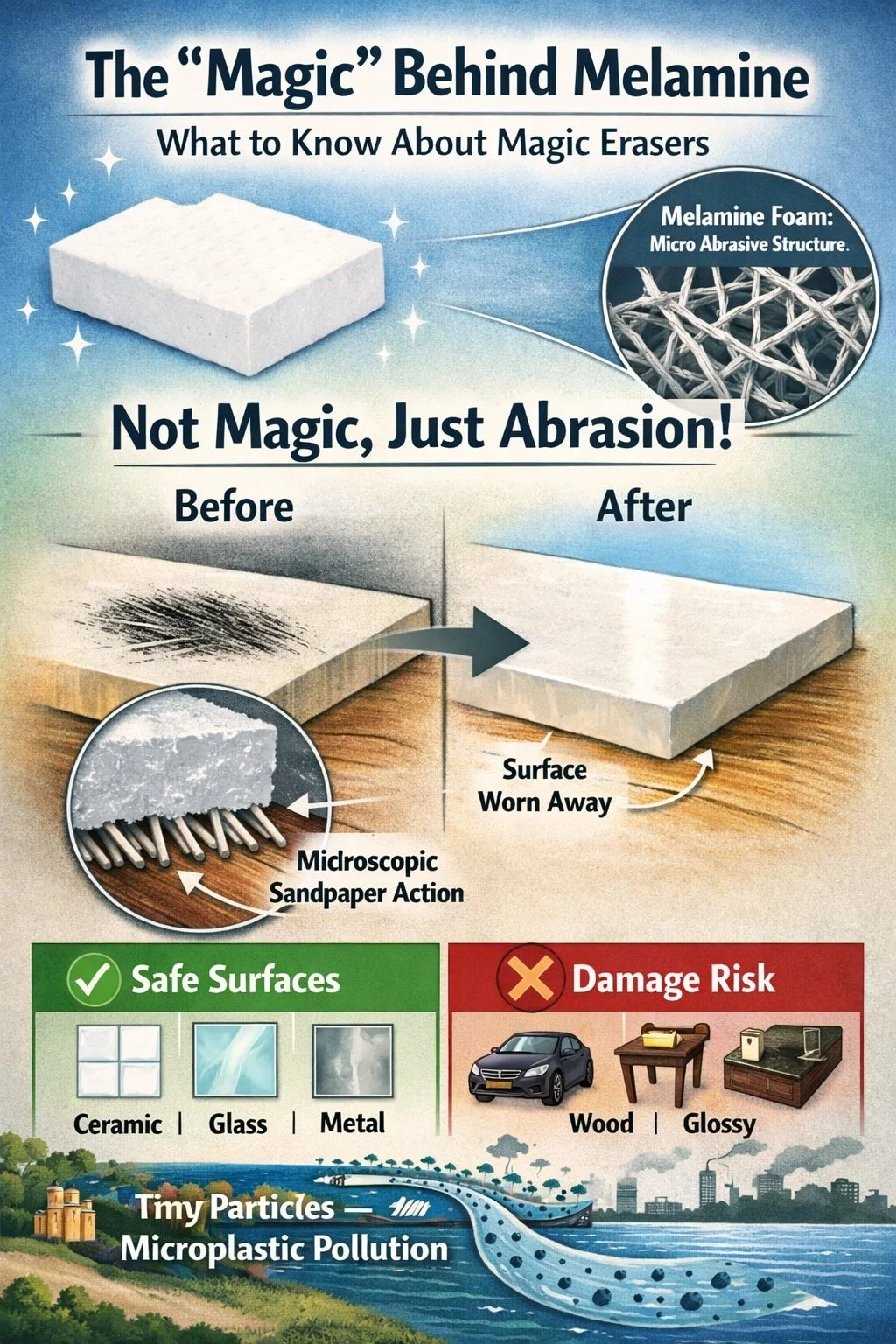
The "magic" behind melamine: What to know about Magic Erasers
Magic Erasers seem to work like, well, magic—removing stubborn scuff marks and stains with just water. But here's the truth: there's no magic involved. These white sponges are made from melamine foam, which works through abrasion—essentially acting as very fine sandpaper. While they're brilliant for certain tasks, they can also damage glossy finishes, strip protective coatings, and dull polished surfaces. Understanding what Magic Erasers actually are and how they work will help you use them effectively without accidentally ruining your walls, appliances, or furniture. The real magic? Knowing when not to reach for one.
If you've ever used a Magic Eraser to remove a stubborn scuff mark and watched it disappear like, well, magic — you've probably wondered what sorcery is actually happening. These unassuming white sponges seem to defy the laws of cleaning, removing marks that resist everything else you've tried. No chemicals needed. Just water and a bit of elbow grease.
But here's the thing: there's no magic involved. What's actually happening is both interesting and important to understand. Magic Erasers aren't cleaning in the traditional sense at all — they're essentially very fine sandpaper that's abrading away the top layer of whatever you're cleaning. Sometimes that's exactly what you need. Other times? You're slowly destroying your surfaces without realizing it.
If you've been using Magic Erasers on everything in your home, or if you're curious about what these miracle sponges actually are and whether they're safe for all of your surfaces, this deep dive will answer all your questions. I'll explore what melamine foam is, how it actually works, its environmental impact, and most importantly — which surfaces you should never, ever use it on.
What are Magic Erasers? A brief history
Magic Erasers are the brand name for cleaning sponges made from melamine foam, originally developed by the German company BASF in 1984. The foam was initially created for industrial applications — primarily as thermal insulation and soundproofing material in construction and automotive industries. It wasn't until the early 1990s that Japan realized this industrial foam had remarkable cleaning properties when wet.
Procter & Gamble (the company behind Mr. Clean) gave it an inspired name, and launched the Magic Eraser in 2003. The product became an instant phenomenon, generating hundreds of millions in sales and spawning countless generic melamine foam competitors.
The genius of the Magic Eraser wasn't inventing something new — it was recognizing that an existing industrial material could solve a common household problem. Marketing it as "magic" certainly didn't hurt either.
What makes them different from regular sponges?
Unlike traditional cleaning sponges made from cellulose or polyurethane, Magic Erasers are made from melamine resin that's been foamed into an extremely porous, open-cell structure. Under a microscope, melamine foam looks like a three-dimensional network of incredibly hard, thin strands — almost like a rigid spider web made of plastic.
This structure is what gives Magic Erasers their unique properties:
Extreme porosity: About 99% of the sponge is air, with only 1% being actual melamine material. This creates millions of microscopic edges and surfaces.
Hardness: Melamine resin is significantly harder than typical sponge materials, which is why it can abrade surfaces.
Microstructure: Each strand in the foam acts like a tiny abrasive fibre, collectively creating a very fine "sandpaper" effect.
Water activation: When dampened, the foam becomes slightly more flexible while maintaining its abrasive properties, making it effective without being overly aggressive.
It's essentially a highly engineered abrasive cleaning tool disguised as a soft, innocent-looking sponge.
How Magic Erasers actually clean: The science of abrasion
Magic Erasers don't clean through chemistry — they clean through physics. Specifically, through a process called mechanical abrasion.
What is abrasion?
Abrasion is the process of wearing away material through friction and scraping. It's the same principle behind sandpaper, nail files, and exfoliating scrubs. When you rub an abrasive material against a surface, you're physically removing microscopic layers of that surface.
Think of it this way: if you have a mark on a piece of wood, you could either dissolve it with a chemical cleaner (which breaks down the stain molecules) or you could sand away the top layer of wood that contains the mark. Magic Erasers take the second approach.
How melamine foam abrades surfaces
When you wet a Magic Eraser and rub it against a surface, here's what's actually happening at a microscopic level:
The foam compresses: Water makes the melamine foam slightly more pliable, allowing it to conform to the surface you're cleaning.
Millions of hard edges engage: Those microscopic melamine strands I mentioned earlier? Each one has sharp edges that act like tiny cutting tools.
Material is abraded away: As you scrub, these edges physically scrape away the top layer of material — whether that's a scuff mark, dried food, crayon, marker, or even a thin layer of paint or finish.
Abraded material fills the sponge: The removed material (along with dirt and grime) gets trapped in the sponge's porous structure, which is why Magic Erasers disintegrate and turn grey as you use them — they're literally filling up with whatever you're removing.
The surface appears "clean": Once the marked or stained layer is removed, the clean layer underneath is revealed. It looks like magic, but you've actually just sanded away the problem.
Why water matters
You might notice that Magic Erasers work much better when damp. This isn't because water is doing any cleaning — it's because:
Water lubricates the abrasive action, making it more efficient
It softens the foam slightly, allowing better surface contact
It helps carry away abraded material from the surface
It prevents the foam from crumbling too quickly
The water itself isn't dissolving or breaking down stains. It's just facilitating the mechanical abrasion process.
What this means for your surfaces
Understanding that Magic Erasers work through abrasion is crucial because it fundamentally changes how you should think about using them. You're not applying a cleaner that will evaporate and leave surfaces unharmed — you're removing material from your surfaces.
Sometimes this is perfectly fine. Light mineral buildup on a glass shower door? A Magic Eraser is softer than glass, so mineral deposits can be abraded away without risk of damaging the glass. But using a Magic Eraser on a glossy finish? You're abrading away the gloss itself, leaving behind a dull spot.
This is why Magic Erasers seem to work miracles on some surfaces and create disasters on others.
The environmental impact of melamine foam
Now that we understand what Magic Erasers are and how they work, let's talk about their environmental footprint. Spoiler: it's not great, and the problems span from manufacturing to disposal.
Manufacturing: The chemical process
Melamine foam is produced through a chemical process that combines melamine resin with formaldehyde and other compounds. Here's why this matters:
Petroleum-based product: Melamine is synthesized from urea, which is typically derived from natural gas or petroleum. This ties Magic Erasers to fossil fuel extraction and all its associated environmental impacts.
Energy-intensive production: Creating melamine resin requires high temperatures and significant energy input, contributing to greenhouse gas emissions.
Chemical concerns: The manufacturing process involves formaldehyde, a known carcinogen. While the finished foam contains minimal formaldehyde (it mostly reacts during production), the manufacturing process creates environmental and worker safety concerns.
Water and resource use: Industrial chemical production requires substantial water and generates chemical waste that must be properly managed.
While companies like BASF have improved the environmental efficiency of melamine foam production over the years, it remains a resource-intensive, petrochemical-based product.
During use: Microplastic pollution
As you use a Magic Eraser, it disintegrates. Those tiny pieces aren't just disappearing — they're contributing to microplastic pollution.
Melamine is plastic: Despite its sponge-like appearance, melamine resin is a thermoset plastic. It doesn't biodegrade.
Particles wash down drains: As the foam breaks apart during use, microscopic and small visible particles flow down your drain with rinse water. These particles are too small for most wastewater treatment plants to filter effectively.
They enter waterways: Those melamine particles end up in rivers, lakes, and oceans, where they persist indefinitely.
They contribute to microplastic accumulation: Like microfibre cloth, melamine foam adds to the growing burden of microplastics in aquatic ecosystems.
Disposal: Landfill burden
When a Magic Eraser is worn out (which happens quickly — they're designed to only be used a few times), where does it go?
Not recyclable: Melamine foam cannot be recycled through standard municipal recycling programs. The material doesn't fit into any recyclable plastic category.
Not biodegradable: In a landfill, melamine foam will persist for hundreds of years. It doesn't break down into harmless components — it just fragments into smaller pieces over time.
Volume considerations: Because Magic Erasers are 99% air, they take up disproportionate landfill space relative to their actual mass. While they compress somewhat, they still contribute to landfill volume.
No circular economy: Unlike materials that can be composted, recycled, or repurposed, used Magic Erasers are essentially one-way tickets to permanent waste.
The broader picture
When you consider the full lifecycle — resource extraction, manufacturing, shipping, brief use period, and permanent disposal — Magic Erasers have a significant environmental footprint relative to their utility.
For occasional use on specific challenging stains, this might be an acceptable trade-off. But many people use Magic Erasers as their primary cleaning tool for routine tasks that could be handled with reusable cloths and appropriate cleaners — essentially generating plastic waste unnecessarily.
This doesn't mean Magic Erasers should never be used, but understanding their environmental cost will help you make more informed decisions about when they're truly the best tool for the job.
Understanding the Mohs Scale: Which surfaces are safe?
Understanding the Mohs Hardness Scale will help you avoid expensive mistakes with your Magic Eraser.
What is the Mohs Scale?
The Mohs Hardness Scale, developed in 1812 by German mineralogist Friedrich Mohs, ranks materials from 1 (softest) to 10 (hardest) based on their scratch resistance. The principle is simple: a harder material can scratch a softer material, but not vice versa.
Here's the scale for reference:
Talc (softest)
Gypsum
Calcite
Fluorite
Apatite
Orthoclase feldspar
Quartz
Topaz
Corundum
Diamond (hardest)
Melamine foam ranks approximately 3-4 on the Mohs scale. This means it's harder than gypsum but softer than most stones and harder minerals.
The Scratch Rule
Key takeaway: Magic Erasers can scratch any surface softer than approximately 3-4 on the Mohs scale.
If what you're cleaning is softer than melamine foam, the Magic Eraser will abrade it. If it's harder, the Magic Eraser will wear away without damaging the surface (though it still might remove their protective coatings or finishes — more on this below).
Surfaces that are safe for Magic Eraser use
These materials are generally harder than melamine foam or have matte finishes where light abrasion won't be noticeable:
Ceramic tile (unglazed or matte): Ceramic rates around 5-7 on the Mohs scale, making it harder than melamine. Matte or textured tiles can handle Magic Erasers well.
Porcelain: Similar to ceramic but denser, porcelain is safe from scratching by melamine foam.
Natural stone (most types): Granite (6-7), quartzite (7), and other hard stones are safe. However, polished finishes can be dulled — more on this below.
Concrete and cement: These are harder than melamine and can be cleaned safely with Magic Erasers.
Glass: Glass rates 5.5 on the Mohs scale, so it won't be scratched by Magic Erasers.
Stainless steel (unpolished): Stainless steel is harder than melamine, though you can dull brushed finishes if you scrub against the grain.
Bathtubs and showers (most): Porcelain, ceramic, and fiberglass tubs can generally handle Magic Erasers. They're effective at removing soap scum and hard water stains.
Surfaces to avoid
These materials are either softer than melamine foam or have finishes that will be damaged by abrasion:
Painted walls: The Magic Eraser will dull the shine of glossy sheens, creating noticeable matte spots. Matte finishes rely on microscopic peaks and valleys to scatter light across their surface. Magic Erasers will remove these peaks and valleys, causing light to instead be reflected — ruining the matte effect.
Wood furniture and floors (finished): Even if the wood itself is relatively hard, the finish (polyurethane, varnish, wax) is softer and will be abraded away, leaving dull spots and potentially exposing bare wood.
Stainless steel appliances (polished): While you won't scratch the steel itself, you could destroy the polished finish, leaving visible dull streaks.
Car exteriors: Automotive paint and clear coats are definitely softer than melamine foam. Using a Magic Eraser on your car will remove clear coat and dull the finish — an expensive mistake.
Acrylic and plastic surfaces: Most plastics are softer than melamine foam. This includes acrylic bathtubs, plastic laminate countertops, phone screens, eyeglasses, and plastic appliance surfaces.
Granite and marble (polished): While the stone itself is hard enough, the polished finish can be dulled by abrasion. You might not scratch the stone, but you'll create matte spots in the shine.
Leather and vinyl: Both materials will be damaged by the abrasive action. You'll remove colour and protective coatings.
Non-stick cookware: Magic Erasers will absolutely destroy non-stick coatings. Never use them on Teflon or ceramic non-stick surfaces.
Fiberglass (gelcoat finishes): While fiberglass itself might withstand Magic Erasers, gelcoat finishes (common on bathtubs and boats) will be dulled or damaged.
Screens and displays: Phone screens, TV screens, monitor screens — all are coated with materials softer than melamine foam. You'll scratch them.
Stone countertops with sealant: Even if the stone is hard enough, you'll abrade away the protective sealant, leaving the stone vulnerable to future staining.
The finish problem
Here's a critical nuance: even on surfaces that are theoretically hard enough to resist scratching, Magic Erasers can still cause damage by removing protective finishes, polishes, or coatings.
Think of it this way: your granite countertop might be hard (6-7 on Mohs scale), but the sealant protecting it could be much softer. The stainless steel on your appliances is hard, but the polished finish could be more vulnerable. The wood floor is protected by polyurethane, which is softer than the wood itself.
Magic Erasers don't discriminate — they abrade whatever they touch, including protective layers you can't see.
How to test safely
If you're unsure whether a Magic Eraser is safe for a particular surface, always test in an inconspicuous area first:
Choose a hidden spot (inside a cabinet, behind furniture, low on a wall)
Dampen the Magic Eraser and use light pressure
Scrub a small area (2-3 inches)
Dry the area completely and examine it in good lighting
Look for dullness, scratches, or changes in sheen
Wait 24 hours and check again (some damage becomes more apparent when fully dry)
If you see any change in appearance, don't use the Magic Eraser on visible areas of that surface.
When Magic Erasers are a suitable last-resort
Despite all these warnings, Magic Erasers do have legitimate uses when other sustainable methods have been unsuccessful. The key is using them strategically on appropriate surfaces for appropriate tasks.
Ideal use cases
Crayon and marker on hard surfaces: On ceramic tile, porcelain, or glass, Magic Erasers remove crayon and permanent marker better than almost anything else.
Soap scum on shower doors and tile: The abrasive action cuts through built-up soap scum on glass shower doors and ceramic tile without harsh chemicals.
Hard water stains on glass: Magic Erasers excel at removing mineral deposits from glass surfaces where abrasion won't cause visible damage.
Adhesive residue on appropriate surfaces: Sticky residue from labels, tape, or stickers comes off easily with Magic Erasers.
Grout cleaning: White grout between tiles can be brightened with Magic Erasers (though a proper grout brush and cleaner is often more effective and less wasteful).
Rubber sole marks on floors: Those black streaks on tile or linoleum floors from shoe soles can be removed with a Magic Eraser, although the risk of damage to the floor’s protective sealant is high.
Smart usage tips
If you're going to use Magic Erasers, use them wisely:
Use the lightest pressure possible: Don't scrub aggressively. Let the abrasive action do the work with gentle pressure.
Keep them damp, not soaking: A damp Magic Eraser is more effective and lasts longer than a dripping wet one.
Work in small sections: This gives you better control and helps you notice if any damage is occurring.
Stop if you see shine changes: If a surface is becoming duller or shinier where you're cleaning, stop immediately—you're damaging the finish.
Consider alternatives first: Before reaching for a Magic Eraser, ask yourself if a less abrasive method might work. Often the right cleaner and a clean cloth will handle the job without generating plastic waste or risking surface damage.
Cut them into smaller pieces: A full Magic Eraser is often more than you need. Cutting them into quarters makes them last longer and reduces waste.
Better alternatives for most cleaning tasks
The truth is, for the vast majority of cleaning tasks, you don't need Magic Erasers at all. Here are some sustainable, surface-safe alternatives:
For general cleaning
Baking soda paste: Mix baking soda with a small amount of water to create a paste. This provides gentle abrasion (baking soda ranks about 2.5 on Mohs scale — softer than melamine) for cleaning without the plastic waste. Works beautifully on sinks, tubs, and tile.
White vinegar: For hard water stains, soap scum, and mineral deposits, vinegar's acidity often works better than abrasion — and it's reusable and biodegradable. Just exercise caution when using vinegar (or any acid for that matter) around surfaces prone to acid damage (grout, natural stone, and wood to name a few).
Plant-based dish soap and warm water: Never underestimate the cleaning power of good old-fashioned surfactants. A quality dish soap and a natural-fibre cloth handle most household cleaning tasks effectively.
For specific problems
Scuff marks on walls: Try a damp cloth first. For stubborn scuffs, a damp cloth with a tiny bit of baking soda often works. I personally recommend investing in a powder-sprayer (often used in salons/barbers) and filling it with baking soda — so that you always have a quick burst on hand.
Crayon and marker: Rubbing alcohol (grain alcohol is an excellent, sustainable alternative) on a cloth removes most marker. For crayon, try a bit of mayonnaise or vegetable oil (it dissolves the wax), followed by a soap and water cleanup.
Adhesive residue: Rubbing alcohol, vegetable oil, or commercial adhesive removers dissolve sticky residue without abrasion.
Soap scum: A mixture of white vinegar and dish soap in a spray bottle, left to sit for 10 minutes, cuts through soap scum on most surfaces without scrubbing.
Hard water stains on glass: Vinegar soaks work wonders. For extreme buildup, a clean razor blade held at a low angle safely removes deposits from glass without scratching.
The reusable approach
For genuinely sustainable cleaning that doesn't generate plastic waste:
Natural-fibre scrub brushes for grout and textured surfaces
Cellulose sponges for general scrubbing
Coconut fibre scrubbers for tough jobs on appropriate surfaces
Cotton cloths with appropriate cleaners for most tasks
Pumice stones for toilet bowl rings and extreme mineral buildup (on porcelain only)
These tools do require appropriate cleaners (unlike the "just add water" appeal of Magic Erasers), but they last much longer, generate far less waste, and don't contribute to microplastic pollution.
Final thoughts: The magic is understanding, not mystery
Magic Erasers are a brilliant example of marketing meeting materials science. By rebranding industrial melamine foam as a household cleaning miracle, Procter & Gamble (Mr. Clean) created a product category that generates hundreds of millions in annual sales.
But understanding what's really happening when a Magic Eraser is used helps you:
Protect your surfaces from unintended damage
Use them strategically only when appropriate
Consider the environmental impact in your purchasing decisions
Explore better alternatives for most cleaning tasks
Are Magic Erasers sometimes the right tool for the job? Absolutely. They excel at specific tasks on appropriate surfaces where their abrasive properties are beneficial rather than destructive.
Should they be your go-to cleaning solution for everything? Definitely not.
The real magic isn't in the sponge — it's in understanding how cleaning actually works, choosing the right tool for each job, and making informed decisions about which products deserve a place in your cleaning routine.
Next time you reach for a Magic Eraser, you'll know exactly what you're doing to your surfaces. And that knowledge — that's the real magic.
Need help with sustainable, surface-safe cleaning solutions for your home? As an independent cleaner and the founder of EcoEthical Cleaning, I understand the science behind every cleaning method and choose approaches that protect your surfaces and the environment. Contact me for a free estimate and experience professional cleaning that's both effective and responsible. I serve Toronto’s Harbourfront-CityPlace district and surrounding areas.
Sources & further reading
“Mr. Clean”, Wikipedia
"The Mohs Hardness Scale" International Gem Society
"Microplastics: more than a drop in the ocean" Environment and Climate Change Canada