Sanitizing vs. Disinfecting: What's the Difference and When Does Each Actually Matter?
In recent years, household hygiene has taken center stage in our daily routines. Learn the crucial differences between cleaning, sanitizing, and disinfecting—and discover when each approach actually matters for your health. Most of the time, simple cleaning is enough. This science-based guide explains what Canadian public health actually recommends, which methods work for different situations, and how to keep your home appropriately clean without unnecessary chemicals or environmental harm.
In recent years, household hygiene has taken center stage in our daily routines. From high-touch surfaces like doorknobs and light switches to kitchen countertops and shared workspaces, the focus on maintaining a germ-free environment has never been higher. As we move toward more sustainable and long-term wellness habits, the priority is shifting from universal application to targeted hygiene — choosing the right level of clean for the right situation.
Applying the most powerful chemical solution isn't always the most effective strategy. To achieve a healthy balance between safety, environmental impact, and household budget, we must move beyond the "one size fits all" approach to cleaning.
The confusion starts with terminology. "Sanitizing" and "disinfecting" sound similar and are often used interchangeably, but they're actually quite different — with different purposes, different chemical requirements, and different appropriate applications.
Understanding the distinction matters for your health, your home, your budget, and the environment. Using disinfectants when you only need to sanitize means exposing your family to unnecessary chemicals. Not disinfecting when you actually need to could leave dangerous pathogens in place. And doing either when simple cleaning is sufficient wastes time, money, and creates environmental harm.
This guide will explain exactly what sanitizing and disinfecting mean, how they differ from basic cleaning, when each is actually necessary, and how to approach them sustainably. You'll learn what Canadian public health guidelines actually recommend, which methods work for different situations, and how to keep your home appropriately clean without creating other health problems in the process.
Defining the terms: Cleaning, sanitizing, and disinfecting
These three terms represent different levels of germ reduction, each with specific purposes and appropriate applications.
Cleaning
What cleaning does:
Removes visible and tactile soil and grime
Reduces germ count through physical removal
Makes surfaces look and feel clean
Cleaning germ reduction: Removes approximately 80-90% of germs through physical action (wiping, scrubbing)
When cleaning is appropriate: Most everyday situations in healthy households
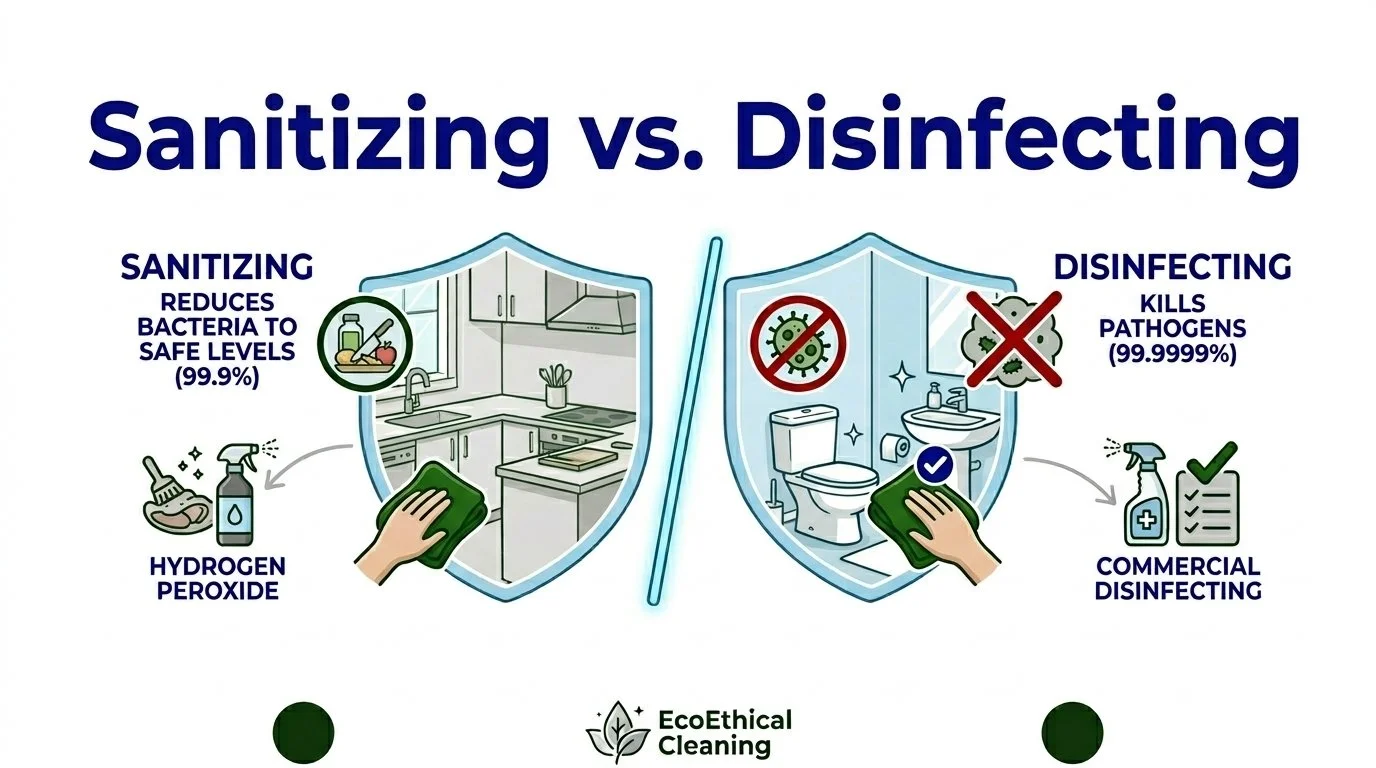
Sanitizing
What sanitizing does:
Reduces bacteria to acceptable levels
Takes less time and uses less harsh chemicals than disinfecting
Appropriate for most food-contact and high-touch surfaces
Sanitizing germ reduction: Reduces bacteria by 99.9% (3-log reduction) within a short contact (dwell) time, depending on the product
Regulatory standard: In Canada, sanitizers must reduce bacteria by 99.9% to meet Health Canada standards when used as directed
When sanitizing is appropriate: Food preparation surfaces, children's toys, eating surfaces, areas with moderate contamination
Disinfecting
What disinfecting does:
Kills bacteria, viruses, and fungi
Eliminates pathogens that cause disease
Requires stronger chemicals and a longer contact time
Very thorough level of germ elimination
Disinfecting germ reduction: Kills 99.9999% of pathogens (6-log reduction) within 5-10 minutes, depending on the product and targeted organism
Regulatory standard: In Canada, disinfectants must be registered with Health Canada and prove efficacy against specific pathogens when used according to label directions
When disinfecting is appropriate: Situations with high contamination risk, illness in the household, immunocompromised individuals, or specific high-risk surfaces (toilets)
Note: There is a 4th level of germ reduction, sterilizing — which is the complete destruction of all microbial life. Sterilizing is almost always reserved for medical scenarios, making it beyond the scope of this guide.
The key differences: Side-by-side comparison
Understanding how these three approaches differ helps you choose the right one for each situation:
Cleaning
Primary goal: Remove dirt and grime
Germ reduction: 80-90% (removal)
Method: Physical removal
Dwell time: None
Products used: Cleaners, water
Chemical strength: Mild
Appropriate for: Daily maintenance
Environmental impact: Lowest
Cost: Lowest
Sanitizing
Primary goal: Reduce bacteria to safe levels
Germ reduction: 99.9%
Method: Chemical reduction
Dwell time: Typically 30 seconds - 5 minutes
Products used: Sanitizers, mild solutions
Chemical strength: Moderate
Appropriate for: Food areas, high-touch surfaces
Environmental impact: Moderate
Cost: Moderate
Disinfecting
Primary goal: Kill pathogens
Germ reduction: 99.9999%
Method: Chemical killing
Dwell time: Typically 5-10+ minutes
Products used: Disinfectants
Chemical strength: Strong
Appropriate for: High contamination zones (toilets), homes with illness
Environmental impact: Highest
Cost: Highest
Important: You must clean before sanitizing or disinfecting. Dirt, grease, and organic matter interfere with sanitizers and disinfectants, preventing them from working effectively.
When regular cleaning is sufficient
This is actually most of the time in most healthy households. Understanding when simple cleaning is enough prevents unnecessary chemical use.
Daily/Weekly household surfaces in healthy homes
These typically need only regular cleaning:
Floors (vacuum, sweep, damp mop)
Countertops (wiped with soap and water or all-purpose cleaner)
Tables and desks
Dusting surfaces
Appliance exteriors
Windows and mirrors
Most furniture
Why cleaning is enough: These surfaces don't typically harbor dangerous pathogens in healthy households. Regular cleaning removes dirt and reduces germs adequately for health.
When to upgrade to sanitizing: If preparing food, after handling raw meat, or weekly for high-touch surfaces.
When to resort to disinfecting: Only during illness or other high-risk situations.
When sanitizing is the right choice
Sanitizing hits the sweet spot for many household situations: effective germ reduction without the unnecessary chemical exposure of disinfection or risk to the environment.
Food preparation surfaces
When: After preparing food, especially raw meat, poultry, or eggs
Why cleaning is not enough: Raw animal products can carry Salmonella, E. coli, Campylobacter, and other foodborne pathogens. Sanitizing reduces these pathogens to safe levels.
How to do it sustainably:
Option 1: 3% Hydrogen peroxide
Clean surface first with soap and water
Spray hydrogen peroxide, let sit 2-3 minutes
If it is food-grade hydrogen peroxide, allow it to air dry. Non-food-grade hydrogen peroxide (what is found in first aid sections) should be rinsed off any surface that will come into contact with food.
Keep hydrogen peroxide in its original container until ready to use
Option 2: Commercial food-safe sanitizer
Choose products approved for food contact surfaces
Follow label directions for dilution and contact time
Look for eco-certified options when available
Option 3: Very hot water
Water above 77°C (170°F) can sanitize
Suitable for sanitizing via dishwasher
Children's toys and items that go in mouths
When: Regularly for infant/toddler toys, after illness, when visibly soiled
Why cleaning is not enough: Cleaning removes visible dirt but may not adequately reduce pathogens that cause common childhood illnesses (colds, stomach bugs, hand-foot-and-mouth disease).
How to do it sustainably:
Hard plastic toys:
Wash with soap and water first
Sanitize with hydrogen peroxide (as described above)
Or wash in dishwasher on ‘Sanitize’ setting
As with food contact surfaces, food-grade hydrogen peroxide can be left to air dry. Otherwise rinse thoroughly before next use.
Soft toys and fabric items:
Wash in washing machine with hot water
Use hot dryer cycle (the heat provides sanitization)
For items that can't be washed: steam clean or leave in direct sunlight for several hours (ultraviolet rays have sanitizing properties)
Teething toys and pacifiers:
Many can be boiled for 5 minutes (check manufacturer instructions)
Or sanitize with hydrogen peroxide, then rinse thoroughly with clean water
High-touch surfaces in healthy households
When: Weekly or as part of regular cleaning routine
Why cleaning is not enough: High-touch surfaces (door handles, light switches, faucets, etc.) collect bacteria and viruses from hands. Regular cleaning may not adequately reduce germ levels.
How to do it sustainably:
The approach:
Incorporate sanitizing into weekly cleaning routine
Clean first (remove visible dirt)
Then sanitize high-touch surfaces
Sustainable sanitizing methods:
Hydrogen peroxide - safe for most household surfaces
Hot water at a minimum sustained temperature of 66°C (150°F) for a minimum of 20 seconds - most sustainable way to sanitize, but caution required as water at this temperature can cause severe burns
70% Alcohol solution - for surfaces sensitive to heat, moisture, oxidation, or anything mildly acidic
Commercial eco-certified sanitizers
Which surfaces:
Door handles and knobs
Light switches
Faucet handles
Cabinet pulls
Stair railings
Remote controls
Phones and tablets (follow device manufacturer guidance)
Cutting boards after use
When: After every use, especially after raw meat, poultry, or fish
Why cleaning is not enough: Soap and water may not adequately penetrate the knife grooves on a cutting board, where bacteria hide.
How to do it sustainably:
Clean first by scrubbing with soap and hot water
Apply hydrogen peroxide and allow it to sit for 10 minutes, to give it time to penetrate the knife grooves
Rinse non-food-grade hydrogen peroxide
Wipe the surface dry, to prevent the wood from warping and splitting
Plastic, dishwasher-safe cutting boards can be sanitized via dishwasher
Replace cutting boards when they become heavily scored
When disinfecting is actually necessary
Disinfecting uses stronger chemicals and should be reserved for specific high-risk situations where sanitizing isn't sufficient.
Someone in the household is sick
When: During and immediately after illness, particularly with highly contagious conditions
Why disinfecting: Some viruses and bacteria are highly contagious and resistant to sanitizers. Disinfecting kills these pathogens to prevent household spread.
Conditions that warrant disinfection:
Norovirus (stomach flu) - extremely contagious, sanitizers may not kill it
Influenza - spreads easily through respiratory droplets and surface contact
COVID-19 - can survive on surfaces, though surface transmission is less common than airborne
MRSA or any other antibiotic-resistant infections
Which surfaces to disinfect:
Bathroom surfaces (toilets, sinks, faucets, counters)
Door handles and light switches throughout the home
Faucets and cabinet handles
Specific surfaces the sick person touched frequently
Shared items (remote controls, touchscreens, medicine bottles)
How to do it sustainably:
Ensure that the sustainable disinfectant you wish to use has a Drug Identification Number (DIN) and is listed in the Drug Product Database (DPD)
Important: Follow contact time requirements. Spraying and immediately wiping removes the disinfectant before it can work. The surface must stay wet with disinfectant for the time specified by the manufacturer.
After sewage backup or flood contamination
When: After any sewage exposure or flood water containing sewage
Why disinfecting: Sewage contains dangerous pathogens including E. coli, Hepatitis A, rotavirus, and many others. Sanitizing isn't sufficient for this level of contamination.
Approach:
Remove all porous materials that contacted sewage (carpets, drywall, insulation)
Clean hard surfaces thoroughly first
Disinfect with appropriate solution
May require professional remediation
Note: This is a situation where calling professionals is often warranted. Sewage cleanup involves serious health risks.
Immunocompromised household members
When: Someone in the home has a significantly weakened immune system
Why disinfecting: Individuals with compromised immunity are vulnerable to infections from pathogens that don't typically affect healthy people. Additional precautions are necessary.
Who this includes:
Cancer patients undergoing chemotherapy
Organ transplant recipients
People with HIV/AIDS
Those on long-term immunosuppressive medications
Elderly with significantly weakened immune systems
Approach:
Consult with their healthcare provider about specific recommendations
May need to disinfect bathroom surfaces and high-touch areas daily
More frequent than needed in healthy households
Focus on surfaces the vulnerable person contacts
Important: Work with healthcare providers to determine the necessary level of disinfecting. Over-disinfecting creates chemical exposure concerns; under-disinfecting creates infection risk.
Bathroom surfaces after vomiting or diarrhea
When: After incidents of vomiting or diarrhea, even if not from known illness
Why disinfecting: Vomit and diarrhea may contain highly contagious pathogens. Quick disinfection prevents potential spread.
Which surfaces:
Toilet (entire fixture, including exterior and floor around base)
Bathroom sink and counter
All high-touch surfaces (door handles, faucets, light switches, etc.)
Safety note: Wear gloves and wash hands (and reusable gloves) thoroughly after cleaning contamination.
Pet accidents involving diarrhea or vomit
When: After pet diarrhea or vomiting, especially if pet is ill
Why disinfecting: Pets can carry pathogens transmissible to humans (zoonotic diseases), including some that cause serious illness.
Approach:
Safely remove all solid matter
Clean the area thoroughly
Disinfect with pet-safe disinfectant (use as directed)
Note: Routine pet urine accidents on hard floors typically only require cleaning, not disinfection (unless the pet has a urinary tract infection).
The risks of over-disinfecting
Using disinfectants unnecessarily creates several problems:
Chemical exposure:
Disinfectants contain strong chemicals that can cause respiratory irritation, skin irritation, and other health effects
Children are particularly vulnerable to chemical exposures
Chronic exposure to strong disinfectants may have long-term health impacts
Environmental harm:
Disinfectants enter waterways through drains
Many are toxic to aquatic life
Many don't break down quickly in the environment
Antimicrobial resistance:
While less studied than antibiotic resistance, some research suggests the overuse of antimicrobial products may contribute to bacterial resistance
Creates selection pressure for resistant organisms
Immune system concerns:
Some researchers believe excessive disinfection may interfere with normal immune system development in children
"Hygiene hypothesis" suggests some pathogen exposure is beneficial for immune system training
Balance is key: protect against dangerous pathogens without creating a sterile environment
False sense of security:
Disinfecting surfaces doesn't address airborne transmission (the main route for many respiratory illnesses)
Hand hygiene and respiratory etiquette are often more important than surface disinfection
What Canadian public health actually recommends
Health Canada and Public Health Ontario guidelines emphasize:
For healthy households:
Regular cleaning with soap and water is sufficient for most surfaces
Hand hygiene (handwashing) is more important than surface disinfection
Ventilation (open windows, air circulation) matters more than chemical interventions
Reserve disinfection for specific situations (illness, contamination events)
The focus should be:
Regular cleaning to remove dirt and reduce germs
Handwashing frequently and properly
Avoiding touching face
Covering coughs and sneezes
Staying home when ill
Good ventilation
Surface disinfection ranks lower in importance for disease prevention than these behavioral and environmental interventions.
Best practices
Whatever product you choose:
Clean first: Always remove visible dirt before sanitizing or disinfecting. Organic matter interferes with chemical efficacy.
Follow contact time: Product must stay wet on surface for specified time. Spraying and immediately wiping doesn't work.
Use proper dilution: Concentrated products must be diluted according to instructions. More concentrated isn't better and may actually be less effective.
Ensure adequate ventilation: Open windows, use fans, especially when using bleach or strong disinfectants.
Wear gloves: Protects skin from irritation through exposure.
Store safely: Keep all products away from children and pets.
Check expiration dates: Effectiveness decreases with product age. Expired products can not be relied upon to provide adequate disinfection.
Practical scenarios: Choosing the right approach
Let's apply this knowledge to real-world situations:
Scenario 1: Daily kitchen counter maintenance
Situation: Wiping down kitchen counters after preparing daily meals
Right approach: Cleaning
Why: Daily light maintenance of surfaces without contamination doesn't require sanitizing or disinfecting. Cleaning removes crumbs, spills, and reduces germs adequately.
When to sanitize: After preparing raw meat, poultry, or eggs.
Scenario 2: Child's high chair after meals
Situation: Cleaning high chair tray and seat after each meal
Right approach: Cleaning, with periodic sanitizing
Why: Daily cleaning removes food and most germs. Weekly or after messy meals, sanitizing provides extra assurance.
Method:
Wipe with soap and water after each meal
Weekly: Spray with food-grade hydrogen peroxide, let sit 3 minutes, air dry (or rinse with clean water if using non-food-grade hydrogen peroxide)
Or wash removable parts in dishwasher’s sanitation cycle (if safe to do so)
Scenario 3: Bathroom surfaces
Situation: Weekly bathroom cleaning in a healthy household
Right approach:
Cleaning for low-touch items (mirrors, shelves, floors)
Sanitizing for high-touch items (counters, sinks, faucets, door knobs, light switches)
Disinfecting for toilets and surrounding area
Why: Bathrooms need regular cleaning. Toilets and adjacent areas come into direct contact with harmful pathogens from human waste and need disinfecting to remove these often more resilient germs
Method:
Clean all surfaces first
Disinfect toilet bowl and exterior, flush handle, adjacent surfaces
Sanitize remaining high-touch areas
Scenario 4: Child's daycare sends note about stomach flu outbreak
Situation: Several kids at daycare have norovirus; your child is healthy but was exposed
Right approach:
Increased sanitizing of high-touch surfaces
Upgrade to disinfecting if child develops symptoms
Scenario 5: Pets
Situation: Pet has an accident in the home
Right approach:
Cleaning to remove pet waste
Disinfect the area after cleaning
Why: Like human waste, pet waste contains unsafe pathogens requiring disinfection.
Method:
Clean pet waste with enzymatic pet cleaner or soap and water
Disinfect with an appropriate product
Wash hands thoroughly after dealing with pet waste
Teaching children about hygiene without creating anxiety
Balancing cleanliness education with appropriate attitudes helps children develop healthy relationships with hygiene.
What to teach
Emphasize handwashing:
Most important hygiene practice
Before eating, after bathroom, after playing outside, after touching pets
Proper technique:
Wet
Lather
Scrub for 20 seconds
Rinse
Dry
Explain basic cleanliness:
Food shouldn't stay on surfaces where bacteria can grow
Bathroom surfaces need regular cleaning
Living spaces should be kept clean and tidy
Age-appropriate germ concepts:
Germs exist and some can make us sick
Cleaning and handwashing help remove germs
Our bodies are good at fighting most germs
Many germs are good for us and help fight against the bad ones
What to avoid
Don't create germophobia:
Excessive focus on eliminating germs creates anxiety
Constant disinfecting teaches that everything is dangerous
Don't over-promise:
You can't eliminate all germs (nor should you want to)
Hand sanitizer doesn't replace handwashing
Being "too clean" may not be healthier
Model a balanced approach:
Children learn by watching
If you're constantly disinfecting and anxious about germs, they'll adopt that attitude
Show that normal living involves some exposure, and that's okay
The bottom line: Rational, science-based hygiene
The key takeaways for maintaining a healthy home:
1. Understand the hierarchy:
Cleaning → removes dirt and most germs → sufficient for most daily situations
Sanitizing → reduces bacteria to safe levels → appropriate for food surfaces, moderate risk areas
Disinfecting → kills pathogens → necessary for illness, contamination, high-risk situations
2. Reserve stronger interventions for situations that warrant them:
Don't sanitize when cleaning is sufficient
Don't disinfect when sanitizing is sufficient
3. Focus on what matters most:
Handwashing prevents more illness than surface disinfection
Ventilation (opening windows) reduces airborne transmission
Staying home when sick prevents spread better than disinfecting afterward
Covering coughs and sneezes (with elbows, not hands) matters more than sanitizing surfaces
4. Use chemicals purposefully, not routinely:
Every disinfectant has an environmental and health impact
Use them only when the benefits outweigh the costs
In healthy households, that's less often than product marketing suggests
5. Trust the science:
Canadian public health guidelines don't recommend routine disinfection for healthy households
Regular cleaning + handwashing + smart practices = adequate protection
Over-sanitizing/disinfecting doesn't necessarily make you healthier and may lead to other problems
The goal isn't a sterile home. It's a home that's clean enough to be healthy, maintained in a way that's sustainable for your family and the environment.
Looking for cleaning services that understand the difference between clean, sanitized, and disinfected — and apply each appropriately? As an independent cleaner and founder of EcoEthical Cleaning, I bring science-based, sustainable practices to every Toronto home I serve. Contact me for a free, no-obligation estimate. Proudly serving Toronto’s Harbourfront and surrounding neighbourhoods.
Sources & Further Reading
Public Health Ontario, "Best Practices for Environmental Cleaning for Prevention and Control of Infections"
Centers for Disease Control and Prevention (CDC), "When and How to Clean and Disinfect Your Home"
Journal of Hospital Infection, "Factors Affecting the Efficacy of Disinfection and Sterilization"
Bohaychuk VM, Gensler GE, King RK, Manninen KI, Sorensen O, Wu JT, Stiles ME, McMullen LM. “Occurrence of pathogens in raw and ready-to-eat meat and poultry products collected from the retail marketplace in Edmonton, Alberta, Canada”. J Food Prot. 2006 Sep;69(9):2176-82. doi: 10.4315/0362-028x-69.9.2176. PMID: 16995521.
Preventing cross-contamination while cleaning: A practical guide to keeping your home truly healthy
Your cleaner just finished. Everything sparkles. But here's what you didn't see: the same cloth that wiped your toilet just cleaned your kitchen counters. The vacuum that cleaned your bathroom floor is now on your bedroom carpet. The mop water from the bathroom was used throughout your entire home. You've just paid someone to spread fecal bacteria, viruses, and pathogens everywhere. This is cross-contamination—the transfer of harmful microorganisms from one area to another—and it's standard practice for many cleaning services. Learn what it is, why it's dangerous, and what protocols help to prevent it.
Your cleaner just finished your home. The bathroom sparkles. The kitchen gleams. Everything looks spotless.
But here's what you didn't see: the same cloth that wiped your toilet was just used on your kitchen counters. The vacuum that cleaned your bathroom floor also ran across your living room carpet. The mop bucket that started in the bathroom finished in the kitchen — with the same water.
You've just paid someone to spread bacteria, viruses, and fecal matter throughout your entire home.
This is neither an exaggeration or worst-case scenario. It's standard practice for many cleaning services — and many homeowners have no idea it's happening.
Cross-contamination is one of the most overlooked problems in residential cleaning. While your home might look clean, it could actually be less hygienic than before the cleaner arrived.
This comprehensive guide will explain exactly what cross-contamination is, how it happens during cleaning, why it's dangerous, and most importantly — how to prevent it. You'll learn what questions to ask cleaning services, what practices to look for, and how professional protocols should actually work.
Because a truly clean home isn't just about removing visible dirt. It's about not spreading invisible dangers in the process.
What is cross-contamination?
Cross-contamination is the transfer of microorganisms (bacteria, viruses, fungi, parasites) from one surface, object, or area to another where they don't belong.
In the context of home cleaning, this typically means:
Transferring pathogens from bathrooms to kitchens
Spreading toilet bacteria to other surfaces throughout the home
Moving germs from high-contamination areas (toilets) to low-contamination areas (countertops, tables)
Carrying microorganisms between different homes on the same day
Why cross-contamination is dangerous
The health risks are significant:
Gastrointestinal illness: E. coli, Salmonella, Norovirus, and other pathogens from fecal matter cause vomiting, diarrhea, and serious illness—especially dangerous for young children, elderly, pregnant women, and immunocompromised individuals.
Skin infections: Staphylococcus aureus (including antibiotic-resistant MRSA) can cause skin infections, boils, and more serious systemic infections.
Respiratory infections: Viruses like influenza, common cold, and SARS-CoV-2 (Covid-19) can spread through contaminated surfaces touching faces, food preparation areas, or commonly touched objects.
Food poisoning: Kitchen cross-contamination with pathogens from bathrooms or raw food residue creates serious food safety risks.
Secondary infections: Open cuts, wounds, or compromised skin exposed to contaminated surfaces can lead to infections.
The high-risk areas in your home
Not all areas of your home pose equal contamination risk. Understanding this hierarchy is key to developing effective cleaning protocols.
Zone 1: Highest contamination (toilets)
Why it's high-risk:
Direct contact with fecal matter and urine
Aerosolized particles from flushing (toilet plume)
Handles, seats, and bowls harbour dangerous pathogens
Floors around toilets exposed to splatter and aerosolized matter
What should never touch other areas:
Toilet brushes
Cloths used on toilet bowl, seat, or base
Tools used to clean around toilet base
Mops used on bathroom floors
Zone 2: High contamination (bathrooms)
Why it's high-risk:
Body fluids: urine, feces (splatter), vomit, blood
High moisture = bacteria and mould growth
Sink drains contain biofilm with various pathogens
Floors contaminated from toilet aerosol, shower runoff, tracked particles
What should stay in bathrooms:
Bathroom-specific cloths
Bathroom floor mops
Cleaning tools for tubs, sinks, counters
Anything that touches bathroom floors
Zone 3: Moderate contamination (kitchens)
Why it requires caution:
Raw food contamination (meat, poultry, eggs)
Sink drains with food debris and biofilm
Garbage bins and areas
High-touch surfaces (handles, switches)
Why it needs protection:
Food preparation happens here
Cross-contamination directly leads to foodborne illness
Counters, cutting boards, and tables need to be truly hygienic
What should stay in kitchens:
Kitchen-specific cloths
Tools for counters, appliances, floors
Separate equipment from bathrooms
Zone 4: Low contamination (living areas)
Why it's lower risk:
Less exposure to body fluids
Lower moisture (less bacterial growth)
Primarily dust, dirt, and general grime
Why it still needs protection:
Vulnerable to contamination from bathrooms and kitchens if protocols aren't followed
People touch surfaces, then touch faces and food
Children play on floors and put hands/toys in mouths
How cross-contamination happens during cleaning
Most people assume professional cleaners follow protocols that prevent spreading germs. Unfortunately, many don't — often because they're rushing, untrained, or their employer prioritizes speed over safety.
Using the same cloth in different spaces
What happens:
The cleaner wipes a toilet with a cloth
That same cloth also wipes down the bathroom counter
Now the same cloth moves to bedroom, wiping nightstands and door handles
The same cloth finishes in the kitchen, wiping counters and other surfaces
The result: Fecal bacteria from the toilet are now on every surface touched by that cloth, including where you will prepare food.
Why cleaners do this: Using one cloth is faster than switching between designated cloths. Fewer cloths to launder. Less organization required.
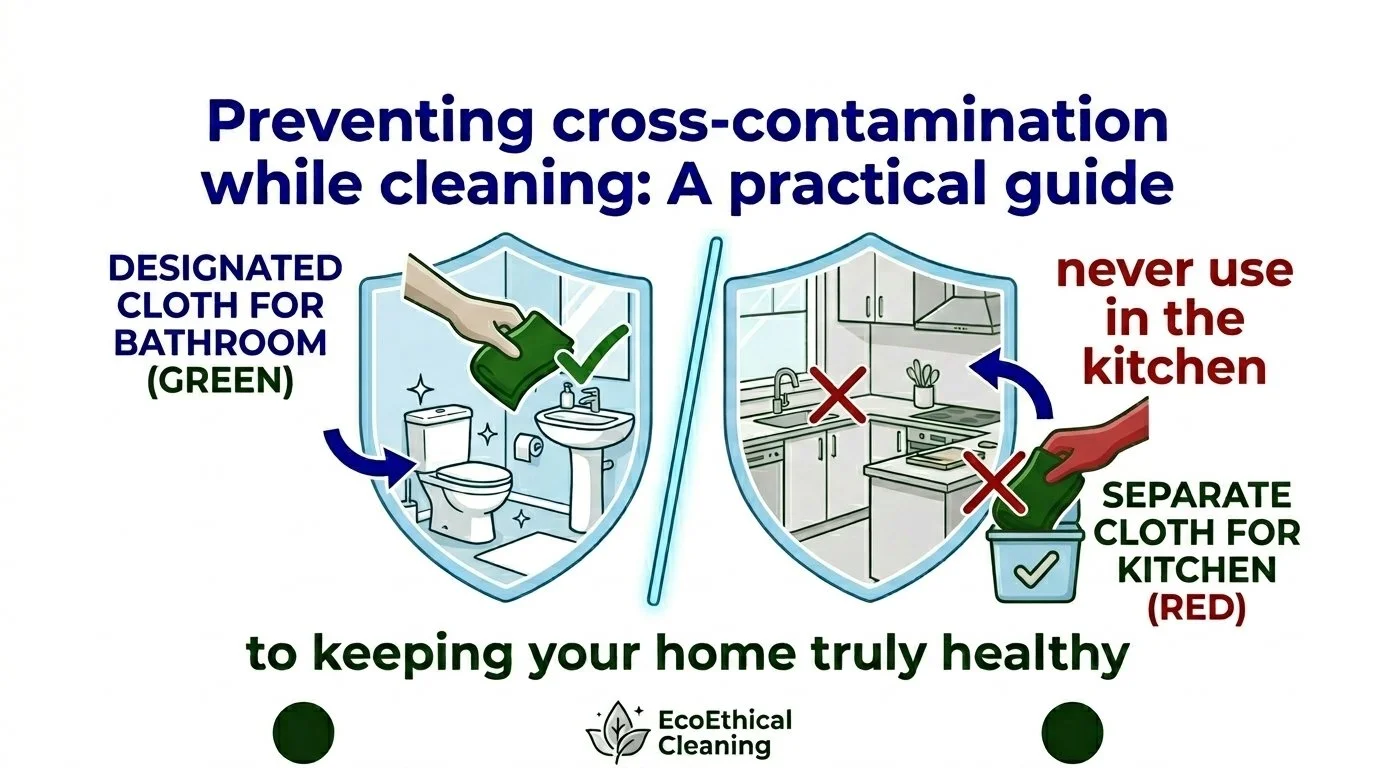
The solution: Ensure that all cloths, brushes, and scrubbers are designated for use only in specific contamination zones. Ensure that all cloths, brushes, and scrubbers are cleaned and disinfected between uses.
Contaminated vacuums
What happens:
A vacuum is used on a bathroom floor (which is now exposed to fecal particles, urine splatter, body fluids)
The same vacuum immediately cleans a bedroom carpet
Then cleans the living room
The vacuum is never cleaned between services
Tomorrow, this vacuum goes to another client's home
The result: Bathroom contaminants are aerosolized and spread through every carpeted and hard floor surface. Your bedroom carpet now contains particles from the bathroom floor — and possibly from someone else's bathroom.
Why cleaners do this: Cleaning vacuums is time-consuming. Many services never even consider it necessary.
The solution: Ensure the contact points of the vacuum (cord, wheels, hose, handle, attachments) are disinfected between contamination zones and at the end of every service.
Dirty mop buckets
What happens:
A mop bucket is filled with water and cleaning solution
The mop cleans the bathroom floor first
Mop is returned to bucket (which is now contaminated with bathroom bacteria)
The same mop and water is used to clean the kitchen floor
By the end of the service, the water is visibly dirty and full of dangerous pathogens
The result: Kitchen floor is mopped with bathroom-contaminated water. When you walk from the kitchen to other rooms, you’ll track those pathogens throughout the home.
Why cleaners do this: Changing mop water multiple times takes time. Many cleaners are taught to use one bucket for the entire house.
The solution (between zones):
Empty mop bucket water and disinfect bucket
Remove dirty mop head from service and replace with clean one
Refill mop bucket with clean water
Ensure that mop bucket and all mop heads are cleaned and disinfected before their next use.
Unwashed hands
What happens:
Cleaner cleans toilet
Cleaner doesn't change gloves before moving to the next area
Cleaner touches door handles, countertops, faucets, etc. throughout the home
Everything the cleaner touched is now cross-contaminated with pathogens from the toilet
The result: High-touch surfaces throughout your home are contaminated with whatever was on the cleaner's hands.
Why cleaners do this: Hand-washing between tasks disrupts workflow. Gloves might not be used to "save time" or due to preference.
The solution: Make sure gloves are changed and hands are washed when moving from any area that contains dangerous pathogens (toilets, bathrooms, kitchen). Ensure that all reusable gloves are cleaned and disinfected before their next use.
Questions to ask your cleaning service
Not all cleaning services follow proper cross-contamination protocols. Here are specific questions to ask to evaluate whether they're protecting your home:
Essential questions
1. "Do you use separate cloths for different areas of the home?"
What you're looking for:
Clear "yes" with an explanation of their system
Mention of designated cloths for toilets, bathrooms, kitchens
Colour-coding or other clear organizational systems
Red flags:
Vague answers
"We rinse the cloth between areas"
"We use microfibre that doesn't spread germs" (false — microfibre spreads germs just like anything else)
Other defensive or dismissive responses
2. "How do you prevent bathroom germs from spreading to the kitchen?"
What you're looking for:
Specific protocols (separate tools, cleaning order, storage methods)
Understanding of why this matters
Details about their system
Red flags:
"We're very careful"
"We clean the kitchen first" (doesn't address equipment contamination)
"It's not really a problem"
They can't articulate specific procedures
3. "How are your cleaning tools cleaned between uses and between homes?"
What you're looking for:
Daily laundering of cloths
Equipment sanitization protocols
Vacuum cleaning process
Storage methods to prevent contamination
Red flags:
"We wash cloths weekly" (not frequently enough)
"We rinse the mop" (inadequate)
"We've never had a complaint" (doesn't answer the question)
Admission they don't clean equipment between clients
4. "Do you clean the vacuum, and if so, how often?"
What you're looking for:
After every service
A specific description of what's involved (emptying, wiping down, cleaning attachments)
Recognition that this matters
Red flags:
"When it looks dirty"
"Weekly" or "monthly" (too infrequent)
"We've never had to do that"
Being surprised by the question (shows they've never considered it)
5. "Do your staff wear gloves, and do they change gloves between areas?"
What you're looking for:
Gloves used for high-contamination tasks (toilets, bathroom floors)
Changed between zones or single-use for toilets
Hand hygiene protocols
Red flags:
No glove use
Same gloves worn entire service
Follow-up questions if you're not satisfied
"Can I observe your cross-contamination prevention during a service?"
Professional services should agree to this
You'll see exactly what happens
Actions speak louder than protocol claims
"Can you provide written documentation of your sanitation protocols?"
Established services should have documented procedures
Gives you something to reference and hold them accountable to
"What training do your staff receive on hygiene and cross-contamination?"
Professional services train staff specifically on this
"On-the-job" training often means no systematic instruction
"Are you willing to customize your service if I have specific health concerns?"
Reputable services will accommodate immunocompromised individuals or specific needs
Inflexibility suggests protocols aren't that strong to begin with
DIY cross-contamination prevention
If you clean your own home, following professional protocols protects your family just as effectively.
Set up your own zoned system
Implement colour-coded cloths:
Buy sets of cloths in different colours
Assign colours to zones (for example: red=toilet, yellow=bathroom, green=kitchen, blue=other less-contaminated areas)
Designate equipment:
If possible, use a separate mop for bathrooms vs. other areas
Or use washable mop pads and change between zones
Toilet brushes stay in their designated bathroom and never leave that space
Create storage system:
Dirty cloths go immediately into a hamper or bag
Clean cloths stored separately by colour/zone
Tools stored in a way that prevents cross-contamination
Follow proper cleaning order
Your cleaning sequence:
Dust and general cleaning (bedrooms, living room)
Kitchen (with kitchen-designated tools)
Bathrooms (with bathroom-designated tools)
Toilets last (with toilet-designated tools)
Between zones:
Wash hands
Switch to appropriate cloths/tools
Never backtrack to earlier zones with tools that were used in another zone
Proper cloth laundering
Wash contaminated cloths properly:
Hot water (60°C/140°F minimum)
Appropriate detergent
Dry completely before storage
Launder bathroom/toilet cloths separately from kitchen cloths if possible
Don't:
Let dirty cloths sit for days (bacteria multiply)
Wash contaminated cloths with regular laundry
Hand hygiene
Wash hands:
Between zones
After removing gloves
Before touching food, face, or personal items
Use gloves appropriately:
Always wear for toilet cleaning
Change between contamination zones
Remove gloves and wash hands before touching other surfaces
The bottom line: Clean shouldn't mean contaminated
You hire a cleaning service to make your home healthier, not to spread pathogens throughout it. Understanding cross-contamination helps you:
Evaluate cleaning services properly:
Ask the right questions
Recognize red flags
Choose services that actually protect your home
Understand what you're paying for:
Not just surface-level appearance
Actual hygiene and pathogen control
Professional protocols that prevent contamination
Advocate for proper practices:
You have the right to know how your home is being cleaned
Professional services should welcome questions about hygiene
Don't accept dismissive answers about contamination prevention
When you choose a cleaning service, you're inviting someone into your most intimate spaces. They should earn that trust by protecting your health, not just making things look tidy.
Ask questions. Expect standards. Demand protocols that actually prevent cross-contamination.
Because your family deserves a home that's truly clean.
Looking for cleaning that prioritize hygiene, not just appearance? As an independent cleaner and founder of EcoEthical Cleaning, I follow strict cross-contamination prevention protocols in every Toronto home I serve. Hospital-grade sanitation, zoned equipment systems, and transparency about every step. Contact me for a free, no-obligation estimate and experience cleaning done right. Proudly serving Toronto’s Harbourfront and surrounding neighbourhoods.
Sources & further reading
“Good Housekeeping”, William D. Frye
“The effects of different hygiene procedures in reducing bacterial contamination in a model domestic kitchen”, E. Røssvoll, S. Langsrud, S. Bloomfield, B. Moen, E. Heir, T. Møretrø