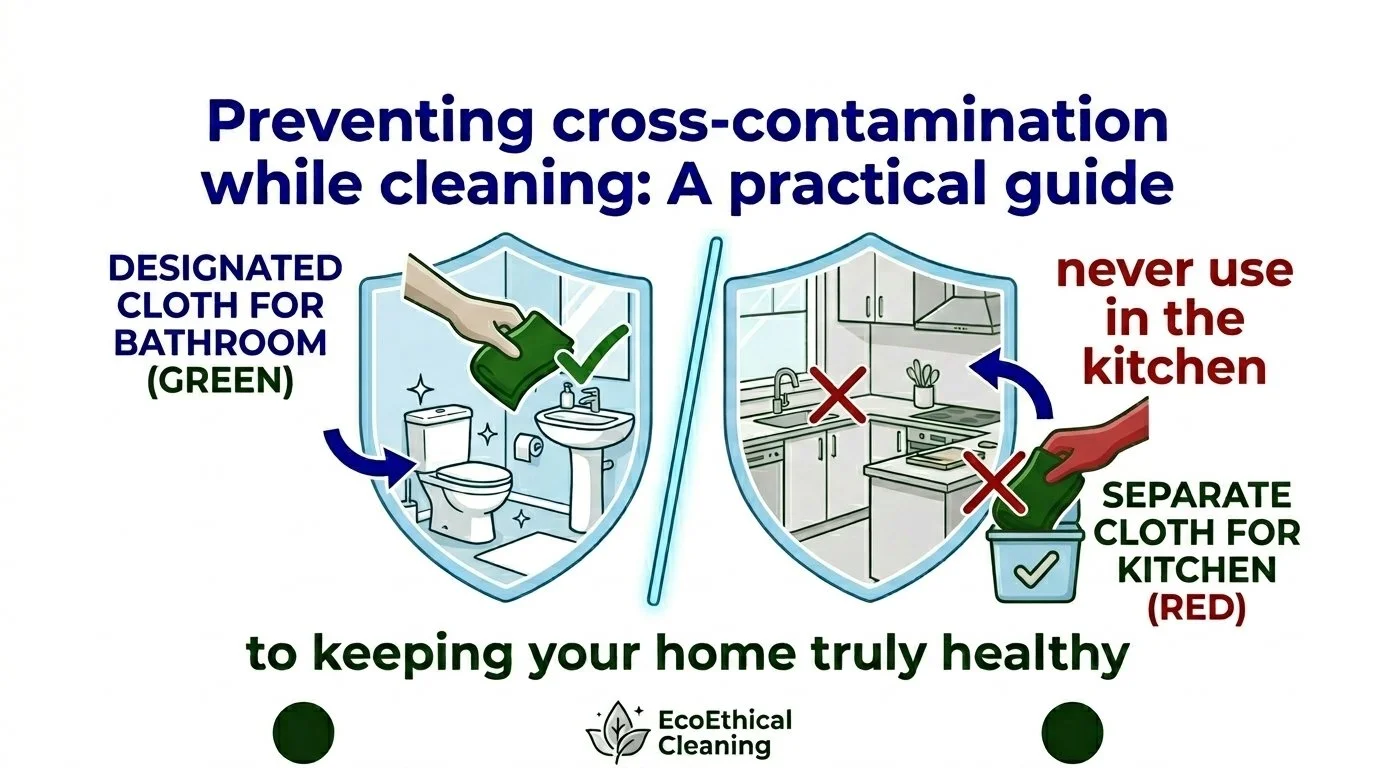
Preventing cross-contamination while cleaning: A practical guide to keeping your home truly healthy
Your cleaner just finished. Everything sparkles. But here's what you didn't see: the same cloth that wiped your toilet just cleaned your kitchen counters. The vacuum that cleaned your bathroom floor is now on your bedroom carpet. The mop water from the bathroom was used throughout your entire home. You've just paid someone to spread fecal bacteria, viruses, and pathogens everywhere. This is cross-contamination—the transfer of harmful microorganisms from one area to another—and it's standard practice for many cleaning services. Learn what it is, why it's dangerous, and what protocols help to prevent it.
Your cleaner just finished your home. The bathroom sparkles. The kitchen gleams. Everything looks spotless.
But here's what you didn't see: the same cloth that wiped your toilet was just used on your kitchen counters. The vacuum that cleaned your bathroom floor also ran across your living room carpet. The mop bucket that started in the bathroom finished in the kitchen — with the same water.
You've just paid someone to spread bacteria, viruses, and fecal matter throughout your entire home.
This is neither an exaggeration or worst-case scenario. It's standard practice for many cleaning services — and many homeowners have no idea it's happening.
Cross-contamination is one of the most overlooked problems in residential cleaning. While your home might look clean, it could actually be less hygienic than before the cleaner arrived.
This comprehensive guide will explain exactly what cross-contamination is, how it happens during cleaning, why it's dangerous, and most importantly — how to prevent it. You'll learn what questions to ask cleaning services, what practices to look for, and how professional protocols should actually work.
Because a truly clean home isn't just about removing visible dirt. It's about not spreading invisible dangers in the process.
What is cross-contamination?
Cross-contamination is the transfer of microorganisms (bacteria, viruses, fungi, parasites) from one surface, object, or area to another where they don't belong.
In the context of home cleaning, this typically means:
Transferring pathogens from bathrooms to kitchens
Spreading toilet bacteria to other surfaces throughout the home
Moving germs from high-contamination areas (toilets) to low-contamination areas (countertops, tables)
Carrying microorganisms between different homes on the same day
Why cross-contamination is dangerous
The health risks are significant:
Gastrointestinal illness: E. coli, Salmonella, Norovirus, and other pathogens from fecal matter cause vomiting, diarrhea, and serious illness—especially dangerous for young children, elderly, pregnant women, and immunocompromised individuals.
Skin infections: Staphylococcus aureus (including antibiotic-resistant MRSA) can cause skin infections, boils, and more serious systemic infections.
Respiratory infections: Viruses like influenza, common cold, and SARS-CoV-2 (Covid-19) can spread through contaminated surfaces touching faces, food preparation areas, or commonly touched objects.
Food poisoning: Kitchen cross-contamination with pathogens from bathrooms or raw food residue creates serious food safety risks.
Secondary infections: Open cuts, wounds, or compromised skin exposed to contaminated surfaces can lead to infections.
The high-risk areas in your home
Not all areas of your home pose equal contamination risk. Understanding this hierarchy is key to developing effective cleaning protocols.
Zone 1: Highest contamination (toilets)
Why it's high-risk:
Direct contact with fecal matter and urine
Aerosolized particles from flushing (toilet plume)
Handles, seats, and bowls harbour dangerous pathogens
Floors around toilets exposed to splatter and aerosolized matter
What should never touch other areas:
Toilet brushes
Cloths used on toilet bowl, seat, or base
Tools used to clean around toilet base
Mops used on bathroom floors
Zone 2: High contamination (bathrooms)
Why it's high-risk:
Body fluids: urine, feces (splatter), vomit, blood
High moisture = bacteria and mould growth
Sink drains contain biofilm with various pathogens
Floors contaminated from toilet aerosol, shower runoff, tracked particles
What should stay in bathrooms:
Bathroom-specific cloths
Bathroom floor mops
Cleaning tools for tubs, sinks, counters
Anything that touches bathroom floors
Zone 3: Moderate contamination (kitchens)
Why it requires caution:
Raw food contamination (meat, poultry, eggs)
Sink drains with food debris and biofilm
Garbage bins and areas
High-touch surfaces (handles, switches)
Why it needs protection:
Food preparation happens here
Cross-contamination directly leads to foodborne illness
Counters, cutting boards, and tables need to be truly hygienic
What should stay in kitchens:
Kitchen-specific cloths
Tools for counters, appliances, floors
Separate equipment from bathrooms
Zone 4: Low contamination (living areas)
Why it's lower risk:
Less exposure to body fluids
Lower moisture (less bacterial growth)
Primarily dust, dirt, and general grime
Why it still needs protection:
Vulnerable to contamination from bathrooms and kitchens if protocols aren't followed
People touch surfaces, then touch faces and food
Children play on floors and put hands/toys in mouths
How cross-contamination happens during cleaning
Most people assume professional cleaners follow protocols that prevent spreading germs. Unfortunately, many don't — often because they're rushing, untrained, or their employer prioritizes speed over safety.
Using the same cloth in different spaces
What happens:
The cleaner wipes a toilet with a cloth
That same cloth also wipes down the bathroom counter
Now the same cloth moves to bedroom, wiping nightstands and door handles
The same cloth finishes in the kitchen, wiping counters and other surfaces
The result: Fecal bacteria from the toilet are now on every surface touched by that cloth, including where you will prepare food.
Why cleaners do this: Using one cloth is faster than switching between designated cloths. Fewer cloths to launder. Less organization required.
The solution: Ensure that all cloths, brushes, and scrubbers are designated for use only in specific contamination zones. Ensure that all cloths, brushes, and scrubbers are cleaned and disinfected between uses.
Contaminated vacuums
What happens:
A vacuum is used on a bathroom floor (which is now exposed to fecal particles, urine splatter, body fluids)
The same vacuum immediately cleans a bedroom carpet
Then cleans the living room
The vacuum is never cleaned between services
Tomorrow, this vacuum goes to another client's home
The result: Bathroom contaminants are aerosolized and spread through every carpeted and hard floor surface. Your bedroom carpet now contains particles from the bathroom floor — and possibly from someone else's bathroom.
Why cleaners do this: Cleaning vacuums is time-consuming. Many services never even consider it necessary.
The solution: Ensure the contact points of the vacuum (cord, wheels, hose, handle, attachments) are disinfected between contamination zones and at the end of every service.
Dirty mop buckets
What happens:
A mop bucket is filled with water and cleaning solution
The mop cleans the bathroom floor first
Mop is returned to bucket (which is now contaminated with bathroom bacteria)
The same mop and water is used to clean the kitchen floor
By the end of the service, the water is visibly dirty and full of dangerous pathogens
The result: Kitchen floor is mopped with bathroom-contaminated water. When you walk from the kitchen to other rooms, you’ll track those pathogens throughout the home.
Why cleaners do this: Changing mop water multiple times takes time. Many cleaners are taught to use one bucket for the entire house.
The solution (between zones):
Empty mop bucket water and disinfect bucket
Remove dirty mop head from service and replace with clean one
Refill mop bucket with clean water
Ensure that mop bucket and all mop heads are cleaned and disinfected before their next use.
Unwashed hands
What happens:
Cleaner cleans toilet
Cleaner doesn't change gloves before moving to the next area
Cleaner touches door handles, countertops, faucets, etc. throughout the home
Everything the cleaner touched is now cross-contaminated with pathogens from the toilet
The result: High-touch surfaces throughout your home are contaminated with whatever was on the cleaner's hands.
Why cleaners do this: Hand-washing between tasks disrupts workflow. Gloves might not be used to "save time" or due to preference.
The solution: Make sure gloves are changed and hands are washed when moving from any area that contains dangerous pathogens (toilets, bathrooms, kitchen). Ensure that all reusable gloves are cleaned and disinfected before their next use.
Questions to ask your cleaning service
Not all cleaning services follow proper cross-contamination protocols. Here are specific questions to ask to evaluate whether they're protecting your home:
Essential questions
1. "Do you use separate cloths for different areas of the home?"
What you're looking for:
Clear "yes" with an explanation of their system
Mention of designated cloths for toilets, bathrooms, kitchens
Colour-coding or other clear organizational systems
Red flags:
Vague answers
"We rinse the cloth between areas"
"We use microfibre that doesn't spread germs" (false — microfibre spreads germs just like anything else)
Other defensive or dismissive responses
2. "How do you prevent bathroom germs from spreading to the kitchen?"
What you're looking for:
Specific protocols (separate tools, cleaning order, storage methods)
Understanding of why this matters
Details about their system
Red flags:
"We're very careful"
"We clean the kitchen first" (doesn't address equipment contamination)
"It's not really a problem"
They can't articulate specific procedures
3. "How are your cleaning tools cleaned between uses and between homes?"
What you're looking for:
Daily laundering of cloths
Equipment sanitization protocols
Vacuum cleaning process
Storage methods to prevent contamination
Red flags:
"We wash cloths weekly" (not frequently enough)
"We rinse the mop" (inadequate)
"We've never had a complaint" (doesn't answer the question)
Admission they don't clean equipment between clients
4. "Do you clean the vacuum, and if so, how often?"
What you're looking for:
After every service
A specific description of what's involved (emptying, wiping down, cleaning attachments)
Recognition that this matters
Red flags:
"When it looks dirty"
"Weekly" or "monthly" (too infrequent)
"We've never had to do that"
Being surprised by the question (shows they've never considered it)
5. "Do your staff wear gloves, and do they change gloves between areas?"
What you're looking for:
Gloves used for high-contamination tasks (toilets, bathroom floors)
Changed between zones or single-use for toilets
Hand hygiene protocols
Red flags:
No glove use
Same gloves worn entire service
Follow-up questions if you're not satisfied
"Can I observe your cross-contamination prevention during a service?"
Professional services should agree to this
You'll see exactly what happens
Actions speak louder than protocol claims
"Can you provide written documentation of your sanitation protocols?"
Established services should have documented procedures
Gives you something to reference and hold them accountable to
"What training do your staff receive on hygiene and cross-contamination?"
Professional services train staff specifically on this
"On-the-job" training often means no systematic instruction
"Are you willing to customize your service if I have specific health concerns?"
Reputable services will accommodate immunocompromised individuals or specific needs
Inflexibility suggests protocols aren't that strong to begin with
DIY cross-contamination prevention
If you clean your own home, following professional protocols protects your family just as effectively.
Set up your own zoned system
Implement colour-coded cloths:
Buy sets of cloths in different colours
Assign colours to zones (for example: red=toilet, yellow=bathroom, green=kitchen, blue=other less-contaminated areas)
Designate equipment:
If possible, use a separate mop for bathrooms vs. other areas
Or use washable mop pads and change between zones
Toilet brushes stay in their designated bathroom and never leave that space
Create storage system:
Dirty cloths go immediately into a hamper or bag
Clean cloths stored separately by colour/zone
Tools stored in a way that prevents cross-contamination
Follow proper cleaning order
Your cleaning sequence:
Dust and general cleaning (bedrooms, living room)
Kitchen (with kitchen-designated tools)
Bathrooms (with bathroom-designated tools)
Toilets last (with toilet-designated tools)
Between zones:
Wash hands
Switch to appropriate cloths/tools
Never backtrack to earlier zones with tools that were used in another zone
Proper cloth laundering
Wash contaminated cloths properly:
Hot water (60°C/140°F minimum)
Appropriate detergent
Dry completely before storage
Launder bathroom/toilet cloths separately from kitchen cloths if possible
Don't:
Let dirty cloths sit for days (bacteria multiply)
Wash contaminated cloths with regular laundry
Hand hygiene
Wash hands:
Between zones
After removing gloves
Before touching food, face, or personal items
Use gloves appropriately:
Always wear for toilet cleaning
Change between contamination zones
Remove gloves and wash hands before touching other surfaces
The bottom line: Clean shouldn't mean contaminated
You hire a cleaning service to make your home healthier, not to spread pathogens throughout it. Understanding cross-contamination helps you:
Evaluate cleaning services properly:
Ask the right questions
Recognize red flags
Choose services that actually protect your home
Understand what you're paying for:
Not just surface-level appearance
Actual hygiene and pathogen control
Professional protocols that prevent contamination
Advocate for proper practices:
You have the right to know how your home is being cleaned
Professional services should welcome questions about hygiene
Don't accept dismissive answers about contamination prevention
When you choose a cleaning service, you're inviting someone into your most intimate spaces. They should earn that trust by protecting your health, not just making things look tidy.
Ask questions. Expect standards. Demand protocols that actually prevent cross-contamination.
Because your family deserves a home that's truly clean.
Looking for cleaning that prioritize hygiene, not just appearance? As an independent cleaner and founder of EcoEthical Cleaning, I follow strict cross-contamination prevention protocols in every Toronto home I serve. Hospital-grade sanitation, zoned equipment systems, and transparency about every step. Contact me for a free, no-obligation estimate and experience cleaning done right. Proudly serving Toronto’s Harbourfront and surrounding neighbourhoods.
Sources & further reading
“Good Housekeeping”, William D. Frye
“The effects of different hygiene procedures in reducing bacterial contamination in a model domestic kitchen”, E. Røssvoll, S. Langsrud, S. Bloomfield, B. Moen, E. Heir, T. Møretrø
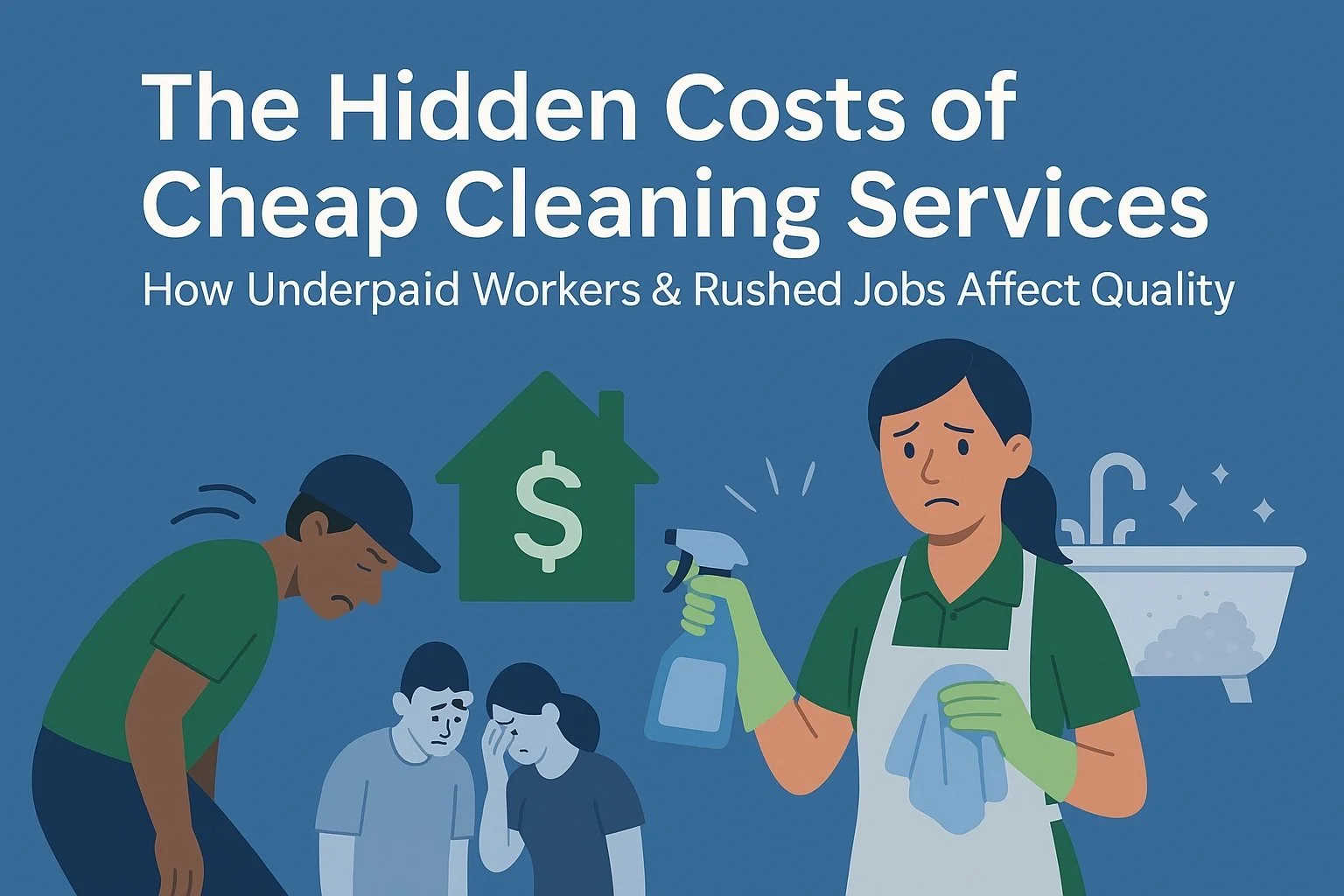
The real price of a cheap clean: What low-cost cleaning services really cost
You're comparing cleaning quotes and one is 40% cheaper than the rest. Sounds like a great deal, right? But here's what that low price usually means: workers paid below minimum wage, impossible schedules that force corner-cutting, cash payments to evade taxes, no insurance if something goes wrong, and rushed jobs that leave your home barely cleaner than before. That "bargain" often costs more in the long run through damaged surfaces, poor results, and supporting practices that hurt workers and burden taxpayers. Understanding what's behind rock-bottom pricing helps you choose services based on value, not just price.
You're comparing quotes from three cleaning companies. One is significantly cheaper than the others. It seems like an obvious choice. Why would you pay more for the same service?
But… is it the same service? How is that company able to charge so much less?
The answer usually isn't efficiency, innovation, or better business practices. More often, it's because they're cutting corners in ways that hurt workers, compromise quality, burden taxpayers, and ultimately cost you more in the long run. That "bargain" cleaning service might be underpaying staff, rushing through jobs, operating in the cash economy to avoid taxes, or all of the above.
This isn't about guilt-tripping anyone for being budget-conscious. It's about understanding what you're actually getting — and what you're inadvertently supporting — when you choose the lowest price. Because in the cleaning industry, the cheapest option rarely delivers the value it promises, and the hidden costs affect everyone from the workers to your community to you as the client.
Let's look at how rock-bottom pricing actually works and why it matters more than you might think.
The illusion of a bargain: What you think you're getting vs. what you actually get
When you see a cleaning quote that's significantly lower than competitors, it's natural to feel like you've found a great deal. The service description might look identical — "deep cleaning," "eco-friendly products," "experienced staff" — so why not save the money?
However, cleaning isn't like buying a standardized product where you can easily comparison shop. A $2 bottle of vinegar at one store is the same as a $2 bottle at another. But two cleaning services charging $80 and $120 for a "standard home clean" are providing fundamentally different services, even if the marketing sounds similar.
What the low price actually means
When a cleaning company offers rates significantly below market average, that discount has to come from somewhere. Companies can't defy basic economics. If their prices are much lower than competitors, they're reducing costs in one or more of these ways:
Underpaying workers: Paying below-market wages, misclassifying employees as contractors to avoid paying benefits, or operating partially or entirely in the shadow economy to avoid payroll taxes and employment standards.
Rushing through jobs: Scheduling so many clients per day that workers must work at an unsustainable pace, cutting corners and reducing quality.
Skipping proper training: Not investing in teaching employees proper techniques, safety protocols, or surface-specific care methods.
Using substandard or diluted products: Buying the cheapest cleaning products available or diluting them beyond manufacturer guidelines to reduce costs.
Avoiding insurance and proper business infrastructure: Operating without proper liability insurance, workers' compensation, or business licensing to minimize overhead.
Not paying taxes: Operating primarily or entirely in cash to avoid GST/HST, income tax, and payroll deductions — which shifts their tax burden onto everyone else.
None of these cost-cutting measures benefit you as the client. In fact, they create risks and problems that often cost more to fix than you saved on the original service.
The true cost of "savings"
Let's say you hire a cleaning service for $80 instead of $120, saving $40. Sounds good, right? But consider what often happens:
Scenario 1: The cleaner rushes through in 90 minutes instead of the 3 hours needed to do the job properly. You notice missed spots, poor attention to detail, and surfaces that don't feel truly clean. You spend your own time re-cleaning or call another service to fix it. Your time has value. If you value it at even $25/hour, spending 90 minutes re-cleaning costs you $37.50, nearly erasing your savings.
Scenario 2: The cleaner uses harsh chemicals on your natural stone countertops because they weren't trained on surface compatibility. Six months later, you discover etching and dullness that requires professional restoration costing $400-800. Your $40 savings just cost you hundreds of dollars. Worse still, you may never connect the damage to the cleaning and suffer the same fate again with future cleans.
Scenario 3: The cleaner, rushing and improperly trained, accidentally damages a piece of furniture or causes water damage. The company has no insurance. You're stuck covering the repair costs yourself or taking them to small claims court (good luck collecting from a cash-based business with no assets).
Scenario 4: The cleaner is injured on your property. If they're misclassified as a contractor instead of an employee, and the company has no workers' compensation coverage, you could potentially be held liable. Legal exposure aside, there's the ethical dimension of someone being hurt on your property with no safety net.
These aren't hypothetical worst-case scenarios — they're common outcomes of choosing services based solely on lowest price.
How low-price cleaning companies actually operate
Understanding the business model behind rock-bottom pricing reveals why these services rarely deliver good value. Let's break down the tactics commonly used.
Tactic 1: Underpayment and worker exploitation
The single largest expense for any cleaning company is labour. It typically accounts for 50-70% of operating costs. When you see a company with prices dramatically lower than competitors, they're almost certainly paying workers less — often significantly less.
Below-market wages: While the average wage for professional cleaners in Toronto ranges from $18-25 per hour for employees (plus benefits and employer taxes), some low-cost companies pay workers $12-15 per hour in cash, or structure payment per job at rates that work out to be below minimum wage when you factor in actual hours worked.
Misclassification as contractors: Many low-cost companies classify workers as independent contractors rather than employees. This allows them to avoid:
Employment Insurance (EI) premiums
Canada Pension Plan (CPP) contributions
Vacation pay and statutory holiday pay
Workers' compensation coverage
Health and safety obligations under the Occupational Health and Safety Act
The workers bear all these costs themselves—except many don't realize they should be setting aside money for CPP and EI, leaving them vulnerable when they retire or face job loss.
Cash payments: Paying workers in cash under the table is illegal tax evasion, but it's rampant in the cleaning industry. This means:
Workers aren't receiving Records of Employment for EI claims
No paper trail for CPP contributions toward their retirement
Workers can't prove income for mortgages, credit applications, or rental applications
The company avoids remitting income tax, employer EI/CPP, and GST/HST
Economic insecurity: Workers in these arrangements have no job security, no benefits, no sick days, and no predictable income. When they're injured, ill, or facing slow seasons, they have no safety net. This precarious employment creates a workforce that's stressed, financially vulnerable, and unable to speak up about poor working conditions for fear of losing income.
According to the Canadian Labour Congress, precarious work disproportionately affects women, immigrants, and racialized workers — demographics that make up a significant portion of the cleaning industry. Choosing low-cost services often means inadvertently supporting a system that perpetuates economic inequality.
Tactic 2: Maximizing volume at the expense of quality
Low-price cleaning companies operate on thin margins. To make their business model work, they need volume. This means scheduling as many jobs per day as possible, which translates to workers being given impossible timelines.
Unrealistic scheduling: A quality residential cleaning typically takes 2.5-4 hours depending on size and condition. Low-cost companies might schedule workers for 5-7 homes per day, meaning each clean gets 1-1.5 hours maximum, including travel time.
Physical toll: The Canadian Centre for Occupational Health and Safety (CCOHS) has documented that cleaning is physically demanding work involving repetitive motions, heavy lifting, awkward positions, and chemical exposure. When workers are forced to work at frantic speeds day after day, the risk of musculoskeletal injuries skyrockets. Rushed workers experience higher rates of back injuries, shoulder problems, knee issues, and repetitive strain injuries.
Mental health impact: The stress of impossible quotas, combined with economic insecurity and lack of control over working conditions, creates significant mental health challenges. Workers experience anxiety about meeting unrealistic expectations, guilt about not doing thorough work (many genuinely care about doing a good job), and burnout from unsustainable pace.
Quality suffers inevitably: When a worker has 75 minutes to clean a 1,200 square foot home, something has to give. Corner-cutting becomes necessary just to finish:
Dusting becomes a quick pass rather than thorough coverage
Floors get a cursory mop rather than proper cleaning
Bathrooms get quick surface wipes, without addressing buildup
Detail work is skipped entirely
Deep cleaning tasks are never completed
Clients get a surface-level clean that looks okay initially but doesn't address the actual dirt, grime, and pathogens that make spaces unhealthy.
Tactic 3: The cash (shadow) economy and tax evasion
This is the elephant in the room that rarely gets discussed openly, but it's a huge factor in how some cleaning services can undercut competitors so dramatically.
How cash-based operations work: A cleaning company operating in the cash economy doesn't report all (or any) of their revenue. They:
Don't charge GST/HST
Don't remit income tax on unreported revenue
Don't remit employee source deductions (income tax, CPP, EI)
Don't pay their corporate income taxes on hidden revenue
Often don't pay proper workers' compensation premiums
The math of tax evasion: Let's say a company charges $100 for a cleaning (cash, no receipt). A legitimate company charging the same would need to:
Collect $113 ($100 + 13% HST)
Remit the $13 HST to the Canada Revenue Agency (CRA)
Pay income tax on business profit
Pay employer portion of CPP and EI on employee wages
Pay Workplace Safety and Insurance Board (WSIB) premiums
By operating in cash and avoiding these obligations, an underground company saves approximately 25-35% on their tax burden alone. This is how they can charge $80 while legitimate companies charge $120.
They're not more efficient, they're just not paying what they legally owe.
Who actually pays for this? You do. We all do. When businesses evade taxes, governments collect less revenue for essential services — healthcare, education, infrastructure, social programs. That shortfall gets made up through:
Higher tax rates for compliant businesses and individuals
Reduced public services
Increased public debt
According to Statistics Canada, the underground economy in Canada is estimated at $45.6 billion annually, with service industries like cleaning being significant contributors. When you pay cash to save money, you're shifting your service provider's tax burden onto yourself and your neighbours.
The ethical dimension: Beyond the practical financial impact, there's a moral question: is it ethical to knowingly participate in tax evasion to save money? When a cleaner offers you a "discount for cash," you're not just getting a deal — you're becoming complicit in fraud that harms public services and shifts costs onto compliant taxpayers.
Tactic 4: Skipping insurance and proper business infrastructure
Legitimate cleaning companies carry several types of insurance and operate with proper business structures:
General liability insurance: Covers property damage or injuries that occur during cleaning (accidentally breaking a vase, scratching floors, etc.). Costs approximately $500-2,000 annually depending on coverage.
Workers' compensation (WSIB in Ontario): Mandatory insurance that covers workers if they're injured on the job. Costs approximately 2.5-4% of payroll for cleaning services.
Commercial auto insurance: If using vehicles for business, proper commercial coverage is required and costs more than personal auto insurance.
Bonding: Some professional cleaners carry bonding insurance that protects clients against theft by employees.
These protections aren't optional extras — they're fundamental to responsible business operation. But they cost money, which is why many low-cost operators skip them entirely.
What this means for you: If something goes wrong — damage occurs, someone is injured, property is stolen — you have no recourse. The company has no insurance to cover damages, and often has no assets to collect against in a lawsuit. You're left holding the bag.
The business licensing gap: Legitimate cleaning businesses register properly, obtain necessary business licenses, and comply with municipal bylaws. Underground operators skip these steps, avoiding fees and regulatory oversight. This means:
No accountability to regulatory bodies
No record if you need to file a complaint
No way to verify credentials or track record
Likely no actual business — just someone working informally
The costs that come back to haunt you
The true cost of choosing a cleaning service based solely on price often doesn't appear immediately. The consequences unfold over time in ways that can be expensive, frustrating, and even dangerous.
Poor quality and re-cleaning costs
When cleaning is rushed or performed by inadequately trained staff, the results are predictably subpar:
Surface-level only: Visible dirt might be removed, but deeper grime, allergens, and pathogens remain. Your space looks cleaner but isn't actually hygienically clean.
Inconsistent results: Different workers each time (due to high turnover) means no consistency. One week it's decent; the next week it's terrible.
Missed areas: Rushing means many areas get overlooked — behind appliances, baseboards, window tracks, light fixtures, vents. These areas accumulate grime that eventually becomes much harder to clean.
You end up cleaning anyway: When the service doesn't meet basic standards, you spend your own time touching up, which defeats the entire purpose of hiring help.
Eventually need a real deep clean: After months of surface-level cleaning, your space needs a proper deep clean to address accumulated buildup. This often costs 2-3x a regular cleaning, erasing any savings from the low-cost service.
Surface damage from improper methods
Inadequately trained cleaners often use wrong products or techniques that damage surfaces:
Natural stone etching: Using acidic cleaners (vinegar, lemon juice, harsh bathroom cleaners) on marble, granite, or limestone causes permanent etching. Repair requires professional restoration costing hundreds to thousands of dollars.
Wood floor damage: Excessive water, the wrong cleaning products, or abrasive tools can damage hardwood finishes. Refinishing floors costs $3-8 per square foot.
Countertop scratches: Using abrasive tools inappropriately (like Magic Erasers on glossy surfaces, or scouring pads on laminate) creates scratches and dullness.
Grout deterioration: Using bleach or acidic cleaners repeatedly breaks down grout structure, leading to crumbling that requires regrouting.
Finish removal: Abrasive cleaning on painted walls, especially glossy or semi-gloss finishes, removes the sheen permanently.
Appliance damage: Using wrong cleaners on stainless steel, glass cooktops, or special finishes can cause permanent damage.
Professional restoration companies see these types of damage constantly from improper cleaning methods. The repair costs can easily reach thousands of dollars.
Liability and legal exposure
When things go wrong with uninsured, improperly structured cleaning services, you can face serious problems:
Property damage with no recourse: If a cleaner damages something valuable and the company has no insurance, you might sue — but you can't collect from someone with no assets. You're left covering the loss yourself.
Workplace injury complications: If a worker is injured at your property and they're not properly covered by WSIB (because they're misclassified or the company isn't compliant), there's potential for you to be drawn into liability claims. While homeowner's insurance might provide some protection, it's not designed for regular business activity on your property.
Theft with no bonding: If items go missing and the worker isn't bonded, you have little recourse.
CRA implications: If you're paying cash for services and claiming them for tax credits (like the home accessibility tax credit or if you have a home office), you need proper receipts from a legitimate business. Cash payments without proper documentation can create problems if audited.
Health and safety concerns
Rushed, poorly trained cleaning with inadequate products creates health risks:
Ineffective disinfection: During flu season or concerns about illness, proper disinfection requires appropriate products used correctly with adequate contact time. Rushed cleaning with wrong products doesn't actually disinfect, leaving pathogens on surfaces.
Allergen removal failure: Effective allergen removal requires proper technique and tools. Inadequate cleaning leaves dust, dander, and other allergens that affect household members with sensitivities.
Chemical misuse: Improperly trained workers might mix incompatible chemicals (creating toxic fumes), use products on wrong surfaces, or fail to rinse properly, leaving chemical residues.
Cross-contamination: Using the same cloth or mop throughout the house without proper protocols spreads bacteria from bathrooms to kitchens and living areas.
For households with children, elderly residents, or anyone with compromised immune systems, inadequate cleaning isn't just unsatisfying—it's a genuine health risk.
The broader impact: How your choice affects your community
When you choose a cleaning service, you're not just making a personal consumer decision. You're influencing labour practices, tax revenue, and the overall business environment in your community.
Perpetuating exploitative labour practices
Every time someone chooses the cheapest cleaning option, they're voting with their wallet for a business model that depends on worker exploitation. This creates a race to the bottom:
Legitimate companies face pressure: When consumers consistently choose the lowest price, companies that pay fair wages and operate ethically struggle to compete. They face pressure to cut costs or lose business.
Bad actors proliferate: When exploitative practices are rewarded with business, more companies adopt those practices. The problem grows rather than shrinks.
Workers remain vulnerable: As long as there's demand for rock-bottom prices, there will be companies willing to exploit workers to meet that demand. The precarious employment cycle continues.
Industry standards deteriorate: When bad practices become normalized, overall industry standards decline. What was once considered unacceptable becomes commonplace.
This isn't abstract economic theory — it's happening in Toronto's cleaning industry right now. Companies that want to do right by their workers face constant pressure from competitors who undercut them through exploitation.
Starving public services through tax evasion
The underground economy isn't a victimless practice. When businesses evade taxes, essential public services suffer:
Healthcare: Ontario's healthcare system is funded by tax revenue. Lost tax revenue means less funding for hospitals, doctors, medical equipment, and research.
Education: Public schools, universities, and skills training programs depend on tax funding. Underground economic activity reduces the resources available for education.
Infrastructure: Roads, public transit, water systems, and other infrastructure requires investment funded by taxes. Tax evasion means deteriorating infrastructure or higher costs for compliant taxpayers.
Social safety nets: EI, CPP, disability supports, and other programs that provide security depend on proper contribution. When workers are paid under the table, they're not building these protections, and the system is weakened for everyone.
According to the Canada Revenue Agency, the tax gap (the difference between taxes owed and taxes collected) costs Canadians billions annually. Service industries operating in cash are significant contributors to this gap.
Toronto-specific impact: Toronto faces particular challenges with infrastructure funding, housing, and public services. When local businesses evade taxes, the city has less revenue for transit, housing initiatives, parks, community programs, and other services that make Toronto livable.
Enabling unfair competition and market distortion
When companies that evade taxes and exploit workers can charge 30-40% less than legitimate businesses, they're not competing fairly — they're cheating.
Legitimate businesses can't compete: A company that pays proper wages, remits all taxes, carries appropriate insurance, and invests in training simply cannot match the prices of companies that skip these obligations. No amount of efficiency makes up for a 30% advantage gained through illegal practices.
Innovation and quality suffer: When competition is based solely on price rather than service quality, there's no incentive to innovate, improve techniques, or invest in better training and equipment. The market rewards cost-cutting, not value creation.
Skilled workers leave the industry: When the only way to make money in cleaning is to either exploit workers or be exploited, talented people who could build careers in professional cleaning leave for other industries. This reduces overall professionalism and expertise.
Consumer trust deteriorates: When consumers are repeatedly disappointed by low-quality service, they begin to view all cleaning services with skepticism, harming even the companies doing good work.
The collective responsibility
Markets work well when consumers make informed decisions based on value, not just price. But when information is hidden, the market fails.
You have more power than you might realize. Your choices about which companies to support directly influence:
Whether fair-wage employers can survive and thrive
Whether workers have decent jobs or precarious exploitation
Whether tax revenue adequately funds public services
Whether industry standards rise or fall
You can choose to support business practices that build strong communities rather than extracting value from vulnerable workers while dodging social responsibilities.
What fair pricing actually represents
When a cleaning company charges fair market rates, that price reflects the true cost of operating a legitimate, ethical business.
What you're paying for
Sustainable wages: Workers earning $30-40/hour plus employer contributions to CPP, EI, and WSIB. This allows workers to support themselves and their families with dignity.
Adequate time to do the job properly: Realistic scheduling that allows 2.5-4 hours for a thorough residential cleaning, rather than a 90-minute rush job.
Professional training: Investment in teaching employees proper techniques, surface-specific care, safety protocols, and customer service. This means fewer mistakes and better results.
Quality products and equipment: Professional-grade cleaning products that are effective and appropriate for different surfaces. Well-maintained equipment that performs efficiently.
Insurance protection: Liability coverage that protects you if something goes wrong. WSIB coverage that protects workers if they're injured. Bonding that protects against theft.
Business legitimacy: Proper licensing, GST/HST remittance, tax compliance, and business structures that ensure accountability and recourse if problems arise.
Consistency and reliability: Lower turnover means you get the same workers who learn your home, your preferences, and your specific needs. Scheduling is reliable because workers aren't burning out.
Actual supervision and quality control: Management that checks work quality, responds to concerns, and maintains standards. Someone accountable if service doesn't meet expectations.
Long-term relationship: A company that will still be around next year and the year after, building a relationship and consistently delivering good service.
The true value proposition
Fair pricing isn't about paying more for the same thing — it's about paying appropriate amount for actual value:
Time savings that's real: When the job is done properly, you don't spend time re-cleaning or managing problems. Your time is freed up for work, family, or leisure.
Surfaces that last longer: Proper care means your floors, countertops, appliances, and finishes last longer, saving thousands in premature replacement or restoration.
Health and hygiene: Thorough, competent cleaning actually removes pathogens, allergens, and grime that affect your family's health.
Peace of mind: Knowing workers are insured, trained, and properly compensated. No ethical concerns about supporting exploitation. No liability worries.
Predictability: Consistent quality means you know what you're getting. No surprises, no disappointments, no need to manage or supervise.
Support for your community: Your money supports fair wages, contributes to tax revenue for public services, and encourages ethical business practices.
When you calculate the full value — including avoided costs, reduced risks, time saved, and community impact — fair pricing is actually the bargain. The "cheap" option is expensive when you account for everything it actually costs.
How to identify legitimate vs. problematic cleaning services
Not all lower-priced services are exploitative, and not all higher-priced ones are ethical. Here's how to evaluate what you're really getting:
Red flags that suggest problematic practices
Cash-only or "discount for cash": This is the biggest red flag. Legitimate businesses accept normal payment methods and provide proper receipts. "Cash discount" almost always means tax evasion.
No HST charged: In Canada, any business with revenue over $30,000/year must register for and charge HST. If they're not charging it, they're either very small (uncommon for non-solo cleaning services) or evading taxes.
No proper business name or GST/HST number: Vague business names, no website, no business number to verify — these suggest an informal or underground operation.
Can't provide insurance documentation: Legitimate companies readily provide certificates of insurance showing liability coverage and WSIB clearance. Evasiveness about insurance is a major red flag.
Prices dramatically below market rate: If quotes are 40-50% below competitors, ask yourself how that's possible. The answer is usually corner-cutting that hurts workers and quality.
Vague about worker classification: When you ask if workers are employees or contractors, legitimate companies answer clearly. Evasiveness suggests misclassification to avoid obligations.
High turnover/different people each time: While some variation is normal, constantly different workers suggests poor retention from low wages or bad conditions.
No contract or terms of service: Professional companies provide clear agreements outlining services, rates, cancellation policies, and responsibilities. Operating without documentation suggests informality that benefits the company, not you.
Reluctance to provide references: Established, legitimate services readily provide references or reviews. Evasiveness suggests problems.
Poor communication: Difficulty reaching the company, unreturned calls, lack of professionalism in interactions — these indicate future service problems.
Questions to ask when vetting services
Don't be afraid to ask direct questions. Legitimate companies welcome them:
"Are your workers employees or independent contractors? Why?"
Look for clear explanation. Employee classification is generally more protective of workers.
"Can you provide proof of liability insurance and WSIB clearance?"
They should readily provide certificates. If they hesitate, that's concerning.
"What's included in your quote, is HST additional?"
Professional services clearly state HST separately.
"How long do you schedule for a cleaning of my home's size?"
Should be realistic, not impossibly short.
"What's your training process for new cleaners?"
Professional companies have structured training, not just "learn as you go."
"How do you handle complaints or issues with service?"
Should have clear process with accountability.
"Can you provide references from long-term clients?"
Established services should easily provide references.
"What products do you use, and how do you ensure they're appropriate for different surfaces?"
Professional services understand surface compatibility and use appropriate products.
Trust your instincts. If answers are evasive, if something feels off, or if you're being pressured to "just pay cash," walk away.
Making the ethical choice: What you can do
If you're convinced that fair pricing matters but concerned about affordability, there are ways to balance budget with ethics:
Adjust service frequency
Rather than choosing a cheap service with poor results, consider quality service less frequently:
Bi-weekly instead of weekly
Monthly deep cleans with you handling light maintenance between
Seasonal deep cleans (spring and fall) with regular upkeep yourself
Less frequent professional service that's actually thorough often provides better value than frequent surface-level cleaning.
Prioritize specific areas
If full-home cleaning isn't affordable, focus on high-value areas:
Bathrooms
Kitchen
High-traffic areas (where dirt accumulates fastest)
Handle lower-priority areas yourself while investing in professional service where it matters most.
Research subsidies and programs
Some programs make professional cleaning more accessible:
Home care support for Toronto seniors or those with disabilities
Employment assistance programs that might cover cleaning for those returning to work
Support companies that pay fair wages
When you can afford professional cleaning, choose companies that:
Clearly communicate their commitment to fair wages
Provide employee benefits and proper classification
Charge HST and operate transparently
Invest in training and professional development
Treat workers with dignity and respect
Your business rewards ethical practices and helps legitimate companies compete against exploitative ones.
Spread awareness
Talk to friends, family, and neighbours about these issues:
Share information about why rock-bottom pricing is problematic
Recommend ethical cleaning services you've had good experiences with
Discuss the broader implications of supporting fair-wage employers
Challenge the assumption that "cheapest is best"
Changing how people think about service pricing creates market pressure for better practices.
Advocate for better enforcement
Support stronger enforcement of:
Labour standards and minimum wage laws
Tax compliance and underground economy crackdowns
Worker misclassification penalties
WSIB coverage requirements
Contact your MPP and local representatives to express support for protecting workers and enforcing fair business practices.
Conclusion: The choice is yours, and it matters
Every time you hire a cleaning service, you're making a choice that extends far beyond your own home. You're influencing:
Whether workers earn enough to support their families with dignity
Whether businesses can succeed while treating people fairly
Whether tax revenue adequately funds the public services we all depend on
Whether your community thrives or struggles with inequality and deteriorating standards
The lowest price isn't the best price. It's a signal that something is being sacrificed — usually worker welfare, service quality, tax compliance, or all three. That "bargain" comes at a cost that's hidden initially but eventually appears in damaged surfaces, poor results, public service shortfalls, and perpetuated exploitation.
Fair pricing reflects the true cost of ethical, professional service. It means workers earn living wages, businesses operate legitimately, customers receive quality work, and communities benefit from tax compliance and good employment practices.
This isn't about guilt or judgment if you've chosen low-cost services in the past. Most people don't understand what's behind those prices. But now you do. And with that knowledge comes the power to make different choices — choices that align your spending with your values.
Ready to experience professional cleaning that doesn't compromise on quality or ethics? EcoEthical Cleaning serves Toronto's Harbourfront District and surrounding areas with transparent, fair-wage service you can trust. Contact me for a free, no-obligation estimate and join my other clients who value both excellent results and ethical practices.
Sources & further reading
Canadian Centre for Occupational Health and Safety (CCOHS)
"The Underground Economy in Canada,", Statistics Canada
"Payment Tax Gap and Collection Efforts", Canada Revenue Agency
"Why companies who pay a living wage create wider societal benefits", World Economic Forum
"Your guide to the Employment Standards Act", Ontario Ministry of Labour, Immigration, Training and Skills Development
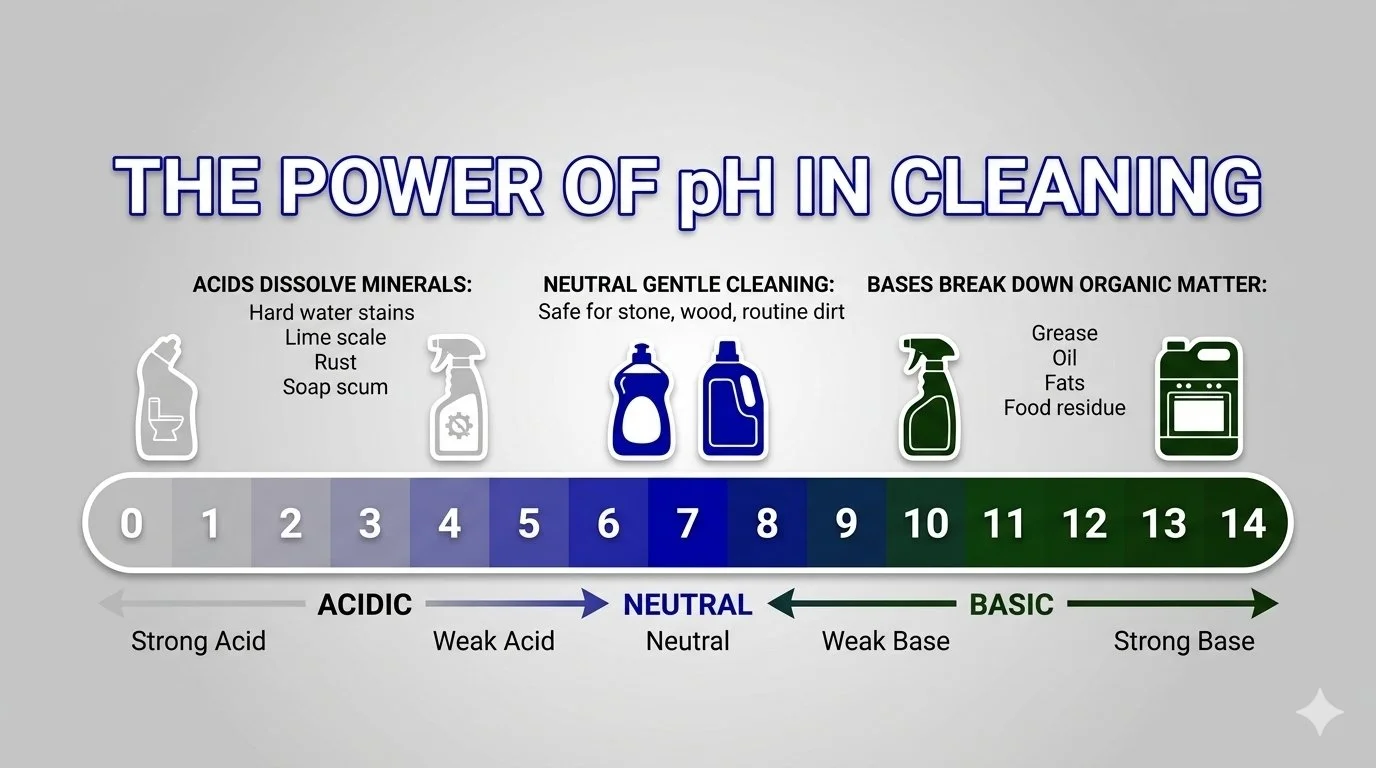
The power of pH: A guide to how acids and bases influence cleaning
Standing in the cleaning aisle, overwhelmed by dozens of products? The secret isn't buying more—it's understanding pH. Most cleaning challenges come down to chemistry: acids dissolve mineral deposits (hard water, lime scale, rust), while bases break down grease and organic matter. Using the wrong pH is like unscrewing a bolt with a hammer—you're applying force, but it's the wrong tool. Once you understand this one concept, cleaning stops being guesswork and becomes logical problem-solving. Learn which common products fall where on the pH scale, how to identify what you're cleaning, and match the right chemistry to every mess.
You're standing in the cleaning aisle, overwhelmed by dozens of products. Bathroom cleaner. Kitchen cleaner. All-purpose cleaner. Glass cleaner. Each bottle promises to tackle specific areas in your home, but you're not entirely sure why you need so many different products—or which one will actually solve your problem.
Most cleaning challenges come down to chemistry, specifically pH. Understanding this one simple concept will save you money, time, and frustration. You'll stop buying products you don't need, stop using the wrong cleaner for the job, and start actually solving problems instead of just scrubbing harder.
The secret isn't buying more products, it's understanding what you're actually trying to clean and matching it with the right chemical approach. Once you understand pH, cleaning stops being guesswork and becomes logical problem-solving.
This guide will teach you everything you need to know about pH in cleaning: what it means, why it matters, which common products fall where on the scale, and most importantly, how to identify what you're cleaning so you can choose the right product every single time.
What is pH? Understanding the scale
pH stands for "potential of hydrogen" and measures how acidic or basic a substance is on a scale from 0 to 14.
The pH scale:
0-6: Acidic (the lower the number, the stronger the acid)
7: Neutral (pure water)
8-14: Basic (the higher the number, the stronger the base)
Why this matters for cleaning: Different types of dirt, grime, and buildup respond to different pH levels. Acids dissolve certain substances. Bases dissolve others. Using the wrong pH is like trying to unscrew a bolt with a hammer — you're applying force, but it's the wrong tool for the job.
The pH scale with common household cleaners
Here's where everyday cleaning products actually fall on the pH scale. Note that a product’s pH can be found in Section 9 of their respective Safety Data Sheet.
Strong acids (pH 0-4):
Common toilet bowl cleaners (Lysol / Scrubbing Bubbles)
Oxalic acid (Bar Keeper's Friend)
Acetic acid (white vinegar)
Citric acid (lemon juice)
Weak acids (pH 4-6):
Bathroom cleaners designed for hard water (Seventh Generation / Method Daily Shower Spray)
Neutral range (pH 6-8):
Distilled water (pH 7.0 – true neutral)
Palmolive dish soap
pH-neutral cleaners (Bona Hard Surface Floor Cleaner / Zep Neutral pH Floor Cleaner / Method Hard Floor Cleaner)
Weak bases (pH 8-10):
Baking soda (sodium bicarbonate)
Borax (sodium borate)
Dawn Ultra dish soap
Strong bases (pH 11-14):
Oven cleaners (Easy Off Fume-Free / Zep
Drain cleaners (Drano Max Gel / Liquid Plumr)
Toilet bowl cleaners with bleach (Clorox)
Important note: The pH scale is logarithmic, not linear. This means each number represents a tenfold difference. pH 3 is ten times more acidic than pH 4, and one hundred times more acidic than pH 5. Small numerical differences represent huge differences in strength.
Not-so-important note (but still important to know going forward): Alkalis are bases that dissolve in water.
The chemistry behind how acids and bases actually clean
Understanding what acids and bases do at a molecular level explains why they work on different types of dirt.
What acids do
Acids donate hydrogen ionsto chemical reactions. This makes them excellent at:
Dissolving mineral deposits:
Hard water stains (calcium and magnesium carbonate)
Lime scale
Rust stains (iron oxide)
Soap scum (mineral soap residue)
Efflorescence (white mineral deposits on tile/concrete)
Why this works: Minerals are alkaline compounds. Acids react with them chemically, breaking their molecular bonds and dissolving them into solution. This is why acids work so well on hard water buildup — they're chemically breaking it down, not just scrubbing it away.
Acids also:
Brighten and restore shine to some surfaces (including ceramic, porcelain, stainless steel)
Remove tarnish from metals (brass, bronze, copper)
Neutralize alkaline residues
Kill certain bacteria
What acids DON'T do well:
Remove grease or oil
Cut through organic buildup
Dissolve proteins or fats
What bases do
Bases accept hydrogen ionsin chemical reactions. This makes them excellent at:
Breaking down organic matter:
Grease and oils
Fats (cooking residue, body oils)
Proteins (food residue, blood, organic stains)
Dirt and grime with organic components
Why this works: Bases cause a chemical reaction called saponification with fats and oils, essentially turning them into soap. This is why dish soap cuts through grease so effectively, and why oven cleaner dissolves baked-on grease.
Bases also:
Break down proteins and carbohydrates
Neutralize acidic residues
What bases DON'T do well:
Remove mineral deposits
Dissolve hard water stains
Clean rust
The neutral zone (pH 6-8)
True neutral cleaners:
Don't chemically react with most substances
Safe for almost all surfaces
Good for general dust and light dirt
Not effective for stubborn, chemically-bonded grime
When to use neutral cleaners:
Sensitive surfaces that acids or bases could damage
Routine maintenance cleaning
When you need safe, gentle cleaning
Identifying what you're actually cleaning
Before you can choose the right cleaner, you need to identify what you're trying to remove. Here's how to recognize common household messes by their characteristics:
Mineral-based buildup
Hard water stains:
Appearance: White, chalky, or cloudy deposits
Texture: Crusty, rough, difficult to scrub off
Common locations: Shower doors, faucets, sinks, toilets (waterline), tile, glass
What it is: Calcium and magnesium minerals left behind when water evaporates
Lime scale:
Appearance: White or off-white thick deposits, sometimes flaky
Texture: Very hard, almost rock-like where buildup is heavy
Common locations: Inside kettles, coffee makers, around faucet aerators, showerheads
What it is: Calcium carbonate buildup from repeated water exposure and heating
Rust stains:
Appearance: Orange, brown, or reddish stains
Texture: Can be surface-level or embedded in porous materials
Common locations: Toilets, sinks (where metal touches water), around old pipes
What it is: Iron oxide from metal corrosion or iron-rich water
Soap scum:
Appearance: White or gray filmy residue, sometimes with slight iridescence
Texture: Waxy, sticky feeling, difficult to remove with water alone
Common locations: Shower walls, tubs, shower doors, sinks
What it is: Combination of soap residue (fatty acids) + minerals from hard water. Contains both organic (soap) and inorganic (mineral) components, but the mineral component dominates
Efflorescence:
Appearance: White, powdery or crystalline deposits
Texture: Dry, powdery, easily brushed off when loose (but reappears)
Common locations: Brick, concrete, tile grout, basement walls
What it is: Salts brought to the surface through moisture evaporation
Organic/Grease-based buildup
Cooking grease and oil:
Appearance: Yellow to brown, glossy or sticky
Texture: Can be slippery (fresh buildup) or tacky (buildup that has been there a while)
Common locations: Stovetops, range hoods, backsplashes, oven interiors
What it is: Fats and oils from cooking that have condensed on surfaces
Baked-on food residue:
Appearance: Brown or black carbonized deposits
Texture: Very hard, crusty, difficult to scrape
Common locations: Oven interiors, baking sheets, pots and pans
What it is: Proteins, fats, and carbohydrates that have been repeatedly heated and carbonized
Body oils and soap residue:
Appearance: Slight film, often invisible until surface looks dull
Texture: Slightly greasy or waxy feeling
Common locations: Bathroom surfaces, tub ring, around sinks
What it is: Natural skin oils, body care products, soap residue
General dirt and grime:
Appearance: Gray or brown, dull appearance
Texture: Often slightly sticky or filmy
Common locations: Floors, walls, high-touch surfaces
What it is: Mix of dust, skin cells, oils, outdoor pollutants
Mould and mildew:
Appearance: Black, gray, green, or pink spots or patches
Texture: Can be surface-level (wipes away) or embedded (staining)
Common locations: Bathrooms, basements, window sills, anywhere with moisture
What it is: Fungal growth that thrives in moist, organic-rich environments
Mixed/Special Cases
Soap scum in hard water areas:
Contains both mineral deposits and organic soap residue
Best approach: Start with an acid to dissolve the minerals, then use a base if any organic residue remains
Or use a product specifically formulated for soap scum (contains both acid and surfactants to lift away the organic residue)
Toilet bowl rings:
Usually mineral deposits (hard water + waste minerals)
Sometimes combined with organic staining
Best approach: Acidic toilet bowl cleaner for minerals
Cloudy glassware from dishwasher:
Hard water etching (permanent damage) vs. mineral film (removable)
Test: If white vinegar removes it, it's mineral buildup. If not, it's etching.
Matching pH to the problem: An eco-friendly guide
Now that you can identify what you're cleaning, here's how to choose the right sustainable product:
For mineral deposits and hard water stains
Use acidic cleaners:
Mild hard water stains:
White vinegar -- cheap, effective, readily available
Apply, let sit 10-15 minutes, scrub, rinse
Safe for most non-porous surfaces
Toronto tip: Keep a spray bottle of vinegar in your bathroom for weekly shower door maintenance to prevent heavy mineral deposits.
Moderate buildup:
Make a paste of white vinegar and corn starch, apply, let sit for a few minutes, scrub gently, rinse thoroughly
Excellent for sinks, tubs, cookware
Mildly abrasive (helps with scrubbing action)
Heavy buildups may require multiple applications.
For rust stains:
Use a citric acid cleaner
Citric acid has the ability to “pull” rust from a surface (chelating), making it more effective than vinegar.
Important surface exceptions:
Never use acids on natural stone (marble, granite, limestone, travertine) - they will cause permanent damage through etching
Caution on metal fixtures - prolonged acid exposure can damage finishes
Test on grout - acids can break down grout sealant over time – leaving the grout vulnerable to erosion
For grease, oil, and organic buildup
Use alkaline cleaners (pH 8-14):
Light grease and daily grime:
Sustainable dish soap (my recommendation)
Dilute as directed by the product manufacturer, spray, let the solution sit for a couple of minutes, wipe clean
Moderate grease:
Sustainable all-purpose cleaner (my recommendation)
Apply, let sit as directed, scrub, rinse
Good for stovetops, kitchen surfaces, floors
Heavy baked-on grease:
Sustainable oven cleaner (my recommendation)
Follow directions carefully, including all safe handling precautions
Excellent for ovens, range hoods, barbecue grates
For mould and mildew:
Hydrogen peroxide / baking soda or a sustainable mould cleaner (my recommendation)
Address the cause of the excess moisture to prevent mould from returning
Protein-based stains:
Sustainable enzyme cleaner (my recommendation)
Use cold or lukewarm water (hot water can set protein stains)
For general/mixed Cleaning
Use neutral or mildly alkaline cleaners (pH 7-9):
Routine maintenance:
Dish soap and water (pH 7-9)
Mild all-purpose cleaners (pH 8-9)
Perfect for dust, fingerprints, light dirt
When surface sensitivity is a concern:
pH-neutral cleaners (pH 7)
Safe for wood, stone, and delicate finishes
Won't damage protective coatings
Surface-specific recommendations
Natural stone (marble, granite, limestone, travertine):
Only use pH-neutral cleaners (pH 7)
Acidic cleaners will etch the stone
Strong alkaline cleaners will strip the stone’s protective sealer
Hardwood floors:
pH-neutral for routine cleaning and slightly acidic (pH 6 or higher) for occasional deep cleaning
Alkaline cleaners can destroy the protective finish
Use minimal moisture
Stainless steel:
Neutral to slightly alkaline (pH 7-9)
Acids can damage the finish with prolonged contact
Strong alkalis can cause discolouration
Glass:
Mildly acidic (pH 4-6) for hard water stains
Use distilled water for streak-free cleaning
A diluted vinegar solution works beautifully
Ceramic tile:
Tolerates wide pH range (pH 2-11)
While the tile itself is durable, the grout surrounding it is not. Start with a mild base, and ensure the grout is properly sealed before escalating to a stronger product. Use acids only when targeting heavy mineral buildup (normally only in showers), and take precautions to prevent contact with grout.
Porcelain:
Very durable, tolerates strong acids and alkalis
Start with a mild acid or base, and only escalate if needed to minimize the risk of damaging the protective surface.
Common cleaning mistakes: Using the wrong pH
Understanding these common errors will save you hours of frustrated scrubbing:
Mistake 1: Using alkaline cleaner on mineral deposits
The scenario: You're scrubbing shower doors with an all-purpose cleaner, but the cloudy hard water stains won't budge no matter how hard you work.
Why it doesn't work: All-purpose cleaners are typically alkaline (pH 9-10). Hard water deposits are alkaline minerals. Bases don't react with bases—you're just pushing minerals around, not dissolving them.
The solution: Switch to an acidic cleaner (vinegar, citric acid). The stains will dissolve chemically with minimal scrubbing.
Mistake 2: Using acid on grease
The scenario: You try using vinegar to clean your greasy stovetop, but it just spreads the grease around and leaves a sticky mess.
Why it doesn't work: Acids don't react with fats and oils. You're just diluting the grease slightly, not breaking it down.
The solution: Use dish soap or an alkaline cleaner.
Alkalines chemically neutralize the fatty acids in the grease.
Surfactants in dish soap surround the oil molecules, "lifting" them off the stovetop so they can be rinsed away with water rather than just pushed around.
Mistake 3: Mixing acids and bases
The scenario: You hear that baking soda (base) and vinegar (acid) create a powerful cleaner, so you mix them together.
Why it doesn't work: They neutralize each other. The impressive fizzing is just carbon dioxide gas escaping as the two chemicals "cancel" each other out. Once the bubbles stop, you are left with water and a tiny amount of salt (sodium acetate). You’ve essentially turned two great cleaners into useless salt water.
The solution: Use them for their specific strengths, separately.
To scrub: Use a baking soda paste. Its high pH breaks down grease and its grit provides gentle abrasion.
To de-scale: Use vinegar. Its low pH dissolves hard water spots and soap scum.
The exception: If you have a slow drain, you can use the reaction for its mechanical energy. Pour the baking soda down first, then the vinegar, and plug the drain. The "fizzing" creates pressure that can physically dislodge hair or gunk—but it's the movement, not the chemistry, doing the work.
Mistake 4: Using acid on natural stone
The scenario: You use vinegar or acidic bathroom cleaner on marble countertops or shower tile to remove water spots.
Why it's a disaster: Acids react with calcium carbonate (which natural stone is made of), permanently etching the surface. Sadly, the damage is irreversible without professional restoration.
The solution: Only use pH-neutral cleaners on natural stone.
Mistake 5: Not letting the cleaner work
The scenario: You spray cleaner and immediately wipe, frustrated that it's not working.
Why it's inefficient: Chemical reactions take time. Spraying and immediately wiping doesn't give the cleaner time to break down the grime chemically.
The solution: Apply cleaner, let it sit (dwell time varies by product and buildup severity), then wipe. Dwell time allows the chemistry to do the work, so that your muscles don’t have to.
The right questions to ask
This is where understanding pH transforms your cleaning approach entirely.
Stop asking: "What will clean my [surface]?"
This question is too vague. It doesn't identify the actual problem.
Examples of vague questions:
"What will clean my bathtub?"
"How do I clean my glass shower door?"
"What's the best cleaner for my sink?"
Why they're too vague: The surface isn't the problem—the substance on the surface is the problem. Different substances require different solutions.
Start asking: "What will remove [substance] from my [surface]?"
This question identifies both the problem and any surface limitations.
Examples of specific questions:
"What will remove hard water stains from glass?" → Acid (vinegar or commercial descaler)
"What will remove grease from ceramic tile?" → Base (degreaser or alkaline all-purpose cleaner)
"What will remove soap scum from my acrylic tub?" → Mild acid with surfactants (a mixture of vinegar and dish soap or a specialized soap scum remover)
"What will remove water spots from marble?" → pH-neutral cleaner
The two-step thinking process:
Step 1: Identify what you're removing
Is it mineral-based? (cloudy, white, crusty) → Needs acid
Is it grease/oil-based? (sticky, greasy, brown) → Needs base
Is it general dirt? (dusty, filmy) → Neutral or mild base
Step 2: Identify surface limitations
Is the surface acid-sensitive? (grout, natural stone, some metals) → Avoid acids
Is the surface base-sensitive? (some wood finishes, soft metals like aluminum, brass, zinc) → Avoid strong bases
Is the surface generally durable? (ceramic, porcelain, glass) → Wide pH range acceptable
The answer: Choose the appropriate pH that removes the substance without damaging the material.
The substance determines the pH you need. The surface determines the pH you must avoid.
Practical application: Real-world scenarios
Let's apply this knowledge to common Toronto household cleaning challenges:
Scenario 1: Cloudy shower doors
What you see: White, hazy film on glass that won't wipe away with water
Identify the substance: Hard water mineral deposits (calcium and magnesium carbonate)
Surface considerations: Glass is durable and acid-resistant
Solution:
Use an acidic cleaner (white vinegar is cheapest, citric acid is more effective but typically costs more)
Spray generously, let sit for appropriate amount of time
Scrub with a non-abrasive sponge
Rinse thoroughly
Prevention: Squeegee doors after each shower, or spray with vinegar weekly
Scenario 2: Greasy range hood
What you see: Sticky, brown, glossy buildup that attracts dust
Identify the substance: Cooking grease and oil (organic fats)
Surface considerations: Usually stainless steel or painted metal (both tolerate alkaline)
Solution:
Use alkaline degreaser (pH 10-11)
Spray, let sit for appropriate amount of time
Wipe with a cloth or sponge
May need multiple applications for thick buildup
Rinse with hot water and dry
Prevention: Wipe weekly with alkaline cleaner before buildup becomes severe
Scenario 3: Toilet bowl ring
What you see: Brown or gray ring at water line, rough texture
Identify the substance: Mineral deposits from hard water, possibly with some organic staining
Surface considerations: Porcelain (very durable, acid-safe)
Solution:
Use acidic toilet bowl cleaner
Apply under rim and to ring, let sit for appropriate amount of time
Scrub with toilet brush
For stubborn rings: pumice stone (wet both stone and surface before use to reduce the risk of scratching the protective glaze)
Prevention: Flush daily to prevent buildup
Safety warning:Never mix a strong acid like an acidic toilet bowl cleaner with chlorine bleach! These 2 substances will react to create chlorine gas – which was literally used to kill soldiers during WWI.
Scenario 4: Soap scum on acrylic tub
What you see: White, filmy, slightly waxy buildup
Identify the substance: Soap scum (mixed: oils + hard water minerals)
Surface considerations: Acrylic can be scratched; avoid abrasives
Solution:
Use a mixture of vinegar and dish soap (I know what you’re thinking–”but the acidic vinegar will neutralize the alkaline dish soap!”--but in this case it’s the surfactants in the dish soap that are being relied on to lift the oils, not its alkalinity to dissolve them)
Prevention: Rinse tub after use, squeegee or wipe down weekly
Scenario 5: Hardwood floor dullness
What you see: Floor looks dingy, has lost shine
Identify the substance: Likely buildup of alkaline cleaner residue or dirt
Surface considerations: Hardwood finish is sensitive to both strong acids and bases
Solution:
First use pH-neutral wood floor cleaner
Damp mop only (never wet)
If residue remains, use a very dilute vinegar solution (1 part vinegar to 10 parts water), and rinse with plain water immediately
Prevention: Only use pH-neutral or manufacturer-recommended cleaners on hardwood to avoid future buildup
Scenario 6: Cloudy marble countertop
What you see: Dull, hazy appearance, possibly etching or residue
Identify the substance: Could be etching (permanent damage from acid) or alkaline residue buildup
Surface considerations: Natural stone—extremely acid-sensitive
Solution:
Clean with pH-neutral natural stone cleaner
If still dull: May be etching (requires professional restoration)
If it's residue: Dish soap and water, dry thoroughly
Prevention:Never use acidic or alkaline cleaners on marble (or any other natural stone). Only pH-neutral products.
Building a sustainable cleaning arsenal
You don't need 20 products. Here's a strategic, pH-based cleaning kit:
The Essential Four
1. Acidic cleaner:
White vinegar for biofilms and light mineral buildup
Citric acid for rust and heavy mineral buildup
Uses: Hard water stains, mineral deposits, rust, soap scum
2. Alkaline cleaner:
Sustainable all-purpose cleaner for routine cleaning and light grease buildup
Sustainable oven cleaner for heavy grease buildup
Uses: Grease, general grime, floors, most durable surfaces
3. pH-neutral cleaner:
pH neutral dish soap and water works for most needs
Consider sustainable cleaners formulated specifically for natural stone / hardwood floors
Uses: Delicate pH-sensitive surfaces, routine maintenance
4. Abrasive cleaner:
Corn starch for mild acidic cleaning
Baking soda for mild basic cleaning
Natural fibre brushes for pH neutral cleaning
Uses: Stubborn stains on durable surfaces, cookware, sinks
Safety considerations when working with pH
Understanding pH includes respecting the power of strong acids and bases.
General safety rules
Never mix cleaning products unless you know exactly what you're doing:
acid + bleach = toxic chlorine gas (fatal)
ammonia + bleach = toxic chloramine gas (fatal)
hydrogen peroxide + vinegar = peracetic acid (damages the eyes and respiratory system)
acid + base = neutralization (wastes both products, and creates potentially unwanted heat)
Wear appropriate protection:
Gloves for anything below pH 4 or above pH 10
Eye protection for spray products or anything below pH 3 or above pH 11
Ventilation for strong acids or bases (open windows, use fans)
Follow product directions:
Always follow the recommended dilution ratios
Dwell times are tested for effectiveness and safety
Following rinsing instructions help prevent surface damage
Store all cleaning products:
Separate from each other
Out of reach of children and pets
In original containers with labels
Away from heat sources
pH-specific cautions
Strong acids (pH < 3):
Can burn skin and eyes
Can corrode metals
Fumes can irritate respiratory system
Can permanently damage acid-sensitive surfaces
Strong bases (pH > 11):
Can cause severe chemical burns
More dangerous than acids of equivalent pH (bases penetrate human tissue deeper)
Can blind if splashed in eyes
The slippery feeling after touching a base is literally the base turning your skin oils into soap, and should be washed off immediately until that slippery feeling is gone
Test before using:
On new surfaces, test in inconspicuous area
Wait 24 hours to ensure no damage
This is especially important with acids on stone, grout, or metal
Toronto-specific considerations
Understanding your local water and environment helps you anticipate cleaning challenges.
Toronto's water hardness
Toronto water is moderately hard:
This means calcium and magnesium minerals are present
You will deal with hard water buildup regularly
What this means for you:
Keep acidic cleaners on hand
Expect mineral deposits on faucets, shower doors, appliances
More frequent cleaning needed in bathrooms and kitchen
Consider water softener if buildup is severe
Seasonal Humidity
Toronto's humid summers:
Increased mould and mildew risk
More organic growth in bathrooms
Keep alkaline cleaners or hydrogen peroxide ready
Increase ventilation (exhaust fans, dehumidifiers)
Toronto's dry winters:
Heating systems dry air
Dust accumulation increases
Static electricity attracts more dust to surfaces
General cleaning (neutral or mild alkaline) more important
High-rise condo living
Harbourfront and other condo-dense areas:
Sealed buildings with limited ventilation
Shared water systems (consistent water hardness across units)
Smaller spaces mean faster buildup concentration
Regular cleaning more important in confined spaces
Conclusion: From guesswork to strategy
Understanding pH transforms cleaning from trial-and-error frustration into logical problem-solving. You're no longer guessing which product might work or why something isn't cleaning despite your effort.
The simple framework:
Mineral deposits (hard water, lime scale, rust) → Acid
Grease and organic matter (cooking oil, body oils, food residue) → Base
Routine dust and light dirt → Neutral or mild base
Delicate surfaces → pH-neutral only
The right question isn't "What cleans my bathtub?"
The right question is "What removes hard water stains from ceramic?"
One identifies the surface. The other identifies both the problem and the solution.
Armed with this knowledge, you'll:
Save time by eliminating the guesswork
Save money by buying fewer products
Protect your surfaces
Get better results
The next time you face a cleaning challenge: Pause. Identify what you're trying to remove. Consider your surface. Choose the appropriate pH. Let the chemistry do the work for you.
Need help with proper surface care and cleaning in your Toronto home? At EcoEthical Cleaning, I understand the chemistry behind every surface and challenge. I choose products based on science, not marketing, ensuring your home is cleaned effectively without damage. Contact me for a free, no-obligation estimate and experience sustainable cleaning done right.
Sources & Further Reading
“The Chemistry of Cleaning”, American Cleaning Institute,
"Neutralization", LibreTexts Chemistry
"Tap Water Quality & System Reports", City of Toronto
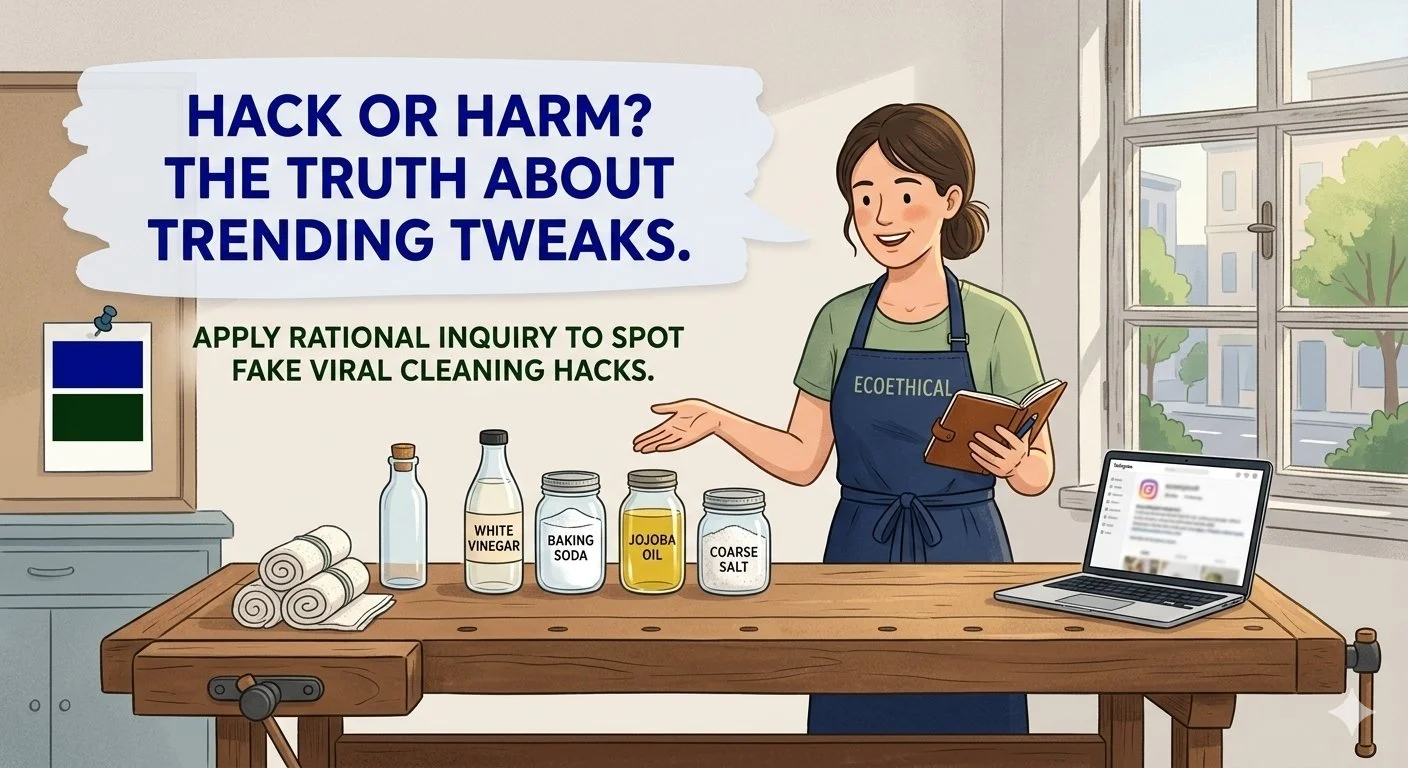
Why social media cleaning hacks are often wrong (and how to spot the bad advice)
You've seen them: viral cleaning hacks promising miracle results with common household items. But here's the uncomfortable truth—many of these tips don't work, and some can permanently damage your home. The problem isn't just uninformed creators; it's that social media's structure incentivizes engagement over accuracy. Algorithms reward novelty and controversy, not truth. Creators need constant content to earn money, which leads to untested methods going viral. Before trying that trending hack, learn to spot logical fallacies, understand basic chemistry, and apply rational inquiry. Your surfaces—and your wallet—will thank you.
You're scrolling through Instagram at 11 PM when you see it: a video of someone mixing dish soap, vinegar, and baking soda into a bottle, claiming it's the "ultimate all-purpose cleaner that professionals don't want you to know about." The comments are filled with fire emojis and people tagging their friends. It has 2.3 million views. It must work, right?
Not necessarily. In fact, probably not.
Welcome to the world of "cleanfluencers"—social media personalities who've built massive followings by sharing cleaning tips, hacks, and product recommendations. Some are knowledgeable professionals sharing genuinely helpful advice. But many are content creators who've discovered that cleaning videos get exceptional engagement, regardless of whether the advice actually works or could even damage your home.
The problem isn't just that bad cleaning advice wastes your time and money. It's that some of these viral hacks can make cleaning problems worse, permanently damage surfaces, or create dangerous chemical reactions that put your health at risk. And the very structure of social media—the algorithms, the monetization, the pressure to constantly create content—incentivizes quantity over accuracy.
If you've ever tried a viral cleaning hack that didn't work, damaged something, or left you wondering "wait, should I really be mixing those chemicals?", this article is for you. I’ll dig into how social media cleaning content actually works, why misinformation spreads so easily, and most importantly, how to tell the difference between legitimate advice and viral nonsense.
Let's start by understanding the landscape.
The cleanfluencer ecosystem: Where the content lives
Cleaning content has exploded across virtually every social media platform, but each one has its own flavour and format that shapes what gets shared.
TikTok: The viral hack factory
TikTok is ground zero for viral cleaning hacks, and it's easy to see why. The platform's algorithm is designed to surface engaging content to massive audiences quickly, regardless of the creator's follower count. A single video can go from zero to millions of views overnight.
What's trending: Quick transformations (often sped up), satisfying before-and-after reveals, "secret" product combinations, dramatic reactions to results, and controversial takes that spark debate in comments.
The format influence: TikTok videos max out at 10 minutes but perform best under 60 seconds. This creates pressure to oversimplify, skip important context (like safety warnings or surface compatibility), and prioritize visual drama over practical accuracy.
Popular cleanfluencers promote: Miracle product combinations (often chemically questionable), "forbidden" cleaning methods, extreme cleaning scenarios, and product "dupes" that supposedly work better than expensive alternatives.
Instagram reels: TikTok's slightly more polished cousin
Instagram Reels borrowed TikTok's format and many of the same trends have migrated over. The main difference is Instagram's slightly older, more affluent demographic.
What's trending: Aesthetic cleaning routines, product recommendations with affiliate links, home organization combined with cleaning, and luxury cleaning product showcases.
The format influence: Similar time constraints to TikTok, with added pressure for visual polish. This often means content is more styled but not necessarily more accurate.
Popular cleanfluencers promote: "Clean girl aesthetic" routines, expensive cleaning products positioned as investments, cleaning as self-care, and curated product collections.
YouTube: Long(er)-form content (but not always better)
YouTube allows for longer, more detailed content, which theoretically should mean more accurate information. Sometimes it does. Often it doesn't.
What's trending: Deep cleaning videos, product testing and reviews, cleaning routines, and "satisfying" cleaning compilations.
The format influence: Longer videos need to maintain engagement, which often leads to dramatic thumbnail promises ("I DIDN'T CLEAN MY OVEN FOR 5 YEARS"), clickbait titles, and stretched-out content with important information buried or omitted.
Popular cleanfluencers promote: Viral products (often the same ones being pushed on TikTok), cleaning product hauls, sponsored content disguised as genuine recommendations, and elaborate cleaning systems.
Facebook: Where misinformation gets shared by your aunt
Facebook cleaning content tends to be less about individual influencers and more about viral posts that get shared repeatedly through groups and personal networks.
What's trending: Text-based "miracle" cleaning recipes, before-and-after photos (often without methodology), cleaning group recommendations (some good, many questionable), and nostalgia-based cleaning methods ("my grandmother always did this").
The format influence: Facebook’s older demographic relies on different trust signals. People are more likely to trust advice that seems to come from peers or has been "tested" by their social network, even without verification.
Popular content promotes: DIY cleaner recipes (accuracy varies wildly), old wives' tales presented as proven methods, and products positioned as "chemical-free" alternatives.
Pinterest: The recipe card graveyard
Pinterest is where cleaning "recipes" go to be saved, reshared, and rarely fact-checked. It's a visual search engine where content gets divorced from its source and recirculated endlessly.
What's trending: Printable cleaning schedules, DIY cleaner recipes, infographics about cleaning methods, and "natural" cleaning solutions.
The format influence: Content is optimized for saving and sharing, not accuracy. Once a pin goes viral, it continues circulating regardless of whether it's been debunked.
Popular content promotes: All-purpose DIY cleaners (many chemically ineffective), cleaning "systems" and schedules, essential oil cleaning solutions, and visual before-and-after comparisons.
The economics of cleanfluencing: Why accuracy takes a back seat
Understanding why so much cleaning misinformation exists requires understanding how social media creators make money. The incentive structures don't reward accuracy, they reward engagement and volume.
How cleanfluencers actually make money
Creator fund payments (TikTok, YouTube): Platforms pay creators based on views and engagement. More videos = more views = more money. The accuracy of those videos? Not factored into payment.
Affiliate commissions:When a creator links to a product and you buy it, they earn a percentage (typically 3-10%). This creates incentive to recommend products whether they work well or not—the commission is the same either way.
Sponsored content: Brands pay creators directly to feature products. These deals can range from a few hundred dollars to tens of thousands for top creators. The creator's job is to make the product look good, not to provide unbiased assessment.
Ad revenue (YouTube): Longer videos with more ads generate more revenue. This incentivizes stretching content, adding drama, and creating series rather than comprehensive single videos.
Product lines and partnerships: Successful cleanfluencers often launch their own cleaning products or cleaning tools, creating financial incentive to drive followers toward those products specifically.
Course and e-book sales: Many cleanfluencers sell cleaning courses, guides, or systems—positioning themselves as experts, regardless of actual credentials.
The content treadmill problem
Social media algorithms reward consistency and frequency. Creators who post daily or multiple times per week get more algorithmic promotion than those who post weekly or monthly. This creates enormous pressure to constantly generate new content.
Here's the problem: there are only so many legitimate, tested, safe cleaning methods. Once you've covered the basics, you need to either:
Repeat yourself (which gets boring and hurts engagement)
Go deeper with proper research (time-consuming and doesn't guarantee virality)
Start making things up or sharing untested methods (fast, novel, and more likely to go viral)
Guess which option most creators choose?
The virality trap
Not all content performs equally. Social media algorithms prioritize content that generates engagement—comments, shares, saves, and watch time. What generates engagement?
Content that works moderately well: Gets a polite "thanks for sharing" and a few saves.
Content that's shocking, controversial, or seemingly revolutionary: Gets massive engagement as people debate, share with friends, and express surprise.
This creates perverse incentives. A video showing the correct way to clean hardwood floors (barely-damp mop, pH-neutral cleaner) might get 10,000 views. A video claiming you can clean hardwood floors with a mixture of vinegar, olive oil, and lemon juice (don't do this!) might get 5 million views because it's novel, surprising, and sparks debate in the comments.
The algorithm doesn't care that the second video will damage people's floors. It only cares that more people are engaging with it.
The credibility problem
Here's an unsettling truth: you don't need credentials, training, or expertise to become a cleanfluencer. You just need a camera and a willingness to create content.
Some popular cleaning content creators are former professional cleaners or have relevant education. Many are not. Some are simply people who like cleaning and started sharing videos. Some actively misrepresent their expertise to build authority.
The platforms don't verify credentials or fact-check content (except in narrow cases like medical or electoral misinformation). There's no quality control. Terrible advice and excellent advice look exactly the same in your feed—it's up to you to tell the difference.
The echo chamber effect
Once a creator builds an audience, they're surrounded by followers who trust them. Negative feedback gets filtered out (comments can be deleted, critics can be blocked), and the creator receives constant positive reinforcement regardless of content accuracy.
This creates an environment where creators can genuinely believe they're providing good advice even when they're not. They see thousands of comments saying "this worked great!" (often from people who haven't actually tried it, or who can't yet see the long-term damage), and dismiss the occasional "this damaged my countertop" comment as user error.
The bottom line
The economic model of social media content creation rewards:
Volume over accuracy
Novelty over effectiveness
Engagement over truth
Entertainment over education
This doesn't mean all cleanfluencers are intentionally spreading misinformation. Many believe they're helping. But the system they operate within actively incentivizes the spread of questionable advice, and that's what we need to understand to protect ourselves.
Common logical fallacies in viral cleaning content
Now that we understand why misinformation spreads, let's talk about how to spot it. Viral cleaning content relies heavily on logical fallacies—errors in reasoning that make bad arguments seem convincing. Here are the most common ones you'll encounter.
Appeal to nature ("it's natural, so it's better")
What it sounds like: "This all-natural cleaner uses only ingredients you can pronounce!" or "Why use harsh chemicals when vinegar and essential oils work just as well?"
Why it's a fallacy: "Natural" doesn't mean safe, effective, or appropriate. Arsenic is natural. So is poison ivy. Many synthetic cleaning products are safer and more effective than natural alternatives for specific tasks. The issue isn't whether something is natural or synthetic—it's whether it works safely for the intended purpose.
Example in the wild: A TikTok video promoting essential oil cleaning spray for disinfection. Essential oils smell nice, but they're not EPA-approved disinfectants and won't kill dangerous bacteria or viruses. Claiming they're "better because they're natural" is both misleading and potentially dangerous—especially if you have pets.
Appeal to tradition ("my grandmother did this")
What it sounds like: "This is how people cleaned before all these chemicals existed" or "Old-fashioned methods are always better."
Why it's a fallacy: Traditional methods aren't inherently better. We've developed new approaches because old ones often weren't effective or were unnecessarily labour-intensive. Yes, some traditional methods work well. Others persist despite being suboptimal. Tradition alone isn't evidence of effectiveness.
Example in the wild: Posts claiming you should clean everything with vinegar because "that's what people used to do." While vinegar has legitimate uses, it's not appropriate for all surfaces.
Anecdotal evidence ("it worked for me")
What it sounds like: "I've been doing this for years and never had a problem" or "Everyone in the comments says this worked for them!"
Why it's a fallacy: Individual experiences don't constitute reliable evidence. People might not notice slow damage, might be using different surfaces or products than you, might have different definitions of "clean," or might be experiencing placebo effect. Thousands of anecdotes still aren't the same as controlled testing.
Example in the wild: A viral post about using bleach on grout with hundreds of comments saying "this worked great!" Missing context: bleach can break down grout over time, but the damage isn't immediately visible. The people celebrating success might discover deteriorating grout years later without connecting it to the method.
False equivalence ("it's just like...")
What it sounds like: "If it can clean your toilet, imagine what it can do for your sink!" or "This removes stains from clothes, so it'll work on upholstery too."
Why it's a fallacy: Different surfaces have different properties, tolerances, and cleaning requirements. A method that works on one surface can damage another. Materials aren't interchangeable just because they seem similar.
Example in the wild: Videos suggesting you can clean natural stone countertops the same way you clean laminate. Stone is porous and acid-sensitive; many cleaners safe for laminate will permanently damage stone.
Cherry-picking ("look at this amazing result!")
What it sounds like: Before-and-after photos showing dramatic improvements, without mentioning failed attempts, time required, or special circumstances.
Why it's a fallacy: Showing only successes while hiding failures creates false impression of reliability. Maybe this method worked once out of ten tries. Maybe the "before" photo was staged to look worse. Maybe important context was omitted.
Example in the wild: A dramatic before-and-after of a "miracle" grout cleaner, without mentioning that the grout was sealed beforehand, the creator used professional-grade equipment, and it took four hours of work.
Appeal to authority (misrepresented)
What it sounds like: "Professional cleaners use this" or "This is what experts recommend" (without citing actual sources or when the creator isn't actually a professional).
Why it's a fallacy: Vague appeals to unnamed authorities aren't evidence. Even when sources are cited, they might be misrepresented or taken out of context. Credentials matter, but they need to be verifiable and relevant.
Example in the wild: A creator claiming "professional cleaners swear by this mixture" when promoting a homemade solution that most professionals would never use because better alternatives exist.
Hasty generalization ("this cleans everything")
What it sounds like: "The only cleaner you'll ever need!" or "Use this on literally any surface in your home."
Why it's a fallacy: No single cleaner is appropriate for every surface. Different materials require different approaches. Universal claims are almost always overstated.
Example in the wild: Videos promoting a single DIY mixture for cleaning everything from windows to hardwood floors to granite countertops. In reality, what's safe for glass might damage wood, and what's fine for sealed surfaces might etch stone.
Correlation implies causation ("I did this and that happened")
What it sounds like: "I started using this method and my surfaces look better than ever!" without considering other factors.
Why it's a fallacy: Just because two things happened together doesn't mean one caused the other. Maybe they also started cleaning more frequently. Maybe they replaced old sponges. Maybe seasonal humidity changed. Maybe they’re simply paying more attention now.
Example in the wild: Someone credits their DIY cleaner for improved results when they've also switched to better cloths and started cleaning twice as often. The improvement might have nothing to do with the cleaner itself.
Conspiracy thinking ("they don't want you to know this")
What it sounds like: "Big Cleaning doesn't want you to know about this simple solution" or "The cleaning industry hates this one simple trick."
Why it's a fallacy: Implying there's a conspiracy to hide effective methods positions questionable advice as "secret knowledge" while dismissing legitimate criticism as industry protection. It's a rhetorical shield against fact-checking.
Example in the wild: Videos claiming that mixing dish soap, vinegar, and baking soda is a "secret" that cleaning product companies don't want you to know—when actually, this mixture is chemically ineffective (the acid and base neutralize each other) and professionals don't use it because it doesn't work.
Recognizing fallacies in the wild
These fallacies rarely appear alone. A typical viral cleaning video might combine appeal to nature ("all-natural ingredients!"), anecdotal evidence ("worked perfectly for me!"), hasty generalization ("cleans everything!"), and conspiracy thinking ("they don't want you to know!") all in 60 seconds.
Learning to recognize these patterns helps you evaluate claims more critically, regardless of how many views or likes they have.
How to apply rational inquiry to cleaning hacks
Now that you can spot logical fallacies, let's talk about how to actually evaluate cleaning advice using rational inquiry—a systematic approach to determining what's likely true versus what's likely nonsense.
Step 1: Consider the source
Ask yourself:
Does this person have relevant credentials or professional experience?
Do they disclose potential conflicts of interest (sponsorships, affiliates, their own products)?
Do they cite sources for their claims or just present personal opinion?
What's their content history? Are they primarily an entertainer or educator?
Do they acknowledge limitations and risks, or only promote benefits?
Red flags:
No identifiable expertise in cleaning, chemistry, or materials science
Every video promotes products with affiliate links
Claims of being a "professional" without specifics about experience
Credential misrepresentation ("I worked in a cleaning company" could mean they were a receptionist)
Defensive or dismissive responses to legitimate questions
Green flags:
Verifiable professional experience (business name, years in industry)
Transparent about sponsorships and conflicts of interest
Cites specific sources (studies, manufacturers, industry standards)
Acknowledges when they don't know something
Discusses trade-offs and limitations of methods
Step 2: Understand the chemistry
You don't need a chemistry degree, but understanding basic principles helps immensely:
Acids and bases neutralize each other. Mixing vinegar (acid) with baking soda (base) creates mostly water and carbon dioxide. The bubbling looks impressive but actually reduces cleaning effectiveness. If a video promotes this combination as a miracle cleaner, the creator doesn't understand basic chemistry.
Not all cleaners are interchangeable. Surfactants (like dish soap) work differently than solvents (like alcohol) which work differently than abrasives (like baking soda) which work differently than oxidizers (like bleach). Different cleaning problems require different approaches.
"Natural" chemicals are still chemicals. Vinegar is acetic acid. Baking soda is sodium bicarbonate. Essential oils are complex chemical compounds. Being derived from nature doesn't change their chemical properties or make them universally safe.
Some chemical reactions are dangerous. Mixing bleach with vinegar or ammonia creates toxic gases. Combining certain cleaners can damage surfaces or create hazardous fumes. "Experiment and see what works" is dangerous advice.
pH matters for surfaces. Acidic cleaners (vinegar, lemon juice) will etch natural stone, damage grout sealant, and can strip wood finishes. Alkaline cleaners can damage some metals and finishes. The right cleaner depends on the surface.
Step 3: Think about surface compatibility
Before trying any cleaning method, ask:
What material am I cleaning? Natural stone? Sealed or unsealed wood? Laminate? Stainless steel? Glass? Ceramic? The answer determines what will be safe to use.
Does it have a protective coating? Many surfaces have finishes, sealants, or coatings that can be damaged even when the underlying material is durable. Abrasives can dull glossy paint. Acids and bases can strip sealants. Solvents can damage many finishes.
How hard is the surface? If a method involves abrasion (like Magic Erasers or powdered cleaners), is the abrasive softer or harder than the surface? Harder abrasives will scratch.
Is the surface porous or non-porous? Porous surfaces (unsealed stone, unfinished wood, grout) absorb liquids and can be damaged by too much moisture or stained by coloured cleaners.
What does the manufacturer recommend? If your flooring, countertops, or appliances came with care instructions, those should be your starting point. Warranty-voiding methods should raise red flags.
Step 4: Look for verifiable evidence
Strong evidence includes:
Peer-reviewed studies
Manufacturer testing and specifications
Industry standards and recommendations (from organizations like IICRC, ISSA, or BSCAI)
Repeated validation from independent sources
Long-term results documentation (not just immediate before-and-after)
Weak evidence includes:
"Everyone says this works" (appeal to popularity)
Before-and-after photos without methodology
Testimonials without verification
Viral spread without fact-checking
Claims without sources
Questions to ask:
Can I find this method recommended by multiple credible sources?
Do professional cleaners actually use this technique?
Are there any professional organizations or manufacturers that endorse this?
What happens if I search for "<method name> + damage" or "<method name> + doesn't work"?
Are there any long-term studies or tests of this method?
Step 5: Consider what's being left out
Viral content optimizes for engagement, not completeness. What important information might be missing?
Common omissions:
Safety warnings (ventilation, chemical reactions, protective equipment)
Surface compatibility limitations ("works great!" ...on what exactly?)
Time requirements (sped-up video hides that it took two hours)
Special conditions (their water is soft; yours is hard)
Product specifications (not all “dish soap" is identical)
Failure rate (how often does this not work?)
Long-term effects (it looks good now, how about in a week?)
Cost analysis (is this actually cheaper than the alternatives?)
Skill requirements (is this only easier for someone with lots of experience?)
Red flag questions:
Why isn't this person showing themselves doing this in real-time?
Why are there no cautionary statements about what not to do?
Why don't they specify which surfaces this works on?
Why isn't there any mention of what could go wrong?
Step 6: Test conservatively (if you decide to try it)
If a method seems plausible after your evaluation, test it cautiously:
Start with an inconspicuous area. Look for a hidden spot inside a cabinet, behind furniture, or in a low-traffic area. Never start with the most visible surface.
Use the mildest version first. If they recommend concentrated vinegar, try it diluted first. If they say scrub hard, try gentle pressure first.
Wait and observe. Immediate results aren't the only concern. Check again in 24 hours, one week, and one month for delayed damage like discolouration, dullness, or deterioration.
Document your test. Take photos before, immediately after, and during follow-up checks (under the same lighting conditions). This helps you notice subtle changes.
Stop at the first sign of problems. If you notice any dulling, discolouration, texture change, or surface damage, stop immediately. Don't assume it will get better or that you're "doing it wrong."
Compare to known-good methods. Test both the viral method and a conventional approach. Which actually works better? Is the viral method really superior, or just novel?
Step 7: Update your conclusions as you learn
Rational inquiry isn't about being right immediately—it's about being willing to change your mind when evidence warrants it.
Be willing to admit:
"I thought this would work, but it didn't"
"This seemed safe, but it caused damage"
"The viral video made this look easy, but it's actually complicated"
"I was wrong to recommend this to friends"
Keep learning:
Pay attention to long-term results of methods you've tried
Notice if professional cleaners avoid methods that are popular online
Stay updated on product recalls or safety warnings
Be skeptical of your own confirmation bias (wanting something to work because it's convenient or popular)
This process sounds like a lot of work, and sometimes it is. But it gets faster with practice, and it's far less work than repairing damaged surfaces or dealing with ineffective cleaning methods.
Case study: The viral dawn + vinegar shower cleaner
Let's apply everything we've discussed to one of the most viral cleaning hacks online: the Dawn dish soap and vinegar mixture for cleaning soap scum in showers.
The claim
Across TikTok, Instagram, and Pinterest, you'll find thousands of posts claiming that mixing equal parts Dawn dish soap with white vinegar creates an incredible shower cleaner that removes soap scum effortlessly. The promise: spray it on, wait 30 minutes, wipe off, and your shower will be spotless without scrubbing.
Step 1: Consider the source
What we find:
This hack appears across thousands of accounts, from professional cleaners to home accounts
Most posts don't explain why this works, just that it does
Many include affiliate links to spray bottles or cleaning supplies
Some sources have cleaning experience; many don't
Almost none discuss limitations or risks
Initial assessment: The widespread sharing suggests some people find it effective, but lack of expertise in many sources and absence of risk discussion is concerning.
Step 2: Understand the chemistry
Dawn dish soap is a surfactant that breaks down oils and grease. This is why it's excellent for dishes—it lifts away food oils.
White vinegar is acetic acid (typically around a 5% concentration), which can dissolve mineral deposits and cut through some types of buildup.
When combined: The acid (vinegar) and the surfactant (Dawn) don't neutralize each other the way an acid and base would, so theoretically both components could work in the mixture. The surfactant helps the vinegar spread and cling to surfaces, and the acid helps break down soap scum (which often contains mineral deposits).
Chemical plausibility: Unlike the baking soda + vinegar combination, this mixture isn't chemically nonsensical. The components can work together.
Concerns:
Vinegar is acidic and can damage certain surfaces
The mixture doesn't have any controlled ratio or standardized formulation
Different brands of dish soap have different formulations
"Wait 30 minutes" means prolonged acid exposure to surfaces
Step 3: Think about surface compatibility
Where this might be safe:
Ceramic tile (glazed)
Porcelain fixtures
Glass shower doors
Where this could cause damage:
Natural stone (marble, travertine, limestone, slate)—acid will etch
Grout —acid can break down both the sealant and binder of grout, making it more brittle
Some metal finishes (brushed nickel, chrome, oil-rubbed bronze)
Acrylic shower surrounds (the acid can dull the finish over time)
Key realization: Most viral posts don't specify which surfaces are safe. They present this as universal, but it's not appropriate for all shower types.
Step 4: Look for verifiable evidence
What we find:
Lots of anecdotal "this worked for me!" testimonials
Before-and-after photos (though cleaning methodology isn't always clear)
Some professional cleaners endorse modified versions
No manufacturer recommendations to combine these products
Some reports of damage to grout and stone surfaces
Mixed reviews on effectiveness—works well for some, not at all for others
Assessment: Evidence is mostly anecdotal. Success seems highly dependent on water hardness, shower surfaces, and severity of soap scum buildup.
Step 5: Consider what's being left out
Common omissions in viral posts:
No mention that this will damage natural stone
No mention that this works best on fresh soap scum, not years of buildup
No comparison to commercial soap scum removers
No discussion of grout sealant degradation with repeated use
No mention that different water types affect results
Why this matters: People try this on marble showers, expecting it to remove years of neglect, and wind up with damaged stone.
Step 6: The reality check
When we apply rational inquiry, here's what we learn:
What's accurate:
This mixture CAN remove soap scum from appropriate surfaces
The chemistry makes sense
It's less toxic than some commercial cleaners
For mild soap scum on safe surfaces, it can work reasonably well
What's overstated:
It's not a miracle solution—commercial soap scum removers often work better
It doesn't work "without scrubbing" for anything beyond light buildup
It's not safe for all shower surfaces
It's not a "professional secret"—professionals typically use variations of this approach daily
What's missing:
Surface safety warnings
Proper ventilation requirements
Realistic expectations about scrubbing needs
Long-term effects on grout sealant
Comparison to purpose-made products
Step 7: The informed conclusion
Is this hack completely wrong? No. It can work for certain applications.
Is it presented accurately online? No. It's oversold, limitations are hidden, and risks are ignored.
Should you use it? Maybe, with important caveats:
Safe for ceramic tile (keep if off grout) and glass shower doors
Effective for mild-to-moderate soap scum
Still requires scrubbing for tough buildup
Test in inconspicuous area first
Never use on natural stone showers
Not dramatically better than quality commercial cleaners
Can destroy unsealed grout and degrade grout sealant with frequent use
Better approach: For ceramic tile and glass showers, a quality commercial soap scum remover is often more effective, faster-acting, and formulated to be safe for typical bathroom surfaces. If you prefer DIY, this mixture can work—but understand its limitations and use it appropriately.
The lesson
Even when a viral hack has some legitimate basis, the way it's presented online often strips away crucial context, overstates benefits, and hides risks. Your job isn't to reject everything from social media—it's to evaluate it critically and understand what you're really doing.
Final thoughts: Becoming a smarter consumer of cleaning content
Social media has democratized information sharing, and that's brought both benefits and problems. Anyone can share cleaning tips—which means both expert professionals and complete amateurs have equal voices. The algorithm doesn't distinguish between them.
In my opinion, this isn’t going to change anytime soon. Platforms will continue to prioritize engagement over accuracy. Cleanfluencers will keep creating content under the same economic pressures. Viral misinformation will continue to spread as long as controversy and novelty gets more views than careful, measured advice.
What can change is how you engage with this content.
Remember these key principles:
Virality doesn't equal validity. A video with 10 million views isn't more accurate than one with 10,000. It's just more engaging—and sometimes misinformation is more engaging than truth.
Entertainment and education aren't the same thing. Enjoy satisfying cleaning videos for what they are, but don't assume dramatic transformations represent realistic, safe methods.
Credentials matter. A professional cleaner's advice generally carries more weight than a home content creator's, though neither is infallible. Look for verifiable expertise.
If it sounds too good to be true, it probably is. "One ingredient cleans everything!" No, it doesn't. "This miracle method professionals don't want you to know!" They're probably not using it because it doesn't work well.
Your surfaces are not worth risking. Replacing damaged countertops, refinishing floors, or repairing etched stone is expensive. When in doubt, err on the side of caution and use methods with established track records.
Chemical reactions are real. Mixing random products together is not "experimenting"—it's potentially creating dangerous situations or ineffective solutions. Understand what you're combining and why.
Context matters enormously. What works for someone with soft water might not work with hard water. What's safe for their floors might damage yours. Surface compatibility isn't optional information.
The good news is that you don't need to become a cleaning expert or chemistry major. You just need to think critically, ask good questions, and be willing to research before trying something that could cause harm or waste your time.
Professional cleaning isn't about secrets or tricks. It's about understanding surfaces, choosing appropriate methods and products, and applying them correctly. That knowledge comes from experience, training, and yes—sometimes from social media, when the source is credible and the advice is sound.
The next time you see a viral cleaning hack, you'll know how to evaluate it. That's real power—not the power to remove a stain in 10 seconds, but the power to distinguish what actually works from what just looks impressive in a 60-second video.
And that's worth more than any cleaning hack.
Tired of sorting through conflicting cleaning advice? EcoEthical Cleaning strives to bring professional expertise and planet-safe, science-based methods to every job. Contact me for a free, no-obligation estimate. Proudly serving Toronto’s Harbourfront and surrounding neighbourhoods.
Sources & further reading
"Does Influencer Marketing Really Pay Off?", Harvard Business Review
"Fallacies", Stanford Encyclopedia of Philosophy
"Use household chemicals safely", Health Canada
“Cleaning products—working safely”, Canadian Centre for Occupational Health and Safety