Greenwashing in the cleaning industry: what to know about this unethical practice
"Green" is everywhere — on labels, in taglines, and throughout marketing materials. But how much of it is real? Learn how to identify greenwashing in the cleaning industry, what warning signs to look for, and how to find a company that genuinely walks the walk.
Walk through any grocery store, scroll through any cleaning company’s website, or read a product label, and you’ll find the same language everywhere: "green," "natural," "eco-friendly," "non-toxic," "plant-based," "earth-conscious." The words are reassuring. They suggest that the company behind the product cares about the same things you do; your family’s health and the health of the planet.
Sadly though, Canada still lags behind other nations when it comes to regulating product labels. Many of these terms are entirely unregulated. At the time of this writing, any company can still use the word "natural" on a label without a single gram of a natural ingredient inside. The gap between what companies and products claim and what they actually do has a name: greenwashing.
This guide is designed to help you understand what greenwashing is, why the cleaning industry is particularly prone to it, how to spot it, and most importantly, how to find cleaning companies and products that genuinely do what they advertise.
What is greenwashing?
Greenwashing is the practice of using misleading, vague, or outright false environmental claims to create the impression that a product, service, or company is more sustainable or eco-friendly than it actually is. The term was coined in the 1980s by environmentalist Jay Westervelt, who noticed that hotels were promoting towel reuse programs as a conservation initiative, while simultaneously expanding their properties in environmentally destructive ways.
Today, greenwashing is far more sophisticated. It ranges from subtle misdirection (using the colour green and nature imagery with no substantive environmental claims) to outright deception (claiming a product is biodegradable when it isn’t). It can be intentional or the result of genuine ignorance about what “eco-friendly” actually requires.
What makes greenwashing particularly frustrating is that it actively harms the companies and individuals who are doing the right thing. When every cleaning product claims to be green, genuinely sustainable options become harder to identify, and consumers who want to make better choices have no reliable way to do so.
Why the cleaning industry is especially prone to greenwashing
Cleaning products are used in intimate spaces — kitchens, bathrooms, children’s bedrooms — which means health and safety claims resonate strongly with buyers. At the same time, the ingredients in cleaning products are complex, poorly understood by many consumers, and rarely scrutinized. This creates a perfect environment for vague claims to go unchallenged.
Add to this the fact that Canada has no single regulated definition for terms like “green,” “natural,” or “eco-friendly” in cleaning products, and the incentive to use this language without substantiating it becomes very strong.
The most common greenwashing tactics in the cleaning industry rarely looks like outright lying. It’s usually more subtle — a carefully chosen word here, an omission there. Here are the most common tactics to watch for:
Vague and unregulated language
Words like “natural,” “green,” “eco-friendly,” “earth-conscious,” and “plant-derived” have no legal definition in Canada when used on cleaning product labels.
This doesn’t mean every product using this language is greenwashing, but it does mean the words alone are not evidence of anything. They should prompt you to look deeper, not reassure you that the work is done.
Irrelevant claims
Some products trumpet the absence of something that was never present in the first place. "CFC-free" is a classic example — chlorofluorocarbons have been banned in Canadian consumer products since 1996, so advertising their absence is technically accurate but entirely meaningless.
Hidden trade-offs
A product might genuinely be better in one environmental dimension while being worse in others. A cleaning product might use biodegradable surfactants, and also contain synthetic fragrances that are harmful to aquatic life. A company might use recycled packaging, and also ship their products across the planet.
Hidden trade-offs are a form of greenwashing because they highlight a single positive attribute while obscuring the overall environmental picture. Genuine sustainability requires looking at the whole, not just the most flattering part.
Fake or misleading certifications
Certification logos and seals of approval carry a lot of weight with consumers, which is exactly why some companies create their own. A self-awarded badge that says "Eco-Approved" or "Green-Certified" may have no standards behind it whatsoever.
Even legitimate-looking certifications can be misleading. Some are awarded based on self-reported data with no third-party verification. Others have standards so low that almost any product would qualify. It’s worth taking a moment to look up any certification you see, who issues it, what the standards are, and whether verification is independent.
Greenwashing through imagery and design
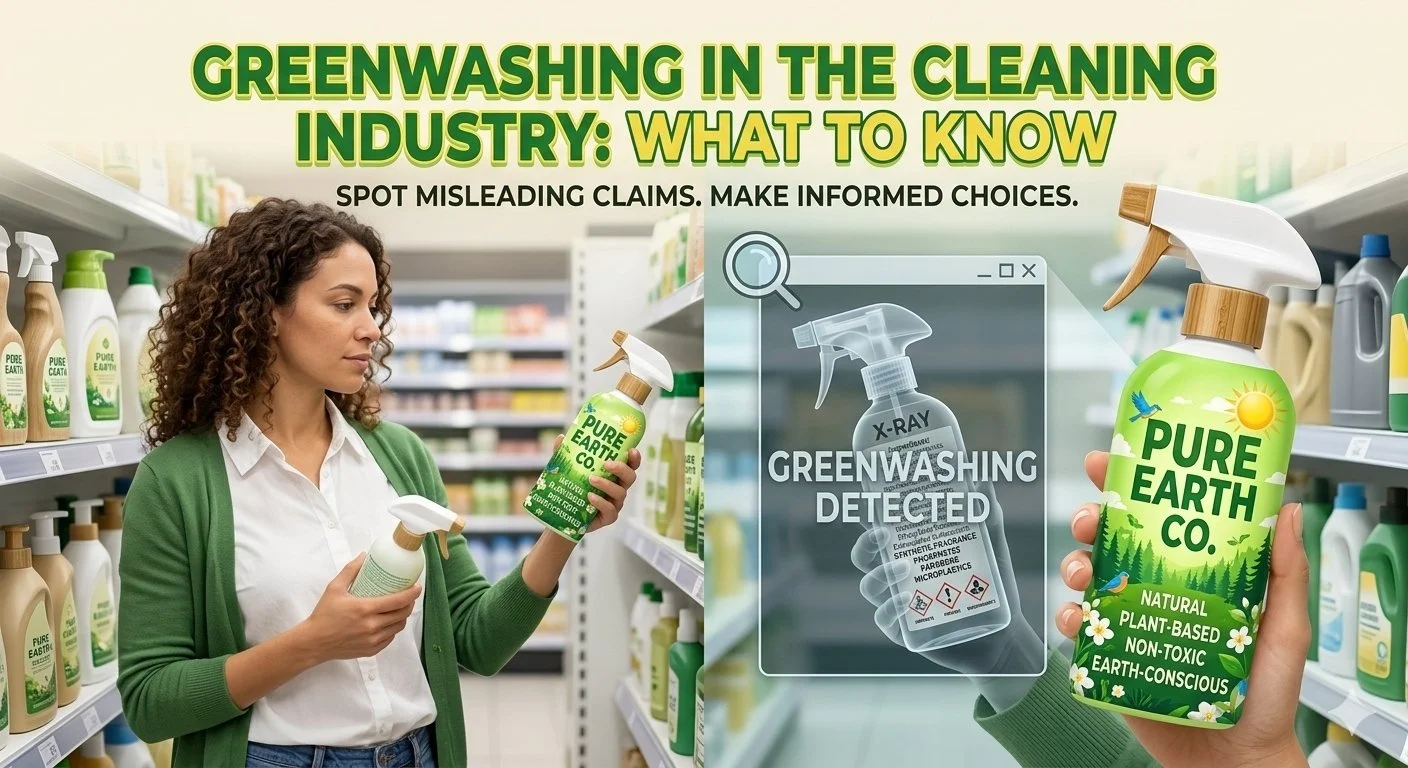
Not all greenwashing is in the words. Green packaging, leaf imagery, earthy colour palettes, and nature photography are all design choices that signal environmental responsibility without making a single verifiable claim. This is sometimes called “visual greenwashing,” and it’s particularly effective because it operates below the level of conscious scrutiny.
Be aware that a bottle covered in leaves and printed in green ink may contain the same ingredients as a bottle printed in clinical white. Design is not evidence.
"Natural" fragrances
This one deserves its own mention because it’s so widespread. Many cleaning products advertise "natural" or "botanical" fragrances as a selling point, implying that they’re safer and more eco-friendly than synthetic alternatives.
The reality is more complicated. The word "fragrance" on an ingredient list, whether natural or synthetic, is a catch-all term that can conceal dozens of individual chemicals, none of which are required to be disclosed in cleaning products. Some naturally derived fragrances are perfectly harmless. Others are known allergens or irritants. And some products labelled "fragrance-free" still contain masking agents designed to neutralize odours without a detectable scent.
The most transparent products will either contain no fragrance at all, or will disclose the specific source and composition of any scent used.
Selective disclosure
A company might publish a list of ingredients that sounds impressive — highlighting the plant-based ones while omitting mention of synthetic additives, preservatives, or processing aids that are also present. Or they might disclose ingredients at a product level but not disclose the environmental and labour practices upstream in their supply chain.
Genuine transparency means sharing the full picture, including potential negatives.
Red flags to watch for
When you’re evaluating a cleaning product or company, here are the warning signs that should prompt closer scrutiny:
Unsubstantiated superlatives: Claims like "the most eco-friendly cleaner on the market" with no data or certification to back them up.
Buzzword overload: Descriptions that lean heavily on words like "green," "natural," "pure," and "clean" without any specifics.
No ingredient disclosure: A company that won’t tell you what’s in their products has no transparency to offer. Full ingredient lists should be readily available.
Self-issued certifications: Any seal or badge that was created and awarded by either the same company selling the product, or any entity that benefits from the sale of their certified products.
Vague "biodegradable" claims: True biodegradability is measurable and verifiable. "Biodegradable" without a timeframe or standard (such as OECD 301) is often meaningless.
No safety data: Reputable products have Safety Data Sheets (SDS) that are publicly available. If a company won’t provide one, that’s a significant red flag.
Greenwashing by association: A company that donates 1% of profits to an environmental charity while using harmful products in their core business is not an eco-friendly company — it’s a company with a charitable giving program.
Inconsistency between marketing and practice: A cleaning company that talks about the environment on their website but ships products from overseas in single-use plastic packaging, uses synthetic microfibre cloths, and drives long distances every day is not living up to its own claims.
Questions to ask a cleaning company
If you’re hiring a cleaning service and want to know whether their environmental claims are genuine, here are the questions most likely to separate the real from the performative. A transparent company should be able to answer all of these without hesitation.
About their products
Can they provide a full ingredient list or Safety Data Sheet for the products they use?
Are their products certified by a third-party organization? If so, which one, and what does that certification require?
Are their products biodegradable, and if so, to what standard?
Do their products contain synthetic fragrances, dyes, or preservatives?
Where are their products manufactured?
About their practices
What type of cloths and scrubbers do they use? Are they synthetic or natural fibre?
How do they dispose of wastewater from the cleaning process?
Do they reuse or refill product bottles, or use single-use packaging?
How do they travel to client homes? Do they account for the carbon footprint?
About their transparency
Can they provide a sample checklist or service summary from a previous job?
How do they handle it if a product they use turns out to have an ingredient that concerns a client?
What would they do if a product they currently use was found to have a harmful ingredient?
What a transparent answer looks like
A genuinely eco-conscious cleaner won’t be defensive about these questions, they’ll welcome them. They’ll be able to name their products, explain why they chose them, point you to the manufacturer’s website, and describe the specific properties that make them a better choice. Vague reassurances like “we only use the best green products” are not answers, they’re deflections.
What genuine sustainability actually looks like
Now that you know what greenwashing looks like, it’s equally important to understand what actually constitutes a viable sustainable option.
Full ingredient transparency
A truly transparent company will publish complete ingredient lists for every product they use, along with explanations of what each ingredient does and why it was chosen. They’ll be able to point you to third-party Safety Data Sheets and explain the biodegradability profile of each product.
Third-party certifications with real standards
Look for certifications issued by credible, independent bodies with publicly available and verifiable standards. In Canada, UL Solutions is one of the oldest and most rigorous environmental certification programs for cleaning products. Products bearing these marks have been evaluated against defined criteria by independent verifiers.
That said, the absence of a certification doesn’t necessarily mean a product isn’t genuinely sustainable — some excellent smaller manufacturers haven’t pursued certification for cost or administrative reasons. In those cases, ingredient transparency and a willingness to answer questions become even more important.
Natural fibre cleaning tools
One of the most overlooked aspects of sustainable cleaning is the tools used, not just the products. Synthetic microfibre cloths shed microplastics into wastewater with every wash. These microplastics pass through most municipal wastewater treatment systems and accumulate in waterways and aquatic life.
Genuinely eco-conscious cleaners use cloths, brushes, and scrubbers made from natural, compostable fibres such as cotton, coconut husk (coir), sisal, bamboo, and wood cellulose. These materials clean effectively, biodegrade naturally, and don’t contribute to microplastic pollution.
Locally sourced products
A cleaning company that sources products manufactured in Canada has a significantly smaller carbon footprint than one importing products from other countries. Local sourcing also supports domestic businesses and keeps money circulating in the community.
Intentional service geography
This one rarely comes up in conversations about sustainable cleaning, but it matters. A cleaner who operates within a small, walkable or transit-accessible geography produces far fewer emissions than one who drives long distances between clients every day. Proximity to clients is a genuine environmental advantage — and one that also tends to improve punctuality and reliability.
Consistent behaviour, not just marketing
The most reliable signal of genuine sustainability is consistency between what a company says and what they do. Do they use refillable product bottles or single-use packaging? Do they disclose the full environmental profile of their business, including the parts that aren’t flattering? Are they willing to be held accountable for their practices by clients who ask questions?
Genuine sustainability is a practice, not a marketing strategy. Companies that are truly committed to it are usually more interested in talking about what they do than in talking about how green they are.
The bigger picture: why this matters beyond your home
Greenwashing is not just an inconvenience for consumers trying to make good choices. It has real environmental consequences.
When cleaning products that claim to be biodegradable are washed down the drain and don’t actually biodegrade, those chemicals accumulate in waterways. When synthetic microfibre cloths shed microplastics into laundry wastewater, those particles pass through treatment systems and enter the food chain. When a company markets itself as sustainable and isn’t, it crowds out the companies that are — and makes it harder for consumers to reward genuine environmental leadership with their purchasing choices.
Consumer demand is one of the most powerful forces available to drive genuine sustainability improvements in industry. But that demand only creates the right incentives when consumers can tell the difference between companies that are genuinely sustainable and those that are merely performing it. Knowing how to spot greenwashing is, in a very practical sense, a form of environmental action.
The bottom line
"Green" is one of the most valuable words in consumer marketing, which is exactly why it’s so widely misused. As a homeowner or tenant hiring a cleaning service, you have every right to ask hard questions and expect straight answers.
The companies worth hiring are the ones that welcome those questions. They can tell you exactly what’s in every product they use, explain why they chose it, point you to third-party data, and describe their full practice — not just the flattering parts. They use natural fibre tools. They source locally. Their environmental commitment shows up in how they run their business, not just in their marketing copy.
If a company can’t answer basic questions about their products, that’s your answer.
About the author
Trevor Delaney is the founder of EcoEthical Cleaning, an independent residential cleaning service serving Toronto’s Harbourfront and surrounding downtown neighbourhoods. EcoEthical Cleaning prioritizes plant-based, biodegradable, Canadian-made products and natural fibre cleaning tools. Full product details, including ingredient breakdowns and manufacturer links, are available at https://www.ecoethicalcleaning.ca/products.
For a free, no-obligation estimate: https://www.ecoethicalcleaning.ca/estimate
📞 (416) 605-7549
📧 trevor.delaney@ecoethicalcleaning.ca
Sources & further reading
Competition Bureau Canada, “Environmental claims and greenwashing” (2025)
Terra Choice Environmental Marketing, “The Sins of Greenwashing” (2010)
U.S. EPA, Safer Choice Program