The complete guide to microbial cleaning
Discover how microbial cleaning uses beneficial bacteria to maintain cleanliness in your Toronto home. Learn what microbial cleaners are, how they work, when to use them, and why this innovative cleaning approach might be the sustainable solution you've been looking for.
In recent years, a new category of cleaning products has been gaining attention among environmentally conscious homeowners: microbial cleaners. If you've seen products labeled as "probiotic cleaners," "enzymatic cleaners," or "bacterial cleaners" on store shelves and wondered what they're all about, you're not alone.
The concept might seem counterintuitive at first. After all, haven't we spent decades trying to kill bacteria in our homes? Why would we intentionally introduce bacteria as part of our cleaning routine?
The answer lies in understanding that not all bacteria are harmful. In fact, beneficial bacteria play crucial roles in many aspects of our lives, from our digestive health to composting our organic waste. Microbial cleaning harnesses these helpful microorganisms to clean and maintain surfaces in ways that traditional chemical cleaners simply can't match.
Whether you're living in a downtown condo, a family home in the suburbs, or renting an apartment, understanding microbial cleaning can help you make informed decisions about maintaining a clean, healthy, and environmentally friendly home.
Let's explore what microbial cleaning actually is, how it works, what it's useful for, and whether it might be the right choice for your household.
What exactly is microbial cleaning?
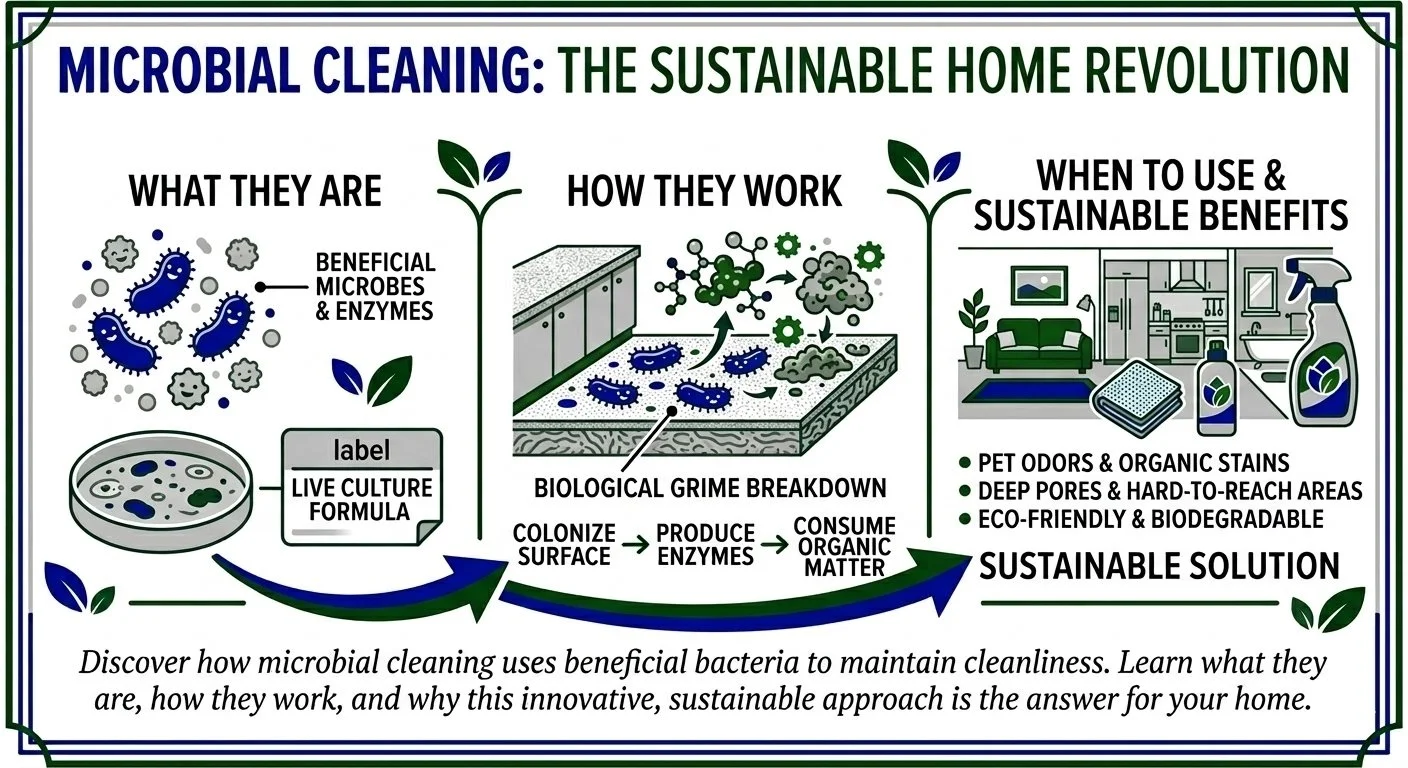
Microbial cleaning refers to cleaning products and methods that use living microorganisms — primarily bacteria and their enzymes—to break down dirt, organic matter, and odour-causing compounds.
There are two main categories of microbial cleaning products you'll encounter:
Enzymatic cleaners contain enzymes, which are proteins that act as biological catalysts. These enzymes are produced by microorganisms but the cleaners themselves may not contain living bacteria. Instead, they contain concentrated enzymes that break down specific types of organic matter. Different enzymes target different substances: proteases break down proteins (like blood or food stains), lipases break down fats and oils, amylases break down starches, and cellulases break down plant-based materials.
Probiotic or bacterial cleaners contain live beneficial bacteria, often along with the enzymes these bacteria produce. When applied to a surface, these bacteria don't just clean once and disappear — they continue to colonize the area, producing enzymes and competing with harmful bacteria for resources. This creates an ongoing cleaning effect that can last for days after application.
The fundamental difference between microbial cleaning and traditional chemical cleaning is the mechanism of action. Chemical cleaners work through immediate chemical reactions — they break apart dirt and kill microorganisms on contact. Microbial cleaners, on the other hand, work biologically and often more slowly, using natural processes to break down organic matter at a molecular level.
Think of it this way: traditional cleaners are like a power washer that blasts everything away immediately. Microbial cleaners are more like having a team of microscopic workers that continue cleaning long after you've walked away, and in some cases, keep working for days.
This doesn't mean microbial cleaners replace all other cleaning methods — they're one tool in your cleaning toolkit, particularly well-suited for specific applications that we'll explore throughout this guide.
How does microbial cleaning actually work?
To understand how microbial cleaning works, it helps to think about what these products are actually doing at a microscopic level.
When you apply an enzymatic cleaner to a surface, you're depositing enzymes that immediately begin breaking down organic compounds. Each enzyme is highly specific — it only works on certain types of molecules. A protease enzyme, for instance, will break protein chains into smaller peptides and amino acids, but it won't affect fats or carbohydrates. This specificity is actually an advantage because it means the enzymes can target exactly the type of soil or stain you're dealing with.
The breakdown process happens through a mechanism that's remarkably elegant. The enzyme binds to its target molecule, breaks it apart, releases the fragments, and then moves on to break down another molecule. A single enzyme can perform this action thousands of times, which is why enzymatic cleaners can be effective even at relatively low concentrations.
Probiotic cleaners add another layer to this process. When you apply a probiotic cleaner, you're introducing millions of beneficial bacteria to the surface. These bacteria do several things simultaneously:
Produce enzymes continuously, creating a sustained cleaning effect rather than a one-time application. As long as the bacteria remain active on the surface, they keep producing the enzymes needed to break down organic matter.
Consume the organic material that the enzymes have broken down. This is important for odour control because many unpleasant smells come from organic compounds. By consuming these compounds, the bacteria eliminate the source of the odour rather than just masking it with fragrance.
Compete with potentially harmful bacteria for space and resources. This is called competitive exclusion. Surfaces in your home are never truly sterile — they're always colonized by some form of microorganism. The question is whether those microorganisms are beneficial or potentially problematic. By establishing populations of beneficial bacteria, probiotic cleaners can help prevent harmful bacteria from gaining a foothold.
This last point is particularly important to understand because it represents a fundamental shift in thinking about cleanliness. Traditional cleaning aims to create a sterile environment by killing all microorganisms. Microbial cleaning instead aims to create a balanced microbial ecosystem dominated by beneficial organisms.
The effectiveness of microbial cleaners depends on several factors. Temperature matters — most enzymes and bacteria work best at room temperature, which is why these cleaners are ideal for typical indoor conditions. Time is also crucial — microbial cleaners generally need more contact time than chemical cleaners to do their work. While a chemical disinfectant might work in seconds, an enzymatic cleaner might need 10-15 minutes, and probiotic cleaners work best when left to dry naturally rather than being wiped away immediately.
Moisture and pH also play roles. Enzymes and bacteria need some moisture to function, and they work best in relatively neutral pH conditions. This is why microbial cleaners are formulated to create optimal conditions for the microorganisms to do their work.
What microbial cleaning is genuinely useful for
Microbial cleaners excel in certain applications where their unique properties provide advantages over traditional cleaning methods. Understanding these specific uses will help you determine whether these products have a place in your home.
Pet odour and stain removal is perhaps the most popular application for enzymatic cleaners. If you have dogs or cats, you've likely dealt with urine accidents on carpets, upholstery, or floors. Pet urine contains uric acid crystals that are extremely difficult to remove with traditional cleaners — they may seem to disappear when wet but return as the area dries, bringing the odour back with them. Enzymatic cleaners specifically break down these uric acid crystals at the molecular level, permanently eliminating the odour rather than just masking it. This is particularly valuable for pet owners living in condos or apartments where lingering pet odours can be problematic for other tenants.
Drain maintenance is another excellent application. The biofilm and organic buildup that accumulates in drains — hair, soap scum, food particles, grease — is exactly what microbial cleaners are designed to address. Regular use of enzymatic drain cleaners can help prevent clogs and eliminate the musty odours that sometimes emanate from drains, especially in older homes where plumbing systems may have decades of accumulated buildup. These cleaners work continuously, slowly breaking down organic matter in pipes without the harsh chemicals that can damage plumbing or harm the environment when they enter the wastewater system.
Grease trap and septic system maintenance also benefits significantly from microbial products. For residents with septic systems, bacterial additives can help maintain healthy microbial populations in the tank, improving waste breakdown and system function. The bacteria in these products enhance the natural decomposition process that septic systems rely on.
Carpet and upholstery cleaning with enzymatic products can be particularly effective for organic stains — food, beverage spills, vomit, or other biological materials. These cleaners penetrate deep into fibres and continue working over time, breaking down staining compounds that traditional cleaners might leave behind. For families with young children or for anyone who's ever dealt with a stubborn wine or coffee stain, this prolonged action can make the difference between a permanent stain and complete removal.
Waste bins and composters benefit enormously from microbial cleaners. Enzymatic sprays designed for garbage bins can help break down the residue that accumulates, reducing odours without introducing harsh chemicals that might contaminate the organic waste stream.
Hard-to-reach areas where soil can accumulate but regular cleaning is difficult — behind appliances, in tight bathroom corners, or in grout lines — can benefit from probiotic cleaners that continue working after application. Since these products keep producing enzymes and breaking down organic matter over time, they can help maintain cleanliness in areas that don't get frequent attention.
Sports equipment and gym bags often develop stubborn odours from sweat and bacteria. Enzymatic cleaners specifically break down the proteins and organic compounds in sweat, eliminating odours at their source. This is particularly useful for families with active kids or adults who regularly use athletic gear.
Automotive interiors, especially cloth seats and carpets that have absorbed spills or developed odours, respond well to enzymatic treatment. The ability of these cleaners to penetrate fabrics and continue working makes them ideal for car cleaning tasks.
What microbial cleaning is not designed for
While microbial cleaners have genuine benefits for specific applications, it's equally important to understand their limitations and what they're not designed to do.
Microbial cleaners are not disinfectants in the traditional sense. If you need to kill harmful bacteria, viruses, or other pathogens — for instance, after handling raw meat in your kitchen or during flu season — enzymatic or probiotic cleaners are not the appropriate choice. While probiotic cleaners may reduce harmful bacteria through competitive exclusion over time, they don't provide the immediate pathogen kill that you get from disinfectants. This is particularly important for households to understand during cold and flu season or when dealing with potential foodborne illness concerns.
They're not designed for inorganic soils. Enzymatic cleaners break down organic matter — proteins, fats, carbohydrates. They don't work on mineral deposits, rust, soap scum (which is largely inorganic), or hard water stains. For these cleaning challenges, you'll still need traditional acidic cleaners or other chemical solutions.
Microbial cleaners are not fast-acting solutions for general cleaning. If you need to quickly wipe down your kitchen counters before dinner guests arrive, a spray-and-wipe enzymatic cleaner isn't your most efficient choice. These products work best with time — from 15 minutes to several hours. They're not ideal for routine quick cleaning tasks where immediate results are needed.
They typically don't provide visible cleaning power for greasy surfaces. While enzymes can break down fats and oils, this happens slowly and at a molecular level. For a stovetop covered in cooking grease or a greasy range hood, you'll get faster, more satisfying results with a traditional degreaser. The enzymatic approach is better suited for maintaining drains or breaking down grease over time rather than tackling heavy visible grease deposits.
Microbial cleaners don't work well in conditions that are too hot, too cold, or chemically extreme. The enzymes and bacteria in these products are living or biological molecules that denature (break down) at high temperatures and become inactive when frozen. Similarly, they don't function well in highly acidic or alkaline conditions. This means they're not appropriate for use with very hot water, in ovens, or in combination with strong chemical cleaners.
They won't remove physical debris or dirt. If your floor is covered in crumbs and visible dirt, an enzymatic spray won't make that disappear. You still need to sweep, vacuum, or physically remove debris. Microbial cleaners work on the microscopic level — breaking down organic residues and odour-causing compounds — not on visible dirt and particles.
These products are also not a replacement for proper ventilation and moisture control. If you have a mould problem in your home, the solution isn't a probiotic cleaner — it's fixing the underlying moisture issue. While some microbial products claim to help with mould, they don't address the root cause, which is excess humidity or water infiltration.
Understanding these limitations helps you use microbial cleaners appropriately as part of a comprehensive cleaning strategy rather than expecting them to replace all other cleaning methods.
The science behind microbial cleaning: What research tells us
The concept of using beneficial microorganisms for cleaning isn't new, but the commercial development of consumer products is relatively recent. Understanding what scientific research actually tells us about microbial cleaning can help you separate evidence-based benefits from marketing hype.
Enzymatic cleaners have the strongest scientific backing. The use of enzymes for cleaning has been well-established for decades, particularly in laundry detergents where they've been a standard ingredient since the 1960s. Research consistently shows that proteases, lipases, and amylases effectively break down their target organic compounds. This isn't controversial science — it's well-understood biochemistry. When you use an enzymatic pet stain remover, you're applying technology that has decades of research and practical application supporting it.
The evidence for probiotic cleaners is more nuanced and still developing. Several studies have shown that beneficial bacteria can colonize surfaces and compete with potentially harmful bacteria, which is the theoretical basis for these products. Research in healthcare settings has demonstrated that probiotic cleaning systems can reduce the presence of certain pathogens on surfaces, though results have been mixed and more research is needed.
One area where the science is particularly interesting is in the concept of the "home microbiome." Just as we now understand that our bodies are home to trillions of beneficial microorganisms, researchers are discovering that our homes have their own microbial ecosystems. Some research suggests that homes with more diverse microbial populations — including plenty of bacteria from the natural environment — may actually be healthier than homes where we attempt to maintain sterile conditions.
This research challenges the traditional notion that "cleaner" means "more sterile." Instead, it suggests that a balanced microbial ecosystem might be preferable to a constantly disinfected environment, particularly for immune system development in children. However, it's important to note that this research is still evolving, and the implications for cleaning practices aren't entirely clear yet.
Studies on enzymatic drain cleaners have shown they can effectively reduce organic buildup in pipes when used regularly. This maintenance approach — preventing buildup rather than clearing severe clogs — appears to be where these products are most effective. They're not a substitute for a plumber's snake when you have a complete blockage, but they can help prevent reaching that point.
Research has also confirmed what we know about enzyme specificity. A protease designed to break down blood won't help with a grease stain, and a lipase won't remove protein-based stains. This means the most effective enzymatic cleaners contain multiple types of enzymes to address various organic compounds.
What the research doesn't show is that microbial cleaners are universally superior to traditional cleaning methods for all applications. The scientific literature doesn't support replacing all your cleaning products with enzymatic or probiotic alternatives. Rather, it shows that these products have specific valuable applications where their unique properties provide advantages.
For anyone evaluating microbial cleaning products, the key is to look for products that make specific, scientifically defensible claims rather than vague promises about being "better" or "more natural." Products that clearly state what enzymes they contain and what those enzymes target are more trustworthy than those making broad, unsupported claims.
Environmental advantages of microbial cleaning
For environmentally conscious people, understanding the environmental impact of microbial cleaning products is crucial for making informed choices that align with your values.
The potential environmental benefits of microbial cleaners are significant. These products are generally biodegradable because they're based on biological rather than synthetic chemical processes. The enzymes and bacteria break down naturally, and when these products enter wastewater system through your drains, they're typically less harmful to aquatic ecosystems than traditional chemical cleaners.
Traditional cleaning chemicals can persist in the aquatic environment and harm fish and other wildlife. Enzymatic and probiotic cleaners, in contrast, break down into harmless components relatively quickly.
For homes with septic systems, microbial cleaners can actually be beneficial to the system rather than harmful. Traditional antibacterial cleaners can kill the beneficial bacteria that septic systems depend on to function properly. Enzymatic cleaners and bacterial additives support the biological processes that make septic systems work.
The reduced packaging and concentration of some enzymatic products can also provide environmental benefits. Some probiotic cleaning concentrates can be diluted to make multiple litres of cleaning solution, reducing plastic packaging waste compared to buying multiple bottles of ready-to-use traditional cleaners.
However, there are important caveats to consider. Not all products marketed as "natural" or "enzymatic" are created equal. Some contain enzymes or beneficial bacteria along with traditional chemical ingredients, synthetic fragrances, or other additives that may reduce the environmental benefits. Reading ingredient lists is crucial.
The production of enzymatic and probiotic cleaners also has environmental costs. Growing bacterial cultures requires resources, and the manufacturing processes, while potentially less toxic than producing synthetic chemicals, still require energy and inputs. The environmental benefit comes primarily in the use and disposal phase rather than production.
There's also the question of efficacy and resource use. If an enzymatic cleaner requires more product, more water, or more time and effort to achieve the same result as a traditional cleaner, the environmental calculation becomes more complex. The most environmentally friendly cleaning method is often the one that works efficiently, reducing the need for repeated applications or excessive water use.
For anybody serious about environmental impact, microbial cleaners can be part of a green cleaning strategy, but they should be evaluated alongside other factors: reducing overall product consumption, choosing concentrated formulas, avoiding single-use products, and selecting items with minimal packaging.
It's also worth noting that truly sustainable cleaning often involves the simplest methods: vinegar and water for windows, baking soda for scrubbing, and good old-fashioned elbow grease for many other tasks. Microbial cleaners have their place, but they're not automatically more environmentally friendly than basic, time-tested cleaning methods.
The most honest assessment is that enzymatic and probiotic cleaners can be more environmentally friendly than conventional chemical cleaners for specific applications where they're genuinely effective, but they're not a magic solution to all environmental concerns about household cleaning.
Choosing and using microbial cleaners effectively
If you've decided that microbial cleaners might be useful for specific applications in your home, here's what you need to know about selecting and using them effectively.
When shopping for enzymatic or probiotic cleaners, look for products that clearly state what enzymes they contain and what those enzymes are designed to break down. A pet stain remover should list proteases and possibly ureases (for breaking down urea in urine). A drain cleaner should contain lipases for fats and proteases for hair and organic matter. Transparency about ingredients is a good sign that a product is legitimate rather than just capitalizing on the "natural" cleaning trend.
Check for third-party certifications when possible. Products certified by organizations like EcoLogo or Green Seal have been independently verified to meet specific environmental and performance standards. These certifications provide some assurance that the product does what it claims.
Avoid products with added synthetic fragrances or harsh chemical additives. One of the benefits of enzymatic cleaners is that they're gentler on your indoor environment, but this advantage is lost if the product is loaded with artificial scents or other potentially problematic ingredients. Remember that truly effective odour removal comes from breaking down odour-causing compounds, not masking them with perfume.
When using enzymatic or probiotic cleaners, follow these guidelines for best results:
Give them time to work. Unlike spray-and-wipe chemical cleaners, enzymatic products need contact time with the soil or stain they're meant to break down. Follow product directions for application time — usually at least 10-15 minutes for enzymatic cleaners. For probiotic cleaners, allowing the product to air dry rather than wiping it away immediately lets the bacteria establish themselves on the surface.
Use appropriate amounts. More isn't always better, but you do need enough product to thoroughly saturate the affected area, especially for stain removal. For a pet urine spot on carpet, for instance, you need to get the enzymatic cleaner down to the carpet pad where the urine has soaked in, not just treat the surface.
Apply to clean surfaces when possible. For best results with probiotic cleaners, apply them to surfaces that have already been cleaned of visible soil. This gives the beneficial bacteria the best chance to colonize the area without competing with heavy organic buildup.
Store products properly. Enzymatic cleaners should be stored at room temperature — extreme heat or cold can damage the enzymes. Check expiration dates, as enzymes do lose activity over time. Probiotic cleaners containing live bacteria are even more sensitive to storage conditions.
Don't mix microbial cleaners with disinfectants or harsh chemicals. If you've just bleached a surface, don't immediately apply a probiotic cleaner — the bleach will kill the beneficial bacteria. Similarly, don't mix enzymatic cleaners with very acidic or alkaline products, as this can denature the enzymes.
Be patient with results. For some applications like drain maintenance or ongoing odour control, you won't see dramatic immediate results. The benefit comes from consistent use over time as the enzymes work to prevent buildup or the bacteria establish beneficial populations.
For Toronto-specific considerations, remember that our seasonal temperature variations can affect these products. In winter, if your home's temperature drops significantly (perhaps in a basement or mudroom), enzymatic cleaners may work more slowly. Conversely, they work very effectively at typical comfortable room temperatures, which is where most of us keep our homes.
Cost considerations and value assessment
Price is often a concern when considering microbial cleaning products, as they're frequently more expensive than traditional cleaners. Understanding the value proposition helps you make informed decisions about when these products are worth the investment.
Quality enzymatic and probiotic cleaners typically cost more per bottle than conventional cleaning products available at grocery stores or big-box retailers. A specialized enzymatic pet stain remover might cost $15-25 for a bottle that would last for several applications, while a general-purpose chemical cleaner might cost $5-8 for a similar-sized bottle.
However, several factors can offset this higher initial cost:
Enzymatic cleaners are often highly concentrated, meaning you dilute them before use. A single bottle might make multiple litres of working solution, making the per-use cost more comparable to traditional cleaners.
For specific problems — particularly pet odours or drain maintenance — enzymatic products may actually save you money in the long run. If an enzymatic pet cleaner permanently removes a urine odour that would otherwise require professional carpet cleaning or even carpet replacement, the $20 bottle is a bargain. If regular use of an enzymatic drain cleaner prevents a $200 plumber's call to clear a blocked drain, it pays for itself many times over.
Probiotic cleaners that continue working for days after application could potentially reduce cleaning frequency. If you're maintaining surfaces with beneficial bacteria that continuously produce enzymes and compete with harmful bacteria, you might be able to clean less frequently while maintaining the same level of actual cleanliness.
Some enzymatic products can replace multiple traditional cleaning products. A good multi-enzyme cleaner might work as a general cleaner, stain remover, and odour eliminator, potentially reducing the total number of products you need to purchase and store.
That said, it's important to be realistic about value:
Don't replace all your cleaning products with expensive enzymatic alternatives if they're not necessary for your specific needs. If you don't have pets, don't regularly deal with organic stains, and don't struggle with drain odours, you may not benefit from enzymatic cleaners at all.
For routine general cleaning, simple and inexpensive solutions like vinegar and water or basic soap solutions often work just as well as expensive enzymatic products and cost far less.
Generic or store-brand enzymatic cleaners can be significantly cheaper than name-brand products while containing similar enzymes. Compare ingredient lists rather than just brand names when shopping.
Consider making your own solutions for some applications. For drain maintenance, for instance, a simple routine of hot water, baking soda, and vinegar can be effective and costs virtually nothing, though it works through different mechanisms than enzymatic cleaners.
The best value approach is targeted use: employ enzymatic or probiotic cleaners for specific applications where they excel and where the alternatives are either ineffective or more expensive, while using simpler, cheaper methods for routine general cleaning.
Common misconceptions about microbial cleaning
As microbial cleaning products have gained popularity, several misconceptions have emerged that are worth addressing directly.
“Microbial cleaners will make your home sterile or kill all germs.”
This is actually the opposite of what probiotic cleaners do. They introduce beneficial bacteria rather than creating a sterile environment. While enzymatic cleaners break down organic matter, they're not disinfectants. If your goal is to kill pathogens, you need a disinfectant, not a microbial cleaner.
“These products are "all-natural" and therefore completely safe and non-toxic.”
While many enzymatic and probiotic cleaners are derived from biological sources, "natural" doesn't automatically mean safe for all uses or people. Some people may be allergic to specific enzymes or bacterial strains. Additionally, many commercial products contain other ingredients beyond the enzymes or bacteria, and these may not all be natural. Always read ingredient lists and follow safety instructions.
“Microbial cleaners will work instantly like chemical cleaners.”
This is perhaps the most common source of disappointment with these products. People expect the immediate visible results they're used to from traditional cleaners. Microbial cleaners work differently—they need time, and their effects may not be immediately visible even though important cleaning is happening at the molecular level.
“You should replace all your cleaning products with enzymatic or probiotic alternatives.”
This isn't practical or necessary. Microbial cleaners excel in specific applications but aren't ideal for everything. A balanced cleaning approach uses different products for different purposes based on what works best for each specific cleaning challenge.
“If you use probiotic cleaners, you never need to clean again because the bacteria keep working forever.”
While probiotic bacteria can persist on surfaces and continue producing enzymes for some time, they don't eliminate the need for regular cleaning. Populations eventually decline, and you still need to remove visible soil and debris through traditional cleaning methods.
“More expensive products are always better or more effective.”
Price doesn't always correlate with efficacy in enzymatic cleaners. Some expensive products are paying for marketing and packaging rather than superior formulations. Conversely, some very cheap products may contain insufficient enzymes to be effective. The key is looking at actual ingredients and concentrations rather than price tags.
“Enzymatic cleaners will fix serious plumbing clogs or septic system failures.”
While these products can help with maintenance and prevention, they're not miracle workers. A severely clogged drain needs mechanical clearing. A failing septic system needs professional repair. Enzymatic products work best as preventive maintenance, not emergency fixes.
“All ‘enzyme cleaners’ or ‘probiotic cleaners’ are the same.”
There's significant variation in product formulation, enzyme types and concentrations, bacterial strains used, and overall effectiveness. Generic grouping of all enzymatic products together ignores these important differences.
If you’re evaluating whether to try microbial cleaners, understanding these misconceptions will help you set realistic expectations about what these products can and can't do.
Making microbial cleaning work in your home
If you've decided that microbial cleaners have a place in your home, here's how to integrate them effectively into your cleaning routine.
Start with specific problem areas rather than trying to overhaul your entire cleaning approach at once. If you have a dog and periodically deal with accidents, begin with an enzymatic pet stain and odour remover. If your drains tend to develop odours or slow slightly, try an enzymatic drain maintainer. This targeted approach lets you evaluate effectiveness for your specific needs without significant investment.
Establish realistic expectations and give products adequate time to work. If you're treating a pet stain, understand that you might need to apply the product multiple times for complete odour removal, especially if the stain is old or has soaked deep into carpet padding. If you're maintaining drains, consistent weekly use over a month will give you better results than a one-time application.
Create a cleaning system that uses different methods for different purposes. You might use vinegar and water for windows and mirrors, a simple all-purpose cleaner for countertops and general surfaces, enzymatic cleaners for specific stain and odour issues, and traditional disinfectants when you actually need to kill pathogens (like after handling raw meat in the kitchen).
Keep records of what works and what doesn't for your specific situation. Homes vary widely and what works in one environment might not work as well in another. If an enzymatic drain cleaner keeps your bathroom drain fresh and flowing, note that success. If a probiotic surface cleaner doesn't seem to make any difference in your home, that's useful information too.
Consider the seasonal patterns in your home. During humid summers, you might find that microbial cleaners work particularly well. In the dry winter months when you're running the heat and indoor humidity drops, you might need to adjust your approach.
Be mindful of combining products and cleaning methods. If you're using probiotic cleaners to establish beneficial bacterial populations, don't immediately disinfect surfaces afterwards — you'll kill the bacteria you just applied. Similarly, if you've used a harsh chemical cleaner, wait before applying enzymatic products, as the residual chemicals might interfere with enzyme function.
Store products according to directions and use them before expiration dates. Enzymatic and probiotic cleaners have a shelf life. Check dates when purchasing, especially if buying from smaller retailers where products might sit on shelves longer, and don't stock up on so much that products expire before you use them.
Educate other household members about how to use these products correctly. If your partner or roommate is used to spray-and-wipe cleaning, they need to understand that enzymatic cleaners require different application methods. Brief everyone in your household on which products to use for what purposes and how to use them effectively.
Monitor your results over time. For maintenance applications like drain care, assess whether you're seeing the benefits you expected. Are your drains staying fresh and clear? If so, the product is working. If you're still experiencing problems, you might need to adjust your approach or try a different product.
The future of microbial cleaning
The microbial cleaning category is still evolving, and understanding where it might be heading can help you make forward-thinking decisions about these products.
Research is ongoing into more targeted and effective bacterial strains and enzyme formulations. As scientists better understand the specific mechanisms of soil breakdown and odour elimination, we're likely to see more specialized products designed for very specific applications. This could mean even more effective solutions for particular cleaning challenges.
The concept of managing your home's microbiome — rather than trying to sterilize it — is gaining scientific support. Future cleaning approaches might focus more on establishing beneficial microbial ecosystems in our homes rather than attempting to eliminate all bacteria. This represents a fundamental shift in thinking about domestic hygiene.
We may see broader adoption of probiotic cleaning systems in institutional and commercial settings, which could eventually influence residential products. Healthcare facilities, schools, and office buildings are experimenting with these systems, and as evidence accumulates about their effectiveness, residential applications may expand.
Regulation and standardization of microbial cleaning products is likely to improve. Currently, the lack of clear standards makes it difficult for consumers to compare products or verify claims. As the market matures, we may see better testing protocols, clearer labelling requirements, and more reliable third-party certifications.
Integration with other green cleaning technologies might create hybrid approaches that combine the best of multiple methods. We might see products that use enzymes for organic soil breakdown along with plant-based surfactants for general cleaning, creating more versatile solutions.
Greater transparency about ingredients and mechanisms of action is likely as consumers become more educated and demanding. The days of vague "proprietary enzyme blend" listings may give way to detailed disclosure of exactly which enzymes are included and what they're designed to break down.
Staying informed about these developments means you can make increasingly sophisticated choices about cleaning products that align with your health, environmental, and practical priorities.
The bottom line: Is microbial cleaning right for you?
After exploring what microbial cleaning is, how it works, and what it's useful for, the question remains: should you incorporate these products into your home's cleaning routine?
The answer depends on your specific circumstances and needs.
Microbial cleaners are worth considering if you deal with persistent pet odours or stains, experience slow or smelly drains, want to reduce harsh chemical use in your home, have specific applications where their prolonged action provides benefits, or are interested in supporting a more balanced home microbiome rather than attempting sterility.
They're probably not necessary if you don't deal with the specific issues they're designed to address, if you're satisfied with simple, inexpensive cleaning methods that work for your needs, if you're looking for fast-acting solutions for routine cleaning, or if your budget doesn't accommodate higher prices for specialized products.
The most sensible approach for most households is a selective strategy: use microbial cleaners where they genuinely excel—particularly for organic stains and odours, drain maintenance, and specific ongoing cleaning challenges—while continuing to use whatever methods work effectively for your other cleaning needs.
As the founder of EcoEthical Cleaning, I've integrated microbial cleaning products into every service I provide, where appropriate, across Toronto's Harbourfront District and surrounding neighbourhoods. Harnessing the same natural processes outlined in this guide, the products I use break down grease, grime, and organic matter without harsh chemicals — leaving your home genuinely clean at a microscopic level. If you're ready to put the science to work in your own space, reach out today for a free, no-obligation estimate.
What to know about the fragrances in your household cleaners
Discover the truth about fragrances in household cleaners and why that "fresh" scent might be doing more harm than good. Learn about the health risks of synthetic fragrances, their environmental impact, and how marketing has convinced us that clean has a smell—when it actually doesn't.
If you've ever walked down the cleaning aisle at your local grocery store, you've likely been hit with an overwhelming wall of scent. Ocean breeze. Mountain fresh. Lavender fields. Spring rain. The options seem endless, and the marketing promises are enticing: these fragrances will make your home smell clean, feel fresh, and be more inviting.
That "fresh linen" scent wafting through your home after you've wiped down the counters? It's not cleanliness you're smelling — it's a complex cocktail of synthetic chemicals that could be affecting your health and the environment in ways you never imagined.
As we become increasingly conscious about what we bring into our homes, it's time to take a closer look at the fragrances lurking in our household cleaners and why they might be doing more harm than good.
What does clean actually smell like?
Let's start with a fundamental truth: cleanliness is odourless.
When you properly clean a surface (removing dirt, bacteria, grease, and grime) what you're left with is simply the natural scent of that material. A truly clean countertop smells like... nothing. A properly cleaned bathroom smells neutral. Freshly mopped floors shouldn't announce themselves from across the house.
The association between "clean" and "scented" is entirely manufactured. It's a marketing construct that's been so thoroughly embedded in our culture over the past several decades that we've collectively forgotten this basic reality. Think about it: before the mid-20th century and the explosion of synthetic chemistry in consumer products, people cleaned their homes with simple ingredients like vinegar, baking soda, and soap. These products cleaned effectively, without lingering artificial scents.
The equation of fragrance with cleanliness is so powerful that many of us feel like we haven't actually cleaned unless we can smell that telltale scent afterwards. We've been conditioned to believe that if it doesn't smell "fresh," it isn't truly clean. This perception is precisely what cleaning product manufacturers have spent billions of dollars cultivating.
The marketing machine behind scented cleaners
The fragrance industry and household cleaning product manufacturers have executed one of the most successful marketing campaigns in modern history. They've convinced millions of consumers that scent equals cleanliness, and they've done it so effectively that many of us don't even question the assumption.
Walk through any cleaning product advertisement, and you'll notice the patterns. Flowing curtains billowing in an ocean breeze. Sun-drenched meadows. Crisp mountain air. These are carefully crafted narratives designed to tap into our emotions and our desire for a fresh, healthy home environment.
The marketing language is equally calculated. Products promise to "eliminate odours," "refresh your home," and "bring the outdoors in." They use words like "pure," "natural," and "fresh" even when the ingredients are entirely synthetic. The labels feature images of lavender, lemons, and pine trees, creating a visual association with nature that the actual product formulation doesn't support.
Here in Toronto, where many of us live in condos or homes without immediate access to outdoor spaces, these marketing messages can be particularly appealing. The promise of bringing that "cottage country pine" or "ocean breeze" into our urban dwellings taps into our desire for connection with nature. But what we're actually bringing into our homes is far from natural.
Companies also leverage our trust in cleanliness as a form of care. The advertisements often feature families, children playing on freshly cleaned floors, and parents who want the best for their loved ones. The subtext is clear: if you care about your family, you'll choose products that make your home smell this particular way. It's a powerful emotional appeal that has little to do with actual cleaning efficacy.
What's particularly insidious about this marketing is that it's self-reinforcing. Once consumers are conditioned to associate scent with clean, they'll actually doubt whether their home is clean if it doesn't smell a certain way. This creates a cycle where people feel compelled to continue buying scented products, even if they're experiencing negative health effects, because the alternative feels like accepting a "less clean" home.
What's actually in those fragrances?
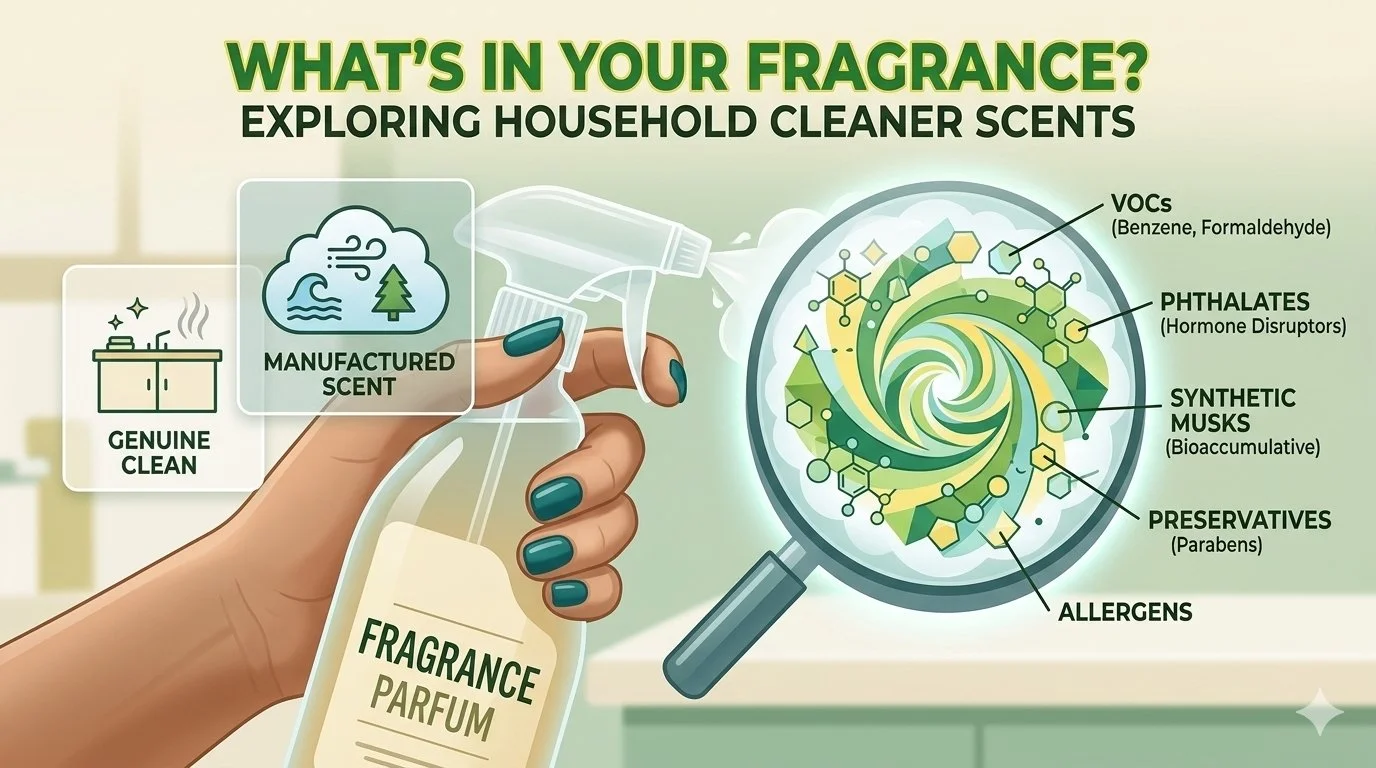
When you see "fragrance" or "parfum" listed on a cleaning product label, you might assume it's a single ingredient. In reality, that one word can represent a mixture of dozens or even hundreds of different chemicals, many of which you'll never know about.
This is where things get particularly concerning for Canadian consumers. While we have regulations through Health Canada regarding product safety, current labelling laws don't require manufacturers to disclose the specific components of their fragrance blends. These formulations are protected as "trade secrets," which means companies can include a wide range of synthetic chemicals without listing them individually on the label.
So what exactly goes into these mystery mixtures? Research has identified thousands of different chemicals used in fragrance formulations, but some of the most common categories include:
Phthalates are frequently used to make scents last longer. These chemicals have been linked to hormone disruption, reproductive issues, and developmental problems in children. Despite growing concerns, they're still widely used in many household products available on Toronto store shelves.
Synthetic musks are another common ingredient, designed to add depth and longevity to fragrances. Studies have found these compounds in human blood, breast milk, and body fat, raising concerns about bioaccumulation and long-term health effects.
Volatile organic compounds (VOCs) are chemicals that easily evaporate into the air. Many fragrance ingredients fall into this category, including substances like benzene, formaldehyde, and toluene—all of which have known health risks. When you spray that scented cleaner, you're releasing these VOCs into your indoor air, where they can linger for hours or even days.
Preservatives like parabens are often added to fragrance mixtures to prevent bacterial growth. However, parabens are endocrine disruptors that can mimic estrogen in the body and have been found in breast cancer tumours, though the connection remains under investigation.
Allergens are abundant in synthetic fragrances. The International Fragrance Association has identified 26 known fragrance allergens, but cleaning products can contain these without specific disclosure on Canadian labels. For Toronto residents dealing with allergies or sensitivities, this lack of transparency makes it nearly impossible to avoid problematic ingredients.
What makes this particularly troubling is that many of these chemicals haven't been thoroughly tested for safety, especially in combination with one another. While individual compounds might be present in small amounts, we're exposed to multiple fragranced products throughout the day—cleaners, laundry detergents, air fresheners, personal care products—and the cumulative effect of this chemical exposure is largely unknown.
The European Union has banned all CMR (Carcinogenic, Mutagenic, Reprotoxic) chemicals in personal care and household products, many of them fragrance ingredients. In Canada, our regulations are significantly less stringent, meaning products on our shelves may contain substances that aren't allowed in other developed countries.
Health risks associated with synthetic fragrances
The health implications of regular exposure to synthetic fragrances in household cleaners are more significant than many homeowners realize. While the cleaning product industry maintains that their formulations are safe, a growing body of research suggests otherwise.
Respiratory issues are among the most commonly reported problems. When you spray a scented cleaner, you're creating an aerosol of chemical compounds that you then inhale. For people with asthma, this can trigger attacks. One study found that individuals with asthma reported cleaning products as one of their top triggers. Even for those without pre-existing conditions, regular exposure to scented cleaners has been associated with the development of adult-onset asthma, particularly among professional cleaners and people who use these products frequently.
The impact on indoor air quality is substantial. Toronto homes, especially during our cold winters when windows stay closed for months, can develop particularly poor air quality when scented cleaners are used regularly. Research has shown that using household cleaning products can release as many volatile organic compounds into the air as driving a car—a startling comparison that highlights just how much these products affect the air we breathe in our homes.
Headaches and migraines are frequently triggered by synthetic fragrances. Many people report that exposure to scented cleaners leads to headaches, dizziness, or nausea. For those with chemical sensitivities or fragrance sensitivities, the effects can be debilitating, making it difficult to be in spaces where these products have been recently used.
Skin irritation and allergic reactions are also common. Contact with scented cleaning products can cause rashes, itching, and dermatitis. Because fragrances can contain dozens of potential allergens, identifying the specific cause of a reaction can be extremely difficult, leaving sufferers struggling to find products that won't irritate their skin.
The hormone disruption caused by many fragrance chemicals is particularly concerning for families with children. Endocrine-disrupting chemicals can interfere with normal hormone function, potentially affecting development, reproduction, and metabolism. While the full extent of these effects is still being studied, the precautionary principle suggests we should be cautious about regular exposure, especially for vulnerable populations like pregnant women and young children.
Neurological symptoms have also been reported. Some fragrance chemicals can cross the blood-brain barrier, and studies have linked exposure to issues with cognitive function, mood changes, and even neurodevelopmental problems in children exposed during critical developmental windows.
For Toronto residents living in multi-unit buildings, there's an additional concern: you may be exposed to your neighbours' cleaning products through shared ventilation systems. This means even if you choose fragrance-free products for your own home, you might still be breathing in chemicals from products used elsewhere in your building.
Perhaps most troubling is the emerging research on long-term health effects. Because many of these chemicals accumulate in the body over time and we're exposed to them chronically throughout our lives, researchers are only beginning to understand the potential long-term consequences. Some studies have suggested links between regular use of scented cleaning products and increased risks of certain cancers, though more research is needed to establish definitive causal relationships.
Environmental impact of fragranced cleaning products
The effects of fragranced household cleaners extend far beyond the walls of your home. These products have significant environmental implications that impact our local waterways, wildlife, and broader ecosystem.
When you pour scented cleaning products down your drain, those chemicals don't simply disappear. They enter the wastewater system and eventually make their way to water treatment facilities. While these facilities are designed to remove many contaminants, they weren't built to handle the complex cocktail of synthetic fragrance chemicals we're now sending through them regularly. Many of these compounds pass through the treatment process largely unchanged.
Once in the aquatic environment, these substances can have serious effects on fish and other wildlife. Studies have shown that synthetic musk compounds — common in fragranced products — accumulate in fish tissue and can affect their reproduction and development. These chemicals have been detected in fish in the Great Lakes, demonstrating that our consumer choices are directly impacting our local ecosystem.
Phthalates and other fragrance ingredients are also problematic for aquatic life. Research has shown these chemicals can act as endocrine disruptors in fish, amphibians, and other aquatic organisms, potentially affecting entire populations. When these chemicals enter the food chain, they can accumulate at higher concentrations as you move up trophic levels, ultimately affecting the birds and mammals (including humans) who consume fish.
The production of synthetic fragrances also has environmental costs. Manufacturing these chemicals requires petroleum-based ingredients and energy-intensive processes. The carbon footprint of producing, packaging, and transporting these products contributes to climate change — an issue that Toronto and all Canadian cities are grappling with as we work toward our emissions reduction targets.
Air pollution is another concern. The volatile organic compounds released when you use scented cleaners don't just affect your indoor air quality, they also contribute to outdoor air pollution. Once these VOCs are released into the atmosphere, they can react with other pollutants to form ground-level ozone and particulate matter, both of which are harmful to human health and the environment. In a city like Toronto, where air quality is already challenged by vehicle emissions and industrial activity, adding to the VOC load through unnecessary fragrance chemicals seems particularly unwise.
The packaging of scented cleaning products adds another environmental burden. Most of these products come in plastic bottles, contributing to the enormous amount of plastic waste our society generates. While Toronto has recycling programs, the reality is that much plastic isn't recycled and ends up in landfills or, worse, in our waterways and natural spaces.
There's also the issue of persistence. Many synthetic fragrance chemicals are designed to last, that's why your cleaning product promises "long-lasting freshness." But this persistence means these chemicals stick around in the environment for extended periods, accumulating in sediments, soils, and living organisms. We're creating a legacy of chemical contamination that will affect our local environment for years to come.
In order to protect our natural spaces, ravines, parks, and waterfront — understanding this connection between our cleaning product choices and environmental health is crucial. Every time we choose a heavily fragranced cleaner, we're contributing to the chemical burden on our local ecosystem.
Making the switch to fragrance-free cleaning
The good news is that you don't need synthetic fragrances to have a genuinely clean home. Making the transition to fragrance-free cleaning is easier than you might think, and many people who've made the switch report feeling better and noticing improvements in their health.
Start by reading labels carefully. In Canada, look for products labeled "fragrance-free" rather than "unscented." These terms aren't identical — unscented products may still contain fragrance chemicals used to mask the smell of other ingredients, whereas fragrance-free means no fragrance chemicals have been added at all. Certified products with eco-labels like EcoLogo or Green Seal have been independently verified to meet specific environmental and health standards.
Simple, effective alternatives are readily available at stores or can be made at home. White vinegar is an excellent all-purpose cleaner that kills many types of bacteria. Mixed with water, it's perfect for cleaning countertops, windows, and floors. Yes, it smells while wet, but that scent dissipates quickly, leaving no residual odour.
Baking soda is another powerhouse cleaner. It's mildly abrasive, making it great for scrubbing, and it naturally neutralizes odours rather than masking them with synthetic scents. You can use it on just about everything — from kitchen sinks to bathtubs.
Castile soap, available at many health food stores and some mainstream retailers, is a versatile plant-based soap that cleans effectively without synthetic additives. It can be diluted for various cleaning tasks around your home.
For those who miss having some scent but want to avoid synthetic fragrances, there are safer options. A few drops of pure essential oils can be added to homemade cleaners — but use them sparingly and choose high-quality, pure oils. Be aware that many essential oils are toxic to pets, can cause sensitivities in some people, and they're not necessary for cleaning effectiveness. If you do use them, less is more.
When shopping for commercial cleaning products, look for brands that prioritize transparency. Some companies now list all their ingredients, including fragrance components, on their labels or websites. These brands recognize that consumers have a right to know what they're bringing into their homes.
The transition period might feel strange at first. You've likely spent years associating an artificial scent with cleanliness, so a home that simply smells neutral may initially feel less clean to you. Give yourself time to adjust. Within a few weeks, most people find that they prefer the absence of synthetic scents and become more sensitive to them when encountering scented products elsewhere.
If you live in a condo or apartment with shared laundry facilities, consider requesting that your building switch to fragrance-free cleaning products in common areas. Many buildings are becoming more aware of chemical sensitivities and are willing to make changes when residents voice their concerns.
What about "natural" and "green" fragrances?
As awareness of synthetic fragrance issues grows, many cleaning product manufacturers have responded by marketing their products as "natural," "plant-based," or "green." While this might sound reassuring, it's important to approach these claims with a critical eye.
The term "natural" is largely unregulated in Canada when it comes to cleaning products. A product can be marketed as natural even if it contains predominantly synthetic ingredients, as long as some component is derived from natural sources. This greenwashing is rampant in the cleaning product industry, and consumers need to be aware that marketing claims don't always reflect reality.
Some products advertise "naturally derived fragrances" or "essential oil blends." While these are indeed different from purely synthetic fragrances, they're not necessarily safer or better for everyone. Natural fragrances can still contain allergens and irritants. Essential oils are highly concentrated plant compounds, and some can cause skin sensitization, respiratory issues, or other adverse reactions. They can also pose a risk to any pets in your home. The fact that something comes from a plant doesn't automatically make it safe for everyone.
Additionally, some "natural" fragrances are produced using processes that are far from environmentally friendly. The essential oil industry has its own set of environmental and ethical concerns, from unsustainable harvesting practices to the enormous amount of plant material required to produce small quantities of oil.
Products labeled "green" or "eco-friendly" may be better in some ways—perhaps they're biodegradable or come in recycled packaging—but they can still contain problematic fragrance ingredients. These environmental claims don't necessarily address health concerns related to fragrance chemicals.
The key is to look beyond marketing buzzwords and examine the actual ingredient list. If a product lists "natural fragrance" or "parfum" without disclosing what that fragrance consists of, you're still dealing with a lack of transparency that makes it impossible to make an informed decision about potential health effects.
For people with chemical sensitivities, fragrance allergies, or respiratory conditions, even "natural" fragrances can be problematic. The safest choice is still fragrance-free products, regardless of whether the fragrance would be natural or synthetic.
This doesn't mean all products marketed as green or natural are deceptive—many genuinely are better choices. But it does mean you need to do your homework, read labels carefully, and perhaps research brands before purchasing. Look for third-party certifications, complete ingredient disclosure, and a company track record of transparency.
Creating a healthier home environment
Beyond switching to fragrance-free cleaners, there are several other steps homeowners and tenants can take to create a healthier indoor environment.
Improve ventilation whenever possible. Even during Toronto's cold winters, opening windows for brief periods can significantly improve indoor air quality. If you live in a newer, tightly sealed home or condo, consider using your exhaust fans regularly, particularly when cleaning.
Consider an air purifier with a HEPA filter and activated carbon, which can help remove airborne particles and some chemical compounds. This can be particularly useful for residents living in high-traffic areas or near major roadways where outdoor air quality might also be a concern.
Reduce the number of scented products in your home overall. It's not just cleaners—air fresheners, scented candles, plug-in fragrances, and even some personal care products all contribute to your total chemical exposure. Creating a low-fragrance home environment can make a noticeable difference in how you feel.
Be mindful of what you're bringing into your space. When possible, choose furniture, mattresses, and other home goods that are made without added fragrances or harmful chemicals. That "new furniture smell" is actually off-gassing of chemicals—not something you want to be breathing in your home.
If you're sensitive to fragrances, don't hesitate to advocate for yourself. This might mean requesting that visitors to your home avoid wearing heavily scented products, or asking your workplace to consider fragrance-free policies. Toronto is becoming increasingly aware of these issues, and many public spaces and workplaces are implementing scent-free policies.
Educate your family members, roommates, or household members about why you're making these changes. When everyone understands the reasoning behind choosing fragrance-free products, they're more likely to support and maintain these healthier practices.
The bottom line: You deserve transparency
At the heart of the fragrance issue is a fundamental question of transparency and consumer rights. You have the right to know what chemicals you're bringing into your home and exposing your family to. The current system, where hundreds of potentially harmful ingredients can be hidden under the single word "fragrance," is simply not acceptable.
As we become more health-conscious and environmentally aware, we're seeing increased demand for product transparency. This consumer pressure is slowly beginning to change the market. Some companies are now voluntarily disclosing their fragrance ingredients, recognizing that transparency builds trust with customers.
But we shouldn't have to rely on voluntary corporate goodwill. Stronger regulations requiring full ingredient disclosure for all household products would give Canadian consumers the information they need to make informed choices about their health and their environment.
Until those regulations exist, voting with your wallet remains one of your most powerful tools. By choosing fragrance-free products and supporting companies that prioritize transparency and safety, you're sending a clear message to the industry that these values matter to consumers.
Remember: a truly clean home doesn't need to smell like anything. That neutral, fresh scent of genuinely clean spaces is far healthier and more honest than any synthetic fragrance trying to convince you otherwise. When you eliminate unnecessary fragrances from your cleaning routine, you're not sacrificing cleanliness — you're actually creating a healthier, safer environment for yourself and your family.
Your home should be your sanctuary, a place where you can breathe easily and feel safe. By understanding the truth about fragrances in household cleaners and making informed choices, you're taking an important step toward creating the healthy home environment you deserve.
As the founder of EcoEthical Cleaning, I've built my practice around everything you just read — and fragrance-free cleaning is only the beginning. Every ethically-sourced product I bring into your home is made from natural ingredients, and chosen with your family's health in mind. If you're ready to reclaim some time without compromising on what goes into your air and onto your surfaces, I'd love to help. Reach out today for a free, no-obligation estimate. Proudly serving Toronto’s Harbourfront District and surrounding neighbourhoods.
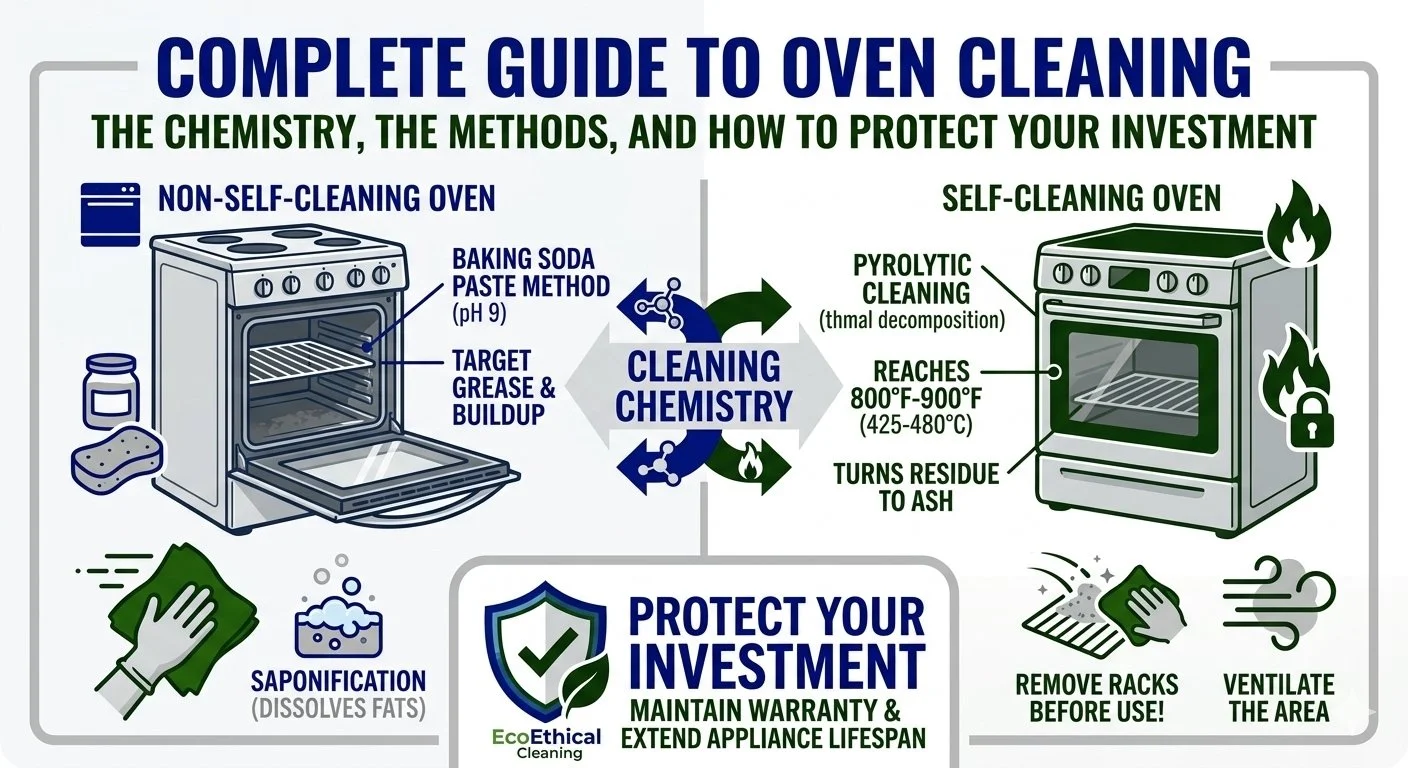
Complete guide to oven cleaning: The chemistry, the methods, and how to protect your investment
Oven cleaning requires understanding chemistry, appliance construction, and warranty protection. Learn the science behind how alkaline cleaners work through saponification, why self-cleaning ovens need different care than standard models, what components you can safely remove, and which cleaning methods protect your investment. This comprehensive guide covers everything Toronto homeowners need to know about maintaining their ovens without voiding warranties or causing damage.
Oven cleaning sits at the intersection of chemistry, appliance care, and household safety. Whether you own a self-cleaning model or a standard oven, understanding how different cleaning methods work — and more importantly, what can damage your appliance — makes the difference between maintaining your investment and voiding your warranty.
This comprehensive guide explains the science behind oven cleaning products, clarifies the critical differences between self-cleaning and non-self-cleaning ovens, and provides detailed guidance on what you can safely clean and what components should never be removed or exposed to certain chemicals.
Understanding oven construction and warranty considerations
Before discussing cleaning methods, it’s important to understand what you're working with, and what's at stake if you damage it.
What's covered by oven warranties
Most oven warranties cover functional components like heating elements, igniters, thermostats, burners, control boards, and oven sensors. However, warranties typically exclude cosmetic items including racks, hinges, shelves, door glass, and interior thermal shells.
More importantly, warranties can become void when:
Commercial oven cleaners are used on self-cleaning oven interiors
Unauthorized repair providers service the appliance
Components are improperly removed or modified
Cleaning products damage heating elements or sensors
The oven hasn't been properly maintained per manufacturer guidelines
Self-cleaning vs. non-self-cleaning ovens: fundamental differences
The construction of your oven determines what cleaning methods are safe to use.
Self-cleaning ovens have:
Special heat-resistant porcelain enamel coating on interior walls
Reinforced door locks that engage during cleaning cycles
Additional insulation to contain extreme heat
Temperature sensors that monitor the cleaning cycle
Non-self-cleaning ovens have:
Standard porcelain enamel or painted interior finish
Basic door seals without high-temperature locks
Standard insulation
Cannot withstand the extreme temperatures of a self-clean cycle
This fundamental construction difference means that self-cleaning ovens require different care than standard ovens, particularly regarding what chemicals you can use.
Newer vs. older ovens: removable components
Oven design has evolved significantly, affecting what you can safely remove for cleaning.
Older ovens (pre-2010):
Heating elements typically bolt to the oven back
Can usually be carefully unbolted and moved forward for cleaning behind them
Oven racks were heavy-duty steel, designed for high heat
Door often removable via simple hinge clips
Simpler electronic controls, easier to avoid during cleaning
Newer ovens (2010-present):
Many have hidden heating elements beneath the oven floor
"Continuous clean" or catalytic liners that shouldn't be scrubbed
Specialized racks with coatings that can't handle self-clean cycle heat
More complex door removal systems
Sensitive electronic control panels and displays
What should NOT be removed without professional help:
Heating elements - bake (lower) or broil (upper) elements
Temperature sensors
Door gaskets or seals
Control panel components
Interior light covers (unless the manual specifically states they are removable)
Catalytic liner panels
Removing components you shouldn't can void warranties and create safety hazards. When in doubt, consult your oven's manual or contact the manufacturer.
The chemistry of oven cleaning: how products actually work
Understanding the science behind oven cleaning helps you choose appropriate methods and avoid damaging your appliance.
The problem: baked-on grease and carbonized food
When you cook, especially at high temperatures, fats and oils polymerize — they transform from liquid oils into hard, solid substances bonded to oven surfaces. This process intensifies each time you use the oven, creating layers of increasingly difficult buildup.
Additionally, sugars caramelize and proteins denature, creating carbonized deposits that resist simple soap and water.
How alkaline cleaners work: saponification
Most commercial oven cleaners contain sodium hydroxide (NaOH), also known as caustic soda or lye. The primary cleaning action is saponification — converting fats and oils into soap.
When sodium hydroxide contacts grease, it causes a chemical reaction that transforms the baked-on fats into water-soluble soap-like substances. The reaction works because sodium hydroxide is highly alkaline (pH 14), and this extreme alkalinity breaks apart the molecular bonds in fats.
The process involves:
Hydroxide ions (OH⁻) break down the ester bonds in fats
This produces fatty acid salts and glycerol
The resulting soap is water-soluble and easily wiped away
The same reaction works on proteins and carbonized material, though less effectively than on fats.
Why this matters: Understanding saponification explains why alkaline cleaners work so effectively, but also why they're dangerous. The same chemical property that dissolves baked-on grease can also damage human skin and certain oven components.
Why oven cleaners require specific pH levels
Commercial oven cleaners maintain pH levels between 11 and 14:
pH 11-12: Effective for light to moderate buildup
pH 13-14: Required for severe, carbonized buildup
The higher the pH, the more aggressive the cleaner — but also the more dangerous to humans and potentially damaging to certain oven finishes.
The role of solvents in oven cleaners
Beyond alkaline ingredients, commercial oven cleaners contain organic solvents like:
Ethylene glycol: Helps dissolve polar molecules
Methylene chloride: Dilutes greasy grime
Monoethanolamine: Acts as a surfactant, helping the solution spread evenly
These solvents attack different components of oven soil than alkaline cleaners do, providing comprehensive cleaning action.
How high-heat pyrolytic cleaning works
Self-cleaning ovens use pyrolysis (thermal decomposition) to clean. When oven temperatures reach 800-900°F (425-480°C), organic materials (food, grease, carbon deposits) burn off and reduce to ash.
The chemistry:
Organic compounds break down at high temperature
Carbon bonds rupture, releasing carbon dioxide and water vapour
What remains is fine white or grey ash (primarily calcium carbonate and metal oxides)
This ash is easily wiped away with a damp cloth
Why this method works: Pyrolysis achieves what chemical cleaners cannot — complete breakdown of carbonized material. However, it requires specialized oven construction to safely contain these extreme temperatures.
How steam cleaning works
Steam-clean cycles use water and moderate heat (around 250-400°F / 120-200°C) to soften baked-on food.
The process:
Water placed in the oven bottom vaporizes
Steam condenses on cooler oven surfaces
Moisture penetrates and softens dried food particles
Softened debris can be wiped away
Limitation: Steam cleaning is effective only for light, recent soiling — not for carbonized, long-term buildup.
Self-cleaning ovens: proper use and protection
Self-cleaning ovens require specific care to maintain their specialized coating and ensure safe operation.
How the self-clean cycle works
The self-clean cycle heats the oven to approximately 800°F to 900°F (425-480°C) for 1.5 to 3 hours, depending on the soil level. At these temperatures, food residue incinerates into ash. The oven door automatically locks when internal temperature reaches 600°F (315°C) to prevent oxygen from entering the cavity and causing fire. The door remains locked until the oven cools to a safe temperature.
What NEVER to use in self-cleaning ovens
Commercial oven cleaners (containing sodium hydroxide): Never use commercial oven cleaners inside a self-cleaning oven's interior. Residue from oven cleaners will damage the inside of the oven during a self-cleaning operation. The extreme heat of the self-clean cycle causes oven cleaner residue to emit dangerous fumes and permanently damage the special porcelain enamel coating.
Even cleaners marketed as "safe for self-cleaning ovens" should be used with caution and rinsed completely before running a self-clean cycle.
Why this damages the oven: The porcelain enamel in self-cleaning ovens is formulated specifically for high-heat cleaning. Chemical residues alter this coating's properties, causing:
Discolouration and staining
Coating breakdown and flaking
Reduced effectiveness of future self-clean cycles
Release of toxic fumes during cleaning
Abrasive scrubbers: Metal scrapers, steel wool, and wire brushes damage the interior walls and make the self-cleaning process less effective. The porcelain enamel coating, once scratched, loses its smooth, non-stick properties and allows food to adhere more easily.
Remove the oven racks
Removing oven racks before self-clean cycles is crucial but often overlooked.
The intense heat of self-cleaning cycles can warp, discolour, and permanently damage oven racks. More critically, racks can expand and contract during the cycle, potentially damaging or completely ruining the porcelain oven cavities that the racks slide into — the grooves on the oven's side walls.
Exception: Some newer ovens have racks specifically designed to remain in place during self-clean cycles. Check your manual — if the racks aren't explicitly labelled "self-clean safe," remove them.
How to clean racks separately:
Remove racks before starting self-clean cycle
Soak them in hot water with dish soap, or place them in an air-tight bag and spray with a food-safe degreaser, and let sit for 4-6 hours
Scrub with non-abrasive brush or sponge
For stubborn buildup: create paste of baking soda and water, apply, let sit overnight, then scrub
Proper preparation for self-clean cycles
Before starting a self-clean cycle:
Remove everything:
All oven racks (unless the oven manual specifies they're self-clean safe)
Oven thermometer
Any cookware, foil, or liners
Food debris large enough to catch fire
Wipe up heavy spills: The self-clean cycle works best on baked-on residue, not large spills or chunks of food. Clean up everything you can manually, and let the self-clean cycle handle the rest.
Ensure ventilation:
Turn on range hood and set to highest setting
Open windows in kitchen and adjacent rooms
Consider using an air purifier during the cycle
Keep children and pets away from the kitchen
Never leave completely unattended: Check periodically for excessive smoke or unusual smells that might indicate a problem.
After the self-clean cycle
Once the cycle completes and the oven has cooled (the door will unlock automatically):
Wipe away white or grey ash with a damp cloth
Clean the door and areas around the gasket with mild detergent
The gasket itself should only be wiped gently, never scrubbed
Inspect for any damage to interior surfaces
How often to use self-clean cycles
Self-cleaning cycles should be used 2-3 times per year maximum. Overuse of the self-cleaning function may wear out heating elements or damage thermal fuses — the safety devices that prevent overheating.
Between self-clean cycles, spot-clean with baking soda paste or mild detergent to reduce buildup.
Steam-clean cycles: A gentler alternative
Many newer ovens offer steam-clean cycles as a less intensive option.
When to use steam clean:
Light, recent spills
Routine maintenance between deep cleans
When self-clean cycle isn't warranted
The process:
Add 1 cup of water to the oven bottom (or follow manual's specific instructions)
Start steam-clean cycle (usually 20-60 minutes)
After cycle completes, wipe interior with damp cloth
For stubborn spots, rub detergent into residue before starting cycle
Benefits:
Faster than self-clean (under 1 hour vs. 3+ hours)
Uses less energy
Lower temperatures mean less smoke and fumes
Safer for more frequent use
Limitations:
Only effective for light soiling
Won't handle carbonized, baked-on buildup
May require multiple cycles for moderate messes
Non-self-cleaning ovens: safe manual cleaning methods
Non-self-cleaning ovens require different approaches — and fortunately, you have more flexibility in product choices.
The safest, most eco-friendly method: baking soda paste
Baking soda (sodium bicarbonate) is mildly alkaline and works through a gentler version of the same chemical process as commercial cleaners — it breaks down fats and food residues without harsh corrosiveness.
The formula:
Mix ½ cup baking soda with 3 tablespoons water
Adjust ratio to create spreadable paste (consistency of toothpaste)
Application process:
Remove oven racks and set aside
Spread paste over entire interior, avoiding heating elements
Pay special attention to particularly greasy areas
Let sit overnight (12+ hours) to allow chemical reaction to complete
Use damp cloth to wipe away dried paste
Repeat if necessary for stubborn spots
Why this works: Baking soda's alkalinity (pH around 9) is sufficient to begin saponification of fats without the dangerous corrosiveness of sodium hydroxide cleaners. The longer dwell time compensates for its lower chemical strength.
When commercial cleaners are appropriate
For non-self-cleaning ovens with severe buildup, commercial cleaners may be necessary. However, choose carefully and use safely.
If using commercial oven cleaner:
Read and follow manufacturer’s instructions
Choose products with lower caustic soda content when possible (to minimize risks to personal safety, the oven, and the environment)
Always wear rubber gloves and safety goggles
Ensure excellent ventilation (open windows, use fans)
Keep children and pets away from the area
Follow product dwell time precisely — don't leave on longer than directed
Rinse thoroughly with clean water
Consider wearing a carbon filter mask if sensitive to fumes
Application for commercial cleaners:
Protect surrounding areas with newspaper or drop cloth
Remove everything from oven
Apply cleaner evenly, avoiding heating elements and sensors
Close oven door and let sit for time specified on label
Wipe away cleaner with damp sponges or cloths
Rinse multiple times with clean water
Turn oven on low (around 200°F / 95°C) for 10-15 minutes to burn off any remaining residue
Air out kitchen thoroughly
What to avoid on standard ovens
Even though non-self-cleaning ovens are more tolerant of various cleaners, some things still cause damage:
Never use:
Steel wool or metal scrapers (scratch the finish)
Harsh abrasive powders (damage enamel coating)
Bleach (doesn't break down grease effectively and is too harsh)
Ammonia (fumes are dangerous, less effective than alkaline cleaners)
Cleaning oven doors and glass
Oven door glass requires special attention because grease and condensation accumulate on both interior and exterior surfaces.
For exterior glass:
Glass cleaner or vinegar-water solution (1:1 ratio)
Wipe with clean, soft cloth
Buff dry for streak-free finish
For interior glass:
Create baking soda paste
Apply to glass, avoiding rubber gasket
Let sit 15-30 minutes
Scrub gently with non-abrasive sponge
Wipe clean with damp cloth
For between-the-glass cleaning: consult manual for disassembly instructions
Never scrub the door gasket (the rubber seal around the door). Clean it only by wiping gently with a damp cloth. Aggressive cleaning damages the seal, affecting oven efficiency and safety.
What you can and cannot remove for cleaning
Knowing what's safe to remove prevents warranty voidance and safety hazards.
Safe to remove (with care):
Oven racks: All models allow rack removal. To remove:
Wait for oven to cool completely
Pull rack forward until it stops
Lift front of rack slightly while pulling
Guide rack out of oven
Oven door (many models): Many oven doors can be removed for easier cleaning, but the process varies significantly by brand and model.
Common removal process:
Open door to first stop position (about 45 degrees)
Locate hinge locks or clips on both sides
Move locks to unlocked position
Close door slightly
Lift door up and out
Critical: Always consult your specific oven's manual before attempting door removal. Improper removal can damage hinges or cause the door to fall.
Never remove or disturb:
Heating elements: Both bake elements (bottom) and broil elements (top) are wired directly to the oven's electrical system. Clean around elements, not by removing them.
Temperature sensor: Usually a thin metal probe extending into the oven cavity. This controls oven temperature accuracy. Bending, removing, or cleaning it aggressively can make your oven temperature unreliable.
Door gasket: The rubber or silicone seal around the door should never be removed. Clean only by gentle wiping.
Catalytic liners: Some ovens have special self-cleaning panels on the side walls. These should never be removed or scrubbed—they're designed to clean themselves during oven operation.
Light cover: While some models allow light cover removal, many don't. Check your manual. Forcing removal can crack the cover or damage the mounting system.
Cleaning heating elements safely
You cannot remove heating elements for cleaning, but you can clean around them:
Wait for oven to cool completely
Wipe elements gently with damp cloth
Don't scrub or use chemicals directly on elements
Clean the area beneath and around elements carefully
If food has baked onto elements, run oven at 350°F (175°C) for 30 minutes—this will burn off most residue
Why elements burn clean: Heating elements reach temperatures high enough to carbonize food debris during normal operation. Most buildup burns off on its own.
Maintenance practices that protect your oven
Proper maintenance extends oven lifespan and maintains warranty coverage.
After each use:
Wipe up spills immediately: Fresh spills clean easily. Once they’ve been baked on, they become increasingly difficult to remove with each use of the oven.
Use the oven light to monitor cooking: Opening the door during cooking causes temperature fluctuation and potential spillovers. Use the oven light and window instead.
Place baking sheets under potentially messy dishes: Casseroles, pies, and dishes with liquid ingredients should sit on baking sheets to catch any overflow.
Weekly:
Wipe down interior with damp cloth and mild detergent
Clean door glass inside and out
Wipe control panel with damp cloth (never spray cleaner directly on controls)
Check that vents aren't blocked by grease or debris
Monthly:
Deep-clean oven racks
Check door seal for damage or gaps
Clean beneath and around oven (pull-out drawer or storage area)
Test that oven reaches correct temperature with oven thermometer
Quarterly:
Run self-clean cycle (if applicable)
Or perform thorough manual cleaning with baking soda
Inspect heating elements for damage
Check that oven light works
What voids warranties:
Understanding warranty restrictions helps you avoid costly mistakes:
Actions that void most oven warranties:
Using commercial oven cleaners in self-cleaning oven interiors
Lining oven bottom with aluminum foil (interferes with heat distribution and can damage heating elements)
Making unauthorized modifications or repairs
Failing to follow manufacturer's maintenance guidelines
Using the oven for purposes other than cooking (like storage or space heating)
Physical damage from impacts or dropping items
Always register your oven warranty and keep proof of purchase. If you need repairs, use only authorized service providers to maintain warranty validity.
Special considerations
Hard water and mineral buildup
Water hardness affects steam-clean cycles. Minerals in the water can leave deposits on oven surfaces after steam cleaning.
Prevention:
Use distilled water instead of tap water for steam-clean cycles
Wipe down oven thoroughly after steam-clean cycles
If mineral deposits appear (white, chalky residue), remove with vinegar-water solution
Winter considerations
Cold winters mean:
More oven use for holiday cooking
Kitchen ventilation challenges (can't always open windows)
Temperature fluctuations affecting oven performance
Winter oven care:
Plan self-clean cycles for mild days when you can ventilate properly
Consider breaking large self-clean jobs into smaller, more manageable sessions
Use range hood faithfully to capture moisture and prevent condensation
Small kitchen ventilation
Many condos and older homes have limited kitchen ventilation. This complicates oven cleaning, particularly self-clean cycles.
Solutions:
Run bathroom fan in addition to range hood during self-clean cycles
Use air purifiers with activated carbon filters
Schedule self-clean cycles when you can be away for a few hours but return to ventilate
Consider steam-clean cycles more frequently as alternative to less-frequent self-clean cycles
When to call professionals
Some oven cleaning situations require expert help.
Situations requiring professional oven cleaning:
Extreme buildup from years of neglect
Post-renovation cleaning (construction dust and debris)
Self-clean cycle has failed to clean adequately
Strong, persistent odours that won't clear
You have physical limitations preventing safe manual cleaning
You don't have time for the potentially hours long process manual cleaning requires
Situations requiring appliance repair:
Self-clean cycle won't start or complete
Door won't unlock after self-clean cycle
Heating elements visibly damaged or not glowing red
Error codes appearing on display
Oven not reaching correct temperature
The following situations require immediate professional attention:
Gas smell
Electrical issues or sparking
Choosing a professional oven cleaning service
Look for services that:
Use eco-friendly, non-toxic cleaning methods
Are fully insured
Understand the difference between self-cleaning and standard ovens
Remove oven racks and clean them separately
Protect your floors and surrounding areas
Offer satisfaction guarantees
Creating a sustainable oven cleaning routine
Effective oven maintenance doesn't require harsh chemicals or expensive products.
A sustainable approach:
Tier 1: Prevention (after each use)
Wipe up fresh spills immediately with a damp cloth
Use baking sheets to catch overflow
Keep oven interior as clean as possible through mindful cooking
Tier 2: Light maintenance (every 2-4 weeks)
Quick wipe-down with baking soda paste for any visible blemishes
Clean the door glass inside and out
10-minutes of routine maintenance will keep your oven reasonably clean
Tier 3: Deep cleaning (whenever heavier, baked-on deposits appear)
Run the self-clean cycle (for self-cleaning ovens)
Or do an overnight baking soda paste treatment (for standard ovens)
Deep-clean oven racks separately
Thorough door glass cleaning
Tier 4: Professional help (as needed)
For moves, major buildup, or thorough restoration
Particularly valuable before holidays when oven use increases and free time is limited
This tiered approach prevents buildup, reduces the need for harsh chemicals, and extends oven lifespan.
Common oven cleaning mistakes to avoid
Learning from others' mistakes saves you time, money, and potential oven damage.
Using self-clean cycle with racks inside
This is the most common error. The extreme heat warps metal racks and damages the porcelain coating on rack guides. Damage is permanent and reduces rack lifespan significantly.
Not allowing proper cool-down time
After self-clean cycles, ovens remain extremely hot—sometimes for hours. Forcing the door open risks:
Burns from escaping heat
Damage to door lock mechanism
Injury from sudden release of super-heated air
Wait until the oven automatically unlocks.
Mixing cleaning chemicals
Never mix different cleaning products, especially:
Ammonia + bleach = toxic chloramine gas
Vinegar + bleach = toxic chlorine gas
Commercial oven cleaner + anything else = unpredictable, dangerous reactions
Use one product at a time, rinse thoroughly between products if switching.
Spraying cleaners directly on controls
Liquid seeping into electronic controls can cause these components to fail. Always spray cleaner onto a cloth, then wipe the controls.
Forgetting to rinse thoroughly
Chemical residue left in ovens causes:
Fumes during cooking
Strange tastes in food
Potential health concerns
Damage to oven components from repeated heating of chemical residue
Always rinse multiple times with clean water, then run oven briefly to burn off any remaining traces.
Using commercial cleaners in self-cleaning ovens
This causes permanent damage to the special coating and creates dangerous fumes during the next self-clean cycle.
Lining oven bottom with foil
Many people line oven bottoms with foil to catch spills. This:
Blocks air circulation
Causes uneven heating
Can damage heating elements
Voids most warranties
Use baking sheets on the rack below your food instead.
Conclusions:
Effective oven cleaning requires understanding three key things:
The chemistry of how cleaners work
Your specific oven type and its limitations
What methods protect rather than damage your appliance
For self-cleaning ovens:
Never use commercial oven cleaners inside the cavity
Remove racks before self-clean cycles
Use the feature 2-3 times annually at most
Spot-clean between cycles with baking soda paste and a good rinse afterwards
For standard ovens:
Baking soda paste is safest and most eco-friendly
Commercial cleaners work for severe buildup but require careful use
Clean regularly to prevent extreme buildup
Consider professional help for move-in/move-out situations
For all ovens:
Consult your manual before removing any components
Never remove heating elements or temperature sensors
Maintain regular cleaning to prevent warranty-voiding neglect
Use appropriate products for your oven type
The goal isn't a sterile oven — it's an appliance that functions efficiently, cooks food without imparting strange tastes or odours, and lasts its expected 15-20 year lifespan. Chemical-free methods like baking soda achieve this without harsh fumes, environmental impact, or risk to your oven's specialized coatings.
As the founder of EcoEthical Cleaning, I understand that oven cleaning is one of those tasks many Toronto homeowners prefer to delegate. I use eco-friendly methods appropriate for your specific oven type, protect removable components, and never use chemicals that might void warranties or damage specialized coatings.
Whether you tackle oven cleaning yourself or hire professionals, understanding the science and safety considerations ensures you make informed decisions that protect your investment and your household.
Need professional oven cleaning in Toronto that respects your appliance and your health? EcoEthical Cleaning provides thorough, eco-friendly oven cleaning services throughout the Harbourfront District and surrounding neighbourhoods. Contact me for a free, no obligation estimate.