The real price of a cheap clean: What low-cost cleaning services really cost
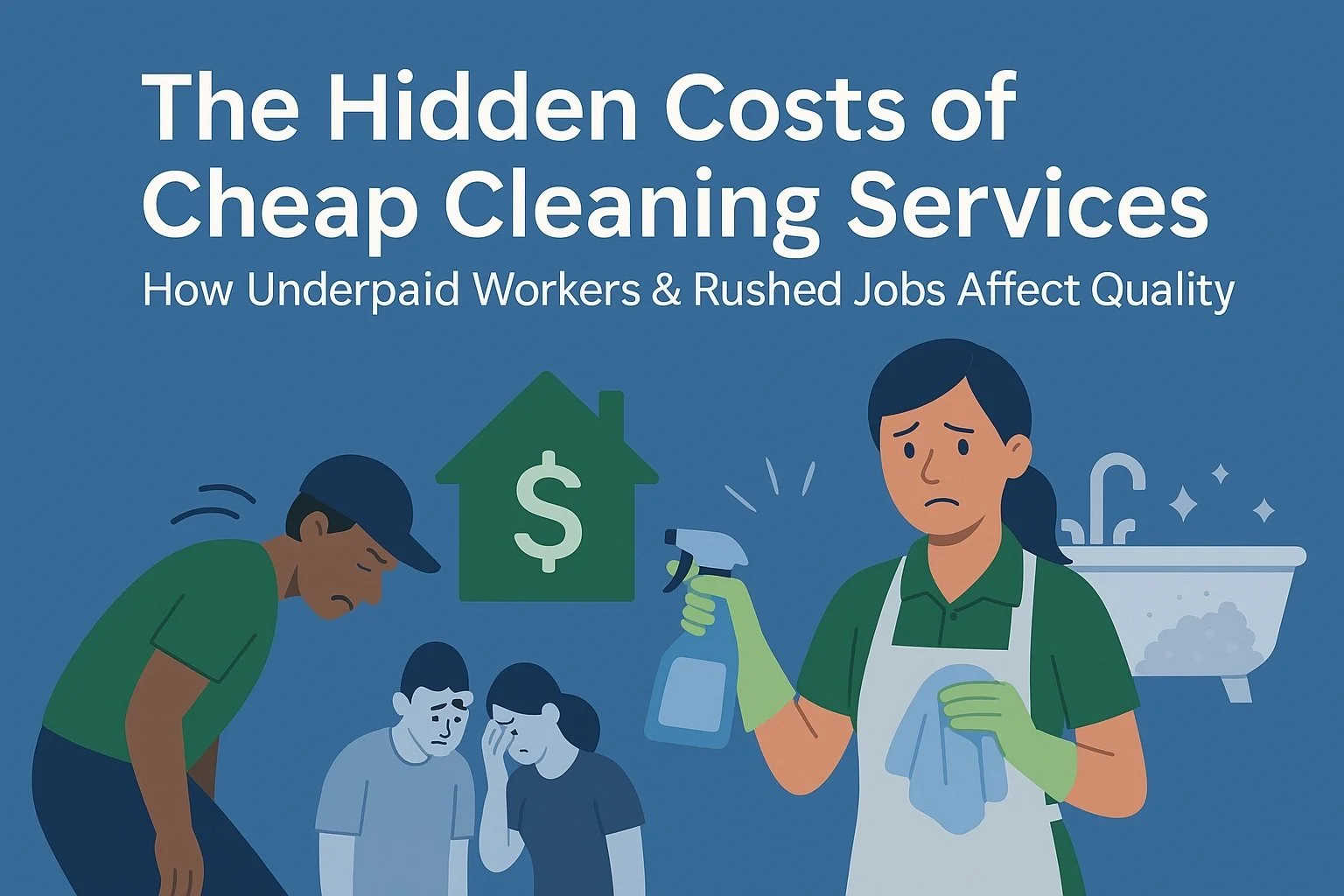
You're comparing cleaning quotes and one is 40% cheaper than the rest. Sounds like a great deal, right? But here's what that low price usually means: workers paid below minimum wage, impossible schedules that force corner-cutting, cash payments to evade taxes, no insurance if something goes wrong, and rushed jobs that leave your home barely cleaner than before. That "bargain" often costs more in the long run through damaged surfaces, poor results, and supporting practices that hurt workers and burden taxpayers. Understanding what's behind rock-bottom pricing helps you choose services based on value, not just price.
You're comparing quotes from three cleaning companies. One is significantly cheaper than the others. It seems like an obvious choice. Why would you pay more for the same service?
But… is it the same service? How is that company able to charge so much less?
The answer usually isn't efficiency, innovation, or better business practices. More often, it's because they're cutting corners in ways that hurt workers, compromise quality, burden taxpayers, and ultimately cost you more in the long run. That "bargain" cleaning service might be underpaying staff, rushing through jobs, operating in the cash economy to avoid taxes, or all of the above.
This isn't about guilt-tripping anyone for being budget-conscious. It's about understanding what you're actually getting — and what you're inadvertently supporting — when you choose the lowest price. Because in the cleaning industry, the cheapest option rarely delivers the value it promises, and the hidden costs affect everyone from the workers to your community to you as the client.
Let's look at how rock-bottom pricing actually works and why it matters more than you might think.
The illusion of a bargain: What you think you're getting vs. what you actually get
When you see a cleaning quote that's significantly lower than competitors, it's natural to feel like you've found a great deal. The service description might look identical — "deep cleaning," "eco-friendly products," "experienced staff" — so why not save the money?
However, cleaning isn't like buying a standardized product where you can easily comparison shop. A $2 bottle of vinegar at one store is the same as a $2 bottle at another. But two cleaning services charging $80 and $120 for a "standard home clean" are providing fundamentally different services, even if the marketing sounds similar.
What the low price actually means
When a cleaning company offers rates significantly below market average, that discount has to come from somewhere. Companies can't defy basic economics. If their prices are much lower than competitors, they're reducing costs in one or more of these ways:
Underpaying workers: Paying below-market wages, misclassifying employees as contractors to avoid paying benefits, or operating partially or entirely in the shadow economy to avoid payroll taxes and employment standards.
Rushing through jobs: Scheduling so many clients per day that workers must work at an unsustainable pace, cutting corners and reducing quality.
Skipping proper training: Not investing in teaching employees proper techniques, safety protocols, or surface-specific care methods.
Using substandard or diluted products: Buying the cheapest cleaning products available or diluting them beyond manufacturer guidelines to reduce costs.
Avoiding insurance and proper business infrastructure: Operating without proper liability insurance, workers' compensation, or business licensing to minimize overhead.
Not paying taxes: Operating primarily or entirely in cash to avoid GST/HST, income tax, and payroll deductions — which shifts their tax burden onto everyone else.
None of these cost-cutting measures benefit you as the client. In fact, they create risks and problems that often cost more to fix than you saved on the original service.
The true cost of "savings"
Let's say you hire a cleaning service for $80 instead of $120, saving $40. Sounds good, right? But consider what often happens:
Scenario 1: The cleaner rushes through in 90 minutes instead of the 3 hours needed to do the job properly. You notice missed spots, poor attention to detail, and surfaces that don't feel truly clean. You spend your own time re-cleaning or call another service to fix it. Your time has value. If you value it at even $25/hour, spending 90 minutes re-cleaning costs you $37.50, nearly erasing your savings.
Scenario 2: The cleaner uses harsh chemicals on your natural stone countertops because they weren't trained on surface compatibility. Six months later, you discover etching and dullness that requires professional restoration costing $400-800. Your $40 savings just cost you hundreds of dollars. Worse still, you may never connect the damage to the cleaning and suffer the same fate again with future cleans.
Scenario 3: The cleaner, rushing and improperly trained, accidentally damages a piece of furniture or causes water damage. The company has no insurance. You're stuck covering the repair costs yourself or taking them to small claims court (good luck collecting from a cash-based business with no assets).
Scenario 4: The cleaner is injured on your property. If they're misclassified as a contractor instead of an employee, and the company has no workers' compensation coverage, you could potentially be held liable. Legal exposure aside, there's the ethical dimension of someone being hurt on your property with no safety net.
These aren't hypothetical worst-case scenarios — they're common outcomes of choosing services based solely on lowest price.
How low-price cleaning companies actually operate
Understanding the business model behind rock-bottom pricing reveals why these services rarely deliver good value. Let's break down the tactics commonly used.
Tactic 1: Underpayment and worker exploitation
The single largest expense for any cleaning company is labour. It typically accounts for 50-70% of operating costs. When you see a company with prices dramatically lower than competitors, they're almost certainly paying workers less — often significantly less.
Below-market wages: While the average wage for professional cleaners in Toronto ranges from $18-25 per hour for employees (plus benefits and employer taxes), some low-cost companies pay workers $12-15 per hour in cash, or structure payment per job at rates that work out to be below minimum wage when you factor in actual hours worked.
Misclassification as contractors: Many low-cost companies classify workers as independent contractors rather than employees. This allows them to avoid:
Employment Insurance (EI) premiums
Canada Pension Plan (CPP) contributions
Vacation pay and statutory holiday pay
Workers' compensation coverage
Health and safety obligations under the Occupational Health and Safety Act
The workers bear all these costs themselves—except many don't realize they should be setting aside money for CPP and EI, leaving them vulnerable when they retire or face job loss.
Cash payments: Paying workers in cash under the table is illegal tax evasion, but it's rampant in the cleaning industry. This means:
Workers aren't receiving Records of Employment for EI claims
No paper trail for CPP contributions toward their retirement
Workers can't prove income for mortgages, credit applications, or rental applications
The company avoids remitting income tax, employer EI/CPP, and GST/HST
Economic insecurity: Workers in these arrangements have no job security, no benefits, no sick days, and no predictable income. When they're injured, ill, or facing slow seasons, they have no safety net. This precarious employment creates a workforce that's stressed, financially vulnerable, and unable to speak up about poor working conditions for fear of losing income.
According to the Canadian Labour Congress, precarious work disproportionately affects women, immigrants, and racialized workers — demographics that make up a significant portion of the cleaning industry. Choosing low-cost services often means inadvertently supporting a system that perpetuates economic inequality.
Tactic 2: Maximizing volume at the expense of quality
Low-price cleaning companies operate on thin margins. To make their business model work, they need volume. This means scheduling as many jobs per day as possible, which translates to workers being given impossible timelines.
Unrealistic scheduling: A quality residential cleaning typically takes 2.5-4 hours depending on size and condition. Low-cost companies might schedule workers for 5-7 homes per day, meaning each clean gets 1-1.5 hours maximum, including travel time.
Physical toll: The Canadian Centre for Occupational Health and Safety (CCOHS) has documented that cleaning is physically demanding work involving repetitive motions, heavy lifting, awkward positions, and chemical exposure. When workers are forced to work at frantic speeds day after day, the risk of musculoskeletal injuries skyrockets. Rushed workers experience higher rates of back injuries, shoulder problems, knee issues, and repetitive strain injuries.
Mental health impact: The stress of impossible quotas, combined with economic insecurity and lack of control over working conditions, creates significant mental health challenges. Workers experience anxiety about meeting unrealistic expectations, guilt about not doing thorough work (many genuinely care about doing a good job), and burnout from unsustainable pace.
Quality suffers inevitably: When a worker has 75 minutes to clean a 1,200 square foot home, something has to give. Corner-cutting becomes necessary just to finish:
Dusting becomes a quick pass rather than thorough coverage
Floors get a cursory mop rather than proper cleaning
Bathrooms get quick surface wipes, without addressing buildup
Detail work is skipped entirely
Deep cleaning tasks are never completed
Clients get a surface-level clean that looks okay initially but doesn't address the actual dirt, grime, and pathogens that make spaces unhealthy.
Tactic 3: The cash (shadow) economy and tax evasion
This is the elephant in the room that rarely gets discussed openly, but it's a huge factor in how some cleaning services can undercut competitors so dramatically.
How cash-based operations work: A cleaning company operating in the cash economy doesn't report all (or any) of their revenue. They:
Don't charge GST/HST
Don't remit income tax on unreported revenue
Don't remit employee source deductions (income tax, CPP, EI)
Don't pay their corporate income taxes on hidden revenue
Often don't pay proper workers' compensation premiums
The math of tax evasion: Let's say a company charges $100 for a cleaning (cash, no receipt). A legitimate company charging the same would need to:
Collect $113 ($100 + 13% HST)
Remit the $13 HST to the Canada Revenue Agency (CRA)
Pay income tax on business profit
Pay employer portion of CPP and EI on employee wages
Pay Workplace Safety and Insurance Board (WSIB) premiums
By operating in cash and avoiding these obligations, an underground company saves approximately 25-35% on their tax burden alone. This is how they can charge $80 while legitimate companies charge $120.
They're not more efficient, they're just not paying what they legally owe.
Who actually pays for this? You do. We all do. When businesses evade taxes, governments collect less revenue for essential services — healthcare, education, infrastructure, social programs. That shortfall gets made up through:
Higher tax rates for compliant businesses and individuals
Reduced public services
Increased public debt
According to Statistics Canada, the underground economy in Canada is estimated at $45.6 billion annually, with service industries like cleaning being significant contributors. When you pay cash to save money, you're shifting your service provider's tax burden onto yourself and your neighbours.
The ethical dimension: Beyond the practical financial impact, there's a moral question: is it ethical to knowingly participate in tax evasion to save money? When a cleaner offers you a "discount for cash," you're not just getting a deal — you're becoming complicit in fraud that harms public services and shifts costs onto compliant taxpayers.
Tactic 4: Skipping insurance and proper business infrastructure
Legitimate cleaning companies carry several types of insurance and operate with proper business structures:
General liability insurance: Covers property damage or injuries that occur during cleaning (accidentally breaking a vase, scratching floors, etc.). Costs approximately $500-2,000 annually depending on coverage.
Workers' compensation (WSIB in Ontario): Mandatory insurance that covers workers if they're injured on the job. Costs approximately 2.5-4% of payroll for cleaning services.
Commercial auto insurance: If using vehicles for business, proper commercial coverage is required and costs more than personal auto insurance.
Bonding: Some professional cleaners carry bonding insurance that protects clients against theft by employees.
These protections aren't optional extras — they're fundamental to responsible business operation. But they cost money, which is why many low-cost operators skip them entirely.
What this means for you: If something goes wrong — damage occurs, someone is injured, property is stolen — you have no recourse. The company has no insurance to cover damages, and often has no assets to collect against in a lawsuit. You're left holding the bag.
The business licensing gap: Legitimate cleaning businesses register properly, obtain necessary business licenses, and comply with municipal bylaws. Underground operators skip these steps, avoiding fees and regulatory oversight. This means:
No accountability to regulatory bodies
No record if you need to file a complaint
No way to verify credentials or track record
Likely no actual business — just someone working informally
The costs that come back to haunt you
The true cost of choosing a cleaning service based solely on price often doesn't appear immediately. The consequences unfold over time in ways that can be expensive, frustrating, and even dangerous.
Poor quality and re-cleaning costs
When cleaning is rushed or performed by inadequately trained staff, the results are predictably subpar:
Surface-level only: Visible dirt might be removed, but deeper grime, allergens, and pathogens remain. Your space looks cleaner but isn't actually hygienically clean.
Inconsistent results: Different workers each time (due to high turnover) means no consistency. One week it's decent; the next week it's terrible.
Missed areas: Rushing means many areas get overlooked — behind appliances, baseboards, window tracks, light fixtures, vents. These areas accumulate grime that eventually becomes much harder to clean.
You end up cleaning anyway: When the service doesn't meet basic standards, you spend your own time touching up, which defeats the entire purpose of hiring help.
Eventually need a real deep clean: After months of surface-level cleaning, your space needs a proper deep clean to address accumulated buildup. This often costs 2-3x a regular cleaning, erasing any savings from the low-cost service.
Surface damage from improper methods
Inadequately trained cleaners often use wrong products or techniques that damage surfaces:
Natural stone etching: Using acidic cleaners (vinegar, lemon juice, harsh bathroom cleaners) on marble, granite, or limestone causes permanent etching. Repair requires professional restoration costing hundreds to thousands of dollars.
Wood floor damage: Excessive water, the wrong cleaning products, or abrasive tools can damage hardwood finishes. Refinishing floors costs $3-8 per square foot.
Countertop scratches: Using abrasive tools inappropriately (like Magic Erasers on glossy surfaces, or scouring pads on laminate) creates scratches and dullness.
Grout deterioration: Using bleach or acidic cleaners repeatedly breaks down grout structure, leading to crumbling that requires regrouting.
Finish removal: Abrasive cleaning on painted walls, especially glossy or semi-gloss finishes, removes the sheen permanently.
Appliance damage: Using wrong cleaners on stainless steel, glass cooktops, or special finishes can cause permanent damage.
Professional restoration companies see these types of damage constantly from improper cleaning methods. The repair costs can easily reach thousands of dollars.
Liability and legal exposure
When things go wrong with uninsured, improperly structured cleaning services, you can face serious problems:
Property damage with no recourse: If a cleaner damages something valuable and the company has no insurance, you might sue — but you can't collect from someone with no assets. You're left covering the loss yourself.
Workplace injury complications: If a worker is injured at your property and they're not properly covered by WSIB (because they're misclassified or the company isn't compliant), there's potential for you to be drawn into liability claims. While homeowner's insurance might provide some protection, it's not designed for regular business activity on your property.
Theft with no bonding: If items go missing and the worker isn't bonded, you have little recourse.
CRA implications: If you're paying cash for services and claiming them for tax credits (like the home accessibility tax credit or if you have a home office), you need proper receipts from a legitimate business. Cash payments without proper documentation can create problems if audited.
Health and safety concerns
Rushed, poorly trained cleaning with inadequate products creates health risks:
Ineffective disinfection: During flu season or concerns about illness, proper disinfection requires appropriate products used correctly with adequate contact time. Rushed cleaning with wrong products doesn't actually disinfect, leaving pathogens on surfaces.
Allergen removal failure: Effective allergen removal requires proper technique and tools. Inadequate cleaning leaves dust, dander, and other allergens that affect household members with sensitivities.
Chemical misuse: Improperly trained workers might mix incompatible chemicals (creating toxic fumes), use products on wrong surfaces, or fail to rinse properly, leaving chemical residues.
Cross-contamination: Using the same cloth or mop throughout the house without proper protocols spreads bacteria from bathrooms to kitchens and living areas.
For households with children, elderly residents, or anyone with compromised immune systems, inadequate cleaning isn't just unsatisfying—it's a genuine health risk.
The broader impact: How your choice affects your community
When you choose a cleaning service, you're not just making a personal consumer decision. You're influencing labour practices, tax revenue, and the overall business environment in your community.
Perpetuating exploitative labour practices
Every time someone chooses the cheapest cleaning option, they're voting with their wallet for a business model that depends on worker exploitation. This creates a race to the bottom:
Legitimate companies face pressure: When consumers consistently choose the lowest price, companies that pay fair wages and operate ethically struggle to compete. They face pressure to cut costs or lose business.
Bad actors proliferate: When exploitative practices are rewarded with business, more companies adopt those practices. The problem grows rather than shrinks.
Workers remain vulnerable: As long as there's demand for rock-bottom prices, there will be companies willing to exploit workers to meet that demand. The precarious employment cycle continues.
Industry standards deteriorate: When bad practices become normalized, overall industry standards decline. What was once considered unacceptable becomes commonplace.
This isn't abstract economic theory — it's happening in Toronto's cleaning industry right now. Companies that want to do right by their workers face constant pressure from competitors who undercut them through exploitation.
Starving public services through tax evasion
The underground economy isn't a victimless practice. When businesses evade taxes, essential public services suffer:
Healthcare: Ontario's healthcare system is funded by tax revenue. Lost tax revenue means less funding for hospitals, doctors, medical equipment, and research.
Education: Public schools, universities, and skills training programs depend on tax funding. Underground economic activity reduces the resources available for education.
Infrastructure: Roads, public transit, water systems, and other infrastructure requires investment funded by taxes. Tax evasion means deteriorating infrastructure or higher costs for compliant taxpayers.
Social safety nets: EI, CPP, disability supports, and other programs that provide security depend on proper contribution. When workers are paid under the table, they're not building these protections, and the system is weakened for everyone.
According to the Canada Revenue Agency, the tax gap (the difference between taxes owed and taxes collected) costs Canadians billions annually. Service industries operating in cash are significant contributors to this gap.
Toronto-specific impact: Toronto faces particular challenges with infrastructure funding, housing, and public services. When local businesses evade taxes, the city has less revenue for transit, housing initiatives, parks, community programs, and other services that make Toronto livable.
Enabling unfair competition and market distortion
When companies that evade taxes and exploit workers can charge 30-40% less than legitimate businesses, they're not competing fairly — they're cheating.
Legitimate businesses can't compete: A company that pays proper wages, remits all taxes, carries appropriate insurance, and invests in training simply cannot match the prices of companies that skip these obligations. No amount of efficiency makes up for a 30% advantage gained through illegal practices.
Innovation and quality suffer: When competition is based solely on price rather than service quality, there's no incentive to innovate, improve techniques, or invest in better training and equipment. The market rewards cost-cutting, not value creation.
Skilled workers leave the industry: When the only way to make money in cleaning is to either exploit workers or be exploited, talented people who could build careers in professional cleaning leave for other industries. This reduces overall professionalism and expertise.
Consumer trust deteriorates: When consumers are repeatedly disappointed by low-quality service, they begin to view all cleaning services with skepticism, harming even the companies doing good work.
The collective responsibility
Markets work well when consumers make informed decisions based on value, not just price. But when information is hidden, the market fails.
You have more power than you might realize. Your choices about which companies to support directly influence:
Whether fair-wage employers can survive and thrive
Whether workers have decent jobs or precarious exploitation
Whether tax revenue adequately funds public services
Whether industry standards rise or fall
You can choose to support business practices that build strong communities rather than extracting value from vulnerable workers while dodging social responsibilities.
What fair pricing actually represents
When a cleaning company charges fair market rates, that price reflects the true cost of operating a legitimate, ethical business.
What you're paying for
Sustainable wages: Workers earning $30-40/hour plus employer contributions to CPP, EI, and WSIB. This allows workers to support themselves and their families with dignity.
Adequate time to do the job properly: Realistic scheduling that allows 2.5-4 hours for a thorough residential cleaning, rather than a 90-minute rush job.
Professional training: Investment in teaching employees proper techniques, surface-specific care, safety protocols, and customer service. This means fewer mistakes and better results.
Quality products and equipment: Professional-grade cleaning products that are effective and appropriate for different surfaces. Well-maintained equipment that performs efficiently.
Insurance protection: Liability coverage that protects you if something goes wrong. WSIB coverage that protects workers if they're injured. Bonding that protects against theft.
Business legitimacy: Proper licensing, GST/HST remittance, tax compliance, and business structures that ensure accountability and recourse if problems arise.
Consistency and reliability: Lower turnover means you get the same workers who learn your home, your preferences, and your specific needs. Scheduling is reliable because workers aren't burning out.
Actual supervision and quality control: Management that checks work quality, responds to concerns, and maintains standards. Someone accountable if service doesn't meet expectations.
Long-term relationship: A company that will still be around next year and the year after, building a relationship and consistently delivering good service.
The true value proposition
Fair pricing isn't about paying more for the same thing — it's about paying appropriate amount for actual value:
Time savings that's real: When the job is done properly, you don't spend time re-cleaning or managing problems. Your time is freed up for work, family, or leisure.
Surfaces that last longer: Proper care means your floors, countertops, appliances, and finishes last longer, saving thousands in premature replacement or restoration.
Health and hygiene: Thorough, competent cleaning actually removes pathogens, allergens, and grime that affect your family's health.
Peace of mind: Knowing workers are insured, trained, and properly compensated. No ethical concerns about supporting exploitation. No liability worries.
Predictability: Consistent quality means you know what you're getting. No surprises, no disappointments, no need to manage or supervise.
Support for your community: Your money supports fair wages, contributes to tax revenue for public services, and encourages ethical business practices.
When you calculate the full value — including avoided costs, reduced risks, time saved, and community impact — fair pricing is actually the bargain. The "cheap" option is expensive when you account for everything it actually costs.
How to identify legitimate vs. problematic cleaning services
Not all lower-priced services are exploitative, and not all higher-priced ones are ethical. Here's how to evaluate what you're really getting:
Red flags that suggest problematic practices
Cash-only or "discount for cash": This is the biggest red flag. Legitimate businesses accept normal payment methods and provide proper receipts. "Cash discount" almost always means tax evasion.
No HST charged: In Canada, any business with revenue over $30,000/year must register for and charge HST. If they're not charging it, they're either very small (uncommon for non-solo cleaning services) or evading taxes.
No proper business name or GST/HST number: Vague business names, no website, no business number to verify — these suggest an informal or underground operation.
Can't provide insurance documentation: Legitimate companies readily provide certificates of insurance showing liability coverage and WSIB clearance. Evasiveness about insurance is a major red flag.
Prices dramatically below market rate: If quotes are 40-50% below competitors, ask yourself how that's possible. The answer is usually corner-cutting that hurts workers and quality.
Vague about worker classification: When you ask if workers are employees or contractors, legitimate companies answer clearly. Evasiveness suggests misclassification to avoid obligations.
High turnover/different people each time: While some variation is normal, constantly different workers suggests poor retention from low wages or bad conditions.
No contract or terms of service: Professional companies provide clear agreements outlining services, rates, cancellation policies, and responsibilities. Operating without documentation suggests informality that benefits the company, not you.
Reluctance to provide references: Established, legitimate services readily provide references or reviews. Evasiveness suggests problems.
Poor communication: Difficulty reaching the company, unreturned calls, lack of professionalism in interactions — these indicate future service problems.
Questions to ask when vetting services
Don't be afraid to ask direct questions. Legitimate companies welcome them:
"Are your workers employees or independent contractors? Why?"
Look for clear explanation. Employee classification is generally more protective of workers.
"Can you provide proof of liability insurance and WSIB clearance?"
They should readily provide certificates. If they hesitate, that's concerning.
"What's included in your quote, is HST additional?"
Professional services clearly state HST separately.
"How long do you schedule for a cleaning of my home's size?"
Should be realistic, not impossibly short.
"What's your training process for new cleaners?"
Professional companies have structured training, not just "learn as you go."
"How do you handle complaints or issues with service?"
Should have clear process with accountability.
"Can you provide references from long-term clients?"
Established services should easily provide references.
"What products do you use, and how do you ensure they're appropriate for different surfaces?"
Professional services understand surface compatibility and use appropriate products.
Trust your instincts. If answers are evasive, if something feels off, or if you're being pressured to "just pay cash," walk away.
Making the ethical choice: What you can do
If you're convinced that fair pricing matters but concerned about affordability, there are ways to balance budget with ethics:
Adjust service frequency
Rather than choosing a cheap service with poor results, consider quality service less frequently:
Bi-weekly instead of weekly
Monthly deep cleans with you handling light maintenance between
Seasonal deep cleans (spring and fall) with regular upkeep yourself
Less frequent professional service that's actually thorough often provides better value than frequent surface-level cleaning.
Prioritize specific areas
If full-home cleaning isn't affordable, focus on high-value areas:
Bathrooms
Kitchen
High-traffic areas (where dirt accumulates fastest)
Handle lower-priority areas yourself while investing in professional service where it matters most.
Research subsidies and programs
Some programs make professional cleaning more accessible:
Home care support for Toronto seniors or those with disabilities
Employment assistance programs that might cover cleaning for those returning to work
Support companies that pay fair wages
When you can afford professional cleaning, choose companies that:
Clearly communicate their commitment to fair wages
Provide employee benefits and proper classification
Charge HST and operate transparently
Invest in training and professional development
Treat workers with dignity and respect
Your business rewards ethical practices and helps legitimate companies compete against exploitative ones.
Spread awareness
Talk to friends, family, and neighbours about these issues:
Share information about why rock-bottom pricing is problematic
Recommend ethical cleaning services you've had good experiences with
Discuss the broader implications of supporting fair-wage employers
Challenge the assumption that "cheapest is best"
Changing how people think about service pricing creates market pressure for better practices.
Advocate for better enforcement
Support stronger enforcement of:
Labour standards and minimum wage laws
Tax compliance and underground economy crackdowns
Worker misclassification penalties
WSIB coverage requirements
Contact your MPP and local representatives to express support for protecting workers and enforcing fair business practices.
Conclusion: The choice is yours, and it matters
Every time you hire a cleaning service, you're making a choice that extends far beyond your own home. You're influencing:
Whether workers earn enough to support their families with dignity
Whether businesses can succeed while treating people fairly
Whether tax revenue adequately funds the public services we all depend on
Whether your community thrives or struggles with inequality and deteriorating standards
The lowest price isn't the best price. It's a signal that something is being sacrificed — usually worker welfare, service quality, tax compliance, or all three. That "bargain" comes at a cost that's hidden initially but eventually appears in damaged surfaces, poor results, public service shortfalls, and perpetuated exploitation.
Fair pricing reflects the true cost of ethical, professional service. It means workers earn living wages, businesses operate legitimately, customers receive quality work, and communities benefit from tax compliance and good employment practices.
This isn't about guilt or judgment if you've chosen low-cost services in the past. Most people don't understand what's behind those prices. But now you do. And with that knowledge comes the power to make different choices — choices that align your spending with your values.
Ready to experience professional cleaning that doesn't compromise on quality or ethics? EcoEthical Cleaning serves Toronto's Harbourfront District and surrounding areas with transparent, fair-wage service you can trust. Contact me for a free, no-obligation estimate and join my other clients who value both excellent results and ethical practices.
Sources & further reading
Canadian Centre for Occupational Health and Safety (CCOHS)
"The Underground Economy in Canada,", Statistics Canada
"Payment Tax Gap and Collection Efforts", Canada Revenue Agency
"Why companies who pay a living wage create wider societal benefits", World Economic Forum
"Your guide to the Employment Standards Act", Ontario Ministry of Labour, Immigration, Training and Skills Development